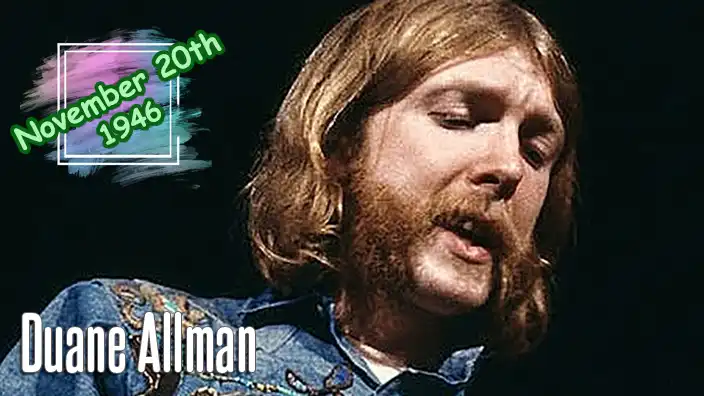
November 20, 1946, in Nashville, Tennessee
 October 29, 1971, in Macon, Georgia

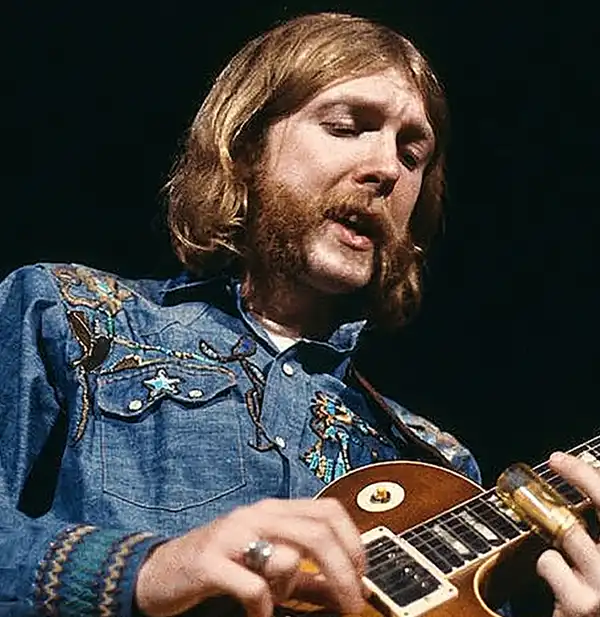
Howard Duane Allman was born on November 20, 1946, in Nashville, Tennessee, and became one of the most influential guitarists in American rock history. Best remembered as the co-founder and driving musical force behind the Allman Brothers Band, he helped establish the distinctive combination of blues, rock, jazz, and improvisation that became known as Southern rock. His extraordinary slide guitar technique, expressive playing, and instinctive understanding of musical collaboration earned him admiration from fellow musicians and audiences around the world. Although his recording career was tragically brief, his influence extended far beyond the relatively small collection of albums he completed. Some guitarists spend decades attempting to develop a recognizable sound; Duane Allman managed to create one that musicians are still trying to reproduce.
Duane was the eldest son of Willis Turner Allman and Geraldine Alice Robbins Allman. His younger brother, Gregg, was born the following year and would eventually become his most important musical partner. Their early childhood was marked by tragedy when their father, a United States Army officer, was murdered in 1949 while stationed at Fort Norfolk in Virginia. Geraldine was left to raise two young boys, eventually moving the family to Daytona Beach, Florida, where she worked to provide them with stability and educational opportunities. The brothers grew up in a household where music became an increasingly important source of entertainment and emotional expression. Neither could have imagined that their shared enthusiasm would eventually produce one of the most celebrated bands in American rock history.
The family's move to Daytona Beach proved particularly important to the brothers' musical development. Florida's expanding entertainment scene exposed them to blues, rhythm and blues, soul, and early rock and roll, while radio stations introduced them to performers whose music combined emotional intensity with extraordinary instrumental skill. Duane and Gregg became fascinated by artists such as B.B. King, Muddy Waters, Robert Johnson, and Elmore James, whose recordings demonstrated the expressive possibilities of the electric guitar. The brothers were especially impressed by the blues tradition, in which musicians could communicate complicated emotions through relatively simple melodies and distinctive instrumental techniques. For Duane, the guitar gradually became more than an instrument; it offered a way to express feelings that ordinary conversation could never quite capture.
One of the most entertaining stories from the brothers' early years involves their first guitars. According to family accounts, Gregg received a guitar for Christmas while Duane was given a motorcycle. Unfortunately for the motorcycle, Duane eventually discovered that he was considerably more interested in his brother's instrument than in mechanical transportation. After damaging his motorcycle, he traded parts from it to obtain a guitar of his own. The incident became part of Allman Brothers folklore, illustrating the unusual circumstances surrounding Duane's introduction to the instrument that would define his career. It also provided an early warning that motorcycles and Duane Allman were not always destined to enjoy a particularly harmonious relationship.
The brothers began practicing together during their teenage years, developing their abilities through hours of listening to records and attempting to reproduce the sounds of their favorite musicians. Duane quickly demonstrated a remarkable natural aptitude for the guitar, combining determination with an intuitive understanding of rhythm and melody. Gregg developed his own musical interests, eventually becoming known for his distinctive singing voice and Hammond organ playing. Their contrasting abilities created a partnership in which each brother contributed something essential. Duane supplied much of the instrumental firepower, while Gregg brought a soulful vocal style that would become one of the defining characteristics of the Allman Brothers Band. Together, they possessed a musical chemistry that could not easily be manufactured through auditions or record company planning.
By the early 1960s, the brothers were performing at local dances and clubs around Daytona Beach, initially participating in groups such as the Kings and the House Rockers. These early performances provided practical experience in entertaining audiences, organizing musical arrangements, and coping with the unpredictable circumstances of live entertainment. The brothers gradually developed a reputation for their enthusiasm and ability, attracting other young musicians interested in blues-based rock. Their performances were influenced by the British Invasion, particularly the growing popularity of bands such as the Rolling Stones and the Yardbirds, whose recordings introduced American blues traditions to a new generation of listeners. Duane absorbed these influences while developing his own increasingly distinctive approach to guitar playing.
In 1965, Duane and Gregg formed the Allman Joys, a blues-rock group that toured extensively throughout the southeastern United States. The band performed in clubs and bars, often traveling considerable distances for modest payments and limited accommodations. These experiences helped the brothers develop the endurance and professionalism required for a sustained musical career. Their repertoire included blues standards, rhythm and blues material, and contemporary rock songs, allowing Duane to experiment with different guitar techniques while refining his stage presence. The group recorded a version of Willie Dixon's Spoonful, demonstrating its interest in the Chicago blues tradition. Although the Allman Joys never achieved major commercial success, the band provided an essential foundation for the musical developments that followed.
The Allman Joys eventually attracted the attention of record industry representatives, leading the brothers to relocate to Los Angeles in 1967. There, they became part of a group called Hour Glass and signed with Liberty Records. The band released two albums, Hour Glass and Power of Love, but the experience proved frustrating for Duane and Gregg. Record company executives favored polished pop arrangements that did not fully reflect the musicians' interest in blues, improvisation, and powerful live performances. The brothers felt increasingly restricted by decisions made by people whose musical priorities differed considerably from their own. For Duane, being told how to play the blues by someone more interested in commercial formulas was probably about as appealing as being instructed to turn down his amplifier.
Disillusioned with the recording arrangements, Duane eventually returned to the southeastern United States, determined to pursue a musical direction that better reflected his interests. During this period, he continued experimenting with guitar techniques and became increasingly interested in slide playing. The slide guitar tradition involved moving a smooth object along the strings to create continuous changes in pitch, producing a sound that could resemble a human voice. Duane was particularly influenced by blues musicians such as Elmore James, whose recordings demonstrated the emotional power of the technique. He also drew inspiration from Taj Mahal's interpretation of Statesboro Blues, which helped encourage his exploration of slide guitar.
Duane developed an unusually expressive slide guitar style, using a glass medicine bottle as a slide and experimenting with the relationship between string tension, amplification, and musical phrasing. The technique allowed him to produce soaring notes, dramatic bends, and sustained tones that became instantly recognizable. Unlike guitarists who relied primarily on speed, Allman emphasized melody and emotional expression, often making individual notes seem almost vocal. His playing combined the raw intensity of traditional blues with the adventurous spirit of contemporary rock, creating a distinctive musical identity. It was an extraordinary achievement considering that his equipment included an ordinary glass bottle, an object most people would have considered considerably more useful for storing medicine than revolutionizing electric guitar performance.
His reputation began growing rapidly in 1968 when he became associated with FAME Studios in Muscle Shoals, Alabama. The studio was already recognized for producing influential soul and rhythm and blues recordings, attracting musicians and singers from across the United States. Producer Rick Hall recognized Duane's exceptional ability and provided opportunities for him to participate in professional recording sessions. The experience introduced Allman to an environment where musicians were expected to contribute creative ideas quickly while adapting to the needs of different performers. His ability to understand a song's emotional direction and develop memorable guitar parts made him particularly valuable, establishing a reputation that soon extended beyond the southern recording industry.
One of his most significant early studio performances came through Wilson Pickett's recording of Hey Jude. The Beatles had released the original song in 1968, and Duane encouraged Pickett to record a soul interpretation. The resulting performance featured Allman's electrifying guitar playing, particularly during the song's extended conclusion. His contribution attracted considerable attention from musicians and producers, demonstrating that he could transform familiar material through an inventive instrumental arrangement. The recording also helped establish his professional nickname, Skydog, although accounts differ regarding its precise origin. Whatever the explanation, the name became closely associated with a guitarist whose playing frequently seemed capable of reaching considerably higher than the average musical performance.
The success of Hey Jude led to further recording opportunities with prominent artists, including Aretha Franklin, King Curtis, Clarence Carter, Arthur Conley, and Boz Scaggs. Duane's session work demonstrated remarkable versatility, allowing him to contribute effectively to soul, blues, rock, and rhythm and blues recordings. He understood that supporting another artist required musical sensitivity rather than constant attempts to dominate the performance. His guitar parts could be subtle and atmospheric when necessary, then explode into powerful solos when the arrangement demanded greater intensity. This ability made him especially valuable to producers who wanted distinctive instrumental contributions without sacrificing the character of the original song.
His collaboration with Boz Scaggs produced one of the most celebrated examples of his early guitar work. On Scaggs's 1969 self-titled album, Duane contributed an extended slide guitar performance to Loan Me a Dime, a blues composition originally associated with Fenton Robinson. The recording developed gradually from a restrained opening into an increasingly powerful musical climax, allowing Allman to demonstrate his ability to build emotional intensity through improvisation. His guitar playing became a central feature of the performance, helping establish the recording as a favorite among blues-rock enthusiasts. The track also demonstrated that a musician could create extraordinary excitement without relying on elaborate production techniques. Sometimes all that was necessary was a good song, a talented band, and someone who knew exactly how to make a guitar complain.
Despite his growing success as a session musician, Duane remained determined to form a band that would allow him to explore his own musical ideas. He wanted a group capable of combining the emotional power of blues with the rhythmic freedom of jazz and the energy of rock and roll. His vision included multiple lead instruments, extended improvisations, and musicians who could respond creatively to one another rather than simply reproducing arrangements note for note. This approach differed from the conventional rock-band format of the period, particularly his desire to include two drummers and two lead guitarists. Record company executives might have regarded the arrangement as unnecessarily complicated, but Duane believed the combination would create extraordinary musical possibilities.
In March 1969, Duane began assembling the musicians who would become the The Allman Brothers Band. The original lineup included guitarist Dickey Betts, bassist Berry Oakley, drummers Butch Trucks and Jai Johanny Johanson, commonly known as Jaimoe, and Duane himself. Gregg Allman was subsequently invited to join the group as lead vocalist and keyboardist, completing the six-member ensemble. The musicians came together in Jacksonville, Florida, where informal jam sessions demonstrated their extraordinary compatibility. Their shared enthusiasm for blues, jazz, and improvisation created an immediate musical connection, encouraging Duane to pursue the ambitious arrangements he had been imagining.
The band's unusual instrumentation became one of its defining characteristics. Duane and Dickey Betts developed a twin-lead-guitar approach in which their instruments frequently played harmonized melodies or exchanged improvisational phrases. Rather than competing for attention, the guitarists created musical conversations, allowing each performer to contribute ideas that the other could develop. Meanwhile, the two drummers established a complex rhythmic foundation that combined traditional rock beats with jazz-influenced patterns and improvisational freedom. Berry Oakley's bass playing connected these elements through powerful melodic lines, while Gregg Allman's Hammond organ and distinctive vocals added emotional depth. The resulting sound was unlike anything most rock audiences had previously encountered.
The group relocated to Macon, Georgia, where manager Phil Walden was establishing Capricorn Records as an important center for Southern music. Macon provided a supportive environment for the band, allowing its members to concentrate on rehearsals, recording, and developing their live performances. The musicians also developed a close personal relationship, sharing living arrangements and spending considerable time together away from the stage. This sense of community became central to the band's identity, reinforcing the idea that its members were participating in something larger than a conventional commercial enterprise. The group's name emphasized the relationship between Duane and Gregg, but its musical success depended on the collective contributions of all six performers.
The Allman Brothers Band released its self-titled debut album in November 1969. The recording introduced audiences to compositions such as Whipping Post, Dreams, and Black Hearted Woman, alongside interpretations of established blues material. Although the album initially achieved modest commercial success, it attracted critical attention for its powerful performances and unusual musical arrangements. Duane's slide guitar playing became a prominent feature, while Gregg's vocals helped establish the band's distinctive emotional character. The album demonstrated the group's willingness to combine traditional blues influences with contemporary rock energy, laying the foundation for a musical style that would eventually become associated with Southern rock.
One of the album's most important compositions was Whipping Post, written by Gregg Allman. The song's unusual rhythmic structure and emotionally intense lyrics provided an ideal foundation for the band's improvisational approach. During live performances, the musicians expanded the composition into extended instrumental passages, allowing Duane and Dickey Betts to explore increasingly elaborate musical ideas. The contrast between the song's structured sections and its improvisational development became a defining characteristic of the Allman Brothers Band. Audiences quickly discovered that attending one of the group's concerts required a flexible understanding of how long a song was supposed to last. A composition that occupied a few minutes on a record could become an entire musical adventure on stage.
The band spent much of 1969 and 1970 touring relentlessly, performing in clubs, theaters, and concert halls across the United States. These appearances allowed the musicians to refine their arrangements and develop the extraordinary communication that distinguished their live performances. Duane emerged as the group's musical leader, encouraging experimentation while maintaining the discipline necessary to prevent extended improvisations from becoming directionless. His ability to recognize when a musical idea was developing successfully helped guide the band's performances, creating an environment in which individual musicians could take creative risks without losing their connection to the ensemble.
In 1970, the Allman Brothers Band released its second studio album, Idlewild South. The recording included songs such as Midnight Rider, Revival, In Memory of Elizabeth Reed, and Hoochie Coochie Man. The album demonstrated the band's growing confidence and introduced several compositions that would become central to its live performances. Duane's guitar playing continued developing, particularly through his interactions with Dickey Betts, whose melodic approach complemented Allman's blues-influenced style. The recording also benefited from the involvement of producer Tom Dowd, whose experience with jazz, soul, and rock musicians made him particularly well suited to the band's unconventional arrangements.
The instrumental composition In Memory of Elizabeth Reed, written by Dickey Betts, became one of the group's most celebrated performances. Its jazz-influenced structure provided opportunities for extended improvisation, allowing the guitarists to exchange melodic ideas over a sophisticated rhythmic foundation. Duane's contributions demonstrated his ability to move beyond conventional blues patterns, incorporating phrasing and harmonic concepts associated with jazz musicians. The piece became particularly effective in concert, where the musicians could explore different approaches during each performance. It illustrated the band's belief that a song should provide a starting point for musical exploration rather than a rigid set of instructions that everyone was required to follow.
During the same period, Duane became involved in one of rock music's most famous recording collaborations. In 1970, Eric Clapton was working with Derek and the Dominos on the album Layla and Other Assorted Love Songs. Clapton had already established himself as one of Britain's most celebrated guitarists through his work with the Yardbirds, John Mayall's Bluesbreakers, Cream, and Blind Faith. When he encountered the Allman Brothers Band during a performance in Miami, he was deeply impressed by Duane's playing and invited him to participate in the recording sessions. The meeting brought together two musicians whose shared enthusiasm for blues created an immediate artistic connection.
Duane joined the sessions at Criteria Studios in Miami, contributing guitar work to much of the album. His playing complemented Clapton's style while introducing a distinctive slide guitar voice that became central to several recordings. Their musical relationship was characterized by mutual admiration rather than competition, with each guitarist encouraging the other to explore new ideas. The collaboration produced some of the most celebrated guitar performances in rock history, particularly on songs such as Key to the Highway, Why Does Love Got to Be So Sad, and the album's famous title track. For listeners accustomed to the idea that two outstanding guitarists might spend most of their time competing for attention, the recordings offered a remarkable demonstration of cooperation.
The song Layla became one of the most recognizable compositions associated with both Clapton and Allman. Its opening guitar riff and emotionally intense arrangement helped establish it as a classic rock recording, while the extended instrumental conclusion provided opportunities for expressive slide guitar playing. Duane's contribution added a distinctive emotional quality to the performance, helping create the soaring guitar sounds that became inseparable from the recording. Although Clapton was the principal artist behind the project, Allman's involvement contributed significantly to its musical identity. Their collaboration demonstrated that extraordinary musicianship often emerges when talented performers listen carefully to one another rather than attempting to prove who can play the most notes.
Clapton reportedly hoped that Duane might become a permanent member of Derek and the Dominos, but Allman remained committed to the band he had founded with his brother. His decision reflected the importance he placed on the Allman Brothers Band and the musical possibilities he believed it had yet to explore. Although the opportunity to work with Clapton offered considerable professional prestige, Duane regarded his own group as the central focus of his career. The choice demonstrated loyalty and artistic determination, qualities that helped establish his reputation among fellow musicians. He was perfectly happy to help create one of rock music's most famous recordings, but he still had a band waiting for him back home.
The Allman Brothers Band's commercial breakthrough arrived with the release of At Fillmore East in July 1971. Recorded during performances at Bill Graham's Fillmore East in New York City on March 12 and 13, the double album captured the band's extraordinary live abilities. Rather than concentrating on conventional studio arrangements, the recording presented extended performances that emphasized improvisation, musical communication, and the distinctive interplay between the group's instruments. The album included celebrated versions of Statesboro Blues, Stormy Monday, You Don't Love Me, In Memory of Elizabeth Reed, and Whipping Post. Its success helped establish the Allman Brothers Band as one of the most important live acts in American rock music.
Duane's performance on Statesboro Blues became one of the defining examples of electric slide guitar playing. The song, originally written and recorded by Blind Willie McTell, had become part of the broader blues tradition before the Allman Brothers developed their distinctive interpretation. Duane's opening slide guitar phrases immediately established the recording's character, combining powerful tone with precise melodic expression. His playing captured the emotional intensity of traditional blues while incorporating the amplified energy of contemporary rock. The performance became essential listening for aspiring slide guitarists, many of whom discovered that reproducing the notes was considerably easier than reproducing the feeling behind them.
The live version of Whipping Post became another extraordinary achievement. Extending beyond twenty minutes, the performance demonstrated the band's ability to maintain musical direction while exploring elaborate improvisational passages. Duane and Dickey Betts exchanged guitar lines, developed harmonized melodies, and responded to the rhythmic ideas emerging from the two drummers and Berry Oakley's bass. The result was a performance that combined the intensity of rock music with the freedom of jazz improvisation. Rather than treating the extended arrangement as an opportunity for unnecessary technical exhibition, the musicians developed a coherent musical journey that kept audiences engaged throughout its considerable length.
At Fillmore East received widespread critical acclaim and became one of the most influential live albums ever released. Its success introduced the Allman Brothers Band to a much larger audience while establishing the group's reputation for extraordinary concert performances. The recording also helped demonstrate the commercial possibilities of extended improvisational rock, encouraging other musicians to explore arrangements that moved beyond conventional radio-friendly song structures. Duane's guitar playing was central to the album's impact, capturing the expressive power and technical imagination that distinguished him from many of his contemporaries. The recording remains an essential document of a remarkable period in American music.
Duane's guitar equipment also became an important part of his legacy. He was particularly associated with Gibson Les Paul electric guitars, including instruments from the late 1950s that became highly prized among collectors and musicians. His use of powerful amplifiers, carefully controlled distortion, and glass slides helped create a distinctive sound characterized by warmth, sustain, and extraordinary expressiveness. Unlike guitarists who relied on numerous effects pedals, Duane generally achieved his tone through a combination of instrument choice, amplifier settings, and playing technique. His approach demonstrated that the most important component of a guitarist's sound is often the musician rather than the equipment. Unfortunately, this remains disappointing news for anyone hoping that purchasing an expensive guitar will automatically provide the ability to play like Duane Allman.
His nickname, Skydog, became closely associated with his reputation as a musician and bandleader. Although accounts differ regarding the precise circumstances in which the nickname developed, it reflected the admiration he inspired among fellow performers. Duane was known for his enthusiasm, confidence, and willingness to encourage other musicians, often helping create an atmosphere in which creative experimentation flourished. His leadership style relied heavily on musical example, demonstrating what he wanted through performance rather than lengthy explanations. He possessed an unusual ability to recognize talent and bring together musicians whose individual approaches might initially appear incompatible.
Duane's influence extended beyond the Allman Brothers Band through his extensive work as a session guitarist. His recordings with Aretha Franklin, Wilson Pickett, King Curtis, Boz Scaggs, and other performers demonstrated the versatility of his playing and his ability to adapt to different musical traditions. He contributed to recordings that helped shape the development of Southern soul and blues-rock, leaving a musical legacy considerably broader than his relatively short career with his own band. His work also illustrated the importance of the studio musicians who frequently contributed essential musical ideas without receiving the public recognition enjoyed by featured singers.
Despite his growing success, Duane's life was not without difficulties. The demanding schedule of touring and recording placed considerable pressure on the musicians, while the culture surrounding rock music during the late 1960s and early 1970s encouraged experimentation with alcohol and drugs. Duane and other members of the band struggled with substance use, creating personal and professional challenges during a period of extraordinary musical achievement. These difficulties reflected broader problems within the entertainment industry, where intense workloads and sudden fame often developed alongside destructive behavior. Although the band's music celebrated freedom and improvisation, its members were also confronting the consequences of a lifestyle that could become increasingly dangerous.
By 1971, the Allman Brothers Band was enjoying growing commercial success and preparing material for its next album. The musicians had established a reputation as one of America's most exciting live acts, while Duane's work with Eric Clapton had further increased his standing among guitarists. The group's future appeared exceptionally promising, with opportunities for larger concerts, additional recordings, and continued musical experimentation. Duane remained central to those plans, providing the leadership and creative direction that had helped transform a collection of talented musicians into a distinctive ensemble. Tragically, that future would be interrupted before he could fully realize his ambitions.
On October 29, 1971, Duane Allman was involved in a motorcycle accident in Macon, Georgia. While riding his Harley-Davidson, he encountered a truck near an intersection and attempted to avoid a collision. The resulting accident caused severe internal injuries, and despite emergency medical treatment, he died later that day. His death shocked the music industry and devastated his family, friends, and bandmates. The loss was particularly tragic because he had only recently achieved the widespread recognition that his extraordinary abilities deserved. A musician whose career had been defined by remarkable energy and creativity was suddenly gone, leaving behind recordings that would become increasingly important to future generations.
The Allman Brothers Band faced an extraordinarily difficult decision following his death. Duane had been the group's founder, musical leader, and one of its defining instrumental voices, making his absence almost impossible to imagine. Nevertheless, the surviving members decided to continue performing and recording, believing that preserving the music represented an appropriate way to honor his memory. Their decision required considerable courage, particularly because the band had developed such a strong collective identity around its original lineup. Continuing without Duane meant confronting both personal grief and the practical challenge of recreating a musical sound that had depended heavily on his unique abilities.
The band completed its next album, Eat a Peach, which was released in February 1972. The recording combined studio material completed before Duane's death with additional performances and live recordings. Songs such as Blue Sky, Melissa, and Ain't Wastin' Time No More helped establish the album as an important chapter in the band's history, while the inclusion of extended live material preserved examples of Duane's extraordinary musicianship. The album became a major commercial success and served as both a continuation of the group's work and a tribute to its fallen leader.
One of the most celebrated performances associated with Eat a Peach was the instrumental composition Mountain Jam, an extended improvisation based loosely on Donovan's There Is a Mountain. The recording demonstrated the extraordinary freedom and musical communication that had characterized the band's performances during Duane's lifetime. Its extended structure allowed the musicians to explore numerous rhythmic and melodic ideas, creating a performance that moved through different moods and musical textures. The recording also illustrated Duane's ability to maintain direction within lengthy improvisations, encouraging individual creativity while preserving the ensemble's collective identity.
The tragedy surrounding the band deepened in November 1972 when bassist Berry Oakley died following another motorcycle accident in Macon. His death occurred just over a year after Duane's and created another devastating loss for the group. Oakley had been an essential part of the band's original sound, contributing powerful bass lines and an instinctive understanding of its improvisational approach. The deaths of two founding members within such a short period could easily have ended the group entirely. Nevertheless, the surviving musicians continued, eventually establishing the Allman Brothers Band as one of the most enduring acts in American rock history.
Duane's influence remained central to the band's identity even as its lineup changed over the following decades. Gregg Allman, Dickey Betts, Butch Trucks, Jaimoe, and later members continued exploring the musical approach that Duane had helped establish, combining blues, rock, jazz, and extended improvisation. The group eventually became closely associated with the Southern rock movement, influencing bands such as Lynyrd Skynyrd, the Marshall Tucker Band, and numerous other performers. Although these groups developed their own distinctive sounds, the Allman Brothers Band helped establish the musical foundation that made the genre recognizable.
The term Southern rock came to describe a broad collection of musical styles associated with performers from the American South, particularly those combining blues, country, rock, and regional musical traditions. Duane Allman's contribution was especially important because he encouraged musicians to approach these influences as interconnected rather than separate categories. His work demonstrated that blues guitar, jazz improvisation, and rock rhythms could coexist within a single performance without sacrificing their individual characteristics. This approach helped create a musical identity that was rooted in Southern traditions while remaining open to influences from across the country and beyond.
In 1982, Duane was inducted into the Georgia Music Hall of Fame, recognizing his extraordinary contribution to the state's musical heritage. The honor reflected the importance of Macon as a center of Southern rock and acknowledged the lasting influence of the Allman Brothers Band on American popular music. His recordings continued attracting new listeners, while guitarists studied his techniques and attempted to understand the distinctive qualities of his playing. The recognition also demonstrated that his reputation had continued growing long after his death, transforming him from a celebrated performer into an important historical figure.
In 1995, the Allman Brothers Band was inducted into the Rock and Roll Hall of Fame, formally recognizing its influence on the development of American rock music. Duane was honored posthumously alongside the group's other founding members, acknowledging his central role in creating its distinctive sound. The induction celebrated the band's musical achievements, its innovative instrumentation, and its contribution to the emergence of Southern rock. For fans and fellow musicians, the recognition confirmed what had long been apparent: Duane Allman's influence extended far beyond the commercial success of the recordings he completed during his lifetime.
His reputation among guitarists has remained particularly strong. In 2003, Rolling Stone ranked him second on its list of the greatest guitarists of all time, behind Jimi Hendrix. Although such rankings are inevitably subjective and frequently generate enthusiastic arguments among music fans, the recognition reflected the extraordinary respect surrounding his work. Later lists continued placing him among the most influential guitarists in rock history, particularly emphasizing his slide technique and improvisational abilities. His recordings remain essential listening for musicians interested in blues-rock guitar, demonstrating how expressive phrasing and musical imagination can create a distinctive sound.
Duane's legacy has also been preserved through numerous archival releases and retrospective collections. In 1972, the album Duane Allman: An Anthology brought together recordings from his work with the Allman Brothers Band, Derek and the Dominos, and various studio collaborations. A second volume followed in 1974, introducing listeners to additional performances that demonstrated the breadth of his musical contributions. These collections helped establish a fuller understanding of his career, revealing that his influence extended well beyond the familiar songs associated with the Allman Brothers Band.
In 2013, the extensive collection Skydog: The Duane Allman Retrospective provided an even more comprehensive examination of his recorded work. The seven-disc set included performances from his early bands, studio sessions, collaborations, and celebrated recordings with the Allman Brothers Band. The project demonstrated the extraordinary volume of music he had created during his relatively brief professional career, revealing a musician whose creativity seemed almost impossible to contain within the available recording opportunities. It also introduced listeners to lesser-known performances that illustrated his development from an enthusiastic young guitarist into one of rock music's most respected instrumentalists.
The retrospective included contributions from Duane's daughter, Galadrielle Allman, who has worked to preserve and explore her father's legacy. Born during the final years of his life, Galadrielle grew up knowing her father primarily through family memories, recordings, and the stories of musicians who had worked with him. Her interest in understanding the person behind the celebrated guitarist eventually led her to write Please Be with Me: A Song for My Father, Duane Allman, published in 2014. The memoir explored Duane's life through family history, interviews, and personal reflection, offering readers a perspective that extended beyond his musical achievements.
Galadrielle's work helped humanize a figure who had become almost legendary among rock enthusiasts. While fans frequently celebrated Duane's guitar technique and influence, her writing examined his personality, relationships, and experiences as a father, son, brother, and friend. The book provided a reminder that behind the famous recordings was a young man whose life included ordinary hopes, personal difficulties, and relationships that were profoundly affected by his death. It also demonstrated how the legacy of a celebrated musician can influence family members who must reconcile public admiration with the private reality of loss.
Duane's guitars have also become important historical artifacts, attracting attention from collectors, musicians, and museums. Several of his Gibson Les Paul instruments have been associated with the Rock and Roll Hall of Fame, where they have helped illustrate the development of his distinctive sound. These guitars are valued not simply because of their age or craftsmanship but because of the extraordinary performances created with them. Their association with recordings such as At Fillmore East gives them particular historical significance, providing tangible connections to one of rock music's most influential performers. For guitar enthusiasts, examining one of Duane Allman's instruments offers an opportunity to appreciate the equipment behind the music, even if the most important ingredient remains impossible to place inside a museum display case.
The influence of Duane Allman's slide guitar technique can be heard in the work of numerous later musicians, including Derek Trucks, Warren Haynes, and countless blues-rock guitarists. Trucks, who eventually joined the Allman Brothers Band, developed his own extraordinary slide style while acknowledging the importance of Duane's recordings. His connection to the band also reflected its enduring musical traditions, demonstrating how younger performers could contribute new ideas while respecting the foundations established by the original members. The continued popularity of slide guitar in blues and rock owes much to Duane's ability to demonstrate its expressive possibilities to a broad audience.
His collaboration with Eric Clapton remains another important part of his musical legacy. The recordings from Layla and Other Assorted Love Songs continue attracting admiration for their emotional intensity and inventive guitar arrangements. Their partnership demonstrated the extraordinary possibilities created when musicians with different backgrounds discover a shared musical language. Duane's slide playing added a distinctive voice to the album, while Clapton's contributions provided a complementary approach that encouraged both musicians to explore new ideas. The recordings remain among the most celebrated examples of collaborative guitar playing in rock history.
Duane's musical philosophy also helped establish the importance of improvisation within rock performance. Although jazz musicians had long explored extended improvisational structures, many rock bands of the 1960s relied primarily on relatively fixed arrangements. The Allman Brothers Band demonstrated that rock musicians could develop sophisticated improvisational conversations while maintaining the energy and accessibility of the genre. Duane's leadership encouraged performers to listen carefully to one another, respond creatively, and allow compositions to develop naturally during concerts. This approach influenced the later development of jam bands and helped establish a tradition of live performances that differed significantly from studio recordings.
The band's emphasis on collective musicianship also challenged the conventional idea that rock groups required a single dominant performer. Although Duane was an extraordinary guitarist and the group's principal musical leader, he encouraged other members to contribute their own ideas and develop individual voices. Dickey Betts's melodic guitar playing, Gregg Allman's vocals and keyboards, Berry Oakley's bass lines, and the rhythmic interaction between Butch Trucks and Jaimoe were all essential to the band's sound. Duane's achievement was therefore not simply his ability to play brilliantly but his talent for creating an environment in which several exceptional musicians could achieve something greater together.
His recordings also demonstrate the importance of emotional expression in music. Duane possessed remarkable technical ability, but his most memorable performances were often distinguished by their sense of feeling rather than complexity. His slide guitar could communicate longing, excitement, sadness, and determination through subtle changes in pitch and rhythm. This expressive quality helped establish his reputation among musicians who valued the emotional impact of a performance above displays of technical speed. His playing frequently seemed to possess a human voice, allowing listeners to connect with the music even when no lyrics were present.
The Allman Brothers Band continued performing until 2014, maintaining a musical legacy that extended across several generations. Although the group experienced numerous lineup changes and personal difficulties, its commitment to improvisation and blues-based rock remained closely connected to Duane's original vision. The band's final performances celebrated decades of music while acknowledging the contributions of the musicians who had shaped its history. Duane's presence remained an important part of that story, even though he had participated in only the earliest years of the group's extraordinary career.
His connection with Daytona Beach, Jacksonville, and Macon also forms an important part of regional music history. Daytona Beach provided the environment in which the brothers developed their early musical interests, Jacksonville became the birthplace of the Allman Brothers Band, and Macon served as the group's professional home during its most influential early period. These locations remain associated with the development of Southern rock, attracting fans interested in exploring the places connected with the band's history. Duane's career illustrates how regional musical traditions can develop into internationally influential styles when talented performers combine local influences with creative ambition.
The circumstances of his death have also contributed to the mythology surrounding his career. Like several other influential musicians who died young, Duane became associated with the idea of extraordinary talent interrupted before its full potential could be realized. However, his legacy should not depend exclusively on the tragedy of his passing. The recordings he completed provide substantial evidence of his musical achievements, demonstrating a level of creativity and technical accomplishment that would have been remarkable regardless of how long he lived. His influence remains grounded in the music itself, particularly the performances that continue inspiring guitarists and audiences.
As November 20 brings another opportunity to remember Duane Allman's birthday, his extraordinary career offers a reminder of how profoundly one musician can influence an entire genre. From his early performances in Daytona Beach and his influential studio sessions at Muscle Shoals to the formation of the Allman Brothers Band, his collaboration with Eric Clapton, and the celebrated recordings of At Fillmore East, he helped reshape the possibilities of electric guitar playing. His life ended far too soon, but his music continues reaching new generations of listeners who recognize the extraordinary emotion and imagination behind every note. Duane Allman did not need a lengthy career to change rock history. He simply needed a guitar, a few exceptional musicians, and enough time to show the world what he could do.
References & Sources