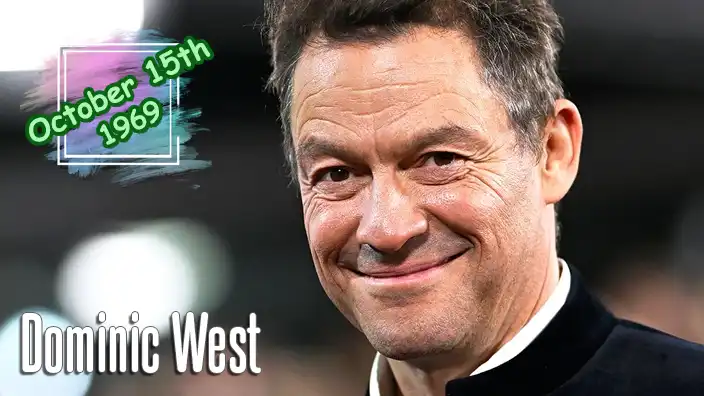
October 15, 1969, in Sheffield, England
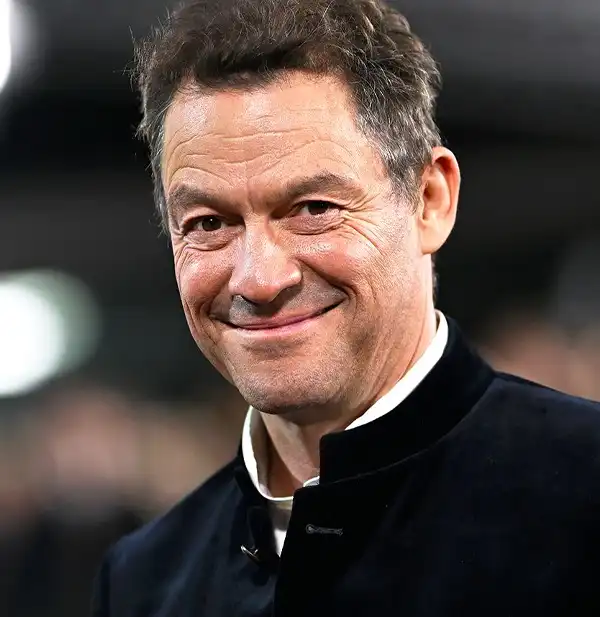
Dominic West is an acclaimed British actor whose remarkable career has taken him from the gritty streets of Baltimore to the elaborate surroundings of Buckingham Palace. Born Dominic Gerard Francis Eagleton West on October 15, 1969, in Sheffield, Yorkshire, England, he is best known for portraying Detective Jimmy McNulty in HBO's The Wire, Noah Solloway in Showtime's The Affair, and Prince Charles in Netflix's The Crown. With a career spanning theater, television, and film, West has established himself as an exceptionally versatile performer, particularly skilled at portraying intelligent, charismatic, and deeply flawed men. His characters frequently possess considerable charm, although their judgment occasionally suggests that charm should come with a warning label.
Dominic West grew up in Sheffield in a large Roman Catholic family, surrounded by the traditions and expectations of an established English household. His father, George West, worked in manufacturing, while his mother, Moya, had an interest in acting and the performing arts. West was introduced to theatrical performance during childhood, developing an enthusiasm for acting that would eventually lead him far beyond Yorkshire. His early experiences helped establish a fascination with storytelling and character, qualities that became increasingly important as he pursued professional training and developed the confidence to perform before demanding audiences.
His formal education included Eton College, one of Britain's best-known independent schools, where his enthusiasm for drama continued to grow. Although Eton has educated numerous members of the British establishment, including royalty and political leaders, West's eventual career would involve portraying authority figures rather than becoming one himself. He subsequently attended Trinity College Dublin, studying English literature and graduating in 1993. During his younger years, he also spent several months working as a cattle herder in Argentina, an unusual addition to the résumé of a future television star. It was certainly a different form of character development, although the cattle probably showed little appreciation for Shakespearean dialogue.
Following his university education, Dominic West enrolled at London's prestigious Guildhall School of Music and Drama, graduating in 1995. His theatrical training provided the technical foundation for a career that would demand convincing performances in several accents, historical periods, and dramatic styles. He soon began appearing in professional stage productions, earning recognition for his work in Anton Chekhov's The Seagull. His performance brought him the Ian Charleson Award for Best Newcomer, establishing him as a promising young actor within British theater. The recognition demonstrated that West possessed the discipline and emotional range necessary for classical drama, even before television audiences became familiar with his particular talent for portraying men who make disastrous personal decisions.
Dominic West's early film career included an appearance in the 1995 adaptation of William Shakespeare's Richard III, starring Ian McKellen. He portrayed Henry, Earl of Richmond, in a production that relocated Shakespeare's historical drama to an alternative version of 1930s Britain. The film provided West with valuable experience working alongside established performers while introducing him to the demands of screen acting. Additional early appearances included Surviving Picasso (1996), True Blue (1996), and The Gambler (1997). Although these roles did not immediately make him a household name, they helped establish his credentials and provided opportunities to develop the versatility that would become a defining feature of his career.
His American film appearances expanded during the late 1990s and early 2000s. West appeared in 28 Days (2000), starring Sandra Bullock, and later in the Academy Award-winning musical Chicago (2002), portraying Fred Casely. The latter production introduced him to the elaborate world of musical cinema, where dramatic confrontations occasionally give way to singing and dancing. He also appeared in Mona Lisa Smile (2003), starring Julia Roberts, and The Forgotten (2004), alongside Julianne Moore. These performances helped broaden his international recognition, but it was a television drama about Baltimore's institutions, criminals, and police officers that would transform his professional reputation.
In 2002, Dominic West began portraying Detective James "Jimmy" McNulty in HBO's The Wire, a groundbreaking crime drama created by David Simon. Set in Baltimore, Maryland, the series explored the interconnected worlds of law enforcement, organized crime, politics, education, journalism, and urban communities. Rather than presenting conventional stories in which heroic detectives simply arrested villains and restored order, The Wire examined the complicated institutions that shape American society. West's McNulty became one of the show's central characters, a gifted homicide detective whose determination to solve crimes was frequently undermined by his drinking, personal relationships, and inability to tolerate authority.
Jimmy McNulty was a particularly demanding character because audiences needed to recognize his intelligence and professional commitment while acknowledging his considerable personal failings. Dominic West portrayed him with a mixture of arrogance, humor, frustration, and vulnerability, creating a detective who could be admirable in one scene and infuriating in the next. McNulty's willingness to challenge his superiors frequently produced important investigative breakthroughs, although his methods also generated enough administrative trouble to keep an entire police department occupied. West's performance captured the contradictions of a man who genuinely cared about justice but often seemed determined to make himself miserable in the process.
One of the most impressive aspects of West's performance in The Wire was his convincing Baltimore-area American accent. As a British actor portraying an American police detective, he faced the challenge of maintaining linguistic authenticity throughout lengthy scenes filled with police terminology, regional expressions, and emotionally charged dialogue. His accent became so closely associated with McNulty that viewers unfamiliar with West's background were sometimes surprised to discover that the actor was English. The role also required considerable emotional stamina, particularly as McNulty's personal and professional difficulties became increasingly complicated throughout the series.
The Wire ran for five seasons from 2002 until 2008 and gradually developed an extraordinary critical reputation. Although its original television ratings were relatively modest, the series became widely regarded as one of the most important dramas in American television history. Its realistic storytelling, complex characters, and examination of institutional failure distinguished it from conventional police procedurals. West appeared throughout the series and directed an episode during its final season, demonstrating an interest in the creative process beyond acting. His portrayal of McNulty remains one of his most celebrated performances and an important part of the show's enduring cultural influence.
Following The Wire, Dominic West continued demonstrating his versatility through a variety of film roles. In Zack Snyder's historical action film 300 (2007), he portrayed Theron, a corrupt Spartan politician whose ambition and treachery contrasted sharply with the battlefield heroism surrounding King Leonidas. The production's stylized visual effects and dramatic action sequences represented a considerable departure from the realistic atmosphere of The Wire. West also appeared in Hannibal Rising (2007), Punisher: War Zone (2008), Centurion (2010), and John Carter (2012), moving between historical adventures, thrillers, and large-scale Hollywood productions.
His television career continued with the BBC drama The Hour, which aired from 2011 to 2012. Set within the world of British television journalism during the 1950s, the series followed reporters and broadcasters navigating political pressure, professional ambition, and international events. West portrayed Hector Madden, a charismatic television presenter whose polished public image concealed considerable personal complications. The performance earned him a Golden Globe nomination and allowed him to explore another variation of the charming but troubled personality that had become one of his specialties. Unlike McNulty, Hector generally arrived at work wearing an immaculate suit, although his personal decisions were not necessarily any more sensible.
In 2011, Dominic West delivered one of his most challenging performances in the ITV drama Appropriate Adult, portraying the notorious British serial killer Fred West. The production examined aspects of the police investigation and the involvement of Janet Leach, a woman appointed to assist during interviews with the suspect. The subject matter required a restrained and disturbing performance rather than conventional dramatic exaggeration. West received the BAFTA Television Award for Best Leading Actor in 2012 for his portrayal, demonstrating his ability to inhabit deeply unsettling characters without sensationalizing the crimes associated with them.
West continued exploring real historical personalities in the 2013 BBC television film Burton & Taylor, portraying the legendary Welsh actor Richard Burton opposite Helena Bonham Carter as Elizabeth Taylor. The drama examined the complicated relationship between the former spouses during their appearance together in a 1983 Broadway production of Private Lives. Playing Burton required West to capture the actor's commanding voice, theatrical confidence, and troubled personal life while avoiding a simple celebrity impersonation. His performance earned a BAFTA nomination and reinforced his reputation as an actor capable of portraying recognizable public figures with psychological depth.
In 2014, Dominic West began starring in Showtime's The Affair, a psychological relationship drama created by Sarah Treem and Hagai Levi. He portrayed Noah Solloway, a married schoolteacher and aspiring novelist whose relationship with Alison Bailey, played by Ruth Wilson, creates profound consequences for their families. The series distinguished itself through an unusual storytelling structure in which events were presented from different characters' perspectives, revealing how memory, emotion, and personal justification can produce conflicting interpretations of the same experience. West's performance required him to portray a man whose understanding of his own behavior frequently differed from the perceptions of those around him.
The Affair ran for five seasons, concluding in 2019, and became another significant achievement in West's television career. His portrayal of Noah earned a Golden Globe nomination for Best Actor in a Television Series – Drama. The character's complicated relationships and persistent self-deception gave West opportunities to explore guilt, desire, ambition, and the consequences of personal choices. Although Noah was considerably more literary than Jimmy McNulty, the two characters shared an unfortunate tendency to create problems that might have been avoided through a modest application of common sense. Fortunately for television audiences, common sense rarely produces five seasons of compelling drama.
Dominic West also appeared in several acclaimed British films during this period, including Pride (2014), a comedy-drama inspired by the unlikely alliance between LGBTQ+ activists and striking Welsh miners during the 1980s. West portrayed Jonathan Blake, a prominent member of the activist group, contributing warmth and humor to a story about solidarity, prejudice, and social change. His performance demonstrated his ability to participate in an ensemble cast while bringing individuality to a supporting character. He subsequently appeared in Genius (2016), Money Monster (2016), The Square (2017), Tomb Raider (2018), and Colette (2018), continuing to work across international productions and genres.
His performance in the 2018 BBC adaptation of Victor Hugo's Les Misérables provided another substantial dramatic challenge. West portrayed Jean Valjean, the former prisoner whose struggle for redemption forms the emotional center of the famous novel. Unlike the internationally celebrated stage musical, the BBC production presented the story as a nonmusical television drama, allowing the characters' experiences and relationships to unfold through conventional dialogue. West's portrayal emphasized Valjean's suffering, moral transformation, and determination to build a meaningful life despite the relentless pursuit of Inspector Javert, played by David Oyelowo. The production demonstrated West's ability to carry a major literary adaptation while remaining faithful to its emotional complexity.
Throughout his screen career, Dominic West maintained a strong connection to live theater. His stage credits include productions of The Seagull, As You Like It, Rock 'n' Roll, The Voysey Inheritance, Othello, and Butley. In 2011, he appeared as Iago in a Sheffield production of Othello, opposite his former The Wire colleague Clarke Peters in the title role. Their reunion provided an entertaining connection between American television drama and classical British theater, although Shakespeare's characters were hardly better behaved than the criminals and detectives of Baltimore. West's stage work demonstrated his continued commitment to the theatrical traditions that had shaped his early career.
In 2022, Dominic West accepted one of the most publicly scrutinized roles of his career when he joined the cast of Netflix's The Crown, portraying Prince Charles during the fifth and sixth seasons. The historical drama examined the British royal family through dramatized interpretations of major events and private relationships. West succeeded Josh O'Connor, who had portrayed the younger Charles in earlier seasons. His performance focused on a period marked by the breakdown of Charles's marriage to Diana, Princess of Wales, his relationship with Camilla Parker Bowles, and the extraordinary public attention surrounding the monarchy during the 1990s.
Portraying Prince Charles presented challenges considerably different from those encountered in The Wire. Rather than creating a largely fictional character, West needed to interpret a living public figure whose appearance, mannerisms, voice, and personal history were familiar to millions of viewers. He approached the role through a combination of physical characterization and emotional interpretation, exploring the tensions between royal duty, personal ambition, and family expectations. The series also featured Elizabeth Debicki as Princess Diana, Imelda Staunton as Queen Elizabeth II, and Olivia Williams as Camilla Parker Bowles, creating an ensemble tasked with portraying some of the world's most recognizable public personalities.
West's performance in The Crown received considerable attention from critics and audiences, particularly because of the differences between his physical appearance and that of Prince Charles. Rather than relying entirely upon visual resemblance, he emphasized the character's emotional conflicts, frustrations, and relationships. His portrayal earned a Golden Globe nomination in 2024 and a Primetime Emmy Award nomination for Outstanding Lead Actor in a Drama Series. The recognition confirmed his ability to tackle high-profile historical drama while adding another distinguished television performance to his career. Having portrayed both a Baltimore detective and the heir to the British throne, West had certainly experienced an unusually broad range of fictional workplace difficulties.
Beyond The Crown, Dominic West appeared in productions including Stateless (2020), The Pursuit of Love (2021), and Downton Abbey: A New Era (2022). He also played Dr. Chris Coxley in the British comedy-drama Brassic, demonstrating that his screen career was not limited to prestigious historical productions and psychologically troubled leading men. In 2024, he returned to the stage in Arthur Miller's A View from the Bridge, portraying Eddie Carbone in a production that played at Theatre Royal Bath before transferring to London's West End. The role demanded considerable dramatic intensity, reinforcing West's reputation as an actor equally comfortable before theater audiences and television cameras.
Away from his professional career, Dominic West married Irish landscape designer Catherine FitzGerald in 2010. The couple have four children together, and West also has a daughter from an earlier relationship. His family maintains connections with Ireland, where FitzGerald's family has a longstanding association with Glin Castle in County Limerick. Despite the international nature of his acting career, West has retained strong personal and professional ties to Britain and Ireland, balancing Hollywood productions with British television and theatrical work.
Dominic West's achievements include a BAFTA Television Award, multiple Golden Globe nominations, and a Primetime Emmy nomination. His professional success reflects more than his ability to adopt different accents or appear convincing in period costumes. He has consistently demonstrated an interest in characters whose motivations are complicated, whose weaknesses are recognizable, and whose actions sometimes challenge an audience's sympathy. Whether portraying a detective, a novelist, a historical criminal, a literary hero, or a member of the royal family, West approaches his roles with an understanding that even the most impressive public personalities can conceal considerable private turmoil.
As audiences celebrate Dominic West's birthday on October 15, his career offers an extraordinary collection of performances worth revisiting. From the institutional realism of The Wire to the psychological complexity of The Affair and the royal drama of The Crown, he has helped shape some of modern television's most memorable stories. His journey from Sheffield schoolboy to internationally recognized actor demonstrates the value of classical training, professional versatility, and a willingness to accept challenging roles. And if his characters have taught audiences anything, it is that a good suit, an impressive title, or a detective's badge offers absolutely no guarantee that the person wearing it knows what he's doing.