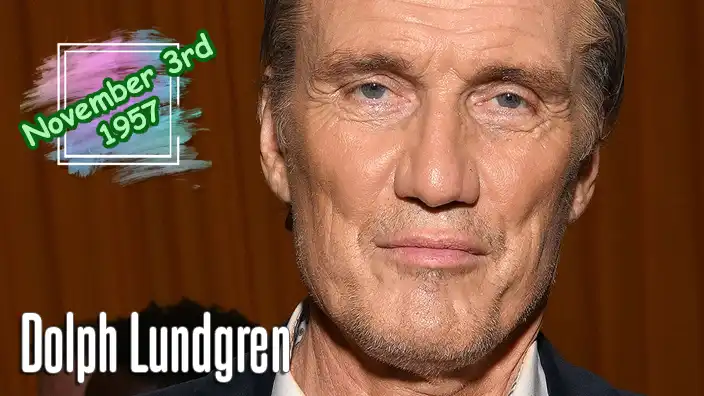
November 3, 1957, in Stockholm, Sweden

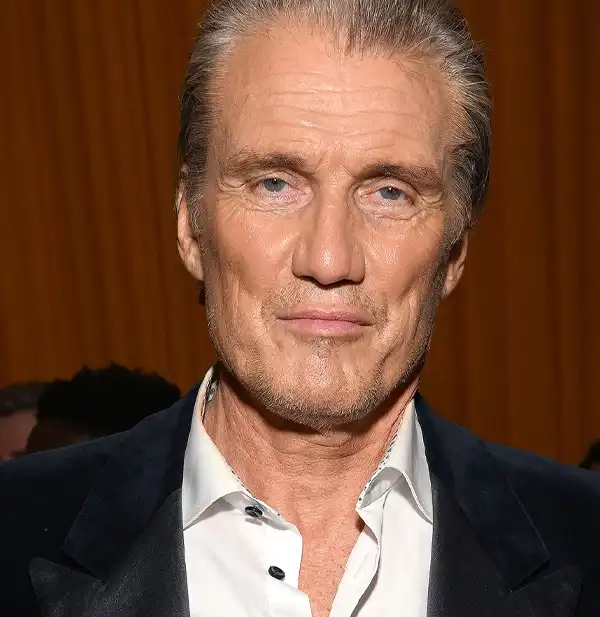
Dolph Lundgren, born Hans Lundgren on November 3, 1957, in Stockholm, Sweden, is an internationally recognized actor, filmmaker, martial artist, and former competitive karate champion. Best known for portraying the formidable Soviet boxer Ivan Drago in Sylvester Stallone's blockbuster Rocky IV (1985), Lundgren became one of the defining action stars of the 1980s and 1990s. His extensive film career includes Masters of the Universe (1987), The Punisher (1989), Universal Soldier (1992), The Expendables franchise, Creed II (2018), and the DC superhero adventure Aquaman (2018). Beyond his imposing screen presence, Lundgren possesses an impressive academic background in chemical engineering, advanced martial arts qualifications, and considerable experience as a film director and producer. His combination of intelligence, athletic ability, and international appeal has made him one of Hollywood's most distinctive action performers.
Lundgren was born into an academically accomplished Swedish family. His father, Karl Johan Hugo Lundgren, worked as an engineer and economist for the Swedish government, while his mother, Sigrid Birgitta Tjerneld, was a language teacher. He grew up with three siblings and spent much of his childhood in Stockholm before moving to live with his grandparents in northern Sweden. Despite the family's professional accomplishments, Lundgren has spoken openly about experiencing a difficult childhood, including physical and emotional abuse from his father. Those experiences influenced his determination to become physically strong, independent, and successful. Rather than allowing his childhood difficulties to define his future, he increasingly directed his energy toward education, sports, and personal discipline.
As a young student, Lundgren demonstrated considerable academic ability, particularly in mathematics and science. He also developed an interest in music, art, and language, revealing a creative side that might surprise audiences familiar only with his action movies. His early athletic interests included ice hockey and other competitive sports, but martial arts eventually became his primary passion. Lundgren began studying karate during his teenage years, attracted by the discipline, physical challenge, and personal confidence associated with the practice. His enthusiasm quickly developed into serious competitive ambition, and he began training intensively while continuing his academic education.
Lundgren became particularly accomplished in Kyokushin karate, a demanding Japanese martial arts discipline emphasizing physical conditioning, powerful strikes, and full-contact competition. His dedication eventually earned him a third-degree black belt, while his competitive achievements included winning the European Kyokushin karate championship in 1980 and 1981. He also won a heavyweight karate championship in Australia. These accomplishments established him as a genuinely skilled martial artist long before Hollywood began casting him as an intimidating fighter. Unlike actors who learned a few convincing punches specifically for the camera, Lundgren arrived in the film industry with years of authentic combat training and competition experience.
His academic achievements were equally impressive. Lundgren studied chemistry and engineering at institutions including Washington State University and Clemson University in the United States before continuing his education at Sweden's Royal Institute of Technology in Stockholm. He earned a degree in chemical engineering and subsequently moved to Australia, where he completed a master's degree in chemical engineering at the University of Sydney in 1982. His academic success eventually earned him a prestigious Fulbright scholarship to study at the Massachusetts Institute of Technology. At that point, his future appeared firmly connected to science and engineering rather than Hollywood. Had events unfolded differently, he might have spent his professional life designing industrial processes instead of throwing fictional opponents through walls.
While living in Australia, Lundgren began working as a bodyguard for Jamaican singer, actress, and fashion icon Grace Jones. Their professional relationship developed into a romantic partnership, introducing him to an international entertainment world far removed from university laboratories. Jones was already an established performer known for her striking appearance, unconventional artistic style, and powerful stage presence. Traveling with her exposed Lundgren to musicians, photographers, filmmakers, and other creative professionals. The experience gradually encouraged him to consider opportunities beyond engineering, particularly as his unusual combination of height, athletic physique, and European appearance attracted attention within the entertainment industry.
Lundgren eventually followed Jones to New York City, where he began exploring modeling, acting, and entertainment opportunities. He worked briefly as a nightclub bouncer, including at the fashionable Manhattan venue Limelight, while developing contacts within the city's creative community. Although he had received an opportunity to study at MIT, his growing interest in acting persuaded him to pursue a different professional direction. It was an extraordinary decision for someone with such strong academic credentials, but Lundgren recognized that the entertainment industry offered opportunities that could not easily be measured through conventional career expectations. Fortunately, his scientific education remained useful, even if Hollywood rarely required him to solve complicated equations between fight scenes.
His first screen appearance came in the 1985 James Bond adventure A View to a Kill, starring Roger Moore as the famous British secret agent. Lundgren appeared briefly as a KGB-associated henchman in a scene involving Grace Jones, who portrayed the formidable May Day. Although his role was small, the production introduced him to professional filmmaking and provided valuable experience working on a major international movie. The film also featured Christopher Walken as villain Max Zorin and became Roger Moore's final appearance as James Bond. Lundgren's contribution was hardly enough to establish him as a household name, but it placed him within one of cinema's most successful franchises at the beginning of his acting career.
His extraordinary breakthrough arrived later in 1985 when Sylvester Stallone selected him to portray Ivan Drago in Rocky IV. The film continued the adventures of fictional boxer Rocky Balboa, placing the American champion against a seemingly unstoppable Soviet opponent during the final years of the Cold War. Lundgren's towering physique, intense expression, and authentic fighting ability made him an ideal choice for Drago, whose character represented the intimidating power of Soviet athletic training. The casting transformed Lundgren from an inexperienced actor into an internationally recognized action star almost overnight.
Rocky IV became one of the most commercially successful installments in the Rocky franchise, combining sports drama with the political tensions of the 1980s. The story begins with an exhibition match between Ivan Drago and former heavyweight champion Apollo Creed, played by Carl Weathers. When the encounter ends tragically, Rocky travels to the Soviet Union to challenge Drago in a confrontation presented as both a personal struggle and a symbolic contest between rival nations. Lundgren's performance relied heavily upon physical presence, controlled movements, and an intimidating lack of emotional expression. His character's memorable declaration, "I must break you," became one of the most recognizable lines in action cinema.
The boxing sequences required considerable physical preparation from both Lundgren and Stallone. Lundgren's martial arts background helped him execute convincing punches and movement, while Stallone pursued a demanding training program to portray Rocky's determination and endurance. During production, Stallone suffered a serious injury that he later attributed to the intensity of their simulated fighting, requiring hospitalization. The incident became part of the film's behind-the-scenes history, illustrating the physical risks involved in creating convincing boxing scenes. Lundgren subsequently expressed concern about the injury, explaining that both performers had been committed to making the confrontation appear authentic. The experience also demonstrated that working with a genuine martial arts champion could present unexpected challenges, even for an established Hollywood action star.
The success of Rocky IV transformed Lundgren's professional prospects. His portrayal of Ivan Drago became so closely associated with his public image that audiences continued recognizing him by the character's name for decades. Although Drago was written as an antagonist, the performance made Lundgren an international celebrity and established his suitability for physically demanding action roles. His imposing appearance initially encouraged filmmakers to cast him as intimidating villains or nearly invincible fighters, but Lundgren was determined to develop a broader career as a leading man. He began accepting projects that allowed him to move beyond the relatively limited dialogue and emotional restraint of his famous boxing character.
In 1987, Lundgren starred as He-Man in Masters of the Universe, a fantasy adventure based on the popular Mattel toy franchise and animated television series. Directed by Gary Goddard, the film followed the heroic warrior He-Man as he battled the evil Skeletor, portrayed by Frank Langella. The production combined elaborate costumes, science-fiction technology, fantasy mythology, and action sequences designed to bring the colorful world of Eternia to the big screen. Lundgren's muscular physique made him a natural choice for the heroic character, although the film's ambitious visual style and unconventional adaptation of the original material received mixed reactions from critics and audiences.
Despite its disappointing theatrical performance, Masters of the Universe developed a loyal following among fans of 1980s fantasy cinema. Lundgren's portrayal of He-Man became an important part of his early film career, demonstrating his willingness to embrace larger-than-life characters and physically demanding productions. The movie's imaginative sets, elaborate costumes, and memorable villain helped establish its reputation as a cult favorite. For Lundgren, the role represented an opportunity to portray a heroic character rather than another intimidating opponent. It also required considerable patience with elaborate costumes and demanding filming conditions, proving that carrying an enormous sword could be nearly as exhausting as boxing Sylvester Stallone.
Lundgren continued developing his action career with Red Scorpion (1988), portraying Nikolai Rachenko, a Soviet special forces soldier sent to Africa on a dangerous military assignment. The film combined Cold War political themes with elaborate action sequences and extensive location filming. Lundgren's character gradually questions his orders and develops sympathy for the people he has been sent to suppress, providing opportunities for greater emotional development than his earlier roles. The production further established him as an international action star capable of carrying a major film, while its politically charged storyline reflected the tensions and ideological conflicts of the late 1980s.
In 1989, Lundgren portrayed Marvel Comics vigilante Frank Castle in The Punisher, one of the earliest feature films centered on the popular comic-book character. Directed by Mark Goldblatt, the movie followed a former police officer who wages a violent campaign against organized crime after the murder of his family. Lundgren's interpretation emphasized the character's grief, isolation, and relentless pursuit of criminals, presenting a darker and more troubled protagonist than many conventional action heroes. Although the film did not receive a major American theatrical release, it developed an audience through home video and international distribution. Lundgren's performance remains an interesting chapter in the history of Marvel adaptations, predating the modern era of interconnected superhero franchises.
His action career continued with I Come in Peace (1990), also released internationally as Dark Angel. Lundgren portrayed police detective Jack Caine, who investigates a series of mysterious deaths connected to an extraterrestrial criminal. The film combined science fiction, police action, and unusual weaponry, offering a distinctly entertaining example of early 1990s genre cinema. Lundgren's character confronts an alien opponent whose advanced technology presents challenges beyond ordinary criminal investigations. The movie became a cult favorite among action and science-fiction enthusiasts, demonstrating Lundgren's ability to combine physical action with humor and unconventional storytelling.
In 1991, Lundgren starred alongside Brandon Lee in Showdown in Little Tokyo, portraying Los Angeles police detective Chris Kenner. The film followed two officers investigating organized crime within the city's Japanese-American community, combining martial arts sequences with buddy-cop comedy. Lundgren and Lee brought genuine fighting experience to the production, creating energetic action scenes that emphasized their contrasting personalities and combat styles. Their on-screen partnership became one of the film's most memorable features. The production also provided Lundgren with an opportunity to demonstrate greater comedic timing, balancing his intimidating appearance with a more relaxed and occasionally humorous character.
Another major career milestone arrived in 1992 with Universal Soldier, directed by Roland Emmerich and co-starring Jean-Claude Van Damme. The science-fiction action film followed deceased American soldiers who are revived through a secret military program and transformed into technologically enhanced fighting machines. Lundgren portrayed Sergeant Andrew Scott, a psychologically unstable soldier whose violent tendencies threaten the entire operation. Van Damme played Luc Deveraux, another resurrected soldier who begins recovering memories of his former life. The film's combination of military science fiction, martial arts, and spectacular action sequences became a commercial success, establishing a franchise that would continue through several sequels.
The confrontation between Lundgren and Van Damme became one of the defining action rivalries of the early 1990s. Both performers possessed extensive martial arts backgrounds, allowing the film to feature physically demanding combat sequences and convincing athletic performances. Lundgren's portrayal of Andrew Scott emphasized the character's growing instability, providing a more openly theatrical villain than the emotionally restrained Ivan Drago. His performance demonstrated his ability to portray dangerous characters with exaggerated personalities while maintaining the physical credibility expected of an action star. The film also reinforced his popularity among international audiences, particularly fans of martial arts and science-fiction cinema.
Throughout the 1990s, Lundgren appeared in numerous action productions, including Joshua Tree (1993), Men of War (1994), Johnny Mnemonic (1995), Silent Trigger (1996), and Blackjack (1998). These films explored a variety of settings, from criminal investigations and military operations to futuristic technology and international espionage. Although many received limited theatrical distribution or were released primarily through home entertainment markets, they helped Lundgren maintain a substantial international following. His willingness to work across different countries and production budgets allowed him to build an unusually extensive filmography while developing practical knowledge of filmmaking beyond acting.
His appearance in Johnny Mnemonic, starring Keanu Reeves, placed him within a cyberpunk science-fiction story based on the work of author William Gibson. Lundgren portrayed Karl Honig, a fanatical street preacher whose imposing appearance and violent behavior make him a dangerous adversary. The film explored a future society dominated by powerful corporations, digital information, and technological dependence. Although its original reception was mixed, Johnny Mnemonic subsequently attracted renewed attention for its depiction of information technology and cybernetic enhancement. Lundgren's unusual character demonstrated his willingness to experiment with unconventional roles rather than restrict himself entirely to straightforward action heroes.
During the 2000s, Lundgren increasingly expanded his career into directing, producing, and screenwriting. His directorial debut came with The Defender (2004), an action thriller in which he also starred as Lance Rockford, a security specialist protecting a high-ranking political figure. The project provided an opportunity to apply his extensive experience in action filmmaking to decisions involving camera placement, stunt coordination, storytelling, and production management. Lundgren subsequently directed films including The Mechanik (2005), Missionary Man (2007), Command Performance (2009), and Icarus (2010). These productions demonstrated his determination to develop creative control over his work rather than remain exclusively an actor hired to perform physically demanding scenes.
His directing career reflected a practical understanding of action filmmaking developed through years of working with stunt teams, cinematographers, and experienced directors. Lundgren frequently emphasized clear storytelling, believable physical action, and efficient production methods, particularly when working with modest budgets. His technical education and disciplined approach to preparation helped him manage the complicated demands of film production. Directing also provided opportunities to develop characters and narratives that differed from the conventional action formulas associated with his early career. For a performer who had once been recognized primarily for his muscles, the transition demonstrated that he was equally interested in the creative decisions taking place behind the camera.
In 2010, Lundgren experienced a major return to mainstream Hollywood attention through The Expendables, directed by and starring Sylvester Stallone. The film assembled an extraordinary collection of action stars, including Jason Statham, Jet Li, Mickey Rourke, and Eric Roberts, in a story about an elite team of mercenaries undertaking dangerous missions. Lundgren portrayed Gunner Jensen, an unpredictable Swedish member of the team whose personal problems and questionable decisions create difficulties for his colleagues. The character allowed Lundgren to combine physical intimidation with dark humor, presenting a more complicated personality than many of his earlier screen roles.
The Expendables became a commercial success and introduced Lundgren to a new generation of action movie fans. The film also reunited him with Stallone, creating a particularly enjoyable connection to their famous confrontation in Rocky IV. Their professional relationship had evolved from fictional enemies into collaborators with decades of experience in the action genre. Lundgren returned as Gunner Jensen in The Expendables 2 (2012), The Expendables 3 (2014), and Expend4bles (2023). Across the series, his character became known for his eccentric personality, unpredictable behavior, and occasional references to his scientific education, an amusing acknowledgment of Lundgren's real academic background.
The Expendables franchise also brought together performers whose careers had helped define several generations of action cinema. Lundgren shared the screen with Arnold Schwarzenegger, Bruce Willis, Chuck Norris, Jean-Claude Van Damme, Harrison Ford, and other prominent entertainers associated with the genre. The films celebrated the practical stunts, muscular heroes, and exaggerated adventures that had made action movies popular during the 1980s and 1990s. Lundgren's participation reinforced his place within that tradition while allowing audiences to appreciate his sense of humor about the larger-than-life characters he had portrayed throughout his career.
In 2018, Lundgren returned to one of his most famous characters when he reprised Ivan Drago in Creed II, directed by Steven Caple Jr. and starring Michael B. Jordan and Sylvester Stallone. The film followed boxer Adonis Creed, the son of Apollo Creed, as he confronted Viktor Drago, played by Romanian boxer and actor Florian Munteanu. Lundgren's character was now a former Soviet boxing champion living with the consequences of his defeat by Rocky Balboa decades earlier. The story explored family relationships, professional disappointment, national identity, and the complicated emotional bonds between fathers and sons.
Lundgren's performance in Creed II offered a more emotionally developed interpretation of Ivan Drago than audiences had seen in Rocky IV. Rather than portraying an almost mechanical opponent, he presented a troubled father attempting to rebuild his reputation through his son's boxing career. The character's vulnerability and regret provided opportunities for dramatic acting that had been largely absent from the original film. Critics and audiences responded positively to the return of Drago, recognizing the emotional depth added to a character previously remembered primarily for his physical intimidation. The performance demonstrated Lundgren's growth as an actor and his ability to revisit familiar material with greater maturity and complexity.
That same year, Lundgren entered another major superhero franchise through Aquaman (2018), directed by James Wan and starring Jason Momoa. He portrayed King Nereus, ruler of the underwater kingdom of Xebel and father of Mera, played by Amber Heard. The film featured elaborate underwater environments, spectacular visual effects, and a story involving rival kingdoms beneath the ocean. Lundgren's commanding presence made him well suited to the role of an authoritative monarch, while the production introduced him to audiences who might have been unfamiliar with his earlier action films. He returned as King Nereus in Aquaman and the Lost Kingdom (2023), continuing his involvement with the DC cinematic universe.
Lundgren also explored television roles, including appearances in the superhero series Arrow, where he portrayed the Russian criminal Konstantin Kovar. His character appeared in flashback sequences involving Oliver Queen's experiences in Russia, allowing Lundgren to portray another formidable antagonist. He also appeared in the comedy series Workaholics and other television productions, demonstrating his willingness to move between action drama and humorous entertainment. These appearances helped broaden his screen career while maintaining the recognizable physical presence and distinctive accent that had become important elements of his professional identity.
Away from acting, Lundgren has remained closely associated with physical fitness, martial arts, and health education. His extensive experience in competitive karate and action filmmaking has influenced his approach to exercise, emphasizing strength, flexibility, endurance, and disciplined training. He has published fitness material, including Train Like an Action Hero: Be Fit Forever, sharing practical advice about maintaining physical conditioning through different stages of life. His approach reflects a belief that exercise should support long-term health and mobility rather than focus exclusively upon appearance. For an actor whose career has involved countless fictional fights, maintaining genuine physical fitness has always been more than a professional requirement.
Lundgren's personal life has included marriage, fatherhood, and the challenges associated with maintaining family relationships while working internationally. In 1994, he married Swedish jewelry designer Anette Qviberg, and the couple welcomed two daughters, Ida and Greta Lundgren. The family spent considerable time living in Europe, particularly Spain, while Lundgren continued traveling for film productions. Their marriage ended in divorce in 2011, but Lundgren has remained involved in his daughters' lives. Both daughters have developed interests in fashion, modeling, and entertainment, occasionally appearing alongside their father at public events and on social media.
In 2023, Lundgren married Norwegian personal trainer Emma Krokdal in a ceremony held in Mykonos, Greece. The couple had previously announced their engagement in 2020, and their relationship attracted public attention because of their shared interest in fitness and wellness. Lundgren has spoken about the importance of companionship, personal support, and maintaining a positive outlook during difficult periods. His marriage represented a new chapter in his personal life, occurring alongside continued professional commitments and significant health challenges.
One of the most difficult experiences of Lundgren's life involved his diagnosis of kidney cancer in 2015. He underwent surgery to remove a cancerous tumor, but the disease later returned and spread to other parts of his body. During the following years, he received extensive medical treatment while continuing to work on film productions. Lundgren eventually revealed publicly that doctors had once given him a limited life expectancy because of the seriousness of his condition. His willingness to discuss the experience offered audiences a more vulnerable perspective on an actor whose screen characters had often appeared nearly indestructible.
Lundgren subsequently received additional treatment, including targeted therapy, and reported encouraging improvements in his condition. In late 2024, he announced that he was cancer-free following a final medical procedure. His experience brought attention to the emotional and physical challenges associated with cancer treatment, particularly for individuals accustomed to maintaining demanding professional schedules. He has spoken about the importance of medical care, personal resilience, and support from loved ones during his recovery. For Lundgren, overcoming serious illness represented a profoundly different challenge from the fictional battles that had defined much of his acting career.
His health experiences also influenced his interest in sharing personal lessons through writing and documentary filmmaking. The 2025 documentary Dolph: Unbreakable explored his career, personal history, family relationships, and battle with cancer, presenting a more intimate portrait of the performer behind the famous action characters. The production examined the contrast between his public image as an exceptionally strong man and the private difficulties he had confronted throughout his life. It also reflected his desire to discuss personal struggles openly rather than maintain the illusion that successful entertainers are immune to hardship.
In September 2026, Lundgren published his memoir Fights Worth Fighting: Finding Strength in Struggle, offering readers a detailed account of his experiences from childhood in Sweden to international movie stardom. The book examines his difficult family background, academic achievements, martial arts career, Hollywood success, relationships, and battle with cancer. Rather than concentrating exclusively upon action movies and celebrity encounters, the memoir explores the meaning of strength, perseverance, and personal growth. Its publication provided an opportunity for Lundgren to reflect upon the experiences that shaped his identity beyond the fictional heroes and villains he has portrayed.
His film career has continued through recent productions including Wanted Man (2024), an action thriller that he directed, co-wrote, produced, and starred in. Lundgren portrayed Travis Johansen, a police officer drawn into a dangerous investigation involving criminal organizations and personal redemption. The project reflected his continuing interest in developing action stories with morally complicated characters rather than relying entirely upon spectacular fight sequences. His later credits also include Exit Protocol (2025), Hellfire (2026), and One Last Shot (2026), demonstrating his ongoing involvement in international film production.
In 2026, Lundgren returned to the Masters of the Universe franchise in a new adaptation, this time appearing as a character called Macho-Man rather than reprising his original role as He-Man. The casting provided an entertaining connection between the 1987 film and the modern interpretation of the popular fantasy property. His participation offered longtime fans an opportunity to see an original franchise star return to Eternia in a different capacity, reflecting the enduring cultural appeal of the characters and mythology.
Lundgren also took on a presenting role in the 2026 television series History's Greatest Machines with Dolph Lundgren, exploring engineering achievements and the technological developments that have shaped human history. The program brought together two seemingly different aspects of his professional background: his scientific education and his experience as an internationally recognized entertainer. As a qualified chemical engineer, Lundgren was particularly well suited to examining the technology and design behind extraordinary machines. The series offered audiences an opportunity to appreciate his academic knowledge rather than simply his ability to perform convincing action sequences. After decades of portraying characters who destroyed machinery, he finally had a television program devoted to explaining how it worked.
Lundgren's career is particularly unusual because he never entirely abandoned the intellectual interests that preceded his acting success. He speaks several languages, possesses advanced scientific qualifications, and has demonstrated a longstanding interest in engineering, art, and international culture. His experience challenges the familiar stereotype that physically imposing action stars must be intellectually limited or professionally one-dimensional. Although his Hollywood reputation was built largely upon his height, athletic physique, and martial arts abilities, his achievements reflect a much broader collection of talents.
His influence upon action cinema extends beyond individual box-office successes. Lundgren helped define the international action star during a period when Hollywood increasingly embraced performers with authentic martial arts experience and distinctive backgrounds. Alongside actors such as Arnold Schwarzenegger, Jean-Claude Van Damme, and Sylvester Stallone, he contributed to a generation of films built around physical performance, memorable characters, and spectacular confrontations. His willingness to embrace both heroic and villainous roles allowed him to establish a recognizable screen identity while developing a loyal international audience.
Dolph Lundgren's extraordinary journey from Swedish engineering student and karate champion to Hollywood action star, filmmaker, television presenter, and author illustrates the possibilities created by determination and adaptability. His portrayal of Ivan Drago in Rocky IV remains one of the most recognizable performances in sports movie history, while his subsequent work in Masters of the Universe, Universal Soldier, The Expendables, Creed II, and Aquaman has introduced him to successive generations of moviegoers. His academic accomplishments, martial arts achievements, and personal resilience add further depth to a career often associated with explosive action sequences and intimidating villains. Whether standing in a boxing ring, commanding an underwater kingdom, or explaining the science behind extraordinary machines, Lundgren continues to demonstrate that genuine strength involves considerably more than throwing a powerful punch.
References & Sources