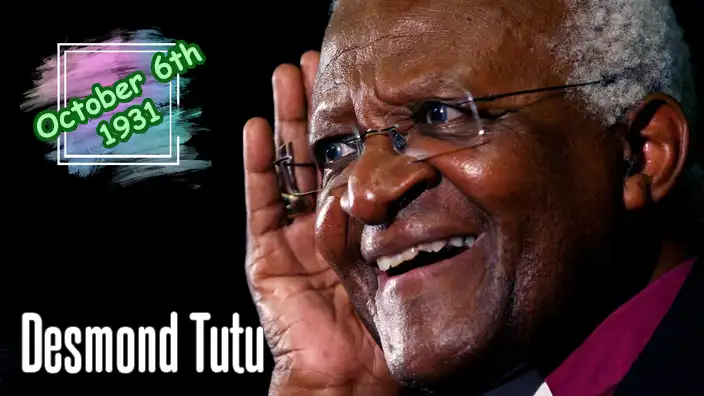
October 7, 1931, in Klerksdorp, South Africa
 December 26, 2021, in Cape Town, South Africa
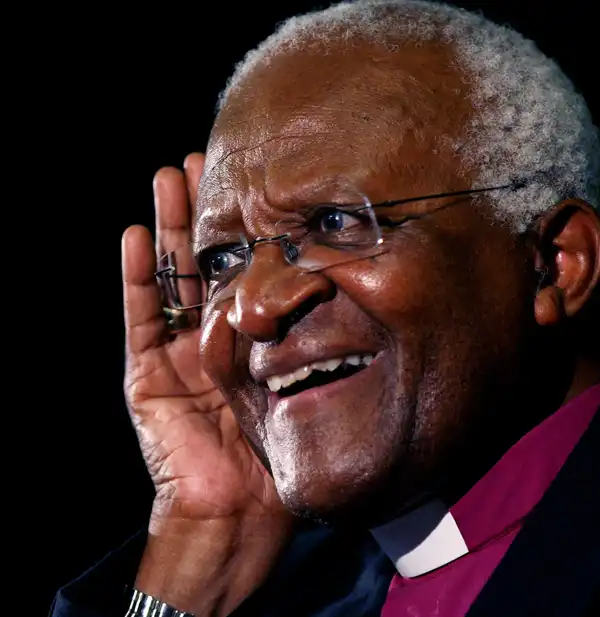
Desmond Mpilo Tutu was born on October 7, 1931, in Klerksdorp, in what was then the Union of South Africa. He grew up during an era when racial discrimination was already deeply embedded in South African society and became institutionalized under apartheid after the National Party came to power in 1948. The system classified South Africans according to race and imposed sweeping restrictions governing where people could live, work, travel, receive an education and participate politically. Tutu would spend much of his adult life confronting that system, although his original career plans had little to do with becoming one of the world's best-known human rights campaigners.
Tutu's father, Zachariah, was a teacher and school principal, while his mother, Aletta, worked as a domestic servant and cook. The family moved during Tutu's childhood, and he attended schools in different parts of the Transvaal. As a boy he suffered from tuberculosis and spent a lengthy period in hospital. During his recovery he encountered Trevor Huddleston, an Anglican priest who strongly opposed racial discrimination. Huddleston's example made a lasting impression on Tutu and would eventually influence his own religious vocation.
Tutu initially hoped to become a doctor, but the expense of medical training placed that ambition beyond the family's resources. Instead, he followed his father into education and trained as a teacher at Pretoria Bantu Normal College. He later studied at the University of South Africa and began teaching at Johannesburg Bantu High School. It might have become a lifelong profession had South Africa's government not introduced policies that Tutu found impossible to accept.
The Bantu Education Act of 1953 placed Black education under tighter government control and was designed around the apartheid state's racial policies. Tutu became increasingly unwilling to participate in an educational system deliberately structured to restrict opportunities for Black South Africans. He resigned from teaching and turned toward the Anglican ministry. It was a decision that changed not merely his occupation but ultimately placed him in a position from which his voice would be heard around the world.
Tutu studied theology at St. Peter's Theological College in Johannesburg and was ordained an Anglican priest in 1961. His abilities soon led to further study in Britain, where he attended King's College London and earned degrees in theology. Living outside South Africa also exposed Tutu and his family to a society in which the rigid racial restrictions of apartheid did not govern everyday life. When he returned to southern Africa, he taught theology and continued rising through the Anglican Church.
In 1975, Tutu became the first Black Anglican dean of St. Mary's Cathedral in Johannesburg. The following year he was appointed Bishop of Lesotho, and in 1978 he became general secretary of the South African Council of Churches. That position gave him a powerful national platform at a time when opposition to apartheid was intensifying and many prominent political organizations and leaders faced bans, imprisonment or exile.
Tutu advocated nonviolent opposition to apartheid and called for international economic pressure against South Africa's government. He supported sanctions and urged foreign companies and governments to reconsider economic relationships that he believed helped sustain apartheid. Those positions made him deeply controversial among defenders of the South African government, who argued that sanctions would damage the country's economy and hurt Black workers as well. Tutu maintained that apartheid itself imposed far greater costs and that peaceful economic pressure offered an alternative to escalating violence.
His international prominence grew steadily. Tutu traveled widely, spoke before audiences around the world and became one of the most recognizable representatives of the anti-apartheid movement. He possessed an unusual ability to address subjects involving brutality, injustice and political repression while retaining warmth and humor. The laughter did not soften his message. If anything, it made his uncompromising arguments more difficult to dismiss.
In 1984, Desmond Tutu received the Nobel Peace Prize for his role in the nonviolent campaign against apartheid. The award placed additional international attention on both Tutu and South Africa's racial system. He joined fellow South African Albert Luthuli among the country's Nobel Peace Prize laureates and would later be followed by Nelson Mandela and F.W. de Klerk, who jointly received the prize in 1993 for their work toward ending apartheid.
Tutu continued advancing within the Anglican Church. He became Bishop of Johannesburg in 1985 and Archbishop of Cape Town in 1986, making him the first Black person to hold that position. He also became primate of the Church of the Province of Southern Africa. The appointment placed one of apartheid's most prominent opponents at the head of an important South African religious institution, which cannot have made government officials particularly enthusiastic about Sunday mornings.
Throughout the turbulent 1980s, Tutu repeatedly called for an end to apartheid while also condemning violence from different quarters. He intervened on several occasions when angry crowds threatened suspected collaborators and argued that the struggle for justice could not abandon its own moral principles. His position was sometimes difficult and unpopular. He opposed the apartheid government while simultaneously insisting that those fighting apartheid should not reproduce the cruelty they were attempting to defeat.
South Africa began its decisive political transformation after President F.W. de Klerk announced major reforms in 1990. The African National Congress and other organizations were unbanned, Nelson Mandela was released after 27 years in prison, and negotiations began over the country's political future. Apartheid legislation was dismantled, and in 1994 South Africa held its first national election based on universal adult suffrage. Mandela became president, completing a political transformation that only a few years earlier had seemed extraordinarily difficult to imagine.
The end of apartheid created another enormous challenge: how should South Africa confront decades of killings, torture, disappearances and other abuses without allowing revenge to consume the country's fragile new democracy? In 1995, Mandela appointed Tutu chairman of the Truth and Reconciliation Commission. The commission investigated serious human rights violations committed during the apartheid era and allowed victims to describe publicly what had happened to them. Perpetrators could seek amnesty if they made full disclosure and demonstrated that their actions had been politically motivated.
The hearings were often emotionally devastating. Tutu listened as victims and relatives described torture, murder and disappearance, and the strain sometimes became visible even in a man accustomed to confronting suffering. The commission's approach remained controversial. Some South Africans believed that granting amnesty sacrificed justice, while others considered the process essential for establishing a public record and avoiding cycles of retaliation. Tutu argued strongly that reconciliation did not mean pretending atrocities had never occurred. Truth, in his view, had to come before genuine reconciliation.
Tutu became closely associated with the expression "Rainbow Nation," which described the hope that South Africa's many racial and cultural communities could build a common national identity after apartheid. The phrase captured the optimism surrounding the country's democratic transition, although Tutu never suggested that removing apartheid legislation had magically eliminated poverty, inequality, racism or political conflict. He remained willing to criticize South Africa's new leaders when he believed they were failing to meet the moral standards for which the liberation movement had fought.
His activism also extended well beyond South Africa. Tutu spoke about conflicts and human rights abuses in numerous countries, supported efforts to combat HIV/AIDS, advocated for refugees and campaigned against discrimination. He became involved with The Elders, an independent group of international leaders founded by Nelson Mandela in 2007 to promote peace, human rights and conflict resolution. His willingness to criticize governments and political movements was remarkably nonpartisan in one respect: possession of political power never appeared to earn anyone immunity from a Desmond Tutu lecture.
Tutu was also an author and collaborator on numerous books dealing with faith, justice, forgiveness and reconciliation. His writings included No Future Without Forgiveness, which examined South Africa's Truth and Reconciliation Commission and the philosophy behind restorative justice. He frequently argued that human beings were interconnected and drew upon the African concept of ubuntu, commonly associated with the idea that an individual's humanity exists through relationships with other people.
His religious faith remained central to his activism. Tutu did not treat Christianity and politics as separate compartments but argued that opposition to racial oppression followed directly from Christian teachings about human dignity. That approach brought him admiration from supporters and criticism from those who believed clergy should remain outside political disputes. Tutu's response, expressed repeatedly throughout his career, was essentially that injustice was already a moral matter and silence therefore constituted a choice of its own.
Behind the international figure was a family man. Tutu married Nomalizo Leah Shenxane in 1955, and they remained married for the rest of his life. They had four children. IMDb records the marriage as lasting from July 2, 1955, until Tutu's death and also documents his extensive appearances in film and television, primarily as himself. His public life inevitably placed him before cameras for decades, creating a substantial collection of documentary, interview and archive-footage credits.
One of his unusual screen credits came with the animated film Jock the Hero Dog in 2011, in which Tutu provided the voice of Baba. IMDb also records him in numerous documentary productions, including In Remembrance of Martin, I Am and projects examining Nelson Mandela, apartheid, peace and human rights. His life was itself the subject of documentaries, including Children of the Light, which traced his journey through the crucial years of South Africa's anti-apartheid struggle.
The combination of solemn religious authority and an irrepressible personality made Tutu particularly distinctive in public. He laughed readily, danced on occasion and displayed a mischievous sense of humor even while discussing enormously serious subjects. IMDb preserves one characteristically playful remark in which Tutu joked that heaven, hearing he might soon arrive, would demand that he remain on Earth because they could not cope with him there. It was the sort of observation that could probably only work when delivered by an archbishop with his particular laugh.
Tutu formally retired as Archbishop of Cape Town in 1996, although retirement proved to be a somewhat theoretical concept. He continued traveling, writing, lecturing and campaigning for human rights. Even after withdrawing from regular public life, his moral influence remained considerable. He was willing to criticize former allies, governments and institutions when he believed they had acted unjustly, maintaining the independence that had characterized his opposition to apartheid.
Desmond Tutu died in Cape Town on December 26, 2021. His death prompted tributes from political, religious and human rights leaders around the world. By then, the country into which he had been born had changed fundamentally. Apartheid had ended, democratic elections had become established and the racial laws that governed his youth had disappeared, although South Africa continued to wrestle with the economic and social consequences of its history.
Tutu's place in that history reaches beyond his titles as bishop, archbishop and Nobel laureate. He helped demonstrate that opposition to apartheid could be forceful without abandoning the principle of nonviolence, and later argued that victory over an unjust political system was only the beginning of the harder work of building a society capable of living with its past. His insistence on truth, forgiveness and human dignity did not provide easy answers, and he never pretended that it did.
Desmond Tutu possessed something comparatively rare in public life: an ability to be deadly serious without becoming permanently solemn. He confronted one of the twentieth century's most notorious systems of institutional racial discrimination, challenged governments, comforted victims, irritated politicians, preached reconciliation and somehow found frequent opportunities to laugh along the way. The small man in the purple clerical robes developed an enormous international voice, and when Desmond Tutu decided that something needed saying, the world generally discovered that ignoring him was considerably harder than simply listening.