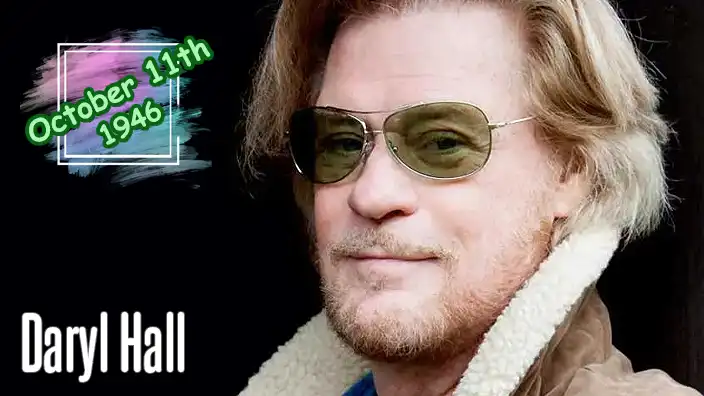
October 11, 1946, in Pottstown, Pennsylvania

Born Daryl Franklin Hohl on October 11, 1946, in Pottstown, Pennsylvania, Daryl Hall is an American singer, songwriter, musician, and record producer best known as the co-founder and principal lead vocalist of the hugely successful pop-rock duo Hall & Oates. His remarkable career has spanned more than six decades, producing some of the most recognizable songs in popular music. Combining rock, rhythm and blues, soul, and sophisticated pop melodies, Hall helped develop a sound that dominated American radio during the late 1970s and 1980s. His powerful yet remarkably smooth singing voice became one of the defining sounds of that era, while his songwriting helped establish Hall & Oates among the most commercially successful musical partnerships in recording history.
Music was part of Hall's life almost from the beginning. His father had a background in professional singing, while his mother worked as a vocal coach, providing an environment in which musical ability was encouraged and developed. Growing up in Pennsylvania, Hall was exposed to a wide variety of musical styles, but he became particularly interested in rhythm and blues, gospel, and the developing soul music scene. He began performing and recording while still attending Owen J. Roberts High School, demonstrating an early commitment to becoming a professional musician. By the time he graduated in 1964, music had already become considerably more than an occasional hobby. It was a calling, and one that would eventually keep him rather busy.
Hall continued his musical education at Temple University in Philadelphia, a city whose vibrant recording industry was helping shape the emerging sound of American soul music. During his college years, he formed a vocal group called the Temptones, which became part of Philadelphia's lively rhythm and blues scene. The group recorded for Arctic Records and performed at local venues, giving Hall valuable experience as a vocalist and performer. He also worked as a session musician and became acquainted with influential producers and songwriters Kenny Gamble and Leon Huff, who would later become central figures in the development of Philadelphia soul. These early experiences helped Hall refine his vocal technique, develop his songwriting abilities, and understand the professional recording industry from the inside.
The most important musical encounter of Hall's early career occurred in 1967, when he met fellow musician John Oates at a Philadelphia band competition. According to the frequently repeated story, the two musicians were performing with separate groups when trouble broke out at the venue, prompting them to escape into the same service elevator. While the circumstances were hardly an ideal networking opportunity, the encounter introduced two musicians who discovered that they shared similar musical interests. Both were students at Temple University, and their friendship gradually developed into a creative partnership. They eventually shared an apartment, and the names on their mailbox reportedly helped inspire the musical identity that would become famous around the world: Hall & Oates.
The partnership developed gradually rather than producing instant commercial success. Hall spent time performing with the rock band Gulliver, while Oates pursued his own musical interests before the two began working together seriously in the early 1970s. They signed with Atlantic Records and released their debut album, Whole Oats, in 1972. Although the album did not become a major commercial success, it introduced their blend of folk, rock, soul, and carefully constructed vocal harmonies. Their second album, Abandoned Luncheonette, followed in 1973 and included the songs "She's Gone" and "When the Morning Comes." The record initially attracted modest attention, but "She's Gone" would eventually become one of their early signature recordings.
"She's Gone" demonstrated the emotional depth and musical sophistication that distinguished Hall & Oates from many of their contemporaries. Written by both musicians, the song combined soulful vocals, rich instrumental arrangements, and lyrics about romantic disappointment. Although its original release achieved limited chart success, the song gained additional attention when the soul group Tavares recorded a successful version in 1974. Hall & Oates subsequently reissued their own recording, which reached number seven on the Billboard Hot 100 in 1976. The song helped establish their reputation as serious songwriters and performers capable of combining traditional soul influences with contemporary pop arrangements. It also proved that sometimes a perfectly good song simply needs a little patience before the public catches up.
A major breakthrough arrived with their self-titled 1975 album, Daryl Hall & John Oates, which featured the hit single "Sara Smile." Written by Hall and Oates, the song was inspired by Sara Allen, Hall's longtime romantic partner and creative collaborator. Its warm melody, intimate lyrics, and expressive vocal performance helped it reach number four on the Billboard Hot 100 in 1976. The recording became one of the duo's most beloved songs and demonstrated Hall's remarkable ability to convey emotion without sacrificing musical precision. His smooth delivery and distinctive phrasing helped establish him as an outstanding interpreter of soul-influenced popular music.
The following year brought an even greater achievement when "Rich Girl" reached number one on the Billboard Hot 100 in March 1977. Written by Hall, the song featured a catchy piano-driven arrangement and lyrics criticizing the entitled behavior of someone protected by family wealth. Interestingly, the inspiration was originally a wealthy young man known to Hall through Sara Allen, but the songwriter changed the character's gender because the revised title worked better musically. The decision certainly did no harm to the song's commercial prospects. "Rich Girl" became Hall & Oates' first American number-one single, opening the door to a period of extraordinary chart success.
Although Hall & Oates were achieving commercial recognition, their musical development continued through experimentation with different arrangements and production techniques. Albums such as Bigger Than Both of Us in 1976, Beauty on a Back Street in 1977, and Along the Red Ledge in 1978 demonstrated their willingness to explore rock, soul, and more elaborate studio production. Their music reflected the changing tastes of American radio, incorporating electric guitars, keyboards, layered harmonies, and increasingly polished arrangements. Hall's songwriting and vocal performances remained central to the group's identity, while Oates contributed guitar work, harmonies, and important creative ideas. Their partnership succeeded partly because the two musicians brought complementary talents to the recording studio.
The release of Voices in 1980 marked another turning point. The album was produced by Hall and Oates themselves, giving them greater control over their musical direction. It included the enormously popular singles "Kiss on My List," "You Make My Dreams," and a cover of the Righteous Brothers' classic "You've Lost That Lovin' Feelin'." "Kiss on My List" reached number one in 1981, while "You Make My Dreams" climbed to number five and eventually became one of the duo's most enduring recordings. With its energetic rhythm, cheerful piano arrangement, and infectious chorus, "You Make My Dreams" has continued appearing in films, advertisements, sporting events, and celebrations. It is one of those songs that can improve the atmosphere of a room before anyone has even located the light switch.
The success continued with the 1981 album Private Eyes, which produced two more American number-one singles: "Private Eyes" and "I Can't Go for That (No Can Do)." The title track became particularly memorable for its distinctive handclaps and playful music video, while "I Can't Go for That" incorporated a smooth, electronic rhythm that reflected the growing influence of synthesizers in popular music. The latter recording achieved an unusual crossover success, reaching number one on both the Billboard Hot 100 and the Hot R&B/Hip-Hop Songs chart, then known as the Hot Black Singles chart. Its popularity among soul and R&B audiences demonstrated the authenticity of the musical influences that had shaped Hall's career since his youth.
By the early 1980s, Hall & Oates had become one of the most successful recording acts in the United States. Their 1982 album H2O produced the international hit "Maneater," which spent four weeks at number one on the Billboard Hot 100. The song's atmospheric keyboard introduction, memorable saxophone passages, and dramatic lyrics helped make it one of the duo's defining recordings. Although listeners often interpreted the song as describing a dangerous romantic relationship, Hall has explained that its meaning was broader, reflecting the greed and destructive behavior he observed in society. The album also included "One on One" and "Family Man," further extending the duo's impressive sequence of hits.
Their success was closely associated with the rise of MTV, which launched in 1981 and quickly transformed the music industry. Hall & Oates became familiar faces on the network, producing videos that combined fashionable clothing, theatrical performances, and the unmistakable visual style of the decade. Hall's blond hair, confident stage presence, and distinctive fashion choices made him particularly recognizable. The videos for songs such as "Private Eyes," "Maneater," and "Out of Touch" helped introduce their music to audiences who increasingly discovered new performers through television rather than radio alone. It was an era when a successful pop musician needed a memorable song, a memorable video, and apparently an industrial quantity of hairspray.
In 1984, Hall & Oates released Big Bam Boom, an album that embraced contemporary electronic production while maintaining their established melodic approach. Its lead single, "Out of Touch," became their sixth and final number-one hit on the Billboard Hot 100. Other successful songs from the album included "Method of Modern Love," "Some Things Are Better Left Unsaid," and "Possession Obsession." By this stage, the duo had developed an impressive catalog of recordings that crossed several musical boundaries. Their ability to combine rock instrumentation, soul vocals, danceable rhythms, and memorable pop melodies helped them appeal to listeners with widely differing musical tastes.
The commercial achievements of Hall & Oates were remarkable. The Recording Industry Association of America recognized them in 1984 as the most successful duo in rock history, reflecting their extraordinary record sales and chart performance. They accumulated six number-one singles on the Billboard Hot 100, numerous additional Top 40 hits, and several platinum-selling albums. Their influence extended beyond the United States, with successful recordings reaching audiences throughout Europe, Australia, and other international markets. Although the musical landscape changed considerably after their greatest period of commercial success, their recordings remained familiar fixtures on radio playlists and retrospective collections.
Alongside his work with John Oates, Hall pursued a substantial solo career that allowed him to explore musical ideas outside the duo's established style. One of his most unusual projects was Sacred Songs, recorded in 1977 with progressive rock guitarist Robert Fripp and eventually released in 1980. The album combined elements of experimental rock, art music, and soul, producing a sound considerably different from the polished pop arrangements associated with Hall & Oates. Its release was delayed because the record company questioned its commercial appeal, but the project later attracted interest from listeners who appreciated Hall's willingness to experiment. It demonstrated that his musical ambitions extended well beyond the pursuit of chart-topping singles.
Hall's solo work continued with Three Hearts in the Happy Ending Machine, released in 1986 and produced with Dave Stewart of Eurythmics. The album included "Dreamtime," which reached number five on the Billboard Hot 100 and became Hall's biggest American solo hit. The recording featured an energetic arrangement and reflected the sophisticated pop production of the period. Other solo albums included Soul Alone in 1993, Can't Stop Dreaming, initially released in Japan in 1996, and Laughing Down Crying in 2011. These projects allowed Hall to explore his interests in soul, rhythm and blues, contemporary pop, and more personal songwriting, reinforcing his identity as an individual artist rather than simply one-half of a famous duo.
Hall also wrote or co-wrote songs that achieved success through other performers. One notable example is "Everytime You Go Away," which originally appeared on the Hall & Oates album Voices in 1980. British singer Paul Young recorded his own version in 1985, transforming the composition into an international hit that reached number one on the Billboard Hot 100. The song's success demonstrated Hall's ability to create material that could be interpreted effectively by performers with different vocal styles. His songwriting frequently emphasized strong melodies and emotional directness, qualities that helped his compositions remain popular long after their original release.
Recognition of Hall's songwriting accomplishments arrived in 2004, when he and John Oates were inducted into the Songwriters Hall of Fame. The honor acknowledged their contributions to popular music and the enduring quality of their extensive catalog. A decade later, in 2014, Hall & Oates were inducted into the Rock & Roll Hall of Fame, with musician Questlove delivering their induction speech. The ceremony celebrated their distinctive combination of rock, soul, and pop, as well as their influence on generations of musicians. The induction represented formal recognition of a partnership that had helped shape the sound of American popular music for several decades.
One of Hall's most imaginative later projects began in 2007 with the launch of ** Live from Daryl's House,** an internet-based music performance series. Rather than presenting conventional interviews or heavily produced television concerts, Hall invited musicians to join him for informal performances and conversations. The program featured established stars, emerging performers, and artists from several musical genres, creating an atmosphere that emphasized collaboration and shared enthusiasm for music. Guests have included Smokey Robinson, Joe Walsh, Todd Rundgren, Rob Thomas, Jason Mraz, CeeLo Green, Aaron Neville, and numerous others. The performances often featured fresh interpretations of familiar songs, allowing audiences to hear musicians experiment together in a relaxed setting.
Live from Daryl's House became particularly important because it demonstrated how established performers could use the internet to reach audiences directly. Hall launched the series at a time when online video was rapidly changing entertainment distribution, recognizing that musicians no longer needed to depend entirely on traditional television networks. The program eventually received television distribution and earned recognition for its innovative format. Its success reflected Hall's continuing curiosity about music and his willingness to embrace new technology. Rather than simply revisiting his greatest hits, he created a platform where musicians from different generations could exchange ideas and perform together. It was rather like inviting some exceptionally talented friends over for a jam session, except that millions of people were allowed to listen.
Hall's interest in historic architecture and restoration also became an important part of his public life. He developed a passion for preserving old buildings and restoring their original character, an interest that complemented his appreciation for traditional musical craftsmanship. In 2014, he opened Daryl's House, a restaurant and live music venue in Pawling, New York. The establishment provided a setting for concerts, musical collaborations, and performances associated with his popular web series. By combining hospitality, historic preservation, and live entertainment, Hall created a venue reflecting several of his interests beyond the recording studio.
Although Hall & Oates remained associated with one another for decades, their professional relationship eventually became strained. In 2023, a dispute emerged over John Oates' proposed sale of his interest in their jointly owned business interests, leading Hall to pursue legal action. The disagreement attracted widespread media attention because the two musicians had been closely identified with one another throughout their careers. By 2024, Oates had publicly indicated that their performing partnership had effectively ended, and the musicians continued pursuing separate professional projects. The dispute marked an unfortunate chapter in the history of a partnership responsible for some of popular music's most recognizable recordings. Nevertheless, the songs they created together remain an important part of both artists' legacies.
Hall continued developing his individual recording career, releasing the solo album ** D in June 2024**. Produced in collaboration with Dave Stewart, the album featured new material that reflected Hall's longstanding interests in soul, rock, and contemporary pop. Its release demonstrated his continuing commitment to writing and recording original music rather than relying exclusively on earlier successes. He also maintained an active performance schedule, appearing with his own musicians and presenting material from throughout his extensive career. His concerts have combined familiar Hall & Oates favorites with solo recordings and newer compositions, allowing audiences to experience different stages of his musical development.
Throughout his career, Hall has been admired for the distinctive qualities of his singing voice. His performances combine technical control with emotional expression, moving between powerful passages and delicate melodic phrases with remarkable ease. His style reflects the influence of classic soul singers while incorporating elements of rock, pop, and rhythm and blues. This combination helped establish the musical approach frequently described as blue-eyed soul, a term historically used for white performers strongly influenced by African American soul music. Hall's own musical development was deeply connected to Philadelphia's soul tradition, and his recordings helped introduce aspects of that sound to wider pop and rock audiences.
The enduring popularity of Hall's music is evident in the continued use of his recordings in films, television programs, advertisements, and online videos. Songs such as "You Make My Dreams," "Maneater," "Rich Girl," and "I Can't Go for That (No Can Do)" remain instantly recognizable to listeners across generations. Their carefully constructed melodies, distinctive rhythms, and memorable vocal performances have allowed them to remain relevant long after their original chart success. Younger audiences frequently encounter the recordings through contemporary entertainment, sometimes discovering Hall & Oates without realizing that the songs were already popular decades before they were born.
Daryl Hall's musical legacy is built upon far more than commercial statistics. His achievements reflect decades of songwriting, recording, experimentation, collaboration, and an enduring commitment to the music that first inspired him. From his beginnings in Pennsylvania and the Philadelphia soul scene to international chart success, solo recordings, and innovative online performances, he has consistently demonstrated an ability to adapt without abandoning his musical identity. Together with John Oates, he helped create a catalog of songs that continues to entertain millions of listeners. And while musical fashions have changed dramatically over the years, one thing remains remarkably consistent: play the opening notes of "You Make My Dreams" at almost any gathering, and somebody will start smiling before the first chorus arrives.
In August 2025, the legal dispute between Daryl Hall and John Oates reached a resolution through private arbitration, bringing their highly publicized business disagreement to an end. Court filings confirmed that a final arbitration judgment had been reached, although the terms remained confidential. The resolution did not signal a reunion, and both musicians continued pursuing their individual careers. For fans who had followed their extraordinary partnership since the 1970s, the separation was disappointing, but it did nothing to diminish the popularity of the music they created together.