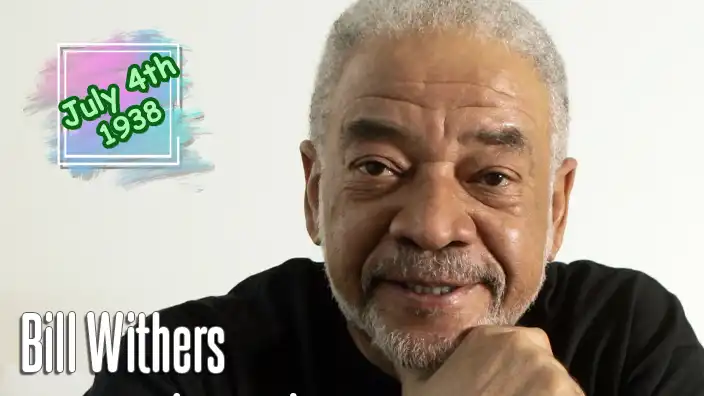
July 4, 1938, in Slab Fork, West Virginia
 March 30, 2020, in Los Angeles, California

William Harrison Withers Jr. was born on July 4, 1938, in Slab Fork, West Virginia, and grew up in the nearby town of Beckley. His upbringing was modest, shaped by hard work, strong family values, and the close-knit communities of Appalachia. Those early experiences became the foundation for songs that spoke to ordinary people with extraordinary honesty.
Unlike many famous musicians, Bill Withers did not become an overnight sensation as a teenager. He served for nine years in the United States Navy before moving to California, where he worked a series of factory jobs while teaching himself to write songs and play guitar. Even after signing his first recording contract, he continued working on an aircraft assembly line because he wasn't convinced the music business would last. That practical outlook remained with him throughout his life and became part of his charm.
His breakthrough arrived in 1971 with the release of Just As I Am. The album introduced listeners to "Ain't No Sunshine," a simple yet emotionally powerful song that became an instant classic. The famous repeated line of "I know" was never intended to stay in the recording. Withers later explained that he had planned to write more lyrics but never found anything better, so the producer wisely left it exactly as it was. The song won the Grammy Award for Best Rhythm & Blues Song and immediately established him as one of America's finest new songwriters.
Success came quickly, but Bill Withers never tried to become a glamorous celebrity. He dressed simply, spoke plainly, and focused almost entirely on writing songs that reflected real life. Rather than chasing trends, he wrote about friendship, family, loneliness, love, heartbreak, hope, and everyday struggles. His music connected with listeners because it felt genuine instead of manufactured.
Only a year after his debut, Withers released Still Bill, which contained two more unforgettable songs. "Lean on Me" became one of the greatest songs ever written about friendship and mutual support. It reached number one on the Billboard Hot 100 and has since become a standard performed in schools, churches, sporting events, charity concerts, and times of national crisis. Few songs have crossed as many generations while remaining just as meaningful decades later. "Use Me," another hit from the same album, showcased a completely different side of his songwriting with its infectious groove and clever lyrics.
Bill Withers continued producing memorable music throughout the 1970s. "Lovely Day" became one of the happiest songs ever recorded, famous for its uplifting melody and Withers' remarkably long sustained note near the end. "Grandma's Hands" paid loving tribute to his grandmother and remains one of the most heartfelt family songs ever written. In 1981, he teamed with saxophonist Grover Washington Jr. to record "Just the Two of Us," another Grammy-winning success that continues to receive regular radio play around the world.
One of the most interesting aspects of Bill Withers' career is how relatively brief it was. Frustrated by conflicts with record company executives and increasingly uncomfortable with the commercial side of the music industry, he gradually stepped away from recording during the 1980s. His final studio album arrived in 1985, after which he chose a quiet family life rather than chasing continued fame. Unlike many retired performers, he rarely attempted a comeback, explaining that he simply no longer enjoyed the business itself.
Despite leaving the spotlight, his influence only continued to grow. Artists across soul, R&B, pop, jazz, rock, gospel, hip-hop, and country have covered or sampled his songs. His straightforward lyrics and unforgettable melodies proved that emotional honesty could outlast changing musical fashions. Songs like "Lean on Me" and "Ain't No Sunshine" have become part of popular culture, appearing in films, television shows, commercials, sporting events, and countless community gatherings around the world.
Recognition followed throughout his later years. Bill Withers was inducted into the Songwriters Hall of Fame in 2005 before entering the Rock and Roll Hall of Fame in 2015, where fellow music legend Stevie Wonder welcomed him with heartfelt praise. Several of his best-known recordings were also inducted into the Grammy Hall of Fame, honoring their lasting cultural importance. During his acceptance speech at the Rock Hall, Withers modestly joked that the award was "an award of attrition," reflecting his characteristic sense of humor and humility.
Away from music, Withers remained known as an unusually grounded individual. He had overcome a childhood stutter, served his country in the Navy, worked ordinary jobs well into adulthood, and never viewed himself as larger than life. Friends and fellow musicians often described him as thoughtful, intelligent, funny, and refreshingly unaffected by celebrity culture.
Bill Withers passed away on March 30, 2020, at the age of 81 from heart complications. Tributes poured in from musicians, political leaders, and millions of fans who found comfort in his songs during both joyful and difficult moments. At a time when much of the world was facing uncertainty, "Lean on Me" once again became an anthem of hope, reminding everyone why his music had endured for nearly fifty years.
Many artists achieve fame through elaborate performances, dazzling costumes, or constant publicity. Bill Withers accomplished something far more difficult. Armed with an honest voice, remarkable songwriting ability, and an unwavering belief in simple truths, he created songs that continue to comfort, encourage, and inspire people around the globe. Long after trends have faded and musical fashions have changed, his work remains as relevant as ever because genuine human emotion never goes out of style.