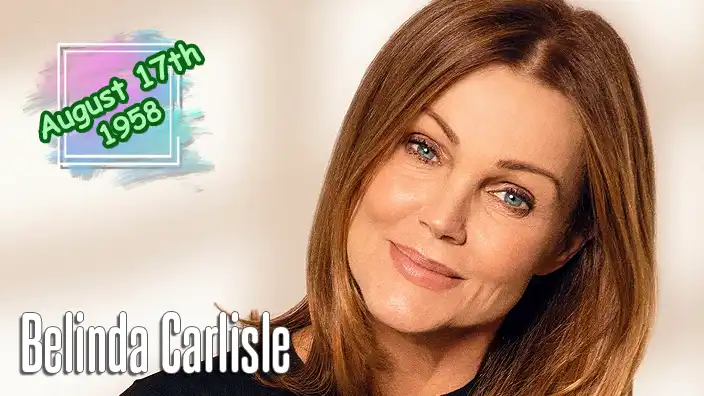
August 17, 1958, in Hollywood, California
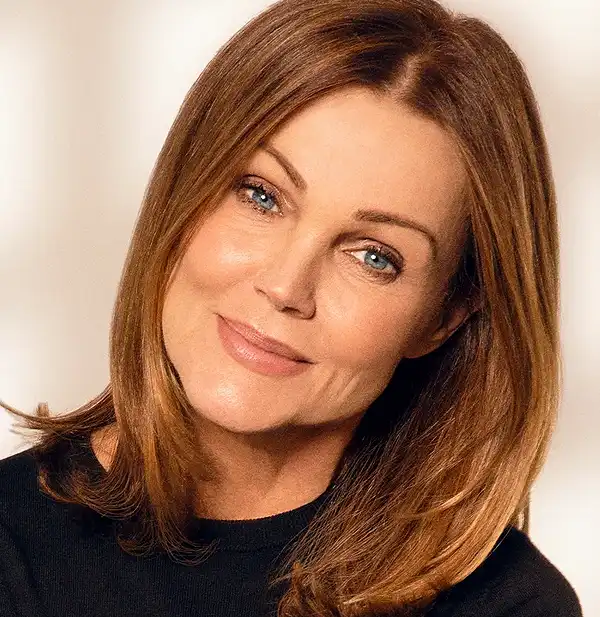
Born Belinda Jo Carlisle on August 17, 1958, in Hollywood, California, Carlisle grew up in Southern California as the eldest of seven children. Her family moved several times during her childhood, and much of her youth was spent in Thousand Oaks. Music became increasingly important during her teenage years, but there was little indication that she would eventually become one of the best-known female singers of the 1980s. Her route into professional music began instead in the rough, experimental Los Angeles punk scene of the late 1970s, a world far removed from the polished videos and international pop hits that would later define much of her career.
Carlisle briefly became associated with the influential punk band The Germs, adopting the memorable name Dottie Danger and intending to play drums. A bout of mononucleosis prevented her from actually performing with the group, but her connection with the emerging Los Angeles punk community remained important. In 1978, she and guitarist Jane Wiedlin became involved in forming a new group initially known as The Misfits. After several personnel changes and a name change, the band became The Go-Go’s, eventually settling into the celebrated lineup of Carlisle, Wiedlin, Charlotte Caffey, Gina Schock and Kathy Valentine.
The Go-Go’s developed their sound through relentless rehearsals, club performances and touring. Although their roots were firmly planted in punk, their music gradually evolved into a highly accessible combination of rock, new wave and pop. Record companies were initially skeptical that an all-female group writing its own material and playing its own instruments could achieve major commercial success. The Go-Go’s answered that particular piece of music-industry wisdom in the most effective manner possible: they sold an enormous number of records.
Their debut album, Beauty and the Beat, arrived in 1981 and transformed the band into stars. Featuring “Our Lips Are Sealed” and “We Got the Beat,” the album climbed to No. 1 on the Billboard 200 and remained there for several weeks. The achievement gave The Go-Go’s an important place in music history as the first all-female band that wrote its own songs and played its own instruments to reach No. 1 on the American album chart. Carlisle's distinctive voice and energetic stage presence naturally made her one of the group's most recognizable members, but The Go-Go’s were never simply a singer surrounded by anonymous musicians. Their identity depended on the personalities, musicianship and songwriting contributions of the entire band.
Success continued with Vacation in 1982, whose infectious title track became another major hit and produced one of the era's memorable music videos, featuring the band water-skiing. Their third album, Talk Show, followed in 1984 and included “Head over Heels” and “Turn to You.” Behind the cheerful songs and colorful videos, however, the pressures of constant touring, sudden fame, internal disagreements and substance abuse were becoming increasingly difficult. Jane Wiedlin departed in 1984, and by the following year The Go-Go’s had broken up.
For Carlisle, the end of the band became the beginning of a second major career. Her debut solo album, Belinda, appeared in 1986 and produced the hit “Mad About You.” The record proved that audiences were willing to accept Carlisle outside The Go-Go’s, while also allowing her to move toward a more polished pop-rock sound. Any lingering question about whether she could succeed independently disappeared with her second solo album, Heaven on Earth, released in 1987.
Its lead single, “Heaven Is a Place on Earth,” became Carlisle's signature solo recording and one of the defining pop songs of the decade. It reached No. 1 on the Billboard Hot 100 and topped charts in several countries, while its striking music video—directed by actress Diane Keaton—became a fixture of the MTV era. The album also produced “I Get Weak” and “Circle in the Sand,” giving Carlisle a succession of international hits and establishing her as far more than the former singer of a successful band.
Carlisle maintained that momentum with Runaway Horses in 1989. The album included “Leave a Light On,” “Summer Rain,” “La Luna” and the title track, and it further strengthened her international following. “Leave a Light On” carried an especially impressive musical credit: former Beatle George Harrison played slide guitar on the recording and contributed to another track on the album. Having George Harrison turn up to play guitar is one of those occasions when a musician can reasonably conclude that the recording session is going rather well.
Although Carlisle's American chart success eventually slowed, her career remained particularly strong in Britain, Australia and other international markets. She continued recording throughout the 1990s, releasing Live Your Life Be Free in 1991, Real in 1993 and A Woman and a Man in 1996. The latter produced several successful British singles, including “In Too Deep” and “Always Breaking My Heart.” Her willingness to explore different styles became particularly apparent with Voila in 2007, an album largely performed in French and reflecting the years Carlisle spent living in France and her affection for European culture.
Her public success concealed a far more difficult personal story. Carlisle struggled for years with alcohol and drug abuse, problems that intensified during the height of her fame and eventually threatened her health, marriage and family life. She later spoke openly about those years and the enormous difference between the cheerful public image surrounding her music and what was happening privately. After becoming sober, she embraced a very different lifestyle that included Buddhism, yoga and meditation, which she has credited with helping her establish greater stability.
Carlisle married Morgan Mason in 1986. Mason, the son of celebrated British actor James Mason, has worked in politics, film and business, and the couple welcomed their son, James Duke Mason, in 1992. Carlisle discussed her family, career, addictions and recovery with considerable candor in her 2010 autobiography, Lips Unsealed. The memoir revealed a life considerably more complicated than the bright videos and catchy pop songs through which millions of people first came to know her.
Meanwhile, The Go-Go’s proved remarkably resistant to remaining broken up. Beginning in the 1990s, the group reunited periodically for recordings and tours, demonstrating that a farewell in rock music sometimes means roughly the same thing as saying goodbye at someone's front door and then continuing the conversation for another 45 minutes. In 2001, they released God Bless the Go-Go’s, their first full studio album of new material since Talk Show.
Recognition of the band's historical importance continued to grow. Their music inspired the Broadway production Head Over Heels, which opened in 2018 and built an original story around songs from The Go-Go’s and Carlisle's solo catalog. The 2020 documentary The Go-Go’s, directed by Alison Ellwood, explored the group's journey from the Los Angeles punk underground to mainstream success while also showing the members recording “Club Zero,” their first new song in nearly two decades.
The culmination of that renewed recognition came in 2021, when The Go-Go’s were inducted into the Rock & Roll Hall of Fame. Carlisle entered alongside Charlotte Caffey, Gina Schock, Kathy Valentine and Jane Wiedlin, with Drew Barrymore presenting the group. The honor recognized not only their commercial success but their importance to women in rock music. The Go-Go’s had challenged a stubborn industry assumption by proving that an all-female band could write, perform and control its own music while competing successfully at the very top of the charts.
Carlisle's solo career makes that legacy even more impressive. Many lead singers remain permanently identified with the group that first made them famous, but Carlisle successfully created two distinct musical identities. She was both the energetic frontwoman of The Go-Go’s and an international solo performer responsible for some of the most recognizable pop recordings of the late 1980s and early 1990s.
The durability of those songs is perhaps the strongest measure of her success. “Our Lips Are Sealed” and “We Got the Beat” remain instantly recognizable decades after their release, while “Heaven Is a Place on Earth,” “Circle in the Sand” and “Summer Rain” continue finding audiences through radio, movies, television and streaming. Younger listeners who weren't remotely close to being born when the records first appeared have continued discovering them, giving Carlisle the kind of multigenerational audience most performers would happily take.
From Dottie Danger and the Los Angeles punk clubs to The Go-Go’s, international solo stardom and the Rock & Roll Hall of Fame, Belinda Carlisle has enjoyed a career spanning dramatically different musical worlds. She survived sudden fame, addiction, changing musical fashions and the notoriously unforgiving machinery of the recording industry while creating music that continues to be played and enjoyed decades later.
And after all these years, heaven apparently remains a place on Earth. At this point, Belinda Carlisle has been telling us that since 1987, so perhaps we should finally take her word for it.