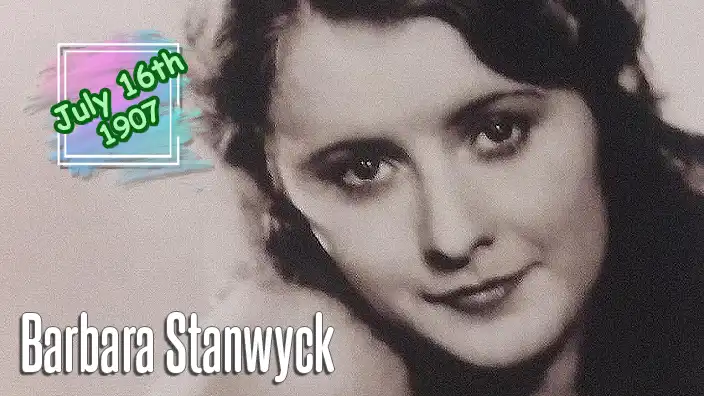
July 16, 1907, in Brooklyn, New York
 January 20, 1990, in Santa Monica, California
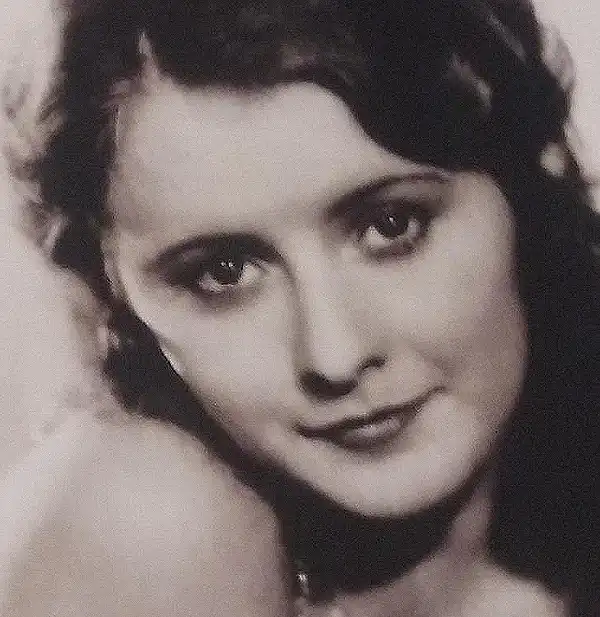
Born Ruby Catherine Stevens in Brooklyn, New York, Barbara Stanwyck rose from a difficult childhood to become one of Hollywood's most respected and versatile actresses. During a career that spanned more than six decades, she appeared in more than 80 films and numerous television productions, earning four Academy Award nominations, an Honorary Academy Award, and the American Film Institute's Life Achievement Award. Today, she is widely regarded as one of the greatest actresses in the history of American cinema.
Stanwyck's early life was marked by hardship. Her mother died when Barbara was just four years old after being injured by a passing streetcar. Her father, unable to cope with the tragedy, abandoned the family several years later, leaving Barbara and her siblings to be raised by relatives and in foster homes. Forced to grow up quickly, she left school at a young age and took a variety of jobs to support herself.
One of those jobs led her to the stage. As a teenager, she worked as a chorus girl in New York's thriving theater district, where she developed the confidence and discipline that would become trademarks of her career. Her natural talent quickly attracted attention, and before long she was performing in Broadway productions.
When she transitioned to motion pictures during the late 1920s, she adopted the stage name Barbara Stanwyck. Hollywood was changing rapidly with the arrival of sound films, and Stanwyck adapted with ease. Unlike some silent-film stars whose careers faded, her strong voice, expressive acting, and emotional range made her perfectly suited to the new era.
Throughout the 1930s, Stanwyck established herself as one of Hollywood's busiest leading ladies. She became known for portraying intelligent, independent women who possessed determination, wit, and emotional depth. Whether starring in romantic dramas, comedies, westerns, or crime thrillers, she brought authenticity to every performance.
One of her earliest critical triumphs came in Stella Dallas (1937), in which she portrayed a working-class mother willing to sacrifice her own happiness for her daughter's future. The emotionally powerful performance earned Stanwyck her first Academy Award nomination and remains one of the defining roles of her career.
She followed that success with an extraordinary series of acclaimed performances during the 1940s. In Ball of Fire (1941), opposite Gary Cooper, she displayed impeccable comic timing. In Meet John Doe (1941), directed by Frank Capra, she portrayed an ambitious newspaper columnist caught in a story that grows beyond her control.
Perhaps her most famous performance came in Double Indemnity (1944), director Billy Wilder's classic film noir. Playing the seductive and calculating Phyllis Dietrichson, Stanwyck created one of cinema's greatest femme fatales. Wearing her now-famous blonde wig and icy smile, she delivered a performance that has influenced generations of actors and filmmakers. The role earned her another Academy Award nomination and remains one of the most celebrated performances in film history.
Unlike many actresses who became identified with a single type of role, Stanwyck consistently reinvented herself. She was equally convincing as a romantic lead, dramatic heroine, comedic performer, villain, or frontier woman. Directors admired her professionalism, while fellow actors praised her willingness to rehearse, prepare thoroughly, and elevate every production in which she appeared.
Stanwyck was famous for arriving on set fully prepared. She memorized her lines, respected the crew, and rarely complained about difficult filming conditions. Her strong work ethic earned admiration throughout Hollywood, where she developed a reputation as one of the industry's most dependable stars.
Her personal life also attracted public attention. In 1928, she married actor Frank Fay, and together they adopted a son, Dion. The marriage eventually ended in divorce. In 1939, she married fellow Hollywood star Robert Taylor, and the couple became one of the industry's best-known celebrity marriages before divorcing in 1952. Despite her fame, Stanwyck generally preferred to keep her private life out of the spotlight.
As the Golden Age of Hollywood evolved, Stanwyck smoothly transitioned into television, where many film stars struggled. During the 1960s she starred in the successful western series The Big Valley, portraying the strong-willed matriarch Victoria Barkley. Her commanding performance introduced her to a new generation of viewers and earned her an Emmy Award.
She later appeared in several popular television productions, including The Thorn Birds, proving that even in her seventies she remained a captivating screen presence. Her ability to adapt to changing audiences and entertainment formats was a remarkable achievement in an industry known for constant change.
Although she received four Academy Award nominations during her career—for Stella Dallas, Ball of Fire, Double Indemnity, and Sorry, Wrong Number (1948)—she never won a competitive Oscar. Many film historians consider this one of the Academy's greatest oversights.
In recognition of her extraordinary body of work, the Academy of Motion Picture Arts and Sciences presented Stanwyck with an Honorary Academy Award in 1982 for her "superlative creativity and unique contribution to the art of screen acting." Five years later, she received the American Film Institute Life Achievement Award, one of the film industry's highest honors.
Barbara Stanwyck passed away on January 20, 1990, at the age of 82. Her influence continues to be felt throughout Hollywood, where actors and directors frequently cite her performances as examples of natural, believable screen acting. The American Film Institute ranks her among the greatest female stars of classic American cinema, a reflection of both her remarkable talent and enduring legacy.
More than three decades after her passing, Barbara Stanwyck remains the standard by which many dramatic performances are measured. From heartfelt family dramas to unforgettable film noir classics and beloved television westerns, she demonstrated that genuine talent, professionalism, and versatility never go out of style.