From Flying Contraptions to Lost Luggage!
Every November, Aviation History Month celebrates one of humanity's greatest achievements: conquering the skies and transforming the dream of flight into an essential part of everyday life. From the earliest hot-air balloons and the Wright brothers' historic first powered flight to supersonic aircraft and modern commercial aviation, the history of flight is filled with remarkable inventions, courageous pioneers, and extraordinary technological breakthroughs. Aviation History Month honors the pilots, engineers, inventors, and aviation professionals whose determination helped turn fragile flying machines into aircraft capable of carrying hundreds of passengers across oceans in a matter of hours.
The story of aviation is also one of persistence, imagination, and occasionally spectacular failure. Early aviation pioneers experimented with unusual designs, unreliable engines, and aircraft that sometimes appeared more likely to become expensive piles of firewood than successful flying machines. Yet their determination laid the foundations for an industry that revolutionized international travel, commerce, military operations, emergency services, and even space exploration. Today, we take flying almost for granted, rarely considering the extraordinary engineering required to lift a massive passenger jet thousands of feet into the air. Of course, the Wright brothers probably never imagined that their invention would eventually lead to airport security queues, lost luggage, and passengers arguing over who gets the armrest!
Aviation History Month in November offers the perfect opportunity to explore the fascinating milestones of aviation, discover the achievements of legendary pilots, learn about historic aircraft, and appreciate the innovations that continue to shape the future of flight. Whether you're a lifelong aviation enthusiast, a history lover, or someone who simply enjoys watching airplanes soar overhead, this month-long celebration provides plenty of reasons to look skyward. So, fasten your seat belt, return your seat to its upright position, and prepare for a fascinating journey through aviation history. Unlike most airlines, we're not charging extra for the window seat!
What Is Aviation History Month?
Aviation History Month is observed throughout November to recognize the extraordinary achievements, technological breakthroughs, and influential personalities that have shaped the history of aviation. This month-long celebration encourages people to explore how humans progressed from dreaming about flight to building sophisticated aircraft capable of crossing oceans, transporting enormous cargo loads, and reaching speeds that would have astonished the earliest aviation pioneers. It also highlights the contributions of pilots, aircraft designers, mechanics, air traffic controllers, and countless other professionals whose work has made modern air travel possible.
The observance provides an opportunity to appreciate both the excitement and the challenges of aviation history. Early aviators risked their lives testing experimental machines, often with little more than basic instruments and an optimistic understanding of aerodynamics. Their accomplishments laid the groundwork for commercial airlines, military aviation, emergency medical flights, aerial firefighting, and numerous other services that depend on aircraft. Today, aviation connects distant communities, supports international commerce, and makes journeys that once required weeks or months possible within hours. Aviation History Month reminds us that every modern flight owes something to generations of determined people who refused to accept that humans were supposed to remain firmly on the ground.
The Origins of Aviation History Month
Aviation History Month is widely recognized as an informal November observance devoted to preserving and promoting the history of flight. Unlike certain aviation commemorations established through presidential proclamations or legislation, the precise founding date and original organizer of Aviation History Month are not clearly documented in authoritative historical records. Nevertheless, museums, educators, aviation enthusiasts, and historical organizations use the occasion to introduce new audiences to the achievements and individuals that transformed aviation from an experimental pursuit into a vital part of modern civilization.
November is particularly suitable for reflecting on aviation's extraordinary development, although the history of flight contains important anniversaries throughout the calendar. The observance also complements National Aviation Day, celebrated in the United States on August 19, the birthday of aviation pioneer Orville Wright. While National Aviation Day focuses attention on the importance of aviation during a single day, Aviation History Month provides an entire month to examine the aircraft, people, inventions, and historical events that changed how humanity travels. Considering the enormous number of milestones involved, thirty days might still leave enthusiasts struggling to fit everything into the flight schedule.
Before the Wright Brothers: Humanity's Earliest Dreams of Flight
Long before airplanes became familiar sights overhead, humans were fascinated by the possibility of flying. Ancient civilizations developed stories about people who could soar through the air, while inventors and philosophers attempted to understand how birds remained aloft. The Greek legend of Daedalus and Icarus illustrated both the attraction and dangers of flight, although its advice about avoiding the sun was somewhat ahead of the available technology. During the Renaissance, Leonardo da Vinci produced detailed drawings of flying machines, including ornithopters designed to imitate the movement of birds' wings. His concepts demonstrated remarkable imagination and mechanical understanding, even though the materials and engines necessary to make many of them practical were unavailable.
The first major breakthrough in human flight came through balloons rather than airplanes. In 1783, French brothers Joseph-Michel and Jacques-Étienne Montgolfier developed hot-air balloons that demonstrated the possibility of carrying people into the sky. On November 21 of that year, Jean-François Pilâtre de Rozier and François Laurent d'Arlandes made a historic free flight over Paris in a Montgolfier balloon. These early aeronauts proved that humans could leave the ground and travel through the atmosphere, although steering remained a considerable challenge. Ballooning eventually inspired further experiments with airships, gliders, and powered aircraft, setting the stage for the revolutionary developments of the nineteenth and twentieth centuries.
The Wright Brothers and the Birth of Powered Aviation
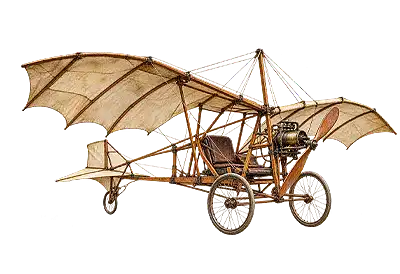
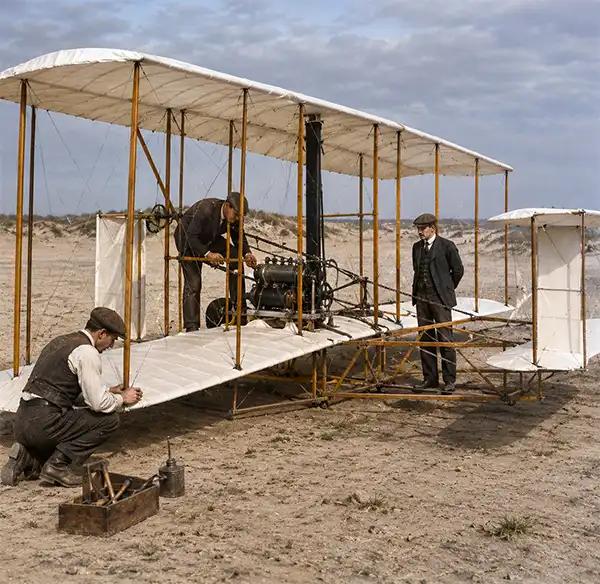
The history of modern aviation changed forever on December 17, 1903, when brothers Orville and Wilbur Wright achieved the first successful sustained, controlled, powered flight of a piloted heavier-than-air aircraft near Kitty Hawk, North Carolina. Their experimental machine, known as the Wright Flyer, was constructed using a lightweight wooden framework, fabric-covered wings, and a specially built gasoline engine. Orville piloted the first successful flight, remaining airborne for approximately 12 seconds and covering 120 feet. It was hardly enough distance to reach the end of a modern airport runway, but it represented one of humanity's most important technological breakthroughs.
The Wright brothers were not simply lucky inventors who attached an engine to a pair of wings. They spent years studying aerodynamics, experimenting with gliders, building a wind tunnel, and developing methods for controlling an aircraft in flight. Their greatest contribution included solving the complex problem of three-axis control, allowing pilots to manage an airplane's pitch, roll, and yaw. By 1905, they had developed a more practical flying machine capable of sustained, maneuverable flights. Their systematic approach to experimentation helped establish principles that remain fundamental to aircraft design. And unlike many modern passengers, the brothers never had to worry about paying extra for baggage. They barely had room for the pilot.
The Early Pioneers Who Helped Aviation Take Off
Although the Wright brothers are central figures in aviation history, the development of flight involved inventors and experimenters from numerous countries. German aviation pioneer Otto Lilienthal conducted extensive glider experiments during the late nineteenth century, documenting the behavior of wings and demonstrating that controlled gliding was possible. French-Brazilian aviator Alberto Santos-Dumont became internationally celebrated for his work with airships and powered airplanes, including his public flights in Europe during 1906. In 1909, French pilot Louis Blériot successfully crossed the English Channel in a powered airplane, proving that aircraft could overcome geographical barriers that had separated communities for centuries.
These pioneers helped transform aviation from an unusual spectacle into a rapidly developing field of engineering. Early aircraft were fragile, engines were unreliable, and pilots frequently navigated using landmarks, maps, and personal judgment. Nevertheless, flying demonstrations attracted enormous crowds, and international competitions encouraged improvements in speed, altitude, endurance, and maneuverability. The enthusiasm surrounding aviation spread quickly as people realized that airplanes might eventually become useful for transportation, communication, and commerce. Within a few decades, the remarkable flying machines that once drew astonished spectators would become essential tools of modern society.
The Golden Age of Aviation: When Flying Became an Adventure
The period between the First and Second World Wars is frequently described as the Golden Age of Aviation, an era characterized by daring long-distance flights, record-breaking pilots, technological innovation, and growing public enthusiasm for air travel. Aircraft became faster, more reliable, and capable of traveling greater distances as engineers improved engines, navigation systems, and airframe construction. Aviation competitions attracted international attention, while newspapers enthusiastically reported the exploits of pilots who attempted journeys that had previously seemed impossible. Flying was still expensive and occasionally dangerous, but it captured the public imagination in ways few other technological developments could match.
One of the era's most famous achievements occurred in May 1927, when American aviator Charles Lindbergh completed the first solo nonstop flight across the Atlantic Ocean. Piloting the Spirit of St. Louis, Lindbergh traveled from New York to Paris in approximately 33½ hours, becoming an international celebrity and demonstrating the potential of long-distance aviation. His achievement followed earlier transatlantic flights, including the first nonstop crossing by British aviators John Alcock and Arthur Whitten Brown in 1919. Lindbergh's success nevertheless helped generate enormous public interest in aviation and encouraged investment in aircraft development and commercial air transportation.
Federal Aviation Administration+1
Amelia Earhart and the Women Who Changed Aviation History
Women played essential roles in aviation history, often overcoming considerable social and professional barriers to pursue careers in flight. Amelia Earhart became one of the world's most recognizable aviation pioneers after completing the first solo nonstop transatlantic flight by a woman in May 1932. Her achievements included numerous aviation records and tireless efforts to encourage women to enter fields traditionally dominated by men. In 1937, Earhart and navigator Fred Noonan disappeared while attempting to fly around the world, creating one of aviation history's most enduring mysteries. Although the circumstances of their disappearance continue to attract public interest, Earhart's accomplishments remain far more significant than the mystery surrounding her final flight.
Other remarkable women also helped expand aviation opportunities. Bessie Coleman became the first African American woman to earn a pilot's license in 1921, traveling to France for training because racial discrimination and gender restrictions prevented her from finding suitable opportunities in the United States. Harriet Quimby became the first American woman to receive a pilot's license in 1911 and later became the first woman to fly across the English Channel. During the Second World War, women pilots served in important military support roles, including the American Women Airforce Service Pilots, commonly known as the WASP. Their determination demonstrated that aviation ability had nothing to do with gender, although convincing certain people of that fact required considerably more effort than flying the aircraft.
How World War I and World War II Transformed Aviation
Military requirements accelerated aviation technology during both world wars, transforming airplanes from experimental machines into powerful instruments of reconnaissance, transportation, and combat. During World War I, aircraft initially served primarily as observation platforms, allowing military commanders to monitor enemy positions and troop movements. As the conflict progressed, specialized fighter aircraft, bombers, and improved engines emerged, while pilots developed new tactics for aerial combat. Famous aviators such as Manfred von Richthofen, widely known as the Red Baron, became international symbols of the dangerous new world of military aviation. Unfortunately, rapid technological progress came at a terrible human cost.
World War II brought even greater advances in aircraft engineering, including powerful piston engines, improved navigation equipment, radar, pressurized cabins, and the introduction of operational jet aircraft. British aircraft such as the Supermarine Spitfire and Hawker Hurricane became closely associated with the Battle of Britain, while American bombers and transport aircraft demonstrated the growing importance of long-range aviation. Germany's Heinkel He 178 made the first flight of a fully jet-powered airplane in 1939, and operational jet fighters appeared before the war ended. Many wartime innovations subsequently influenced civilian aircraft design, helping establish the technological foundation for the modern airline industry.
The Jet Age: Aviation Enters a New Era
The arrival of jet propulsion transformed aviation history by allowing aircraft to travel faster, climb higher, and cover longer distances than many earlier piston-engine designs. British engineer Frank Whittle and German engineer Hans von Ohain made important independent contributions to the development of practical jet engines during the 1930s. Following World War II, jet technology rapidly advanced, eventually revolutionizing both military and commercial aviation. The British de Havilland Comet entered airline service in 1952 as the world's first commercial jet airliner, although early accidents revealed serious structural fatigue problems that led to important improvements in aircraft engineering and safety.
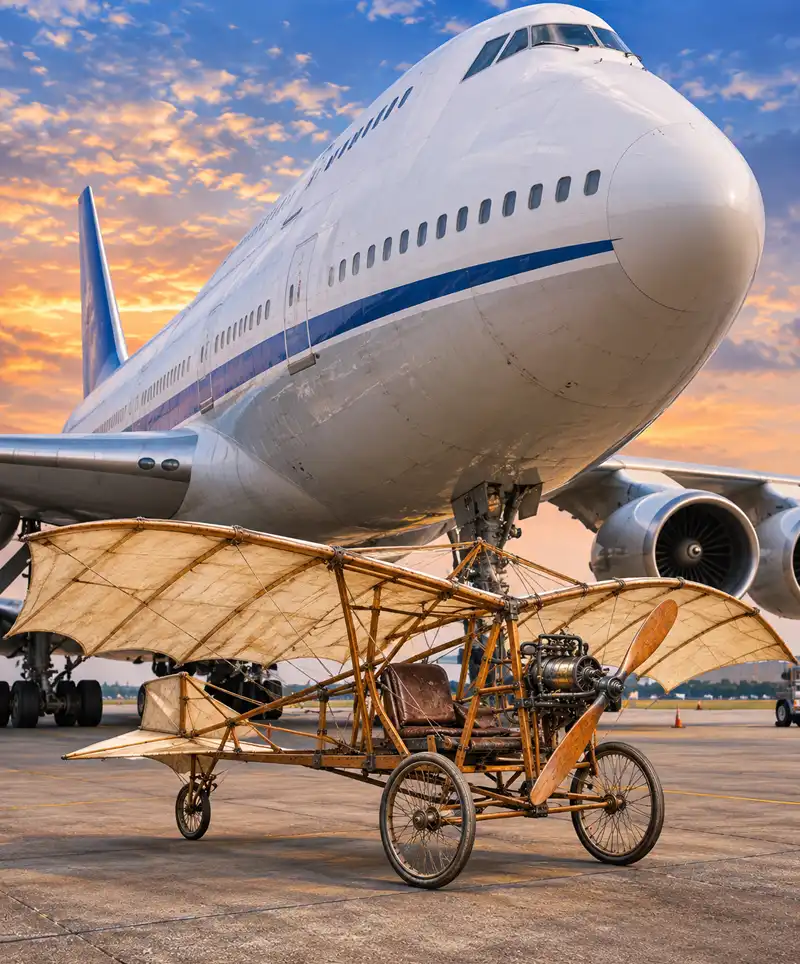
The introduction of the Boeing 707 into commercial service in 1958 helped establish the jet-powered passenger aircraft as a practical means of international transportation. Airlines could carry passengers across continents and oceans much more quickly, gradually making long-distance travel accessible to a broader section of the population. The Boeing 747, which first flew in 1969 and entered commercial service in 1970, introduced an entirely new scale of passenger transportation. Its distinctive upper-deck hump made it one of the world's most recognizable aircraft, while its enormous capacity helped transform international tourism and airline economics. Passengers could now cross the Atlantic in hours rather than days, although airlines still hadn't discovered a way to make the person in front stop reclining their seat.
Breaking the Sound Barrier and the Supersonic Dream
One of aviation's most significant technological achievements occurred on October 14, 1947, when American test pilot Chuck Yeager flew the rocket-powered Bell X-1 beyond the speed of sound in controlled, level flight. The aircraft, nicknamed Glamorous Glennis, reached approximately Mach 1.06, demonstrating that the so-called sound barrier was not an insurmountable obstacle. Yeager's achievement represented an important milestone in aerodynamics, aircraft engineering, and high-speed flight research. The knowledge gained from experimental aircraft programs contributed to the development of increasingly sophisticated military jets and helped engineers understand the challenges associated with supersonic speeds.
 Supersonic passenger travel eventually became a reality with the development of Concorde, a remarkable aircraft created through cooperation between Britain and France. Concorde entered commercial service in 1976 and could cruise at approximately twice the speed of sound, dramatically reducing transatlantic journey times. Its sleek delta-wing design, distinctive drooping nose, and extraordinary performance made it an international aviation icon. However, high operating costs, noise restrictions, environmental concerns, and limited passenger capacity prevented supersonic travel from becoming commonplace. Concorde retired from commercial service in 2003, leaving aviation enthusiasts with fond memories of an aircraft that could cross the Atlantic faster than some people manage to get through airport security.
Helicopters and the Development of Vertical Flight
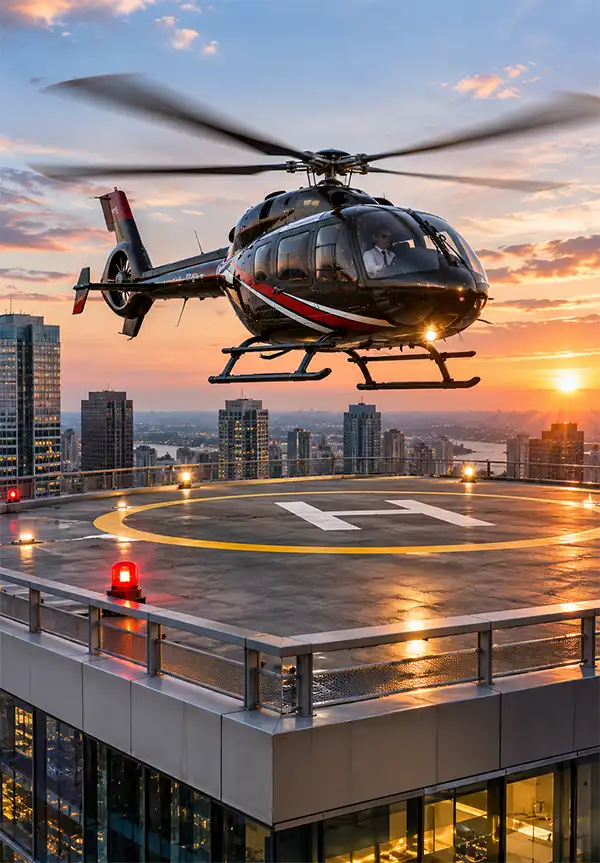
While fixed-wing airplanes captured much of the public's attention, helicopters introduced an entirely different approach to aviation. Unlike conventional airplanes, helicopters use rotating wings, known as rotor blades, to generate lift and provide the ability to hover, take off vertically, and land in confined spaces. Early inventors experimented with vertical flight for generations, but practical helicopters required advances in engine technology, rotor design, and flight control systems. Igor Sikorsky became particularly influential in developing successful helicopter designs, including the VS-300 experimental aircraft, which first flew in 1939 and helped establish the familiar single-main-rotor configuration.
Helicopters eventually became indispensable for emergency medical transportation, search-and-rescue operations, military missions, law enforcement, offshore transportation, and aerial firefighting. Their ability to reach locations inaccessible to conventional aircraft has saved countless lives, particularly in mountainous terrain, disaster zones, and remote communities. Modern helicopters range from compact civilian machines to enormous heavy-lift aircraft capable of transporting substantial cargo. They are also responsible for one of aviation's most recognizable sounds: the unmistakable rhythmic chopping of rotor blades. It may not be the quietest way to travel, but when someone needs rescuing from a mountainside, nobody is likely to complain about the noise.
The Space Age and Aviation's Influence Beyond Earth
Although aviation and spaceflight are distinct fields, the development of aircraft engineering helped establish many of the scientific principles and technologies used in spacecraft. Advances in propulsion, aerodynamics, materials, navigation, and flight testing contributed to the emergence of aerospace engineering during the twentieth century. The Soviet Union launched Sputnik 1, the world's first artificial satellite, in 1957, followed by Yuri Gagarin's historic journey as the first human in space in 1961. The United States achieved another extraordinary milestone in July 1969 when Apollo 11 astronauts Neil Armstrong and Buzz Aldrin became the first humans to walk on the Moon.
The relationship between aviation and space exploration continued through programs involving experimental rocket planes, reusable spacecraft, and advanced aerospace research. NASA's Space Shuttle program, beginning with Columbia's first flight in 1981, combined aspects of rocket-powered spaceflight with a winged orbiter capable of gliding to a runway landing. Today, aerospace engineers continue developing new aircraft, launch vehicles, and technologies intended to expand humanity's ability to travel through the atmosphere and beyond. The Wright brothers would probably have been astonished to discover that, less than seven decades after their first flight, humans were walking on the Moon. Then again, they might have been equally surprised to learn what airlines charge for an extra suitcase.
How Aviation Changed Everyday Life
The influence of aviation extends far beyond airports, passenger terminals, and holiday destinations. Modern aircraft transport medical supplies, agricultural products, emergency personnel, and time-sensitive cargo across enormous distances. Air freight supports international trade by moving goods that require rapid delivery, while specialized aircraft perform aerial surveying, environmental monitoring, firefighting, and disaster relief. Remote communities depend on aviation for access to essential services, and medical evacuation aircraft can transport patients to specialized treatment facilities when ground transportation would be too slow or impractical.
Commercial aviation has also transformed tourism, international business, education, and personal relationships. Families separated by oceans can reunite in a matter of hours, businesses can operate across continents, and travelers can experience cultures that earlier generations might only have encountered through books or photographs. Of course, modern aviation has also introduced its own peculiar traditions, including airport security queues, baggage carousels, and the mysterious disappearance of legroom. Nevertheless, the ability to travel thousands of miles in a single day remains an extraordinary achievement that earlier aviation pioneers could scarcely have imagined.
The Future of Aviation: What's Next for Flight?
Aviation continues to evolve as engineers, researchers, and manufacturers investigate ways to improve aircraft efficiency, reduce environmental impacts, and introduce new forms of transportation. Electric propulsion, hydrogen-powered aircraft concepts, sustainable aviation fuels, advanced air traffic management systems, and increasingly sophisticated aircraft materials are all areas of ongoing development. Some technologies are already being tested or introduced in limited applications, while others face significant engineering, economic, infrastructure, and regulatory challenges before they can become commercially practical.
Uncrewed aircraft systems, commonly called drones, have also expanded aviation into new fields, including photography, agriculture, infrastructure inspection, emergency response, and scientific research. Developers are exploring electric vertical takeoff and landing aircraft, sometimes described as air taxis, although widespread passenger operations will depend on safety certification, infrastructure, public acceptance, and economic viability. The future may eventually include quieter aircraft, more efficient engines, improved navigation systems, and new methods of regional transportation. Whether personal flying cars will finally arrive remains uncertain. Considering how some people behave at four-way stop signs, perhaps we should finish teaching everyone to drive before giving them permission to fly.
Famous Aviation Milestones Worth Remembering
Aviation History Month offers an opportunity to revisit the events that changed humanity's relationship with the sky. These milestones represent some of the most important achievements in the development of flight, illustrating the remarkable speed at which aviation technology advanced.
|
Year |
Aviation milestone |
|---|---|
|
1783 |
The Montgolfier brothers' balloon carries humans on a free flight over Paris. |
|
1903 |
Orville and Wilbur Wright achieve controlled, powered flight at Kitty Hawk. |
|
1909 |
Louis Blériot becomes the first person to cross the English Channel by airplane. |
|
1919 |
John Alcock and Arthur Whitten Brown complete the first nonstop transatlantic airplane flight. |
|
1927 |
Charles Lindbergh makes the first solo nonstop transatlantic flight. |
|
1932 |
Amelia Earhart becomes the first woman to fly solo nonstop across the Atlantic. |
|
1939 |
The Heinkel He 178 makes the first flight of a fully jet-powered airplane. |
|
1947 |
Chuck Yeager breaks the sound barrier in the Bell X-1. |
|
1952 |
The de Havilland Comet enters service as the first commercial jet airliner. |
|
1969 |
The Boeing 747 makes its first flight. |
|
1976 |
Concorde begins scheduled supersonic passenger service. |
|
1986 |
The Rutan Voyager completes the first nonstop, unrefueled flight around the world. |
These achievements illustrate how aviation progressed from experimental flying machines to sophisticated aircraft capable of traveling enormous distances at extraordinary speeds. Each milestone involved years of research, considerable financial investment, and the determination of people willing to challenge established limitations. Some breakthroughs emerged from careful scientific research, while others resulted from courageous individuals attempting journeys that had never been completed. Together, they form an extraordinary record of human ingenuity and provide plenty of reasons to celebrate Aviation History Month.
How to Celebrate Aviation History Month in November
Celebrating Aviation History Month in November is a wonderful opportunity to explore the fascinating world of flight, honor legendary aviation pioneers, and discover the incredible aircraft that changed the course of history. Whether you're visiting an aviation museum, attending an airshow, building a model airplane, experimenting with a flight simulator, or introducing children to the wonders of aviation, there are plenty of entertaining and educational ways to participate. You don't need to be a licensed pilot or an aerospace engineer to appreciate the achievements of the men and women who helped humanity conquer the skies. All you need is a little curiosity, a sense of adventure, and perhaps a willingness to look up occasionally. So, prepare for takeoff as we explore some enjoyable ways to celebrate Aviation History Month. And don't worry, there are no baggage fees, security checkpoints, or mysterious delays at Gate 23!
Visit an Aviation Museum
One of the most rewarding ways to celebrate Aviation History Month is to visit an aviation museum, where historic aircraft, photographs, flight instruments, and personal stories bring the history of flight to life. The Smithsonian National Air and Space Museum in Washington, D.C., preserves remarkable aircraft, including the original 1903 Wright Flyer, while the National Museum of the United States Air Force in Dayton, Ohio, showcases an extensive collection of military aircraft and aviation technology. Smaller regional aviation museums can be equally fascinating, particularly when volunteers and retired pilots share firsthand knowledge about the aircraft on display. A museum visit can transform an ordinary afternoon into a journey through more than a century of technological achievement, with the added benefit of being able to admire historic airplanes without having to squeeze into an economy-class seat.
Learn About Famous Pilots and Aviation Pioneers
Aviation History Month is an excellent opportunity to explore the lives of influential pilots, inventors, engineers, and aviation professionals. Read about the Wright brothers' experiments, Amelia Earhart's record-breaking flights, Bessie Coleman's determination to overcome discrimination, or Chuck Yeager's contribution to supersonic aviation. Aviation biographies reveal that technological progress rarely comes easily and that many pioneers faced financial difficulties, skepticism, dangerous conditions, and repeated failures before achieving success. Their stories can inspire young people interested in science, technology, engineering, and mathematics while reminding adults that persistence and curiosity remain valuable qualities. Fortunately, most of us can learn from their experiences without personally attempting to fly a homemade machine off a sand dune.
Build a Model Airplane or Try a Flight Simulator
Building model airplanes provides an entertaining introduction to aircraft design and the basic principles of flight. Traditional plastic kits, wooden gliders, and radio-controlled aircraft can help enthusiasts understand how wings, control surfaces, and propulsion systems work together. Younger children can begin with paper airplanes, experimenting with different wing shapes and observing how changes affect distance, stability, and flight performance. Flight simulators offer another engaging way to explore aviation, allowing participants to experience simulated takeoffs, landings, navigation, and different aircraft types without leaving home. Modern simulators can be remarkably realistic, although successfully landing a virtual airliner does not automatically qualify someone to take command of the next flight to London.
Attend an Airshow or Watch Historic Aviation Documentaries
Airshows provide opportunities to see aircraft performing maneuvers, flying in formation, and demonstrating capabilities that are difficult to appreciate from photographs alone. Many events feature historic warbirds, civilian aircraft, aerobatic performers, and educational exhibits explaining aviation technology. Always follow event safety guidance and respect designated spectator areas. For those who prefer a quieter celebration, aviation documentaries offer fascinating accounts of historic flights, aircraft development, military aviation, and the individuals who shaped the industry. Watching original footage of early airplanes struggling into the air can provide a remarkable appreciation for modern engineering, particularly when compared with the enormous passenger aircraft that now routinely cross oceans.
Share Aviation History With the Next Generation
Introducing children to aviation history can encourage curiosity about science, engineering, geography, and exploration. Simple activities such as making paper airplanes, visiting an airport observation area, studying famous pilots, or learning how aircraft generate lift can provide memorable educational experiences. Teachers and parents might organize classroom projects featuring important aviation milestones, aircraft identification activities, or discussions about careers in aerospace engineering and aviation maintenance. Aviation History Month also provides an opportunity to explain how teamwork contributes to safe flight, emphasizing that pilots are supported by mechanics, controllers, engineers, ground crews, and many other professionals. The lesson is simple: an airplane may have one or two people in the cockpit, but getting it safely into the sky requires considerably more than someone shouting, "Clear for takeoff!"
Fun Facts About Aviation History
Aviation history contains countless fascinating details, unusual achievements, and surprising developments. Here are a few interesting facts that demonstrate just how far flying technology has progressed since the earliest successful aircraft.
- The Wright brothers' first flight lasted just 12 seconds, covering approximately 120 feet.
- The longest Wright Flyer flight on December 17, 1903, covered 852 feet, with Wilbur at the controls.
- Charles Lindbergh spent approximately 33½ hours crossing the Atlantic during his historic 1927 solo flight.
- Amelia Earhart became the first woman to fly solo nonstop across the Atlantic in 1932.
- The Boeing 747 first flew in 1969, introducing a new era of large passenger aircraft.
- Chuck Yeager broke the sound barrier in 1947, piloting the experimental Bell X-1.
- The Rutan Voyager flew around the world without refueling in 1986, completing its journey in approximately nine days.
- The original 1903 Wright Flyer is preserved by the Smithsonian, allowing visitors to see the aircraft that helped launch the age of powered flight.
Why Aviation History Month Matters
Aviation History Month is more than a celebration of airplanes, famous pilots, and remarkable engineering achievements. It recognizes the generations of people whose imagination, determination, and technical abilities transformed the way humanity experiences the world. From the earliest balloon flights to modern jetliners and experimental aerospace vehicles, the history of aviation demonstrates how scientific discovery and human ambition can overcome seemingly impossible obstacles. It also provides important opportunities to examine the lessons learned from aviation accidents, technological failures, and the continual development of safety standards that have helped make flying a reliable form of transportation.
The celebration also encourages future generations to consider careers in aviation, engineering, scientific research, and related industries. Understanding the achievements of earlier pioneers can inspire new ideas and help preserve the historical knowledge necessary for continued progress. Museums, historical organizations, educators, and aviation enthusiasts all contribute to keeping these stories alive, ensuring that the people and aircraft responsible for important breakthroughs are not forgotten. Aviation history is a reminder that extraordinary accomplishments often begin with ordinary individuals asking a simple question: "What if we tried something different?"
Celebrating Aviation History Month: The Sky Is No Longer the Limit
Every November, Aviation History Month invites us to appreciate the extraordinary journey from humanity's earliest dreams of flight to the sophisticated aircraft that connect the modern world. The achievements of aviation pioneers transformed transportation, communication, commerce, and exploration, while continued advances in aerospace technology promise new possibilities for future generations. Whether you're visiting an aviation museum, reading about legendary pilots, building a model airplane, or simply watching aircraft pass overhead, there are countless ways to recognize the remarkable people and inventions that made modern flight possible.
So, this Aviation History Month, take a moment to look skyward and remember the extraordinary determination that carried humanity from fragile experimental gliders to powerful jet aircraft. Celebrate the pioneers who challenged gravity, the engineers who solved seemingly impossible problems, and the countless aviation professionals who keep the world moving. And the next time you settle into an airline seat, consider how far we've come since Orville Wright's 12-second flight. He probably never imagined that one day passengers would travel thousands of miles through the sky while complaining that the complimentary pretzels were too small!
References & Sources