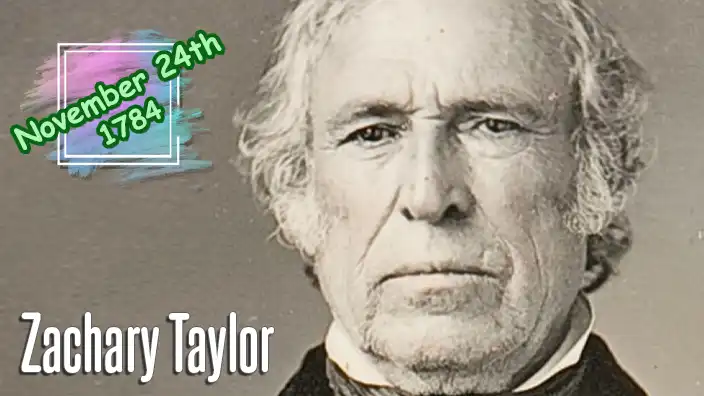
November 24, 1784, in Orange County, Virginia
 July 9, 1850, in the White House, in Washington, D.C.

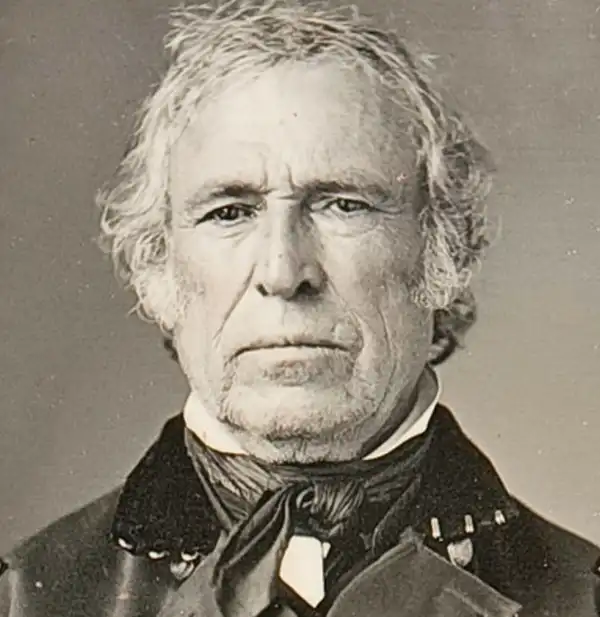
Born on November 24, 1784, in Orange County, Virginia, Zachary Taylor was an American military officer and politician who served as the 12th President of the United States from March 4, 1849, until his death on July 9, 1850. Nicknamed Old Rough and Ready, Taylor spent approximately forty years in the United States Army before his victories during the Mexican-American War transformed him into a national celebrity. His military reputation helped carry him to the White House despite his limited political experience, but his presidency was dominated by the growing national conflict over slavery and the expansion of the United States into western territories. Taylor's sudden death after only sixteen months in office left many of the country's most difficult questions unresolved. Having spent much of his adult life facing enemy soldiers, difficult terrain, and dangerous military campaigns, he discovered that the political battlefield in Washington could be every bit as unpredictable.
Zachary Taylor was born into a prominent Virginia family whose ancestors had established themselves in colonial America. His father, Richard Taylor, was a veteran of the American Revolutionary War and a plantation owner, while his mother, Sarah Dabney Strother Taylor, came from another established Virginia family. Shortly after Zachary's birth, the family moved west to Kentucky, settling near Louisville when the region was still developing as part of America's expanding frontier. The Taylor family eventually accumulated substantial landholdings and relied on enslaved labor to operate its agricultural properties. Growing up in this environment exposed Zachary to the economic and social institutions of the slaveholding South, influences that would remain important throughout his life and presidency.
Taylor received a relatively limited formal education compared with many future American presidents. Schools were scarce in frontier Kentucky, and his early education was conducted through private instruction and local educational opportunities. He developed practical skills associated with farming, horseback riding, and frontier life, becoming familiar with the physical demands of rural existence. Unlike political figures who spent their youth studying classical literature and preparing for careers in law, Taylor appeared more interested in outdoor activities and military service. His upbringing helped produce a man who valued practical experience, direct communication, and personal determination over elaborate speeches and political ceremony. He was not particularly interested in impressing people with polished language, which would later distinguish him from many of his political contemporaries.
In 1808, Taylor received a commission as a first lieutenant in the United States Army, beginning a military career that would last approximately four decades. His early assignments involved service at remote frontier posts, where soldiers faced difficult weather, limited supplies, isolation, and the constant challenges of maintaining military installations far from established settlements. Life in the frontier army required considerable endurance and adaptability. Officers were expected to supervise construction, maintain discipline, manage supplies, and respond to military threats while operating with relatively little support from Washington. Taylor became accustomed to solving practical problems directly, an approach that later contributed to his reputation as a dependable commander.
During the War of 1812, Taylor commanded Fort Harrison in the Indiana Territory when it came under attack by Native American warriors in September 1812. Despite the small size of his garrison and the difficulties created by a fire inside the fort, Taylor organized a successful defense. His conduct earned recognition and promotion, helping establish his reputation as a capable military officer. The defense of Fort Harrison became an important early achievement in his career, demonstrating his ability to maintain discipline and respond effectively under pressure. It also introduced him to the realities of warfare on the American frontier, where military engagements were closely connected with the United States' expanding settlement and its conflicts with Native American nations.
Taylor married Margaret Mackall Smith on June 21, 1810, beginning a marriage that would continue throughout his military and political career. Margaret, affectionately known as Peggy, came from a Maryland family and shared many of the challenges associated with life as an army officer's wife. The couple had six children, although two daughters died during childhood. Military assignments frequently required the family to relocate between isolated posts, creating considerable difficulties for Margaret and the children. Eventually, Margaret spent more time in established communities while her husband continued his demanding military duties. Their family life reflected the sacrifices required of military households during an era when transportation was slow, communication unreliable, and a journey between assignments could become a substantial undertaking.
Throughout the following decades, Taylor served in numerous military campaigns and frontier assignments. His service included involvement in the Black Hawk War of 1832 and the Second Seminole War in Florida. These conflicts were part of the United States government's efforts to expand settlement and impose control over lands occupied by Native American peoples. The military campaigns involved displacement, violence, and policies that had devastating consequences for Indigenous communities. Taylor's participation contributed to his advancement within the army, but it also connected his career to one of the most consequential and painful chapters of American territorial expansion.
During the Second Seminole War, Taylor commanded American forces at the Battle of Lake Okeechobee on December 25, 1837. The engagement involved American troops confronting Seminole warriors who resisted removal from their Florida homeland. Taylor's forces claimed the battlefield, although they suffered substantial casualties and failed to destroy Seminole resistance. His conduct nevertheless earned official recognition, and he received promotion to brigadier general. The battle became an important milestone in his military career, contributing to the reputation that eventually made him a nationally recognized figure. The broader conflict continued for several years, demonstrating the difficulty and human cost of the federal government's removal policies.
Taylor's nickname, Old Rough and Ready, reflected his informal appearance, practical habits, and willingness to share the hardships experienced by ordinary soldiers. Unlike officers who emphasized elaborate uniforms and ceremonial displays, Taylor often preferred comfortable civilian clothing, a broad-brimmed hat, and an unpretentious manner. He was known for riding his horse, Old Whitey, and maintaining a relatively straightforward relationship with the men under his command. His appearance sometimes surprised observers expecting a commanding general to arrive dressed in impressive military finery. Taylor seemed considerably more interested in whether his soldiers had adequate supplies and ammunition than whether his uniform would impress a visiting dignitary.
His reputation for informality did not mean that he lacked discipline or determination. Taylor expected soldiers to perform their duties and demonstrated considerable persistence during difficult campaigns. His practical approach to military leadership emphasized preparation, endurance, and the ability to respond to changing circumstances. These qualities became particularly important during the Mexican-American War, when Taylor's victories would transform him from a respected army officer into one of the most recognizable public figures in the United States.
The Mexican-American War began in 1846 following growing tensions between the United States and Mexico over the annexation of Texas and disputed territorial boundaries. President James K. Polk ordered American forces into the contested region between the Nueces River and the Rio Grande, a decision that contributed to the outbreak of hostilities. Taylor commanded American troops in northern Mexico, where his military operations attracted considerable public attention. The war itself remained controversial, with critics arguing that American expansionist ambitions had helped provoke the conflict. Nevertheless, Taylor's battlefield successes quickly established him as a national military hero.
In May 1846, Taylor's forces defeated Mexican troops at the Battles of Palo Alto and Resaca de la Palma, helping secure American positions near the Rio Grande. These victories were widely reported in American newspapers, and Taylor's reputation grew rapidly. His soldiers subsequently advanced into northern Mexico, capturing the fortified city of Monterrey in September 1846 after several days of intense fighting. The campaign required difficult urban combat and careful coordination between American units. Taylor negotiated an armistice following the city's surrender, a decision that attracted criticism from President Polk and others who believed the terms were too generous. The disagreement illustrated the growing tension between Taylor's independent military judgment and the political expectations of the administration in Washington.
Taylor's most celebrated military achievement came at the Battle of Buena Vista in February 1847. His comparatively small American force confronted a much larger Mexican army commanded by General Antonio López de Santa Anna. The battle was fought across difficult terrain in northern Mexico, with both armies experiencing heavy casualties during intense engagements. Despite the numerical disadvantage, Taylor's troops successfully resisted the Mexican attacks, and Santa Anna eventually withdrew. News of the victory produced widespread celebrations throughout the United States, transforming Taylor into a national hero whose name became familiar to Americans far removed from the battlefield.
The Battle of Buena Vista also strengthened Taylor's political prospects. His reputation for courage, determination, and practical leadership appealed to voters who admired military success and distrusted professional politicians. Newspapers published accounts of his victories, while supporters celebrated his nickname and informal appearance. Taylor's public image became that of a straightforward American soldier who had achieved remarkable success without relying on elaborate political speeches or complicated theories of government. His supporters saw him as an attractive alternative to established political leaders, although his limited experience with national policy would soon become an important consideration.
By 1848, the Whig Party was searching for a presidential candidate capable of winning support across different regions of the country. Party leaders recognized Taylor's popularity and believed his military reputation could attract voters who might otherwise disagree over political issues. The Whigs nominated Taylor for president, selecting Millard Fillmore of New York as his running mate. The decision disappointed some established party figures, including Henry Clay, who had spent decades pursuing the presidency. Taylor had not developed a conventional political career and had rarely participated in elections. His candidacy demonstrated the appeal of military celebrity in American politics, a tradition already established by figures such as George Washington and Andrew Jackson.
The presidential election of 1848 took place against a background of increasing national disagreement over slavery and the territories acquired from Mexico. The Democratic Party nominated Senator Lewis Cass of Michigan, who supported allowing territorial settlers to determine whether slavery would be permitted. Former President Martin Van Buren became the candidate of the Free Soil Party, which opposed the expansion of slavery into western territories. Taylor's own position was complicated by his status as a wealthy Southern slaveholder and his reluctance to make detailed public commitments on controversial political questions. His campaign emphasized his military record, national loyalty, and personal character rather than a comprehensive legislative program.
Taylor won the election of 1848, defeating Cass and Van Buren in the Electoral College. The election was historically significant because it was the first presidential election held on a uniform national voting day. His victory demonstrated the continued appeal of military leadership as a qualification for political office, although it also revealed the deep divisions emerging within American political society. Northern and Southern voters supported Taylor for different reasons, and the coalition that elected him contained conflicting expectations about slavery and territorial expansion. The new president would soon discover that winning an election was considerably easier than persuading Congress to agree on the nation's future.
Taylor's inauguration took place on March 5, 1849, because the traditional March 4 inauguration date fell on a Sunday. His administration began at a moment of extraordinary national change. The discovery of gold in California had triggered a massive migration westward, while the territories acquired from Mexico raised urgent questions about political representation, statehood, and the expansion of slavery. The United States was growing geographically and economically, but its political institutions were struggling to manage the competing interests of different regions. Taylor entered office with considerable public popularity but limited experience navigating the complicated relationships between the presidency, Congress, and political parties.
As president, Taylor maintained his preference for direct communication and practical decision-making. He generally supported the Whig principle that Congress should play a major role in developing domestic legislation, but he was unwilling to accept party instructions when they conflicted with his own judgment. His independence frustrated some Whig leaders who had expected a more cooperative administration. Taylor also demonstrated limited enthusiasm for the elaborate social and ceremonial expectations of the presidency. Having spent decades in military camps and frontier forts, he was not particularly interested in becoming the centerpiece of Washington's political social scene.
The central challenge of Taylor's presidency was the expansion of slavery into the territories acquired following the Mexican-American War. The question threatened to destabilize the balance between free and slave states, with Northern and Southern political leaders advancing sharply different positions. Taylor personally owned enslaved people and operated plantations in Louisiana and Mississippi, yet he opposed extending slavery into the newly acquired western territories. His position reflected a combination of national political concerns, economic assumptions about the suitability of western lands for plantation agriculture, and his determination to preserve the Union.
Taylor's relationship with slavery remains one of the most important contradictions of his presidency. He was not an abolitionist and did not advocate ending slavery in states where it already existed. He personally benefited from enslaved labor throughout his life, and hundreds of enslaved men, women, and children worked on properties associated with his family. Enslaved individuals also served in the White House during his presidency. His opposition to the expansion of slavery into western territories therefore did not represent a rejection of the institution itself. Rather, it reflected a political position that distinguished between protecting slavery where it already existed and allowing its expansion into new areas.
Taylor proposed that California and New Mexico should move toward statehood without first passing through an extended period of territorial government. He believed this approach could reduce congressional disputes over slavery by allowing settlers to establish state constitutions and seek admission to the Union. California's growing population, driven by the Gold Rush, made its application for statehood particularly urgent. Because California was expected to prohibit slavery, its admission threatened to alter the political balance between free and slave states. Southern leaders increasingly viewed the issue as a challenge to their regional influence and economic interests.
The dispute intensified during 1850 as congressional leaders attempted to develop a compromise capable of preserving the Union. Senator Henry Clay proposed a collection of measures addressing California statehood, territorial government, the slave trade in Washington, D.C., and the enforcement of laws requiring the return of escaped enslaved people. These proposals eventually became associated with the Compromise of 1850. Taylor opposed the broader compromise approach, preferring his plan for California and New Mexico to pursue statehood directly. His position placed him at odds with influential members of Congress, including politicians from his own party.
Some Southern political leaders began discussing secession as a possible response to restrictions on slavery's expansion. Taylor reacted strongly to these threats, making clear that he regarded preservation of the Union as a fundamental responsibility of the presidency. Accounts of his discussions with Southern representatives describe his willingness to use federal military power if necessary to enforce the law and resist rebellion. His determination reflected the nationalism developed during his long military career. Having spent decades serving the United States Army, Taylor was unwilling to accept the idea that individual states could simply abandon the Union when political disagreements became inconvenient.
His position created an unusual political situation. A Southern slaveholder was prepared to confront other Southern leaders over threats of secession, while Northern politicians remained divided over the future of slavery in western territories. Taylor's administration demonstrated how the political divisions of the period could produce alliances and disagreements that did not fit neatly into regional categories. His presidency also revealed the increasing difficulty of maintaining national unity through compromises that avoided confronting the fundamental moral and political conflict surrounding slavery.
Taylor's foreign policy included efforts to maintain American commercial interests while avoiding unnecessary international conflicts. One important development was the Clayton-Bulwer Treaty of 1850, negotiated between the United States and Great Britain. The agreement addressed competing interests in Central America, particularly proposals for constructing a canal connecting the Atlantic and Pacific Oceans. Both countries agreed to restrictions intended to prevent either nation from obtaining exclusive control over such a canal. The treaty reflected the growing importance of international transportation and trade as Americans increasingly looked toward the Pacific and the expanding western territories.
Although Taylor's administration was brief, it operated during a period of rapid economic and territorial transformation. The California Gold Rush brought enormous numbers of migrants to the Pacific coast, creating new communities and accelerating demands for government institutions. Transportation routes, commercial networks, and communication systems were expanding, while national debates increasingly focused on the political consequences of westward settlement. The administration faced the challenge of responding to these developments while managing a Congress deeply divided over the country's future.
Taylor's personal life remained closely connected to his family during his presidency. His wife, Margaret, preferred a relatively private existence and participated only sparingly in the public social activities associated with the White House. Their daughter Mary Elizabeth Bliss frequently assisted with official hosting responsibilities. The Taylor family had already experienced considerable personal tragedy, including the deaths of two daughters during childhood and the death of another daughter, Sarah Knox Taylor, shortly after her marriage to future Confederate president Jefferson Davis in 1835. These experiences contributed to the family's complicated history and its connections with figures who would later play important roles in the Civil War.
One particularly striking family connection involved Taylor's son Richard Taylor, who eventually became a general in the Confederate Army during the American Civil War. This development occurred after Zachary Taylor's death, but it illustrated the divisions that would eventually tear apart American families and communities. The elder Taylor had been strongly committed to preserving the Union, while his son later served the Confederacy. Their contrasting historical roles reflected the profound political and social conflicts that developed during the decade following the president's death.
The sudden end of Taylor's presidency began on July 4, 1850, when he attended Independence Day ceremonies near the unfinished Washington Monument. Washington was experiencing extremely hot summer weather, and the president spent considerable time outdoors during the celebrations. Contemporary accounts reported that he consumed cherries and iced milk or other cold refreshments before becoming seriously ill. His condition deteriorated over the following days, with symptoms associated with a severe gastrointestinal illness. Medical treatment during the nineteenth century was limited, and physicians lacked the modern understanding of infectious disease, dehydration, and sanitation that would later transform healthcare.
Zachary Taylor died at the White House on July 9, 1850, becoming the second American president to die while in office, following William Henry Harrison in 1841. His death brought an abrupt end to an administration that had lasted approximately sixteen months. Vice President Millard Fillmore succeeded him, inheriting the growing political crisis over slavery and territorial expansion. Taylor's death also changed the course of congressional negotiations, as Fillmore proved more willing to support the compromise proposals that Taylor had resisted.
The circumstances surrounding Taylor's death eventually inspired speculation that he had been poisoned. Some theories suggested that political opponents might have wanted him removed because of his opposition to the expansion of slavery and his determination to resist secession. Although these claims attracted public attention, no convincing evidence established that Taylor had been murdered. The uncertainty surrounding nineteenth-century medical diagnoses and the dramatic political circumstances of his death helped sustain the rumors for generations.
In 1991, Taylor's remains were exhumed for scientific examination after researchers received permission to investigate the poisoning theory. Samples were analyzed for evidence of arsenic, a substance sometimes associated with historical poisonings. The investigation did not find evidence supporting the claim that Taylor had died from arsenic poisoning. Although the precise medical cause of his death remains uncertain, historians generally attribute it to a severe gastrointestinal illness, possibly connected with contaminated food or water. The investigation helped address one of the more persistent mysteries surrounding an American president, although it did not completely eliminate public fascination with the possibility of foul play.
Taylor's death had important political consequences. Without his opposition, the Compromise of 1850 gained additional support under President Fillmore. The measures admitted California as a free state, organized the territories of Utah and New Mexico, addressed the Texas boundary dispute, prohibited the slave trade in Washington, D.C., and introduced a more stringent Fugitive Slave Act. Although the compromise temporarily reduced some immediate political tensions, it failed to resolve the fundamental conflict over slavery. The Fugitive Slave Act in particular intensified opposition in the North, contributing to the growing sectional divisions that eventually led to the Civil War.
Historians continue to examine how Taylor's presidency might have developed had he survived. His determination to preserve the Union and his opposition to the expansion of slavery suggest that he would have remained involved in the increasingly difficult political disputes of the 1850s. However, the precise consequences of a longer Taylor administration cannot be known. The conflicts surrounding slavery were deeply rooted in American political, economic, and social institutions, and no single presidential decision could easily resolve them. His brief presidency remains an important example of how unexpected events can alter the direction of national politics.
Taylor's funeral attracted widespread public attention, reflecting his continued popularity as a military hero. Large crowds gathered to honor the president, whose reputation had been established through decades of army service and victories during the Mexican-American War. He was eventually buried near Louisville, Kentucky, where his family maintained longstanding connections. His burial place later became part of Zachary Taylor National Cemetery, a site commemorating his military service and presidency.
The historical legacy of Zachary Taylor is shaped by the contrast between his lengthy military career and his comparatively brief time in the White House. As a soldier, he participated in major conflicts associated with American territorial expansion and became nationally famous for his battlefield victories. As president, he confronted the growing crisis over slavery and demonstrated a strong commitment to preserving the Union. Yet his personal ownership of enslaved people and his opposition to slavery's expansion reveal the complicated and often contradictory political attitudes of the period.
Taylor's presidency also illustrates the limitations of military experience as preparation for political leadership. His battlefield reputation helped secure his election, but the challenges of governing required negotiation, coalition-building, and detailed understanding of congressional politics. His independent approach sometimes frustrated political allies, while his determination to resist threats of secession placed him in direct conflict with influential Southern leaders. His administration operated during a period when the nation's expanding territory and unresolved disagreements over slavery were placing extraordinary pressure on American institutions.
Despite serving for only sixteen months, Zachary Taylor remains an important figure in the history of the American presidency. His military achievements, unexpected political rise, opposition to secession, and sudden death all contributed to a distinctive historical legacy. He occupied the White House at a moment when the United States was approaching one of the most consequential crises in its history, and his presidency offers valuable insight into the political tensions that preceded the Civil War.
From the Kentucky frontier to the battlefields of Mexico and finally the White House, Zachary Taylor followed an extraordinary path through American history. His life reflected the ambitions, conflicts, contradictions, and rapid expansion of the young United States. Known as Old Rough and Ready, he preferred practical action to elaborate ceremony and remained closely associated with the military values that shaped his career. Although his presidency ended unexpectedly, his experiences continue to provide an important perspective on the challenges facing America during the turbulent years before the Civil War.
Remembering Zachary Taylor on His Birthday. A general who spent four decades surviving military campaigns, only to discover that the presidency came with hazards no battlefield manual had prepared him for. Old Rough and Ready may have been more comfortable in the saddle than behind a presidential desk, but his place in American history remains firmly established.
The White House – Zachary Taylor – Official presidential biography, military career, and administration. White House Historical Association – Zachary Taylor – Family background, slavery, political positions, and presidency. Miller Center – Zachary Taylor – Presidential biography, political context, and historical analysis. Miller Center – Life Before the Presidency – Childhood, military service, family life, and plantations. Library of Congress – Zachary Taylor Resource Guide – Presidential papers, historical documents, and archival materials. National Park Service – Zachary Taylor – Military career, presidency, death, and burial. PBS American Experience – Zachary Taylor – Presidency, family, and historical background. Smithsonian National Portrait Gallery – Zachary Taylor – Election, presidency, and historical significance. HISTORY – Zachary Taylor – Military victories, political career, and death. American Presidency Project – Zachary Taylor – Presidential chronology, official addresses, and historical records.References & Sources