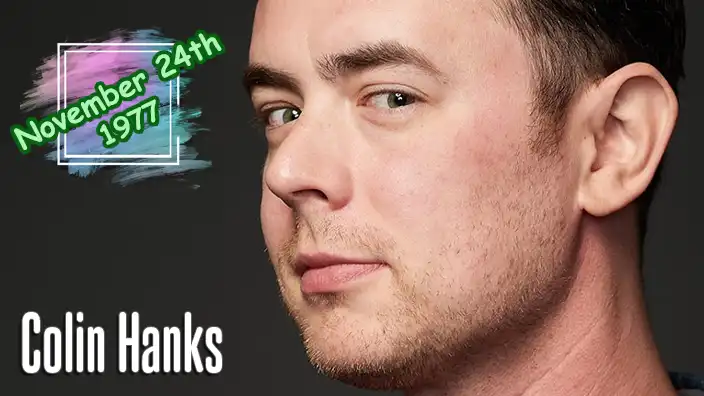
November 24, 1977, in Sacramento, California

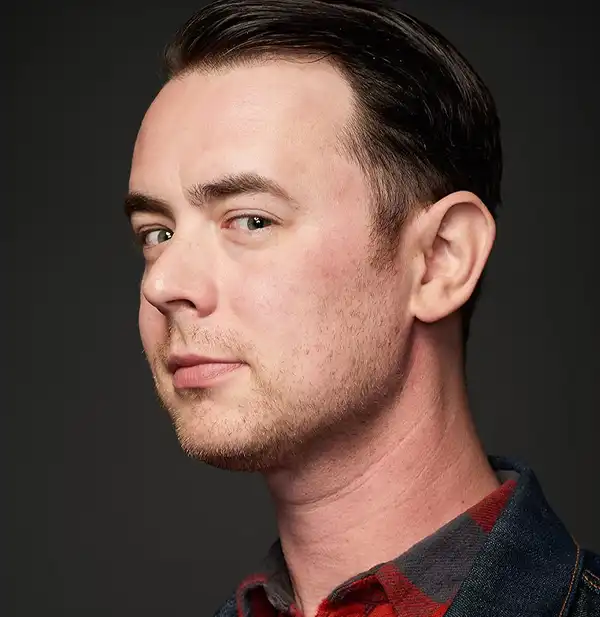
Born on November 24, 1977, in Sacramento, California, Colin Lewes Hanks is an American actor, director, producer, and filmmaker best known for his performances in Fargo, Orange County, Band of Brothers, Roswell, and Life in Pieces. With his approachable personality, natural comic timing, and remarkable ability to portray ordinary people caught in extraordinary circumstances, Hanks has established a successful career in television and film. Although he happens to be the eldest son of Academy Award-winning actor Tom Hanks, Colin has developed his own professional identity through a combination of comedy, drama, independent filmmaking, and documentary production. Having one of Hollywood's most recognizable surnames might help people remember your name, but it certainly doesn't guarantee that you can deliver a convincing performance when the cameras start rolling.
Colin Hanks was born to Tom Hanks and actress and producer Samantha Lewes, whose birth name was Susan Dillingham. His younger sister, Elizabeth Ann Hanks, also pursued creative interests, including writing and acting. Following his parents' divorce in 1987, Colin grew up with connections to both Sacramento and Los Angeles, where his father's acting career was developing rapidly. He later gained two younger half-brothers, Chester and Truman, through his father's marriage to actress Rita Wilson. Growing up in a family closely associated with entertainment introduced Colin to the realities of show business, although his childhood was not simply a succession of Hollywood premieres and celebrity encounters. He experienced the ordinary challenges of school, friendships, family relationships, and discovering his own interests while living with a surname that was becoming increasingly famous.
During his childhood and teenage years, Hanks developed an interest in music, movies, and storytelling. He attended Sacramento Country Day School before continuing his education at Chapman University in Orange, California, and later transferring to Loyola Marymount University in Los Angeles. Although he did not complete a college degree, his university years helped him explore acting and filmmaking while developing a greater understanding of the entertainment industry. His interest in creative work eventually led him toward professional acting, although the prospect of entering the same profession as his extraordinarily successful father undoubtedly presented a unique challenge. Most young actors worry about living up to their own expectations; Colin also had to contend with comparisons to a man who had already won two Academy Awards.
Hanks began appearing in professional productions during the 1990s, including a small role in That Thing You Do! (1996), the musical comedy written and directed by his father. The film followed a fictional 1960s rock band whose unexpected success creates complications for its members. Although Colin's appearance was brief, the experience provided an opportunity to observe a major film production from the inside. He subsequently appeared in the independent film Whatever It Takes (2000), continuing to gain experience while seeking roles that would allow him to establish his own identity as a performer rather than simply becoming known as Tom Hanks' son.
His first major television breakthrough came in 1999 when he was cast as Alex Whitman in the science-fiction drama Roswell. The series followed a group of teenagers in Roswell, New Mexico, whose lives become entangled with extraterrestrial secrets, mysterious government activities, and complicated romantic relationships. Hanks portrayed Alex as a loyal, intelligent, and somewhat awkward young man whose friendship with the central characters draws him into increasingly dangerous situations. His performance combined humor, sincerity, and emotional vulnerability, helping make Alex a popular character among the show's devoted audience. Unfortunately, being a sensible teenager in a television series about alien conspiracies is not necessarily a guarantee of a long and peaceful life.
In 2001, Hanks appeared in the acclaimed HBO miniseries Band of Brothers, portraying Lieutenant Henry Jones. Produced by Steven Spielberg and Tom Hanks, the series dramatized the experiences of Easy Company, part of the 506th Parachute Infantry Regiment of the 101st Airborne Division, during World War II. Hanks appeared in the episode The Last Patrol, playing a young officer who arrives as the soldiers are dealing with the exhaustion, danger, and emotional consequences of prolonged combat. Although his role was relatively brief, the production offered an opportunity to participate in one of television's most highly regarded historical dramas. The series received widespread critical acclaim for its attention to historical detail, powerful performances, and portrayal of the experiences of American soldiers during the war.
Hanks achieved a significant film breakthrough with the comedy Orange County (2002), in which he starred as Shaun Brumder, an aspiring writer determined to escape his dysfunctional California family and attend Stanford University. His carefully planned future begins unraveling when a school administrative mistake threatens his college admission, forcing him to navigate increasingly ridiculous situations involving his eccentric relatives and unreliable acquaintances. Jack Black played Shaun's irresponsible older brother Lance, while Catherine O'Hara portrayed his emotionally unpredictable mother. The film gave Hanks an opportunity to demonstrate his ability to anchor a comedy while surrounded by performers whose characters appeared determined to behave as outrageously as possible.
One of the strengths of Hanks' performance in Orange County was his ability to remain believable while everything around him descended into chaos. Shaun was ambitious, anxious, and frequently exasperated, making him an effective contrast to the film's collection of eccentric personalities. His frustration with his family's behavior provided much of the comedy, particularly during scenes involving Jack Black's spectacularly irresponsible character. The film developed a following among audiences who appreciated its irreverent humor and recognizable depiction of a young person desperately attempting to establish independence from a family that seems determined to interfere. It also demonstrated that Colin Hanks could successfully carry a major comedy without relying on his father's reputation.
He continued developing his film career with appearances in Get Over It (2001), 11:14 (2003), and Standing Still (2005). These productions allowed him to explore different genres, from romantic comedy to darker independent storytelling. He also appeared in the 2005 remake of King Kong, directed by Peter Jackson, portraying Preston, an assistant to the ambitious filmmaker Carl Denham, played by Jack Black. The production featured elaborate visual effects, large-scale action sequences, and a giant gorilla whose presence created considerably more workplace difficulties than most employees encounter. For Hanks, the film represented an opportunity to participate in a major Hollywood spectacle while working alongside an internationally recognized ensemble.
In 2006, Hanks appeared in the comedy The House Bunny's predecessor in his filmography, Alone with Her, a psychological thriller in which he portrayed Doug, a disturbed man who secretly monitors a young woman using hidden cameras. The film departed sharply from his familiar image as a likable, slightly awkward young man, demonstrating his willingness to explore darker and more unsettling characters. He subsequently appeared in The Great Buck Howard (2008), portraying Troy Gable, a young man who abandons law school to become the assistant of an eccentric, fading mentalist played by John Malkovich. Tom Hanks appeared in the film as Troy's father, creating an entertaining example of art imitating life, although the fictional family relationship was considerably more complicated than a simple Hollywood reunion.
The comedy The House Bunny (2008) featured Hanks as Oliver, a kindhearted young man who becomes romantically involved with Shelley, a former Playboy Bunny portrayed by Anna Faris. The film combined romantic comedy with a story about friendship, confidence, and finding acceptance beyond superficial appearances. Hanks brought warmth and sincerity to his role, providing a reassuring contrast to the more exaggerated personalities surrounding him. His performance reflected one of his most consistent professional strengths: the ability to portray decent, approachable characters without making them seem dull or excessively perfect.
Hanks also appeared in W. (2008), director Oliver Stone's biographical drama about President George W. Bush, portraying political strategist Alex Gage. The role demonstrated his interest in more serious dramatic material and his willingness to participate in films addressing controversial historical and political subjects. His growing filmography increasingly reflected a balance between mainstream entertainment and smaller productions that allowed him to explore different acting challenges. Rather than concentrating exclusively on leading roles, Hanks frequently selected supporting characters who contributed significantly to a film's overall storytelling.
His television career continued with guest appearances in several successful series, including Mad Men, in which he portrayed Father John Gill, a young Catholic priest whose interactions with Peggy Olson reveal complicated questions about faith, family, and personal responsibility. He also appeared in The Good Guys (2010), playing Detective Jack Bailey opposite Bradley Whitford. The series followed two mismatched Dallas police detectives whose contrasting personalities created both professional difficulties and comedic opportunities. Hanks portrayed the younger, more methodical officer, whose preference for sensible investigative procedures frequently clashed with his partner's old-fashioned and impulsive approach to police work.
Another memorable television role came in the sixth season of Dexter (2011), when Hanks portrayed Travis Marshall, a troubled man connected to a series of elaborate murders inspired by religious imagery. The character represented a dramatic departure from his familiar comedic roles, requiring him to explore psychological instability, manipulation, and disturbing behavior. His performance demonstrated that he could convincingly portray morally complicated and deeply unsettling characters. For audiences accustomed to seeing Hanks as the pleasant fellow next door, watching him become involved in the sinister world of Dexter was rather like discovering that the friendly neighborhood librarian had developed an alarming interest in medieval torture equipment.
One of the most significant achievements of Hanks' television career arrived in 2014 when he appeared in the first season of FX's acclaimed crime anthology series Fargo. Inspired by the 1996 Coen brothers film, the series presented a darkly humorous story involving murder, deception, and increasingly disastrous decisions in Minnesota and North Dakota. Hanks portrayed Gus Grimly, a mild-mannered Duluth police officer and single father whose encounter with dangerous criminal Lorne Malvo, played by Billy Bob Thornton, draws him into an extraordinary criminal investigation. The character's nervousness, decency, and determination made him one of the show's most sympathetic figures.
Hanks' portrayal of Gus Grimly was particularly effective because the character was not a traditional television hero. Gus was frightened by danger, uncertain of his abilities, and frequently overwhelmed by events beyond his control. Nevertheless, he possessed a strong moral conscience and gradually found the courage to confront circumstances that would have sent many sensible people searching for a new profession. His relationship with police officer Molly Solverson, portrayed by Allison Tolman, provided warmth and humanity amid the series' violence and absurdity. Hanks earned nominations for both a Primetime Emmy Award and a Critics' Choice Television Award for his performance, confirming his ability to deliver compelling dramatic work in a highly acclaimed production.
Following Fargo, Hanks starred in the CBS sitcom Life in Pieces, which premiered in 2015. The series followed the interconnected lives of three generations of the Short family, presenting their experiences through several shorter stories within each episode. Hanks portrayed Greg Short, a husband and father navigating the familiar challenges of marriage, parenting, work, and extended family relationships. His character's attempts to maintain order frequently collapsed under the weight of unexpected complications, creating opportunities for the understated humor that had become one of Hanks' trademarks. The ensemble included James Brolin, Dianne Wiest, Betsy Brandt, Thomas Sadoski, and Zoe Lister-Jones.
During its four-season run, Life in Pieces developed an appreciative audience through its combination of family comedy and relatable everyday situations. Hanks' performance as Greg demonstrated his ability to lead an ensemble sitcom while maintaining the balance between humor and emotional sincerity. His character was often well-intentioned but occasionally spectacularly misguided, particularly when attempting to solve family problems that would probably have been better left alone. The series also allowed Hanks to explore the comedy of parenthood, a subject with which he had become increasingly familiar in his own life.
In addition to acting, Hanks developed a successful career as a documentary filmmaker. His directorial debut came with All Things Must Pass: The Rise and Fall of Tower Records (2015), a documentary exploring the history of the influential music retail chain. Founded in Sacramento, Tower Records grew from a small business into an international cultural institution before collapsing amid changing consumer habits, financial difficulties, and the transformation of the music industry. Hanks' personal connection to Sacramento and his enthusiasm for music helped inspire the project. The documentary featured interviews with musicians, industry figures, and former employees, providing an affectionate but thoughtful examination of a business that had once played an important role in how people discovered and purchased music.
The documentary reflected Hanks' appreciation for the cultural experiences associated with traditional record stores. Before streaming services made millions of songs available instantly, music enthusiasts often spent hours browsing shelves, studying album covers, and discussing their favorite artists with store employees. Tower Records became a gathering place for people who considered music more than background entertainment. Through interviews and archival material, Hanks explored how the company's success, expansion, and eventual decline reflected broader changes in popular culture and the retail industry. For anyone who remembers the excitement of finding a long-awaited album in a record shop, the documentary offered a nostalgic reminder of a very different musical era.
Hanks continued his documentary work with Eagles of Death Metal: Nos Amis (Our Friends) (2017), which examined the American rock band Eagles of Death Metal and the aftermath of the November 2015 terrorist attack at the Bataclan concert hall in Paris. The film explored the emotional consequences of the tragedy and the band's efforts to return to performing. Hanks approached the subject with sensitivity, emphasizing the experiences of the musicians, survivors, and those affected by the attack. The documentary demonstrated his ability to handle serious real-world subjects while maintaining a focus on personal stories and human resilience.
His later acting projects included the television series The Offer (2022), a dramatization of the making of Francis Ford Coppola's The Godfather. Hanks portrayed Barry Lapidus, a fictionalized studio executive involved in the complicated negotiations and creative conflicts surrounding the legendary film's production. The series offered an entertaining look at the challenges of Hollywood filmmaking, including studio politics, financial pressures, and the frequent disagreements between executives and creative professionals. Having grown up around the entertainment industry, Hanks was particularly well suited to portraying a character navigating the sometimes absurd machinery of Hollywood decision-making.
Hanks also appeared in the Peacock crime drama A Friend of the Family (2022), portraying Bob Broberg, the father of a young girl abducted by a manipulative family acquaintance. Based on disturbing real events, the series required a restrained and emotionally demanding performance. Hanks portrayed a father struggling with fear, guilt, confusion, and the devastating consequences of misplaced trust. The role demonstrated his continuing interest in serious dramatic material and his ability to portray vulnerable, imperfect individuals confronting extraordinary circumstances.
In 2023, Hanks portrayed Mike Emmick in the Peacock miniseries The Lost Symbol's successor in his career, the true-crime drama The Girl from Plainville having preceded his appearance in other projects. He also continued pursuing documentary and producing opportunities, including work exploring popular culture and the entertainment industry. His professional interests have increasingly extended beyond appearing in front of the camera, reflecting a desire to participate in storytelling from its earliest creative stages through final production. This combination of acting and filmmaking has allowed him to develop a varied career without depending exclusively on the availability of conventional Hollywood roles.
Outside his professional life, Hanks married former publicist Samantha Bryant in May 2010. The couple have two daughters, Olivia Jane and Charlotte Bryant. Hanks has spoken about the pleasures and challenges of fatherhood, occasionally sharing humorous observations about family life and the unexpected responsibilities that accompany raising children. His experiences as a parent have also informed his performances in television comedies, where his characters frequently discover that children possess a remarkable ability to undermine even the most carefully organized plans.
Music remains one of Hanks' enduring personal interests. He is an enthusiastic collector of vinyl records and has frequently discussed his appreciation for musicians, albums, and the cultural history of recorded music. His passion for music contributed directly to his documentary work and has remained an important part of his public personality. He is also known for his interest in typewriters, an enthusiasm that he shares with his father. In an era dominated by smartphones and digital communication, the Hanks family's affection for old-fashioned mechanical keyboards suggests that some people still appreciate the satisfying sound of a machine that announces every letter with a decisive clack.
Hanks has also supported charitable causes and participated in fundraising activities connected to education, health, and community organizations. His public appearances and interviews frequently reveal a thoughtful, self-deprecating sense of humor, particularly when discussing his famous family background. Rather than attempting to escape comparisons with his father entirely, he has acknowledged the advantages and complications associated with growing up in a well-known entertainment family. His career demonstrates that while family connections may provide opportunities, professional longevity depends on talent, persistence, and the willingness to accept challenging roles.
Throughout his career, Colin Hanks has demonstrated an impressive ability to move between comedy, drama, crime thrillers, science fiction, historical productions, and documentary filmmaking. His performances are frequently characterized by an approachable sincerity that makes his characters believable even when they become involved in extraordinary situations. Whether portraying a frightened police officer in Fargo, an ambitious student in Orange County, a struggling father in Life in Pieces, or a deeply troubled character in Dexter, he brings an understated authenticity to his work.
Colin Hanks has established himself as a versatile actor and filmmaker whose achievements deserve recognition independently of his famous surname. His Emmy-nominated performance in Fargo, memorable roles in successful television series, and thoughtful documentary projects demonstrate a commitment to storytelling that extends beyond conventional Hollywood expectations. From the fictional battlefields of Band of Brothers to the eccentric world of Orange County and the cultural history of Tower Records, he has built a varied and engaging professional career. And although his father may have once famously declared that life is like a box of chocolates, Colin's own career suggests that life is more like a television script: you never quite know when the next page will introduce an alien, a murderer, or Jack Black.
Happy Birthday, Colin Hanks! May your celebration include excellent music, wonderful company, and absolutely no unexpected visits from the criminals of Fargo. And if Jack Black offers to help organize the party, perhaps somebody should check the insurance coverage first!
IMDb – Colin Hanks Biography – Birth details, family background, education, and career information. IMDb – Colin Hanks Filmography – Film credits, television appearances, documentaries, and professional achievements. Rotten Tomatoes – Colin Hanks – Career overview, filmography, and critical reception. Television Academy – Colin Hanks – Emmy recognition and television performances. Turner Classic Movies – Colin Hanks – Film credits and career history. HBO – Band of Brothers – Historical miniseries and production information. FX – Fargo – Crime anthology series and character information. All Things Must Pass: The Rise and Fall of Tower Records – IMDb – Documentary filmmaking and Tower Records history. Eagles of Death Metal: Nos Amis (Our Friends) – IMDb – Documentary directing credits. People – Colin Hanks – Family life, interviews, and career developments.References & Sources