
Giving Our Trees a Festive Makeover
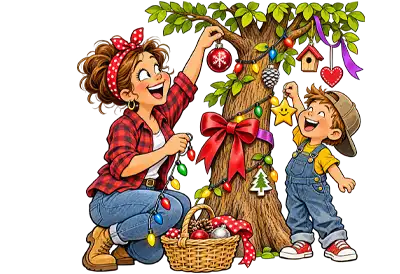
Tree Dressing Day, celebrated over the first weekend in December, encourages us to decorate, appreciate, and celebrate the trees that enrich our lives. While some people have their Christmas decorations up before the Halloween pumpkins have finished decomposing, Tree Dressing Day arrives at a considerably more civilized time of year. So, grab some colorful ribbons, gather your friends and neighbors, and give a tree a festive makeover. For once, even the trees that aren't invited indoors for Christmas get to join the celebrations!
What Is Tree Dressing Day?
Tree Dressing Day is an annual environmental and community celebration that encourages people to recognize the cultural, historical, ecological, and social importance of trees. Observed on the first Saturday and Sunday in December, the occasion provides an opportunity for individuals, families, schools, and community organizations to decorate living trees with colorful ribbons, handmade ornaments, artwork, fabric, and messages of appreciation.
Although its timing conveniently coincides with the beginning of the traditional Christmas decorating season, Tree Dressing Day is not exclusively a Christmas celebration. It welcomes people from all cultural and religious backgrounds and encourages communities to appreciate the trees growing in their gardens, streets, parks, and woodlands.
Having an entire weekend in which to participate also eliminates the pressure of completing everything on a particular day. If Saturday is inconvenient because you are still untangling last year's Christmas lights, Sunday remains available. Of course, if you started untangling them in August, you should be considerably ahead of schedule.
The History and Origins of Tree Dressing Day
Tree Dressing Day was established in 1990 by Common Ground, a British arts and environmental charity dedicated to strengthening the relationship between people and their local surroundings. The observance developed from the organization's Trees, Woods and the Green Man project, which began in 1986 and explored the importance of trees through environmental education, literature, art, and community participation.
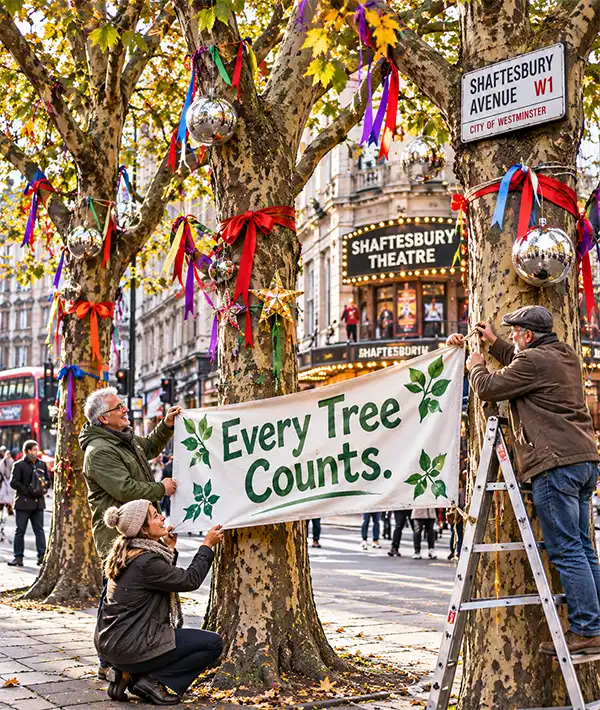
The inaugural celebration involved three London plane trees along Shaftesbury Avenue in London. Large reflective decorations drew attention to the trees beneath the project's slogan, "Every Tree Counts." The nearby Shaftesbury Theatre illuminated the decorated trees, transforming familiar features of a busy urban street into objects of public appreciation.
Common Ground subsequently promoted the observance through publications, educational materials, and community initiatives. What began as a relatively modest environmental project developed into a recurring tradition involving schools, artists, conservation organizations, families, and gardening groups.
The principle behind Tree Dressing Day was refreshingly straightforward. People are more likely to appreciate and protect something when they develop a personal connection with it. Decorating a familiar neighborhood tree encourages residents to notice something they might otherwise walk past every day without giving it a second thought.
Trees, after all, have been standing around providing valuable community services for centuries without submitting a single expense report, requesting a salary increase, or complaining about working conditions.
Ancient Traditions of Decorating Trees
Although the modern observance of Tree Dressing Day dates to 1990, the practice of decorating trees has existed across different cultures for centuries. Trees have traditionally represented life, fertility, wisdom, protection, renewal, remembrance, and spiritual connections between humanity and nature. Their longevity and seasonal transformations have inspired religious beliefs, folklore, artistic traditions, and community celebrations throughout history.
In parts of Scotland and Ireland, traditions associated with sacred wells include attaching pieces of cloth, sometimes known as clooties, to nearby trees. Historically, these practices were associated with healing, spiritual devotion, and personal wishes. The decorated trees became recognizable features of local cultural landscapes.
In Japan, the Tanabata festival includes hanging colorful paper decorations and handwritten wishes from bamboo branches. Buddhist traditions also include decorating sacred trees with ribbons or fabric, while trees feature prominently in various Hindu customs and religious practices.
These traditions developed for different reasons and should not be confused with one another, but they illustrate a shared human tendency to express feelings, hopes, beliefs, and appreciation through our relationship with the natural world.
Humanity has apparently spent thousands of years looking at perfectly respectable trees and deciding that what they really needed was a little accessorizing.
Tree Dressing Day and the Christmas Decorating Epidemic
There was once a time when December marked the beginning of the Christmas decorating season for many households. Families retrieved their decorations from the attic, rediscovered the Christmas tree stand, purchased a few additional ornaments, and prepared their homes for the festive period.
Things have changed somewhat.
Nowadays, Christmas merchandise can appear in stores while customers are still deciding what to wear for Halloween. Pumpkins and artificial Christmas trees occasionally occupy neighboring aisles, leaving shoppers wondering whether they should purchase a witch's hat or a reindeer with illuminated antlers.
Thanksgiving barely gets a chance to finish its turkey before Christmas takes possession of the calendar. In some households, the Christmas tree is already fully decorated, the garden resembles an illuminated airport runway, and Santa Claus has inflated himself on the front lawn while the trees are still shedding their autumn leaves.
At the current rate of festive expansion, it may not be long before Christmas decorations become available immediately after the Fourth of July, with Santa arriving aboard a jet ski wearing sunglasses and carrying sunscreen.
Tree Dressing Day offers a delightful opportunity to restore a little seasonal perspective. The first weekend in December seems an entirely respectable time to begin decorating trees. The weather has generally become cooler across much of the Northern Hemisphere, the autumn celebrations have concluded, and Christmas is sufficiently close for the festivities to feel appropriate.
Of course, nobody is suggesting that enthusiastic early decorators should be arrested. There is no international Christmas decorating police force, although anyone playing Christmas music in September should probably expect a strongly worded letter.
Tree Dressing Day vs. Decorating a Christmas Tree
While both traditions involve decorating trees, there is an important distinction between Tree Dressing Day and the familiar custom of decorating a Christmas tree. Christmas trees are typically evergreen trees, either natural or artificial, displayed inside homes and public buildings as part of the Christmas festivities. Decorations often include lights, ornaments, tinsel, stars, and angels.
Tree Dressing Day focuses primarily on celebrating living trees in their natural surroundings. An oak tree, maple, birch, sycamore, or even an ordinary tree growing beside a neighborhood sidewalk can become the centerpiece of a celebration. The decorations may express artistic creativity, commemorate local history, acknowledge environmental concerns, or simply bring a little color to the winter landscape.
There is no requirement for a tree to be perfectly symmetrical, evergreen, or capable of supporting an enormous illuminated star. Even a somewhat crooked tree with questionable posture is entitled to participate.
The advantage of decorating an outdoor living tree is that nobody has to rearrange the living room furniture, argue about which corner it should occupy, or spend the following three months extracting pine needles from the carpet.
Why Trees Deserve Their Own Celebration
Trees are among the most valuable natural resources on Earth, providing environmental benefits that extend far beyond their appearance. Through photosynthesis, trees absorb carbon dioxide and release oxygen. They store carbon in their trunks, branches, roots, and other tissues, contributing to the global carbon cycle.
Trees also provide shade, reduce temperatures through shading and evapotranspiration, help manage rainfall runoff, stabilize soil, and offer food and shelter to numerous species of wildlife. In urban environments, trees can improve the appearance of neighborhoods while making streets and public spaces more comfortable during hot weather.
For birds, insects, squirrels, and countless other creatures, trees represent entire ecosystems. A single mature tree may provide nesting locations, feeding opportunities, shelter, and protection throughout the year. What humans might regard as an ordinary oak tree could be the wildlife equivalent of a large apartment complex complete with restaurants, recreational facilities, and excellent outdoor views.
Considering everything trees provide, dedicating one weekend each year to acknowledging their contribution hardly seems excessive. Particularly when humanity has found enough room on the calendar to celebrate doughnuts, socks, and the occasional bowl of cold soup.
The Cultural and Historical Importance of Trees
Beyond their environmental value, trees frequently become important landmarks in the history of communities. Ancient trees may have witnessed generations of human activity, including weddings, public gatherings, celebrations, conflicts, and significant changes to the surrounding landscape.
Throughout history, trees have served as meeting places, boundary markers, sources of raw materials, and symbols of community identity. Some are associated with historical figures or important local events, while others acquire significance simply because they have occupied the same location for generations.
An old tree standing beside a village road may have been there long before the surrounding houses were constructed. It may have watched horse-drawn vehicles give way to motorcars, telegraph poles arrive, electricity become commonplace, and successive generations of children discover that climbing down is considerably more complicated than climbing up.
Tree Dressing Day encourages people to investigate these local connections. Learning about the history of a familiar tree can reveal fascinating information about the development of a neighborhood and the people who lived there before us. In an increasingly fast-moving world, trees provide a valuable sense of continuity.
They also possess the admirable ability to remain in one place for several hundred years without once complaining that there is nothing good on television.
Bringing Communities Together Through Tree Dressing
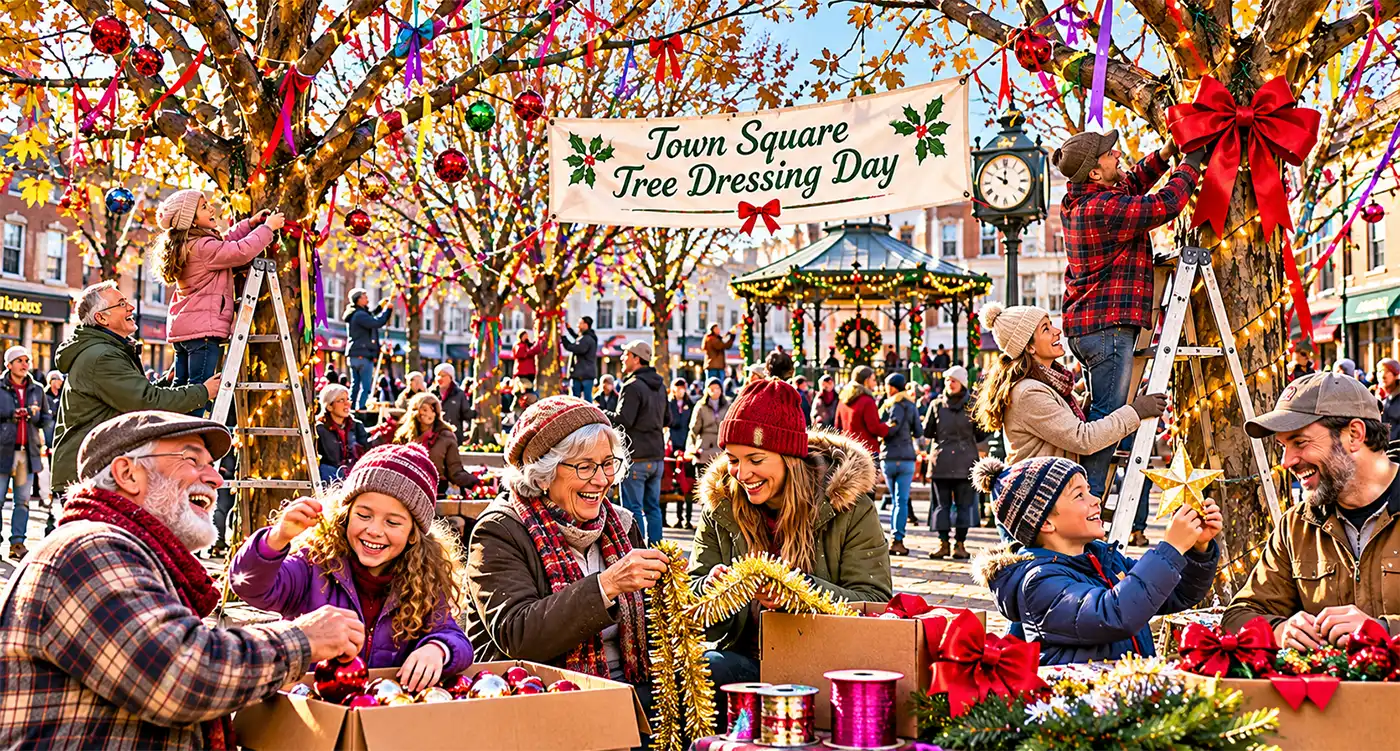
One of the most appealing aspects of Tree Dressing Day is its ability to bring people together without requiring expensive equipment, elaborate preparations, or specialized artistic skills. Community groups can select a suitable tree, obtain the necessary permission, and invite residents to contribute decorations, handwritten messages, artwork, or personal stories.
Schools can incorporate tree dressing into environmental education by encouraging children to learn about different tree species, wildlife habitats, seasonal changes, and conservation. Children might create colorful ornaments representing local birds or animals, write poems about nature, or produce decorations inspired by the history of their community.
Artists, musicians, gardeners, and local historians can also contribute to community celebrations. A decorated tree can become the focal point of an outdoor gathering featuring storytelling, singing, refreshments, and educational activities.
For adults, Tree Dressing Day provides a rare opportunity to gather with neighbors without having to discuss property boundaries, parking arrangements, or whose dog has been visiting whose flower beds.
Environmentally Friendly Tree Dressing Decorations
Tree Dressing Day is ultimately about appreciating and protecting trees, so decorations should be selected with environmental responsibility in mind. There is little point in celebrating nature by covering it with plastic materials that subsequently escape into waterways, become entangled in wildlife, or remain scattered across the countryside.
Suitable temporary decorations might include fabric ribbons, reusable handmade ornaments, painted wooden shapes, paper artwork, and other lightweight materials. Decorations should be securely attached without damaging the bark or restricting the growth of branches. Even biodegradable materials should be collected afterward rather than left to accumulate outdoors.
Avoid hammering nails into trees, using staples, wrapping branches tightly with wire, or hanging heavy objects from fragile limbs. Loose strings, plastic tinsel, artificial snow, and decorations that could trap or injure wildlife should also be avoided.
If lights are incorporated into the display, use equipment specifically designed for outdoor use, follow electrical safety instructions, and avoid decorating trees near overhead power lines. Open flames should never be placed in or near tree branches.
Remember, the tree is the guest of honor, not a convenient structural support for an ambitious engineering project. If decorating it requires scaffolding, a crane, and three separate building permits, you may have become a little carried away.
How to Celebrate Tree Dressing Day
Celebrating Tree Dressing Day can be as simple or elaborate as you wish. Whether you participate on Saturday or Sunday, the most important objective is to develop a greater appreciation for the trees in your surroundings and encourage others to do the same.
- Decorate a living tree: Choose a suitable tree in your garden or an approved community location and add colorful, environmentally responsible decorations.
- Organize a neighborhood celebration: Invite friends and neighbors to contribute handmade ornaments, artwork, and messages of appreciation.
- Create a tree of gratitude: Encourage participants to write down something for which they are thankful and temporarily display their messages.
- Learn about local trees: Identify different species, investigate their histories, and discover the wildlife they support.
- Plant a tree: Where local conditions and the planting season permit, plant a suitable native tree for future generations.
- Support tree conservation: Volunteer with a conservation organization, participate in a community planting project, or support woodland preservation.
- Enjoy a woodland walk: Spend time appreciating trees in their natural surroundings without feeling obliged to decorate every one of them.
- Begin your Christmas decorating: If you have resisted the temptation until December, reward yourself with a thoroughly respectable festive decorating session.
Share photographs of your celebrations on social media using hashtags such as #TreeDressingDay, #EveryTreeCounts, #CelebrateTrees, and #TreeConservation.
Once the celebrations have concluded, remember to remove outdoor decorations and return the tree to its natural condition.
When Is Tree Dressing Day Celebrated?
Tree Dressing Day takes place annually over the first weekend in December. Both Saturday and Sunday are available for celebrations, allowing individuals, families, schools, and community organizations to choose whichever day best suits their arrangements.
Because it follows a weekend-based schedule rather than a fixed calendar date, the dates change each year.
Year Saturday Sunday
2026 December 5 December 6
2027 December 4 December 5
2028 December 2 December 3
2029 December 1 December 2
2030 December 7 December 8
2031 December 6 December 7
2032 December 4 December 5
2033 December 3 December 4
2034 December 2 December 3
2035 December 1 December 2
Having two days available is particularly helpful for outdoor celebrations, where weather conditions can occasionally interfere with the best-laid plans. It also provides an additional day for anyone who discovers that their carefully stored box of decorations has somehow become a single, enormous knot.
Interesting Tree Dressing Day Facts
Tree Dressing Day has a surprisingly rich history, combining ancient cultural traditions, environmental awareness, artistic creativity, and community spirit. Before you rush outside armed with ribbons and decorations, take a moment to explore these fascinating facts about an observance that gives trees their well-deserved moment in the spotlight. After all, they've spent centuries providing shade, shelter, and oxygen without so much as receiving a thank-you card!
- Tree Dressing Day was established in Britain in 1990.
- The environmental charity Common Ground created the observance.
- The original celebration featured three London plane trees.
- Tree Dressing Day falls on the first weekend in December.
- Tree decorating customs existed centuries before the modern observance.
- Living deciduous trees are just as suitable as evergreens.
- Tree Dressing Day is not exclusively a Christmas tradition.
- Decorations should be removed after the celebration.
Trees Are for Life, Not Just for Christmas
Tree Dressing Day reminds us that trees deserve our attention throughout the year, not simply when December arrives and somebody starts looking for an extension cord. Their environmental contributions, historical significance, cultural associations, and ability to enhance our surroundings make them an essential part of everyday life.
The first weekend in December provides an opportunity to slow down, enjoy the natural world, spend time with friends and neighbors, and acknowledge the importance of protecting trees for future generations. Whether you decorate a beloved garden tree, participate in a community celebration, plant a new tree, or simply enjoy a peaceful walk through the woods, you are participating in the spirit of this meaningful annual observance.
And for those who have patiently waited until December to retrieve their Christmas decorations, your moment has finally arrived. You can now decorate with enthusiasm, confidence, and the comforting knowledge that your festive preparations have not interfered with Halloween, Thanksgiving, Easter, or the summer holidays.
Happy Tree Dressing Day! May your branches be colorful, your decorations environmentally friendly, and your Christmas lights work on the first attempt.
Although, admittedly, that last wish may be asking rather too much.
Common Ground – Tree Dressing Day – Official origins, annual observance dates, international traditions, and community participation. University of Exeter – Tracing the Roots of Tree Dressing Day – Historical documentation, archival records, and the development of the original celebration. Common Ground – History – Organizational history, environmental initiatives, and the original London tree dressing project. Common Ground – Tree Dressing Activity Pack – Educational resources, cultural traditions, and community celebration ideas. Common Ground – A Manifesto for Trees – Tree appreciation, environmental responsibility, community involvement, and conservation. The Independent – Dreaming of a Green Christmas – Contemporary newspaper coverage of Tree Dressing Day from December 1994.References & Sources