September 20, 1934, in Rome, Italy
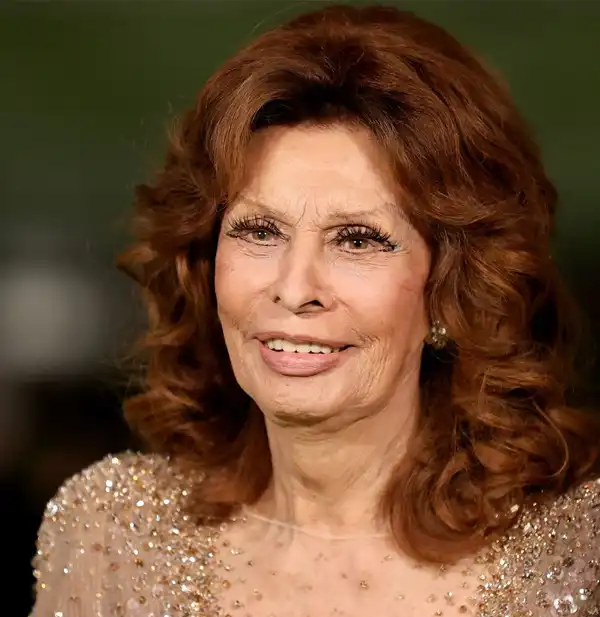
Sophia Loren was born Sofia Villani Scicolone on September 20, 1934, in Rome, Italy, the daughter of Romilda Villani and Riccardo Scicolone. Her parents were never married, and her father provided little support to the family. Loren's mother eventually returned with Sophia and her younger sister Maria to Pozzuoli, near Naples, where they lived with relatives under extremely difficult circumstances. Long before Hollywood gowns, international premieres and photographers shouting her name, Loren knew genuine poverty.
Her childhood coincided with World War II, and Pozzuoli's location near military and industrial targets made it vulnerable to Allied bombing. The family sometimes took shelter in a railway tunnel during air raids. Loren was wounded by shrapnel during one attack, leaving a scar on her chin. Food shortages were common, and the thin young Sophia was teased about her appearance. The experience remained with her throughout her life and later gave her an emotional connection to one of the most important roles she would ever play.
Her mother, Romilda, had ambitions of becoming an actress herself and bore a resemblance to Greta Garbo. She had once won a competition that might have taken her to Hollywood but was prevented from pursuing the opportunity. Instead, some of those unrealized ambitions eventually found another route through her daughter.
As Italy emerged from the war, the teenage Sophia began entering beauty contests. She competed in the Miss Italia competition in 1950 and was awarded the title Miss Eleganza, created for her during the contest. Beauty competitions led to modeling work and appearances in fotoromanzi, enormously popular Italian photo-romance magazines that told melodramatic stories through staged photographs and captions.
During these early years she used variations of her name, including Sofia Lazzaro. The surname supposedly suggested that her beauty might be capable of raising Lazarus from the dead — which, even by Italian standards of complimenting an attractive woman, was setting expectations rather high.
Her earliest film appearances were tiny. She worked as an extra in the enormous Hollywood production Quo Vadis, which was filmed at Rome's Cinecittà studios. She appeared in various small parts while studying acting and learning how the film industry worked. Nobody watching those fleeting appearances could reasonably have known that one of the extras would eventually become more internationally famous than many of the people whose names appeared above hers in the credits.
A crucial figure entered Loren's life during this period: Italian film producer Carlo Ponti. They met when Loren was still a teenager and Ponti was already an established producer. He recognized her screen potential and helped guide her developing career. Her professional name eventually became Sophia Loren, and increasingly substantial roles followed.
By the mid-1950s, Loren was becoming a major Italian star. One of the directors most important to her development was Vittorio De Sica, whose work as both actor and director was central to Italian cinema. He directed Loren in The Gold of Naples, released in 1954, where she played Sofia, a beautiful and spirited pizza seller. The role allowed Loren to display the earthy humor, confidence and emotional directness that became important parts of her screen personality.
Another essential partnership began with Marcello Mastroianni. Loren and Mastroianni first appeared together during the 1950s and eventually became one of international cinema's most celebrated screen pairings. Their chemistry was remarkably flexible. They could play romance, farce, domestic warfare, heartbreak or quiet companionship, often creating the impression that they had known one another for several lifetimes and had probably argued during most of them.
Hollywood inevitably noticed.
Loren's growing international reputation brought her into English-language films opposite some of the biggest male stars in the world. She appeared with Cary Grant and Frank Sinatra in The Pride and the Passion, with John Wayne in Legend of the Lost, with Anthony Perkins in Desire Under the Elms and again with Grant in Houseboat. Suddenly, the young woman from wartime Pozzuoli was sharing movie posters with performers whose names represented Hollywood royalty.
Her relationship with Cary Grant added an unusual personal complication. Grant fell in love with Loren while they were working together, and Loren later wrote and spoke about the emotional difficulty of choosing between the glamorous Hollywood star and Carlo Ponti. She ultimately chose Ponti, beginning one of cinema's most enduring personal and professional partnerships.
Her marriage to Ponti, however, became extraordinarily complicated because Italian divorce law at the time made ending his previous marriage legally difficult. They initially married in Mexico in 1957, but the union was not recognized by Italian authorities and created legal problems involving accusations of bigamy. Eventually Ponti, Loren and Ponti's first wife became French citizens, allowing the earlier marriage to be legally dissolved. Loren and Ponti married legally in 1966 and remained together until his death in 2007.
Meanwhile, Loren was proving that international glamour was only one part of what she could do on screen.
The defining breakthrough came with Vittorio De Sica's Two Women, released in 1960. Loren played Cesira, a widowed mother attempting to protect her young daughter Rosetta during the devastation of World War II. Originally, Loren had been considered for the role of the daughter, while the great Anna Magnani was approached to play the mother. Magnani declined and reportedly suggested that Loren herself should play Cesira.
It was an inspired decision.
Loren stripped away much of the glamour associated with her international image and drew upon memories of wartime Italy to create an emotionally raw performance. Cesira and Rosetta flee Rome hoping to find safety in the countryside, only to encounter violence as the war overtakes them. The film's most devastating sequence comes when mother and daughter are sexually assaulted inside a church while returning home.
Loren's performance transformed international perceptions of her. She was no longer simply the beautiful Italian star who could hold her own beside Cary Grant or Clark Gable. She was an actress of formidable dramatic power.
The awards followed. Loren won Best Actress at the Cannes Film Festival and received numerous other honors, but the greatest recognition came from the Academy Awards. She won the Oscar for Best Actress, becoming the first performer to win an Academy Award for a leading performance delivered in a language other than English.
Loren did not attend the ceremony because she was convinced she would lose and feared the emotional strain of waiting through the broadcast. She learned that she had won by telephone in Rome. The victory was historic not only for Loren but for international cinema, demonstrating that an extraordinary performance did not need to be delivered in English to receive Hollywood's highest acting honor.
Loren's career was now operating simultaneously in Italian cinema and Hollywood. She starred opposite Charlton Heston in the historical epic El Cid, played opposite Clark Gable in It Started in Naples, and appeared with Peter Sellers in The Millionairess. Her leading men during this period constituted an astonishing catalogue of twentieth-century movie stars.
Yet some of her richest work continued to come from collaborations with De Sica and Mastroianni.
In Yesterday, Today and Tomorrow, Loren and Mastroianni played different characters across three separate stories. Loren demonstrated her gift for comedy as well as drama, particularly in the famous sequence in which her character performs a striptease while Mastroianni watches with increasing enthusiasm. The film won the Academy Award for Best Foreign Language Film.
Then came Marriage Italian Style in 1964, again directed by De Sica and again pairing Loren with Mastroianni. Loren played Filumena Marturano, a former prostitute who has spent years in a complicated relationship with wealthy businessman Domenico Soriano. When she discovers that he intends to marry a younger woman, Filumena launches an elaborate effort to force him to confront what their relationship actually means.
The film allowed Loren to move effortlessly between broad comedy and emotional drama. Filumena is clever, manipulative, furious, loving and fiercely protective of her children. Loren's performance earned her a second Academy Award nomination for Best Actress, confirming that Two Women had been no fortunate accident.
Her international films continued throughout the 1960s. She appeared with Paul Newman in Lady L, Gregory Peck in Arabesque and Marlon Brando in A Countess from Hong Kong, the final film directed by Charlie Chaplin. Working for Chaplin while starring opposite Brando put Loren in the unusual position of making a movie with two of the most famous figures in cinema history simultaneously.
She later appeared opposite Peter O'Toole in Man of La Mancha, playing Aldonza/Dulcinea in the screen adaptation of the Broadway musical. Loren was never afraid to move between genres. Historical epics, romantic comedies, war dramas, musicals and intimate Italian character pieces all found their way onto her résumé.
One of the finest performances of her later career came in Ettore Scola's A Special Day in 1977, once again opposite Marcello Mastroianni. The film takes place in Rome on May 6, 1938, while much of the city attends a parade celebrating Adolf Hitler's visit to Benito Mussolini.
Loren plays Antonietta, an exhausted housewife and mother left at home while her family attends the festivities. Mastroianni plays Gabriele, a former radio broadcaster facing persecution by the Fascist regime because he is gay. Their unexpected meeting develops into an intimate portrait of two lonely people trapped by the expectations and oppression surrounding them.
For Loren, the role was another deliberate rejection of glamour. Antonietta is tired, ordinary and emotionally neglected. Loren's performance depends on small gestures rather than movie-star charisma, while her extraordinary chemistry with Mastroianni gives the film much of its emotional force. A Special Day became one of the most acclaimed films associated with both actors.
Loren gradually reduced her workload as family became increasingly important. She and Ponti had two sons, Carlo Ponti Jr., who became an orchestral conductor, and Edoardo Ponti, who became a filmmaker. Loren had endured miscarriages before becoming a mother, making the arrival of her children particularly significant in her life.
She nevertheless continued appearing on screen. Later projects included The Cassandra Crossing, Ready to Wear and the 1995 comedy Grumpier Old Men, in which she joined Jack Lemmon, Walter Matthau and Ann-Margret. Loren played Maria Ragetti, who arrives in the Minnesota town planning to convert the local bait shop into an Italian restaurant.
Putting Sophia Loren together with Lemmon and Matthau was an inspired piece of casting. The two veteran comedians had spent decades perfecting the art of bickering, while Loren was more than capable of giving as good as she received. Her romance with Matthau's Max Goldman provided the film with an additional dose of warmth — and gave audiences the enjoyable spectacle of Walter Matthau somehow winding up opposite Sophia Loren. There was hope for everybody.
In 1991, the Academy presented Loren with an Honorary Oscar recognizing her contribution to world cinema. The honor described her as one of the genuine treasures of international film, placing her career within the larger history of the medium rather than simply celebrating one performance.
She received numerous other lifetime honors, including the Cecil B. DeMille Award at the Golden Globes and the Golden Lion for Lifetime Achievement at the Venice Film Festival. The American Film Institute included her among the greatest female stars of Classical Hollywood cinema.
Loren returned to the movie musical in 2009 with Nine, directed by Rob Marshall. The enormous cast included Daniel Day-Lewis, Marion Cotillard, Penélope Cruz, Judi Dench, Nicole Kidman and Kate Hudson. Loren played the mother of Day-Lewis's troubled filmmaker Guido Contini, providing a direct connection between the film's celebration of Italian cinema and one of the people who had actually helped define it.
A particularly meaningful later role came in The Life Ahead, directed by her son Edoardo Ponti and released in 2020. Loren played Madame Rosa, a Holocaust survivor and former prostitute who cares for the children of sex workers and reluctantly takes in a troubled Senegalese boy named Momo.
The role was substantial rather than ceremonial. Loren portrayed Rosa as stubborn, wounded, compassionate and increasingly vulnerable as her health declines. Decades after Two Women demonstrated that she possessed dramatic ability far beyond her glamorous image, The Life Ahead provided another reminder that the essential ingredient had never disappeared.
Her collaboration with Edoardo also brought Loren's personal and professional lives together in an unusual way. The woman whose own mother had encouraged her earliest ambitions was now being directed by her son in a major film. Cinema had become a family tradition.
Sophia Loren's longevity is remarkable, but merely counting years misses what made her career exceptional. She belonged simultaneously to several cinematic worlds. She was a product of postwar Italian cinema who became an international celebrity. She was a glamorous Hollywood leading lady who repeatedly returned to demanding Italian dramatic roles. She could stand beside Cary Grant, Clark Gable, Marlon Brando or Gregory Peck without disappearing into their star power, yet some of her greatest work came opposite Marcello Mastroianni in films where neither performer needed to dominate the other.
Her partnership with Mastroianni remains one of cinema's great screen relationships. Across numerous films, they could be lovers, spouses, strangers or adversaries and still produce an immediate sense of shared history. They were glamorous when the material demanded it and wonderfully ordinary when it did not.
Loren's life also mirrored enormous changes in Italy itself. She experienced wartime poverty, the rebirth of Italian cinema, the explosion of international filmmaking during the 1950s and 1960s and the transformation of movie stardom across subsequent decades. The skinny child sheltering from bombs near Naples eventually became one of the most recognizable faces in the world.
Beauty unquestionably opened doors for Sophia Loren. Pretending otherwise would be silly.
What made the career last was what happened after she walked through them.
Two Women required emotional courage. Marriage Italian Style demanded comedy and drama almost simultaneously. A Special Day required restraint. Her Hollywood pictures required the confidence to share the screen with some of the industry's most powerful stars. Loren could do all of it without losing the earthy Italian personality that made her distinctive in the first place.
That is why Sophia Loren ultimately became something much more interesting than a beautiful movie star.
She became Sophia Loren.
Cinema really doesn't have another one.