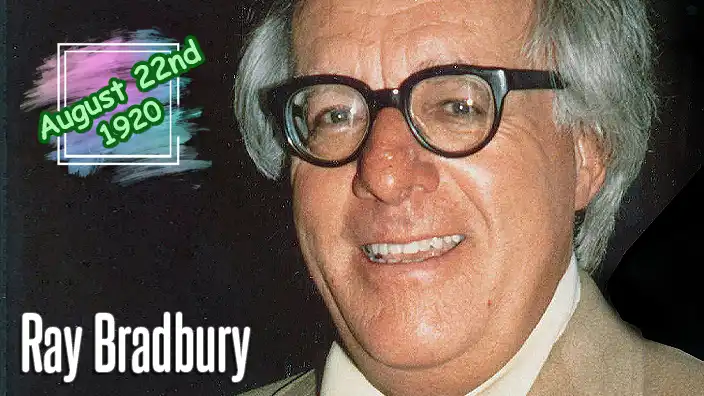
August 22, 1920, in Waukegan, Illinois
 June 5, 2012, in Los Angeles, California
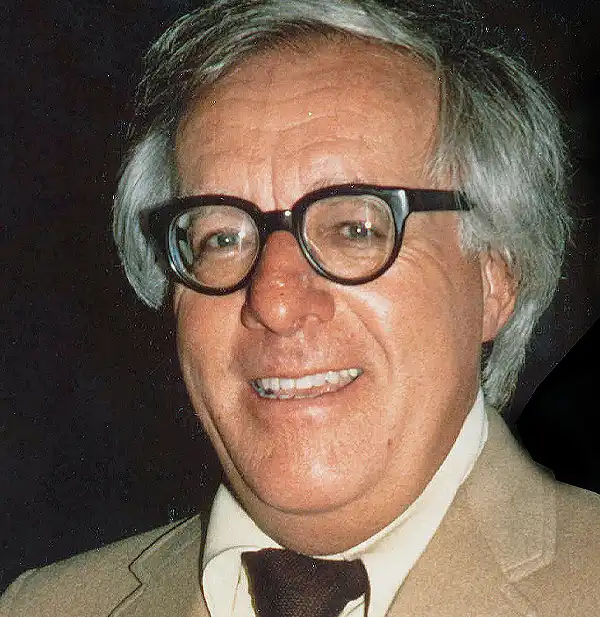
Ray Bradbury spent a lifetime proving that you don't need a spaceship to travel to Mars, a time machine to visit tomorrow, or a carnival ticket to wander into somewhere deeply unsettling. A library card and a sufficiently active imagination will do nicely. Through Fahrenheit 451, The Martian Chronicles, Something Wicked This Way Comes, hundreds of short stories, screenplays, essays, and poems, Bradbury became one of America's most celebrated authors while insisting that the future was never really his principal subject. People were.
Born Ray Douglas Bradbury on August 22, 1920, in Waukegan, Illinois, Bradbury grew up in a family that moved several times between Illinois and Arizona before settling permanently in Los Angeles in 1934. His childhood memories of Waukegan would remain extraordinarily important to his writing, eventually inspiring the fictional Green Town, Illinois, which appears throughout his work.
Bradbury's childhood was filled with books, movies, comic strips, magic shows, carnivals, and the fantastic worlds created by writers such as Edgar Allan Poe, L. Frank Baum, Jules Verne, H.G. Wells, and Edgar Rice Burroughs. Rather than treating childhood wonder as something sensible adults were expected to discard, Bradbury carried it throughout his life and made it one of the engines of his fiction.
One of the most famous stories about young Bradbury involves a carnival performer named Mr. Electrico. In 1932, the 12-year-old Bradbury attended a performance by the entertainer, who sat in an electrically charged chair and performed with a sword. Bradbury later recalled that Mr. Electrico touched him with the electrified sword and commanded him to “Live forever!”
Bradbury obviously took the instruction seriously.
He later described the encounter as a formative moment in his decision to become a writer. The following day, Bradbury returned to the carnival and spoke with Mr. Electrico, an experience that became part of the personal mythology surrounding his career. Whether another 12-year-old might have responded by avoiding electrically charged carnival performers for the remainder of his natural life is another matter entirely.
After the Bradbury family moved to Los Angeles, Ray attended Los Angeles High School, graduating in 1938. Unlike many celebrated American writers, he never attended college. Money was scarce during the Depression, and formal higher education was simply not financially practical for him.
Bradbury developed an alternative educational program.
He went to the library.
For years, he spent enormous amounts of time reading in public libraries, later describing himself as essentially library educated. He read broadly and constantly, absorbing literature, history, science fiction, fantasy, poetry, and anything else that fed his imagination. His example became one of literature's great advertisements for the revolutionary educational technology known as getting yourself to the library and opening books.
Bradbury also began writing relentlessly. As a young man, he sold newspapers on Los Angeles street corners to earn money while working on stories. He joined the Los Angeles Science Fiction Society, meeting other writers and enthusiasts who shared his fascination with speculative fiction.
His earliest professional publications appeared in pulp magazines during the 1940s. Bradbury wrote story after story, learning through sheer production. He later encouraged aspiring writers to produce enormous quantities of short fiction, arguing in effect that nobody could write dozens of stories without eventually producing something worthwhile.
That work gradually attracted attention.
His first collection, Dark Carnival, appeared in 1947. Some of its stories would later be revised and republished in other collections, particularly The October Country. Even in these early works, many of the qualities that would define Bradbury were present: nostalgia, childhood, mortality, technology, fear, wonder, small-town America, and the unsettling possibility that something extremely strange might be waiting just beyond the porch light.
Bradbury's major breakthrough came with The Martian Chronicles, published in 1950. Rather than a conventional novel, the book assembled interconnected stories describing humanity's exploration and colonization of Mars, encounters with Martian civilization, and the consequences of carrying Earth's prejudices and destructive habits to another world.
Mars in Bradbury's hands was not primarily a scientific destination. It was a stage upon which human beings could repeat their mistakes somewhere with a more interesting sky.
The stories addressed subjects including colonialism, racism, nuclear war, censorship, loneliness, cultural destruction, and humanity's apparently limitless ability to arrive somewhere new while dragging its old problems behind it. Bradbury's Mars was poetic and dreamlike rather than scientifically rigorous, which occasionally irritated readers who wanted their fictional spacecraft accompanied by engineering diagrams.
Bradbury was perfectly comfortable with that distinction.
Although routinely described as a science-fiction writer, he frequently argued that much of his work was actually fantasy. He famously regarded Fahrenheit 451 as his principal science-fiction novel because it depicted a plausible extension of existing society, while works such as The Martian Chronicles operated more freely in imaginative territory.
In 1951, Bradbury published The Illustrated Man, another important collection of short stories. The book uses the framing device of a mysterious tattooed man whose moving illustrations reveal individual stories. The collection includes some of Bradbury's best-known works, including “The Veldt,” “Kaleidoscope,” and “The Rocket Man.”
Then, in 1953, came the book that would become inseparable from his name: Fahrenheit 451.
The novel takes place in a future society where books are outlawed and “firemen” no longer extinguish fires. Instead, they burn books and the homes in which they are discovered. The protagonist, Guy Montag, is a fireman who gradually begins questioning the society he serves after meeting the curious young Clarisse McClellan.
Montag's wife, Mildred, spends much of her life absorbed in wall-sized entertainment screens and shallow interactive media. Meanwhile, books have become dangerous objects because they encourage complicated ideas, conflicting opinions, reflection, and the deeply inconvenient habit of thinking.
The novel's title refers to the temperature Bradbury believed to be the point at which book paper catches fire and burns. Whatever the precise ignition temperature of various kinds of paper, the title became one of the most recognizable in 20th-century American literature.
The origins of the novel were wonderfully appropriate. Bradbury needed an inexpensive place to write and discovered that the basement of UCLA's Powell Library contained typewriters that could be rented for ten cents per half hour. He fed coins into a typewriter and produced the manuscript that developed into Fahrenheit 451.
There is something beautifully fitting about one of literature's most famous novels concerning the destruction of books being written in the basement of a library.
Bradbury developed the novel from earlier work, particularly his story “The Fireman,” which had appeared in Galaxy Science Fiction. The expanded book was published in 1953 and became an enduring examination of censorship, conformity, mass entertainment, intellectual freedom, and society's willingness to abandon difficult ideas in favor of comfortable distraction.
Over the decades, Fahrenheit 451 has often been described simply as a novel about government censorship. Bradbury's own explanations were broader and sometimes shifted in emphasis. He was deeply concerned not only with authorities suppressing books but also with societies voluntarily abandoning reading, shortening attention spans, avoiding controversial ideas, and surrendering themselves to constant entertainment.
That aspect of the novel has kept it remarkably relevant. Wall-sized televisions, wireless earpieces, shortened attention spans, constant streams of entertainment, and people increasingly disconnected from one another seemed futuristic in 1953. Modern readers occasionally encounter these details and begin looking suspiciously at the electronics scattered around the living room.
Bradbury continued publishing prolifically. Dandelion Wine, released in 1957, drew heavily upon his memories of childhood in Waukegan. Set in the fictional Green Town during the summer of 1928, the novel follows 12-year-old Douglas Spaulding through experiences involving family, friendship, aging, death, discovery, and the almost overwhelming realization that he is alive.
The book demonstrated how difficult it is to confine Bradbury within the science-fiction label. There are no interplanetary colonies required for Dandelion Wine. Instead, Bradbury turned porches, ravines, summer evenings, sneakers, grandparents, and childhood adventures into material possessing the same sense of wonder that he brought to Mars.
His fascination with carnivals and childhood fear emerged powerfully in Something Wicked This Way Comes, published in 1962. The novel follows two boys, Will Halloway and Jim Nightshade, after a mysterious traveling carnival arrives in Green Town. Its sinister proprietor, Mr. Dark, offers people the things they desperately desire while attaching terms and conditions that would make even the most aggressive credit-card company blush.
The novel combines horror, fantasy, friendship, temptation, aging, fathers and sons, and the fear that accompanies wanting to be older—or younger—than you actually are. The carnival setting also echoed Bradbury's childhood encounter with Mr. Electrico, although the fictional carnival was considerably less advisable to revisit the following afternoon.
Bradbury was enormously prolific as a short-story writer. Among his most famous stories is “A Sound of Thunder,” published in 1952, in which travelers journey into the prehistoric past to hunt a Tyrannosaurus rex. One traveler steps off the designated path and accidentally kills a butterfly, contributing to dramatic changes when the party returns to the present.
The story became strongly associated with the popular concept known as the “butterfly effect,” although the scientific term developed separately through chaos theory. Bradbury's image nevertheless became one of popular culture's most memorable illustrations of how an apparently tiny action in the past might radically alter the future.
Another famous story, “There Will Come Soft Rains,” depicts an automated house continuing its daily routines after its human occupants have been destroyed by nuclear war. Breakfast is prepared, announcements are made, cleaning continues, and machinery faithfully serves people who are no longer there. It is a haunting example of Bradbury's ability to make technology simultaneously marvelous and horrifying without reducing it to a simple declaration that machines are bad.
His interests reached far beyond books. Bradbury wrote for television, radio, theater, and film, bringing his distinctive imagination into multiple forms of storytelling. One particularly notable film credit came when director John Huston hired him to write the screenplay for the 1956 adaptation of Herman Melville's Moby Dick, starring Gregory Peck.
Bradbury later described the experience of working with Huston in Ireland in complicated terms, and elements of that relationship inspired later writing. Nevertheless, the assignment demonstrated that Bradbury's abilities were respected well beyond the science-fiction publishing world.
Television provided another major outlet. His stories were adapted for programs including The Twilight Zone and Alfred Hitchcock Presents, while the anthology series The Ray Bradbury Theater brought numerous Bradbury stories to television during the 1980s and early 1990s. Bradbury himself introduced episodes, giving viewers the pleasant impression that the genial gentleman appearing at the beginning might shortly send them to Mars, a haunted carnival, or a future they would rather not inhabit.
Bradbury also had a long association with Walt Disney and Disney projects. His interests in architecture, cities, imagination, and the future extended naturally into discussions about themed environments. He contributed to the original Spaceship Earth attraction at EPCOT, helping develop the story presented inside the enormous geodesic sphere.
His relationship with Disney illustrated an important aspect of Bradbury's attitude toward technology. He was not simply anti-technology, despite the warnings found throughout his fiction. Bradbury loved inventions, space exploration, futuristic cities, and human ingenuity when technology served human creativity rather than replacing it.
Space exploration particularly fascinated him. Although he never drove a car and was famously reluctant about flying for much of his life, Bradbury enthusiastically supported humanity's expansion into space. The man who created one of literature's most famous versions of Mars very much wanted human beings to go there for real.
That apparent contradiction was entirely Bradbury. He could be suspicious of automobiles while dreaming about rockets. He could warn about television while writing television scripts. He could criticize technology while celebrating machines. His concern was generally not the existence of technology but what human beings chose to do with it.
His influence eventually reached space in a particularly appropriate fashion. Astronauts, scientists, and space organizations repeatedly honored Bradbury and his work, and features on celestial bodies have carried names connected with him. After his death, NASA's Mars rover Curiosity landing site was named Bradbury Landing in his honor.
Bradbury received an extraordinary range of literary and cultural honors during his lifetime. In 2000, he received the National Book Foundation Medal for Distinguished Contribution to American Letters. In 2004, President George W. Bush presented him with the National Medal of Arts, one of the United States government's highest honors for artists.
In 2007, the Pulitzer Prize Board awarded Bradbury a special citation recognizing his distinguished, prolific, and deeply influential career. By then, his writing had been read by generations of students, writers, filmmakers, scientists, teachers, and ordinary readers who had discovered that opening a Bradbury book frequently meant entering a world where nostalgia and the future somehow occupied the same street.
His literary output was immense. Bradbury wrote hundreds of short stories, along with novels, essays, poetry, plays, screenplays, and other works. His collections include The Golden Apples of the Sun, The October Country, I Sing the Body Electric!, and many others.
Yet statistics alone do not explain Bradbury's importance. His prose had a recognizable rhythm and poetic quality that distinguished him from many of his contemporaries. He could describe rockets with the wonder other writers reserved for sunsets, then describe an ordinary summer afternoon with enough intensity to make it feel like an event of cosmic importance.
He was also unusually enthusiastic about the act of writing itself. Bradbury repeatedly encouraged writers to work from passion, curiosity, and joy rather than treating creativity as a grim obligation. His essays and lectures about writing often emphasized reading widely, writing constantly, and allowing subconscious associations to generate ideas.
His 1990 book Zen in the Art of Writing collected essays about creativity and his development as a writer. The book became popular among aspiring authors because Bradbury made writing sound less like a solemn literary ceremony and more like something a person should charge toward enthusiastically before the idea escaped.
Bradbury remained active well into old age. Even after physical limitations made conventional writing more difficult, he continued dictating work. His imagination apparently had no intention of observing retirement regulations.
Ray Bradbury died on June 5, 2012, in Los Angeles at the age of 91. His death produced tributes not only from the literary world but from filmmakers, scientists, astronauts, educators, and readers whose lives had been influenced by his work.
His legacy is particularly broad because Bradbury occupied several worlds simultaneously. Science-fiction readers claimed him, fantasy readers claimed him, horror readers claimed him, teachers assigned him, filmmakers adapted him, astronauts admired him, and librarians understandably regarded the man who wrote Fahrenheit 451 in a library basement with considerable affection.
Most importantly, his stories continued to ask questions that survived the technologies and political circumstances of his own lifetime. What happens when entertainment replaces thought? What do societies lose when they suppress uncomfortable ideas? Can technological progress occur without human progress? Why are people frightened of death? Why do childhood summers seem endless until suddenly they aren't?
Those questions explain why Bradbury remains much more than a writer associated with rockets and burning books. His imagined futures were often mirrors pointed toward the present, while his nostalgic stories about childhood reminded readers that ordinary life can be every bit as mysterious as another planet.
Ray Bradbury never actually reached Mars, but his imagination arrived there decades before humanity's robots began rolling across its surface. He never discovered a sinister carnival arriving in Waukegan at midnight, either, which was probably fortunate for everyone concerned.
What he did discover was something considerably more enduring: if you give readers enough imagination, curiosity, fear, wonder, and beautifully arranged words, they will happily follow you almost anywhere.
And somewhere, Mr. Electrico's instruction worked.