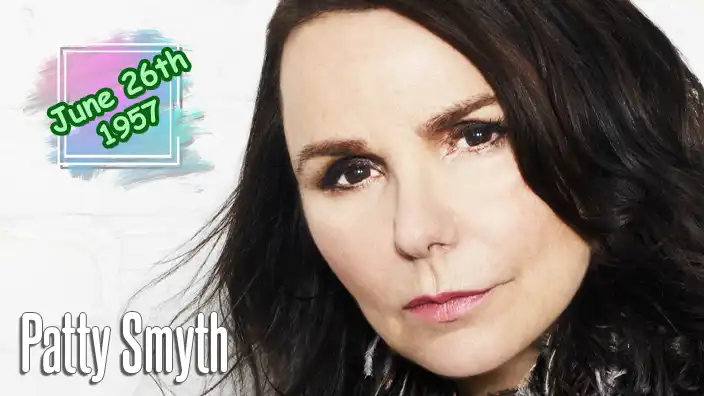
June 26, 1957, in New York City

Patricia Smyth was born on June 26, 1957, in New York City and grew up in the Gerritsen Beach neighborhood of Brooklyn. Music was never far away during her childhood. Her mother had worked as a trapeze artist and later managed legendary guitarist Link Wray while operating several Greenwich Village nightclubs. Growing up in that environment exposed Patty to musicians, performers, and the excitement of live entertainment from an early age.
Before finding fame, Smyth worked a variety of jobs, including waiting tables, while performing in New York clubs whenever she had the opportunity. She developed her vocal style singing at venues such as Folk City and Catch a Rising Star, steadily building a reputation for her powerful voice and commanding stage presence. Those years of hard work prepared her for the opportunity that would change her life.
In 1981, Smyth became the lead singer of the New York rock band Scandal, founded by guitarist Zack Smith. At a time when MTV was transforming the music business, Scandal arrived with an energetic blend of rock, pop, and new wave that fit perfectly into the emerging music-video era. The band's self-titled EP featured songs including "Goodbye to You," "Love's Got a Line on You," and "Hands Tied," earning heavy radio and MTV exposure.
Scandal's biggest breakthrough came in 1984 with the album Warrior. The title track, "The Warrior," became an international hit, reaching the Top 10 on the Billboard Hot 100 and becoming one of the defining rock songs of the decade. Even today, the opening guitar riff and Smyth's unmistakable vocals instantly transport listeners back to the height of the 1980s.
Ironically, just as the band was reaching its greatest commercial success, internal disagreements led to Scandal's breakup. It was a disappointing end to a promising run, but it also opened the door for Smyth to pursue a solo career that would prove equally rewarding.
Following Scandal's breakup, Smyth released her debut solo album, Never Enough, in 1987. The album demonstrated that her success wasn't tied to one band. Songs such as "Never Enough" and her version of "Downtown Train" received strong radio airplay and showcased her versatility as both a singer and songwriter.
One of the most fascinating stories of her career happened during this period. After David Lee Roth left Van Halen, guitarist Eddie Van Halen invited Patty Smyth to become the band's new lead singer. Many musicians would have accepted immediately, but Smyth declined. She was eight months pregnant at the time and later explained that relocating to Los Angeles and joining a band experiencing considerable internal tension simply wasn't the right choice for her. History took another direction when Sammy Hagar ultimately became Van Halen's new frontman.
Her biggest solo success arrived in 1992 with the release of her self-titled album Patty Smyth. The standout single, "Sometimes Love Just Ain't Enough," a duet with Don Henley of the Eagles, climbed to No. 2 on the Billboard Hot 100, reached No. 1 on the Adult Contemporary chart, earned Gold certification, and became one of the year's biggest hits. Its heartfelt lyrics and emotional vocal performances have helped it remain a favorite on adult contemporary radio for decades.
The album also produced additional charting singles, including "No Mistakes" and "I Should Be Laughing," confirming that Smyth could thrive as a solo artist just as successfully as she had with Scandal.
Beyond recording albums, Smyth became a respected songwriter for film. She co-wrote and performed "Look What Love Has Done" for the 1994 Arnold Schwarzenegger comedy Junior. The song earned nominations for both an Academy Award for Best Original Song and a Grammy Award, further demonstrating her songwriting abilities. Later, she wrote "Wish I Were You" for the soundtrack of the blockbuster film Armageddon.
Throughout her career, Smyth has collaborated with an impressive list of artists. She provided backing vocals on albums by Don Henley, appeared with the Hooters, and worked with numerous respected musicians while continuing to refine her own distinctive style. Her voice has always been immediately recognizable—strong, expressive, and capable of shifting effortlessly between rock anthems and emotional ballads.
In 2004, VH1's Bands Reunited brought Patty Smyth and the surviving members of Scandal back together. What began as a television reunion turned into something much more lasting. The renewed enthusiasm from fans encouraged the band to perform again, release new material, and continue touring. It proved that audiences had never forgotten the songs that defined an era.
Smyth has continued recording throughout the years, including the holiday album Come On December in 2015 and It's About Time in 2020, her first collection of new original material in nearly three decades. Rather than chasing current musical fashions, she has remained true to the rock influences that made her successful in the first place.
Away from music, Patty Smyth has enjoyed a long marriage to tennis legend John McEnroe. The couple married in 1997 and have built a family while successfully balancing careers in two very different worlds of entertainment and sports. Their relationship has often attracted attention, yet both have largely maintained a remarkably private family life despite their public profiles.
Looking back, Patty Smyth's career reflects resilience as much as talent. She found success with a groundbreaking rock band, reinvented herself as a solo artist, wrote award-nominated songs for Hollywood, reunited with her original band decades later, and continued performing long after many of her contemporaries had disappeared from the charts. Through every chapter, her unmistakable voice has remained her greatest instrument.
For fans of classic rock, new wave, and powerful female vocalists, Patty Smyth occupies a unique place in music history. Her recordings continue to receive radio airplay, her concerts remain energetic celebrations of timeless songs, and every time "The Warrior" or "Sometimes Love Just Ain't Enough" begins to play, listeners are reminded why her voice became one of the defining sounds of the 1980s and beyond.