Serving Up Community Relations, One Cup at a Time — Donuts Optional
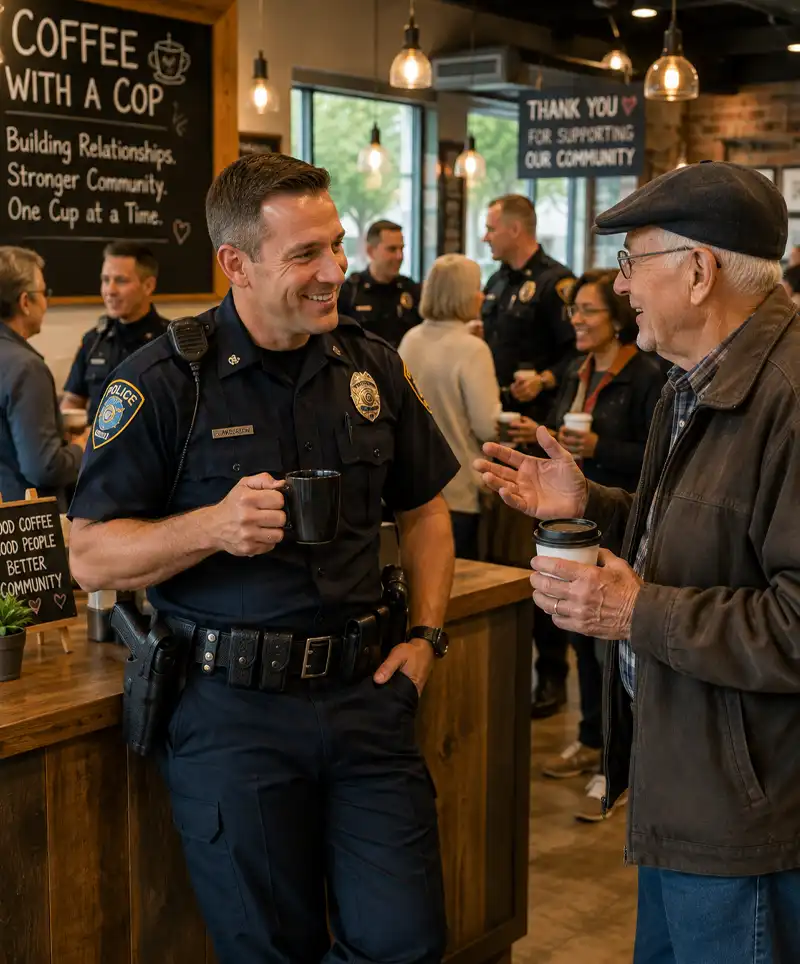
National Coffee with a Cop Day proves that some of the most useful conversations in a community do not require a podium, a public hearing or somebody angrily demanding to speak to the person in charge. Sometimes all that is needed is a police officer, a resident, a table and a decent cup of coffee. Donuts, despite generations of law-enforcement comedy insisting otherwise, remain entirely optional.
When Is National Coffee with a Cop Day?
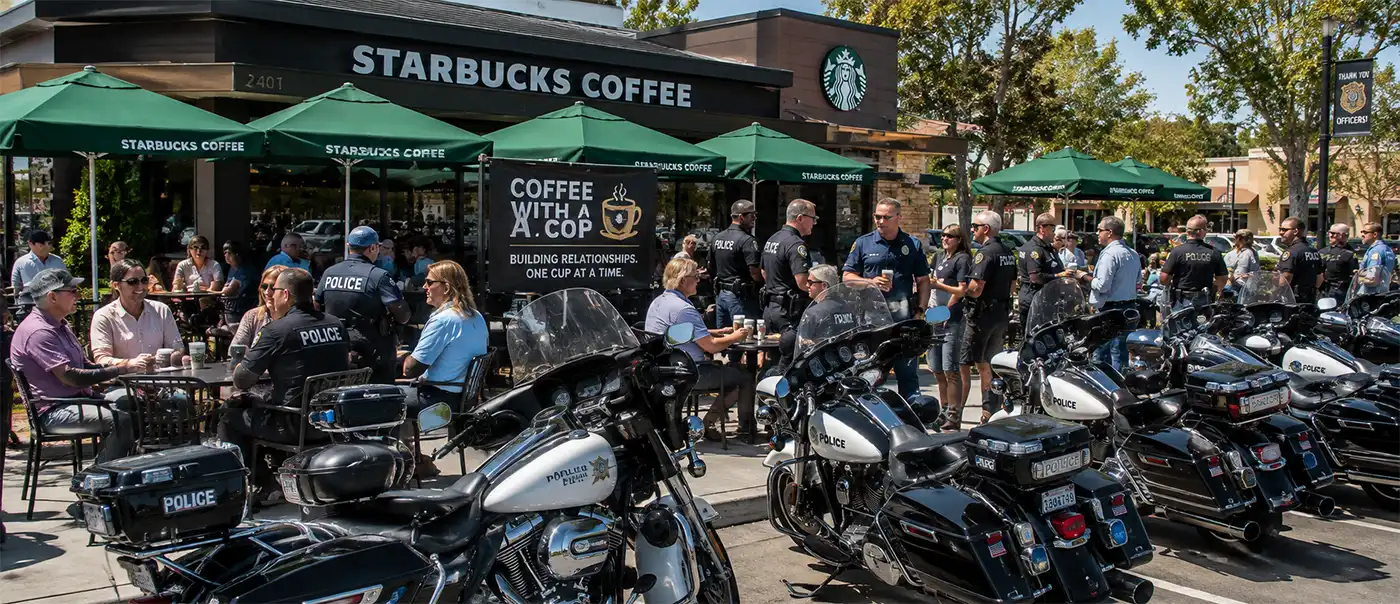
National Coffee with a Cop Day is observed annually on the first Wednesday in October. The nationwide observance encourages police officers and members of the communities they serve to meet informally, usually at a coffee shop, restaurant or other comfortable public location, and simply talk to one another.
There is deliberately very little ceremony involved. You do not need an appointment, a prepared statement or a complaint serious enough to require three copies and somebody's supervisor. Coffee with a Cop events are intended to create relaxed, face-to-face conversations where residents can ask questions, raise concerns, learn about local policing or discover that the officer sitting across the table also has strong opinions about how much cream constitutes too much cream.
The emphasis is on communication rather than enforcement. Most encounters between citizens and police occur because something has already happened: a traffic stop, an accident, a crime, an emergency or some unfortunate incident involving a neighbor, a lawn mower and a property line. Coffee with a Cop deliberately changes the circumstances by allowing people to meet when nobody is in trouble.
How National Coffee with a Cop Day Began
The story of National Coffee with a Cop Day begins not with a national proclamation or a committee locked in a conference room, but with a practical problem at the Hawthorne Police Department in Hawthorne, California. In 2011, the department was placing renewed emphasis on community policing and had created a Community Affairs Unit charged with getting out into neighborhoods, identifying concerns and finding better ways to communicate with the people officers served. The problem was obvious once they thought about it: much of the public's contact with police happens when something has already gone wrong. Officers meet people during traffic stops, accidents, crimes, disputes and emergencies — situations hardly conducive to a leisurely discussion about neighborhood life. The Community Affairs Unit began brainstorming ways to meet residents under completely different circumstances, and the wonderfully uncomplicated answer was coffee.
The officers wanted somewhere informal, comfortable and busy enough to attract a broad cross-section of the community. They chose a local McDonald's in a busy Hawthorne business district, conveniently located near a residential neighborhood. The restaurant's manager, Rafael Lemus, embraced the idea, setting aside tables and offering coffee for the gathering. The police department advertised the event with flyers, social media and even an electronic roadside sign. Then, in March 2011, several officers arrived for the first Coffee with a Cop and waited. At 8:00 a.m., almost nobody appeared. For a few uncomfortable minutes, it must have seemed possible that Hawthorne had invented Coffee with a Cop and forgotten to invite anyone who wasn't a cop.
Then the residents started arriving. People came with questions and concerns about graffiti, parking, fraud, elder abuse, traffic stops and neighborhood signs, while others simply wanted an opportunity to speak with police officers without having to report a crime first. Some were hesitant because they believed their concerns were too minor to bother the police with, only to be reassured that everyday community problems mattered too. Attendance became strong enough that the officers stayed beyond the scheduled finishing time. More importantly, they discovered that the conversations provided information about how residents saw their neighborhoods and how they perceived their police department — information that could be difficult to obtain during the considerably less relaxed circumstances of an emergency call.
The little Hawthorne experiment soon became considerably bigger. In 2013, the Hawthorne Police Department partnered with the University of Illinois' Center for Public Safety and Justice to establish a national training program, supported through the U.S. Department of Justice's Office of Community Oriented Policing Services. Veteran Hawthorne officers conducted regional workshops showing other agencies how to establish their own programs, and by December 2013 Coffee with a Cop events were already being held in more than 36 states. The program crossed the U.S. border in 2014, when Montreal, Canada, hosted the first international Coffee with a Cop event, and in April 2016, an event held by the Honolulu Police Department meant the program had reached all 50 states.
That rapid growth eventually produced the observance we celebrate today. In October 2016, the U.S. Department of Justice's COPS Office supported the establishment of National Coffee with a Cop Day, to be observed annually on the first Wednesday in October. Yet despite becoming a nationwide observance and spreading internationally, the basic idea has remained remarkably close to that first morning in Hawthorne: remove some of the barriers between police officers and the people they serve by allowing them to meet when nobody is being arrested, cited, rescued or asked to explain exactly how fast they thought they were driving. It is community policing stripped down to its simplest ingredients — conversation, listening and a cup of coffee. The donut, history continues to confirm, is entirely optional.
The First National Coffee with a Cop Day
The local initiative officially became a national observance in 2016. The U.S. Department of Justice's Office of Community Oriented Policing Services, better known as the COPS Office, partnered with the Hawthorne Police Department to establish the first National Coffee with a Cop Day on October 7, 2016, as part of National Community Policing Week. More than 500 law-enforcement agencies had agreed to participate by the time the Department of Justice announced the event.
The observance subsequently settled into its annual position on the first Wednesday of October, giving police departments across the country a common day on which to organize local gatherings. The broader Coffee with a Cop program, meanwhile, continued expanding internationally. Its organizers report that the program has now reached 40 countries, with more than 15,000 events worldwide.
What makes that growth particularly interesting is how little the original concept has changed. There has been no need to turn Coffee with a Cop into an enormous conference with lanyards, keynote speakers and a commemorative tote bag. Its strength remains precisely what Hawthorne discovered in 2011: put police officers and residents together somewhere comfortable and give them an opportunity to speak as people.
Why Coffee?
Coffee has been facilitating human civilization for centuries, particularly during those difficult hours before approximately 9:30 in the morning. More seriously, a café or restaurant offers neutral territory. A resident walking into a police station may understandably feel that the surroundings are formal or intimidating. Sitting across from an officer at a coffee-shop table changes the atmosphere immediately.
Coffee with a Cop organizers describe the program as community policing in a particularly straightforward form. Instead of meeting only when a situation is stressful, officers and residents have an opportunity to become acquainted beforehand. They can discuss traffic problems, neighborhood concerns, crime prevention, local policing policies or simply what it is actually like to patrol their community.
The conversation also works in both directions. Police officers spend their working lives seeing communities from a very particular perspective. Residents see those same neighborhoods from another. A shop owner may notice one problem, a parent another, a teenager something entirely different. Informal conversation can provide officers with information and perspectives that may never emerge during a conventional police interaction.
And somewhere during all of this, somebody will inevitably ask whether cops really do eat that many donuts. One assumes officers have developed excellent answers.
Community Policing One Cup at a Time
The phrase community policing can sound like something requiring a 140-page government manual, but the underlying principle is considerably easier to understand. Effective policing depends partly upon relationships between law-enforcement agencies and the people they serve. Communication, familiarity and trust can make those relationships stronger.
Coffee with a Cop addresses one particular difficulty: police and citizens frequently encounter one another under lousy circumstances. If you are talking to an officer because somebody has broken into your house, because you've been involved in a collision or because blue lights have suddenly appeared in your rearview mirror, neither party is beginning the conversation at peak relaxation.
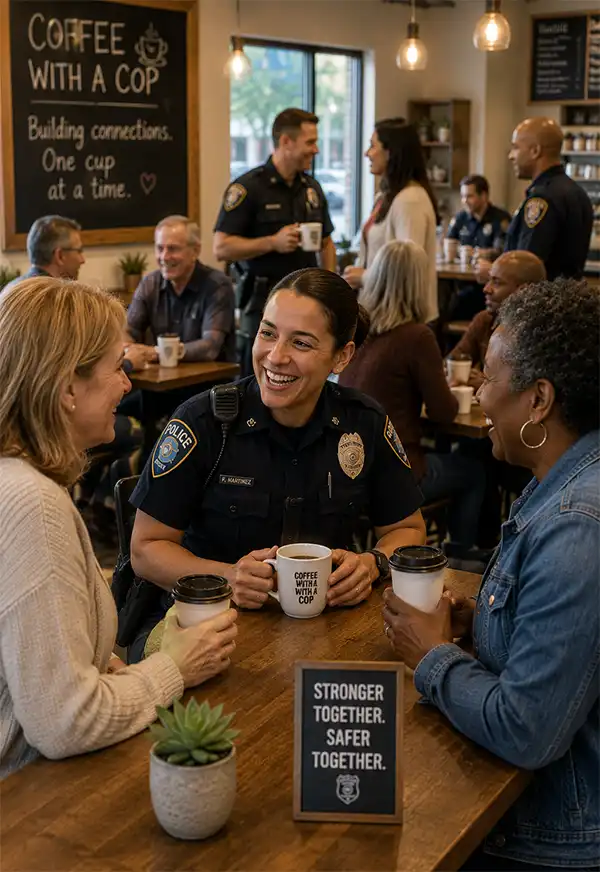
National Coffee with a Cop Day creates an encounter before the emergency. An officer becomes Officer Martinez who takes his coffee black and coaches Little League rather than simply "the cop in the patrol car." Likewise, residents become individual people with families, businesses, concerns and ideas rather than faces seen briefly through the window of a cruiser. It doesn't mean everyone will agree, nor is that the purpose. Productive community relationships do not require universal agreement; they require the ability to communicate.
No Speeches, No Agenda
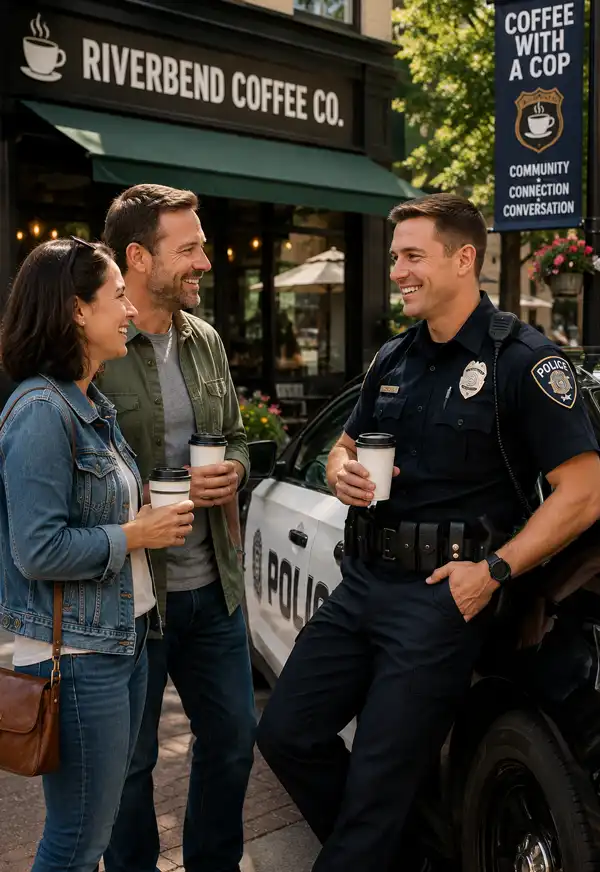
One of the most important ingredients in the original Coffee with a Cop model was the absence of a formal agenda. The Hawthorne program was designed around one-on-one conversations rather than officers delivering presentations to an audience.
That distinction matters. At a traditional town hall, people may have to stand before a room, wait for their turn and squeeze their concern into an allotted amount of time. At Coffee with a Cop, someone can sit beside an officer and ask the question directly. Perhaps it concerns speeding on a particular street. Perhaps the resident wants to know why officers handle certain calls the way they do. Perhaps a child simply wants to know whether the lights and siren are as much fun as they look.
Some conversations will be serious. Others will be ordinary. Both have value because the purpose is not simply to solve individual problems but to make communication between law enforcement and the public normal rather than exceptional.
Coffee with a Cop Around the World
Although National Coffee with a Cop Day began as an American observance, the underlying Coffee with a Cop movement did not remain confined to the United States. Montreal hosted the first international event in 2014, and the program subsequently expanded to communities in Canada, Europe, Australia, Africa and Latin America.
That international growth suggests there is nothing uniquely American about the basic idea. Police agencies everywhere face the challenge of communicating with communities whose populations, expectations and methods of communication continue to change. Social media can distribute information at astonishing speed, but a Facebook post cannot completely replace two people sitting across from one another.
It turns out that one of the world's oldest social technologies — sitting down and having a chat — still has considerable life left in it.
How to Celebrate National Coffee with a Cop Day
If your local police department is holding a Coffee with a Cop event, celebrating is refreshingly straightforward:
- Attend a local event. Check whether your police department, sheriff's office or other local law-enforcement agency is participating.
- Bring a question. Ask about something you've always wondered about policing or an issue affecting your neighborhood.
- Bring the family. These informal events can give children and teenagers an opportunity to meet officers outside an emergency situation.
- Actually have a conversation. Listening is every bit as important as talking.
- Buy a cup of coffee. This isn't technically compulsory, but refusing coffee on National Coffee with a Cop Day does seem unnecessarily rebellious.
- Consider the donut. We promised it was optional. We did not promise we wouldn't mention it again.
If there isn't an organized event nearby, there is nothing preventing community organizations, businesses and law-enforcement agencies from considering one in the future. Coffee with a Cop was designed to be uncomplicated, and the national organization provides information for agencies interested in hosting events.
Why National Coffee with a Cop Day Matters
National Coffee with a Cop Day isn't based on the unrealistic proposition that one cappuccino can solve every disagreement between police departments and their communities. Relationships involving public safety, authority, accountability and trust are considerably more complicated than that. Coffee is powerful stuff, but even espresso has limits.
What the observance does recognize is that communication is easier to build before it is desperately needed. Familiarity can remove some of the uncertainty that exists between police officers and members of the public, while informal conversations give both sides opportunities to ask questions and understand different perspectives.
Perhaps that is why such an uncomplicated idea has traveled so far since those first conversations in Hawthorne in 2011. National Coffee with a Cop Day asks people to do something remarkably ordinary: sit down, have a drink and talk to one another.
Sometimes community building really can begin with "How do you take your coffee?"
 Trivia
Before we finish the last drop of coffee, here are a few quick facts about National Coffee with a Cop Day and the surprisingly far-reaching movement that grew from one simple California gathering. From an almost empty McDonald’s one morning to thousands of events around the world, it turns out that coffee really can bring people together — although adding a donut probably doesn’t hurt.
- First event: Hawthorne, California, in March 2011.
- First National Day: October 7, 2016.
- Annual date: First Wednesday in October.
- International debut: Montreal, Canada, in 2014.
- All 50 states: Achieved by April 2016.
- Worldwide reach: More than 15,000 events reported.
- Donuts required: Absolutely not. We checked.
Coffee With A Cop FAQ
National Coffee with a Cop Day has an admirably simple premise, but there are still plenty of questions hiding at the bottom of the cup. Here are answers to some of the most common questions about the day, the program behind it and whether possession of a glazed donut is actually required.
When is National Coffee with a Cop Day?
National Coffee with a Cop Day is observed annually on the first Wednesday in October. In 2026, it falls on Wednesday, October 7. The national observance has followed the first-Wednesday tradition since it was established in 2016.
Who started Coffee with a Cop?
Coffee with a Cop began with the Hawthorne Police Department in Hawthorne, California, in 2011. Officers were looking for a more informal way to communicate with residents and strengthen relationships outside the stressful situations in which police and members of the public commonly meet.
When was the first Coffee with a Cop event?
The first Coffee with a Cop event was held in March 2011 by the Hawthorne Police Department's Community Affairs Unit. What began as a local community-policing experiment subsequently spread across the United States and internationally.
When did National Coffee with a Cop Day begin?
The first National Coffee with a Cop Day was established in 2016 with support from the U.S. Department of Justice's Office of Community Oriented Policing Services, or COPS Office. More than 500 law-enforcement agencies had agreed to participate in the inaugural national event.
What is the purpose of Coffee with a Cop?
The purpose is to encourage open, informal communication between law-enforcement officers and the communities they serve. Rather than meeting only during emergencies, traffic stops or other stressful circumstances, residents and officers can talk in a relaxed environment without speeches or a formal agenda.
Do I need to have a problem to attend Coffee with a Cop?
No. The entire idea is to make ordinary conversation possible. You can raise a neighborhood concern, ask about local policing, learn more about an officer's work or simply introduce yourself. Nobody needs to manufacture a crime before arriving just to have something to discuss.
Where are Coffee with a Cop events held?
Events are commonly held in coffee shops, restaurants and other accessible community locations rather than formal police settings. Individual police departments and sheriff's offices choose their own venues and schedules, so local arrangements vary considerably.
Is Coffee with a Cop only an American program?
No. Although the program began in California, it has expanded internationally. The first event outside the United States was held in Montreal, Canada, in 2014, and Coffee with a Cop now reports events in 40 countries.
Do I have to drink coffee at Coffee with a Cop?
Certainly not. The coffee provides the setting rather than an entrance examination. Tea, water, soda or simply sitting down for a conversation will accomplish the important part of the exercise. Ordering a triple-shot caramel concoction with enough whipped cream to require structural reinforcement is between you and the barista.
Are donuts required on National Coffee with a Cop Day?
Absolutely not. There is no official donut requirement, donut quota or federally mandated ratio of officers to glazed pastries. However, should a box happen to appear on the table, we see no compelling reason to open an investigation.
One Last Cup Before We Go
National Coffee with a Cop Day succeeds because it asks remarkably little of us. There are no ceremonies to memorize, no gifts to purchase and no requirement to decorate the house with tiny cardboard police cars. It simply encourages police officers and the people they serve to sit down together under circumstances where nobody is in trouble, nobody's emergency lights are flashing and nobody has to begin the conversation with, “Do you know why I stopped you?”
From that first gathering organized by the Hawthorne Police Department in 2011, Coffee with a Cop grew because communities discovered there was genuine value in ordinary conversation. Residents get an opportunity to ask questions, explain neighborhood concerns and learn something about the people behind the badges. Officers, meanwhile, get to hear directly from residents without an emergency, complaint or incident dictating the terms of the meeting. Neither side has to agree about everything. The important part is creating an opportunity to listen, understand and become a little less unfamiliar to one another.
That makes National Coffee with a Cop Day more than an excuse for another cup of coffee — although we should never underestimate the importance of a properly caffeinated population. It is a reminder that stronger communities are often built through surprisingly small encounters. So on the first Wednesday in October, pull up a chair, pour yourself a cup and say hello to one of the officers serving your community. You might learn something, they might learn something, and everybody leaves knowing one more person than they did when they arrived.
And if somebody happens to bring donuts, well... protect and serve them accordingly.