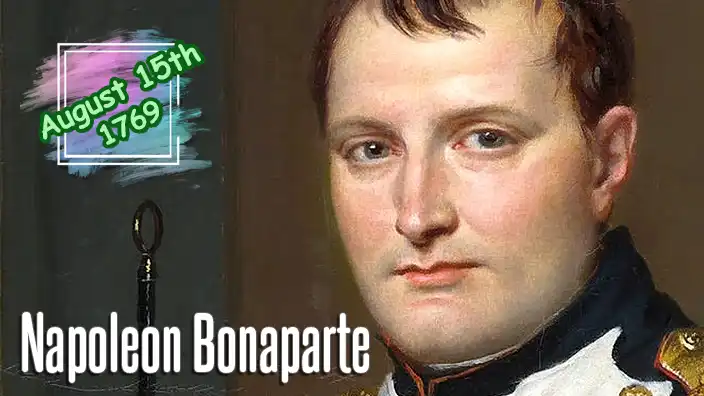
August 15, 1769, in Ajaccio, Corsica
 May 5, 1821 at Longwood, on the Atlantic island of Saint Helena
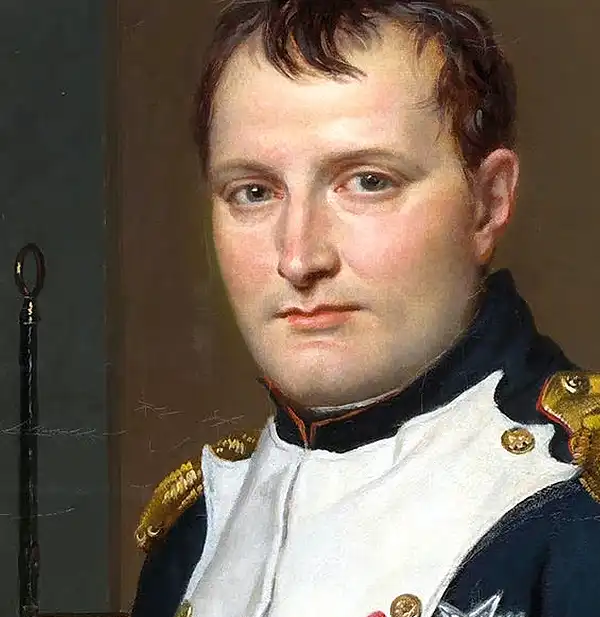
Napoleon was born Napoleone Buonaparte in Ajaccio on the Mediterranean island of Corsica. His birth came shortly after France acquired control of the island from the Republic of Genoa and defeated the Corsican independence movement. His father, Carlo Buonaparte, had supported Corsican nationalist leader Pasquale Paoli before eventually accommodating himself to French rule. Napoleon was the second surviving child of Carlo and Letizia Ramolino Buonaparte, and seven of his siblings also survived childhood.
The Bonapartes belonged to the minor Corsican nobility, which proved extremely important to Napoleon's future. Recognition of the family's noble status helped make him eligible for a royal scholarship and military education in France. He left Corsica as a boy, studied briefly at Autun to improve his French and entered the military school at Brienne in 1779. He later attended the École Militaire in Paris and graduated as an artillery officer in 1785.
Napoleon's Corsican origins remained important during his youth. French was not his first language, and he spoke it with a Corsican accent. His identity initially remained closely connected with the island, and he became involved in Corsican politics during the early years of the French Revolution. A break with Paoli and the political situation on Corsica eventually forced the Bonaparte family to leave the island for mainland France.
Fortunately for Napoleon's career, France was entering precisely the sort of historical upheaval in which an ambitious young artillery officer might find opportunities.
The French Revolution began in 1789 and soon destroyed much of the country's traditional political and social order. France became a republic, King Louis XVI was executed, internal rebellion erupted, and European monarchies went to war against revolutionary France. The turmoil was catastrophic for many people but created unprecedented opportunities for talented military officers who might previously have found advancement restricted by birth and patronage.
Napoleon demonstrated his abilities dramatically during the Siege of Toulon in 1793. Royalist forces had surrendered the important Mediterranean port to a British-led allied fleet. Napoleon developed an artillery strategy that helped French Republican forces recapture the city, and his performance earned him promotion to brigadier general while he was still only 24.
Political circumstances nearly ended his career shortly afterward. Napoleon had connections with Augustin Robespierre, younger brother of revolutionary leader Maximilien Robespierre. Following the fall of the Robespierres in 1794, Napoleon was briefly arrested. He was released, but his position remained uncertain.
His next major opportunity arrived in Paris in October 1795, when royalists launched an uprising against the revolutionary government. Napoleon was given responsibility for helping suppress the revolt and used artillery decisively against the insurgents. The victory made him valuable to the government and accelerated his rise through the military hierarchy.
In March 1796 Napoleon married Joséphine de Beauharnais, a sophisticated widow with two children and valuable connections within French society. Only days later, he departed to take command of the French Army of Italy.
It was in Italy that Napoleon became a legend.
The army he inherited was poorly supplied and demoralized, but Napoleon launched an aggressive campaign against Austrian and allied forces. His ability to move troops rapidly, concentrate forces at decisive points and defeat enemy armies separately produced a remarkable series of victories. Battles including Lodi, Arcole and Rivoli transformed the young general into one of France's greatest military heroes.
Napoleon understood something else remarkably well: publicity. He issued dramatic proclamations to his soldiers and ensured that reports of his victories reached the French public. Long before radio, television or social media, Napoleon understood the importance of managing his image.
His Italian victories made him enormously popular and increasingly independent of the French government. They also established many characteristics that would define his later campaigns: rapid movement, concentration of force, aggressive offensive action and an ability to inspire soldiers personally.
In 1798 Napoleon led an expedition to Egypt. Strategically, the campaign was intended partly to threaten British interests and potentially disrupt Britain's connection with India. French forces defeated the Mamluks at the Battle of the Pyramids, but Admiral Horatio Nelson destroyed the French fleet at the Battle of the Nile, leaving Napoleon's army effectively stranded.
The Egyptian expedition was ultimately a military failure, but it produced an extraordinary scientific legacy. Napoleon brought scholars, engineers and scientists with the expedition, and the resulting research greatly expanded European knowledge of ancient Egypt. The Rosetta Stone was discovered during the campaign, eventually providing the key that allowed scholars to decipher Egyptian hieroglyphics.
Napoleon returned to France in 1799 and found the ruling Directory weak and unpopular. On November 9, 1799—18 Brumaire under the revolutionary calendar—he participated in the coup that overthrew it. A new government known as the Consulate was established, with Napoleon as First Consul.
He was now effectively the ruler of France.
Napoleon's importance extends well beyond battlefields because he proved to be an energetic administrator. His government reorganized French administration, strengthened central authority, established the prefect system, created the Bank of France, reformed education, stabilized state finances and established the Legion of Honour. Many institutions created or reorganized during his rule long outlasted his empire.
His most enduring domestic achievement is associated with the Civil Code of 1804, commonly known as the Napoleonic Code. Napoleon did not personally write the laws; they were drafted by expert jurists. However, he strongly supported the project and participated in discussions surrounding its development. The code created a more unified system of civil law and incorporated principles including equality before the law, property rights and the abolition of remaining feudal privileges. Its influence spread well beyond France.
The code was hardly a modern declaration of universal equality. Women's legal rights remained sharply restricted, and Napoleon's government was authoritarian. Political opposition was controlled, censorship was imposed and the regime relied extensively upon police surveillance. His restoration of slavery in French colonies in 1802 remains one of the darkest decisions of his rule.
Napoleon was a product of the Revolution, but he was not particularly interested in remaining a humble servant of a republic.
In 1804 he became Emperor of the French.
His coronation took place at Notre-Dame Cathedral in Paris on December 2, with Pope Pius VII present. In one of the ceremony's most famous moments, Napoleon took the imperial crown and crowned himself before crowning Joséphine. Whether intended as a carefully planned political symbol or simply Napoleon being extremely Napoleon, the message was difficult to miss: his authority did not depend entirely upon the Church.
The new emperor soon faced another coalition of European enemies. In December 1805 Napoleon won what is widely regarded as his greatest military victory at the Battle of Austerlitz, defeating combined Russian and Austrian forces. The victory dramatically strengthened French dominance in continental Europe.
Further victories followed. Napoleon defeated Prussia in 1806 and Russia in 1807, and the French Empire reached extraordinary power. By the beginning of the following decade, Napoleon controlled France while allies, client states and kingdoms ruled by members of his family extended French influence across much of Europe.
His brothers and relatives acquired an impressive collection of titles. Joseph Bonaparte became king of Naples and later Spain. Louis became king of Holland. Jérôme became king of Westphalia. Napoleon was apparently the sort of family member for whom Christmas presents presented unusual difficulties. Once you have given your brother a kingdom, socks seem rather inadequate.
But ruling Europe proved considerably more difficult than conquering it.
Napoleon attempted to weaken Britain through the Continental System, which sought to exclude British goods from European markets. Enforcing the system created political and economic problems and contributed to French intervention in Portugal and Spain.
The resulting Peninsular War became a prolonged disaster. French troops encountered not only conventional British, Portuguese and Spanish armies but fierce Spanish resistance. Guerrilla warfare steadily drained French manpower and resources, while Arthur Wellesley—the future Duke of Wellington—became an increasingly dangerous opponent.
Napoleon's greatest catastrophe came in 1812 when he invaded Russia with an enormous multinational army commonly called the Grande Armée. He expected to force Tsar Alexander I into a decisive settlement. Instead, Russian forces repeatedly withdrew, denying Napoleon the decisive victory he wanted while destroying supplies and leaving the French increasingly deep inside hostile territory.
Napoleon reached Moscow in September after the bloody Battle of Borodino, but much of the city burned and Alexander refused to negotiate. With winter approaching and supplies inadequate, Napoleon finally ordered a retreat.
It became one of military history's most infamous disasters.
Cold, hunger, disease, exhaustion, desertion and Russian attacks devastated the retreating army. Only a fraction of the enormous force that entered Russia returned in fighting condition. The aura of Napoleonic invincibility had suffered a mortal blow.
France's enemies seized the opportunity. Austria, Prussia, Russia, Britain and other powers joined forces, and Napoleon suffered a major defeat at Leipzig in 1813. Allied armies invaded France the following year, Paris fell and Napoleon abdicated in April 1814.
He was exiled to Elba, a small Mediterranean island off the Italian coast, where he was permitted to retain the title of emperor and govern the island.
That should have been the end.
Napoleon disagreed.
In February 1815 he escaped from Elba and landed in France. King Louis XVIII sent troops to stop him, but Napoleon confronted them and persuaded soldiers to join him. As he advanced toward Paris, more troops rallied to his cause. Louis fled, Napoleon entered the capital and once again became ruler of France.
The extraordinary comeback became known as the Hundred Days.
Europe's other major powers were not interested in seeing how the sequel turned out. They immediately mobilized against him.
Napoleon moved into Belgium hoping to defeat the allied armies before they could fully combine. On June 18, 1815, his forces confronted an Anglo-allied army commanded by the Duke of Wellington at Waterloo. Prussian troops under Field Marshal Gebhard Leberecht von Blücher eventually joined the battle, and Napoleon was decisively defeated.
This time the victorious powers were considerably more careful about choosing his retirement accommodation.
Napoleon abdicated again and surrendered to the British. Rather than another conveniently located Mediterranean island, he was sent to Saint Helena, an isolated British possession in the South Atlantic. There would be no dramatic march back to Paris from there.
Napoleon spent his remaining years at Longwood House, dictating memoirs, discussing his campaigns and helping shape the historical image through which later generations would view him. He died on May 5, 1821, at the age of 51.
His remains were initially buried on Saint Helena. In 1840 they were returned to France and eventually placed in an elaborate tomb beneath the dome of Les Invalides in Paris.
Napoleon's legacy remains fiercely debated because there is no simple way to separate his achievements from their enormous human cost. He spread administrative and legal reforms across Europe, helped destroy remnants of feudal political structures and permanently influenced military organization and strategy. His Civil Code became particularly influential, while institutions established during his government remain part of France today.
At the same time, his ambitions produced years of warfare across Europe. Hundreds of thousands of soldiers and civilians died during the conflicts associated with his rule. He conquered and occupied other nations, imposed members of his family upon foreign thrones, restricted political freedoms and built an empire maintained by military power.
Even his reputation as an almost unbeatable commander requires qualification. Napoleon won spectacular victories and demonstrated extraordinary operational ability, but he also made disastrous strategic decisions. Spain became a prolonged drain on French power, the invasion of Russia was catastrophic, and his return in 1815 ended at Waterloo.
One popular story about Napoleon deserves particular attention because it refuses to die: he was not exceptionally short. Measurements are complicated by differences between French and British units of the period, but modern estimates generally place him around 5 feet 6 or 7 inches—quite ordinary for a French man of his era. British caricaturists enthusiastically portrayed him as tiny, and history apparently decided that the joke was too good to fact-check.
More than two centuries after his death, Napoleon remains one of the most studied individuals in history. Military officers continue examining his campaigns. Legal historians study his reforms. Political historians debate whether he preserved important achievements of the French Revolution or betrayed them by creating an authoritarian empire. Biographers continue producing books about him despite the considerable danger that the world's bookshelves may eventually require structural reinforcement.
Few individuals have influenced so many areas of European history within such a short lifetime.
Napoleon Bonaparte began as a Corsican boy from minor nobility, became an artillery officer, rose through a revolution, took control of France, crowned himself emperor and dominated much of continental Europe. He was defeated, exiled, returned, ruled again, was defeated again and finally transported halfway across the Atlantic to make absolutely certain everyone could get some rest.
And yes, after more than two centuries of research, historians are still arguing about him.
Napoleon would probably have been delighted.