March is that unpredictable friend who shows up in a parka and leaves in flip-flops. One minute you're shoveling snow, the next you’re sneezing at daffodils. It’s Women’s History Month, National Nutrition Month, and, of course, the time when green beer flows like water and people pretend to be 1/16th Irish just to avoid getting pinched. March is a chaotic cocktail of celebration and seasonal whiplash—and we love it anyway. Whether you're chasing rainbows, dodging mud puddles, or just hanging on for spring break, there’s a whole month’s worth of reasons to celebrate.
For many of us, caffeine isn’t just a beverage ingredient—it’s the invisible force standing between us and becoming a blanket-wrapped burrito by 9 a.m. National Caffeine Awareness Month celebrates the world’s favorite pick-me-up while gently reminding us that there is, in fact, a limit between “pleasantly productive” and “speaking fluent squirrel.” Whether your loyalty lies with coffee, tea, soda, or suspiciously neon energy drinks, this month is all about understanding the magical molecule that keeps society functioning one jittery sip at a time.
Celebrated: Annually, throughout March
Learn about National Caffeine Awareness Month, caffeine history, health effects, and fun ways to enjoy your daily boost responsibly

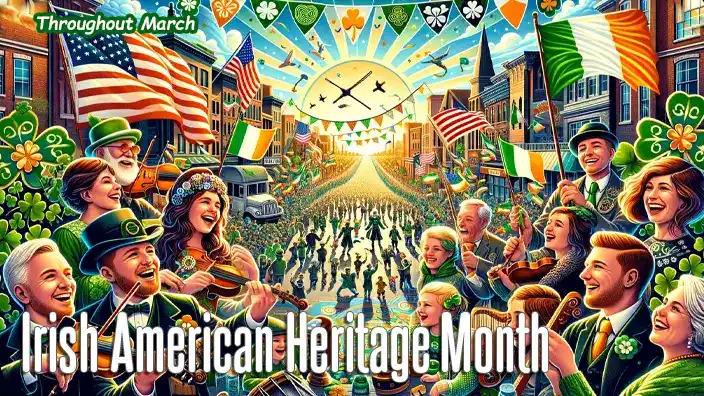
Irish American Heritage Month is that magical time of year when everyone discovers their "long-lost" Irish roots, no matter how tenuous the connection. It's a period filled with green-dyed rivers, vigorous attempts at riverdancing after one too many green beers, and a sudden nationwide shortage of corned beef and cabbage. Yet, amidst the jovial shamrock shakes and leprechaun hats, it’s a heartfelt nod to the profound impact Irish Americans have had on the fabric of American society. From contributing to the arts and public service to teaching the importance of resilience and the art of a perfectly poured pint of Guinness, Irish American Heritage Month is a blend of meaningful celebration and good-natured fun, proving that everyone can be a little Irish in March.
Celebrated: Annually, throughout March
Irish American Heritage Month celebrates the significant contributions of Irish Americans, highlighting their resilience, culture, and lasting impact on the United States.

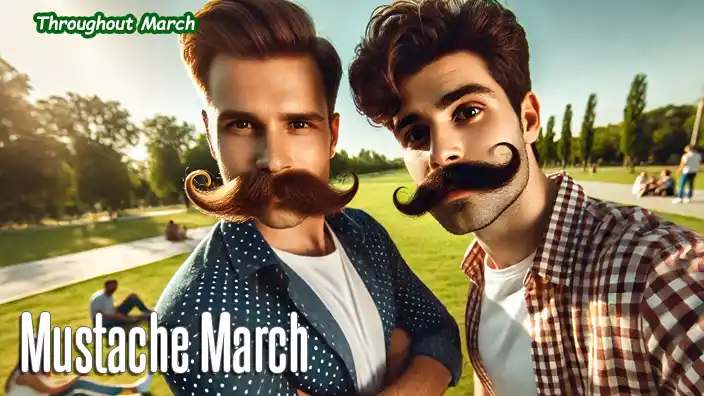
Mustache March is the unofficial holiday where facial hair is not just grown but gloriously celebrated, turning the humble upper lip into a canvas of creativity. It's the time of year when men across the globe put their razors on hiatus, letting their mustaches bloom in full splendor. From the wispy whispers of a beginner's 'stache to the full-on, wind-resistant bristles of the seasoned pro, every mustache gets its moment in the sun. This month, conversations start with a nod to the 'nose neighbor' before moving on to mundane matters, proving that while styles may vary, the love for a good mustache unites us all in a bond of fuzzy fellowship.
Celebrated: Annually, throughout March
Discover the origins and impact of Mustache March, a spirited tradition inspired by a wartime hero's defiance that evolved into a global celebration of facial follicles, humor, and camaraderie.
Every musical superstar has to start somewhere, and for many of us, that somewhere involved a plastic recorder, a sheet of beginner music, and absolute confidence paired with questionable accuracy. National Play the Recorder Month celebrates the humble instrument that introduced generations to music theory, teamwork, and the delicate difference between “playing softly” and “summoning dolphins.” It may be small, but its impact — and its volume — have echoed through school hallways for decades.
Celebrated: Annually, throughout March
Celebrate National Play the Recorder Month with history, humor, and fun facts about the beginner instrument that introduced generations to music.
Dolphins always seem like they know something we don’t. Maybe it’s their constant smiles, impressive acrobatics, or suspiciously advanced communication skills. Dolphin Awareness Month is the perfect time to appreciate these oceanic overachievers who somehow manage to be adorable, intelligent, and better swimmers than we’ll ever be—all while making the rest of us look like confused land mammals.
Celebrated: Annually, throughout March
Dolphin Awareness Month celebrates dolphins with facts, conservation efforts, and ways to protect these intelligent marine mammals
This is a time to honor and celebrate the relentless spirit of humanitarianism that the Red Cross embodies. This month serves as a powerful reminder of the strength of compassion as volunteers and donors come together to provide relief in times of crisis, support our military families, and be a beacon of hope to those facing disasters. It's a call to action for all of us to embody the Red Cross mission, offering a chance to make a profound impact in the lives of others. Whether through donating blood, time, or resources, Red Cross Month inspires us to contribute to a legacy of care that transcends borders, proving that humanity's capacity for kindness knows no bounds.
Celebrated: Annually, throughout March
Celebrate Red Cross Month by honoring the humanitarian efforts of the American Red Cross, dedicated to disaster relief and lifesaving blood donations.
National Women's History Month is like the Oscars for the unsung heroines of history, except instead of a red carpet, there's a timeline stretching back centuries, and instead of an Oscar, the recognition is long overdue respect (and, let's be honest, probably some back pay). It's the time of year when we swap out tales of men discovering things that were never really lost and instead spotlight the women who’ve been quietly changing the world while somehow also remembering where they left their keys. So, this March, let's raise our coffee mugs (because who has time for tea?) to the ladies who've been doing it all, from writing the code that got us to the moon to inventing life-saving medical tech. Here's to remembering women's contributions to history, one Wikipedia deep dive at a time!
Celebrated: Annually, throughout March
Discover the wittiest month of the year - National Women’s History Month in March. Learn about the extraordinary achievements of women throughout history with humor and respect.
There’s gambling for fun, and then there’s the moment you realize your “system” consists mostly of hope, poor math, and the phrase “just one more try.” Problem Gambling Awareness Month is here to remind us that while a little wager can add excitement, repeatedly donating your paycheck to slot machines, poker tables, or online sportsbooks may not qualify as a solid retirement strategy. After all, the house usually wins—but that doesn’t mean it has to win your grocery budget too.
Celebrated: Annually, throughout March
Problem Gambling Awareness Month reminds us that “doubling down” is rarely a sound financial plan. Learn the signs, risks, and smarter ways to play


This is the time of year when we celebrate those bean-shaped heroes living quietly in our lower backs. Think of it as an appreciation party for the unsung workhorses of the human body: the kidneys! These little organs clock in day and night, filtering 200 liters of blood daily without so much as a coffee break. They're the ultimate multitaskers: part detox unit, part water regulation system, and occasionally, the reason you're sprinting to the bathroom during the worst possible moments. So, this month, let’s raise a glass of water (what else?) to our kidneys — just not too many glasses right before bed, unless you fancy a midnight dash.
Celebrated: Annually, throughout March
Discover the humorous side of National Kidney Month as we celebrate the unsung heroes of our bodies - our kidneys. Learn why these bean-shaped organs deserve recognition and care.
Imagine if your socks had a board meeting every morning to decide which pair gets the honor of being worn that day, complete with charts showing wear and tear, and performance metrics on warmth and comfort. That's asset management in a nutshell - a meticulous, sometimes overzealous steward of resources, whether they're billion-dollar portfolios or just ensuring your left sock matches your right. It's the art of making sure everything is exactly where it needs to be, even if it's just preventing your favorite mug from holding more pens than coffee. In a world where even your pet's Instagram account is considered an asset, remember, it's all about keeping your ducks in a row, or at the very least, making sure they're all facing the same direction.
Celebrated: Annually, throughout March
Discover the exciting world of Asset Management Awareness Month and how managing assets can be as exhilarating as finding a lost sock in the laundry.

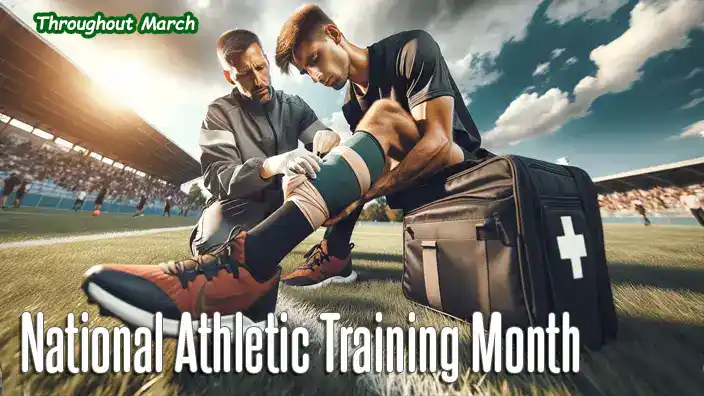
Imagine an athletic trainer, armed with nothing but a roll of tape, a bag of ice, and a sense of humor sharp enough to cut through the tension of the most nail-biting overtime. These unsung heroes of the sports world are like the MacGyvers of muscle sprains, turning catastrophic cramps into mere footnotes of the game. They sprint onto the field with the urgency of a superhero, only their capes are replaced by fanny packs filled with magical healing potions (or, you know, antiseptic). In a world where "walk it off" meets "let's actually treat that," athletic trainers stand at the ready, proving that laughter might not be the best medicine, but it sure helps when you're being taped up like a mummy for the third time this week.
Celebrated: Annually, throughout March
Explore the evolution of athletic training from Ancient Greece to modern-day celebrations, honoring the heroes of sports and healthcare.
Sitting down at the dinner table, there's always that moment when you spot the mashed potatoes,...
Once upon a time, someone looked at tennis and thought, “This would be perfect if it involved less running,...
If you’re the kind of person who likes a little thrill with your meal, then one bite of that...
If you've ever scratched a dog's ears, rescued a turtle from the middle of the road, or apologized...
Who knew that creating a prehistoric masterpiece could lead to such existential questions? Like, did...
It's not uncommon to see a normally quiet neighborhood transform overnight into a glittering...
On September 14, 1814, lawyer Francis Scott Key was inspired to write the poem that eventually became the lyrics of the United States national anthem, “The Star-Spangled Banner.” During the War of 1812, British forces had captured Washington, D.C., and burned several major public buildings before turning their attention toward Baltimore. Key became involved after his friend, physician William Beanes, was taken prisoner by the British. He helped negotiate Beanes' release, but because the Americans had learned details of the planned attack, they were required to remain with the British fleet until the assault on Baltimore was completed.
From aboard a vessel in the Patapsco River, Key watched as British ships bombarded Fort McHenry through the night of September 13 and into the morning of September 14. When daylight came, the enormous American flag flying above the fort was still visible, showing that the defenders had held their position and the British attack had failed. Moved by the sight, Key began writing verses that became a four-stanza poem titled “Defence of Fort M'Henry.” It was soon published and sung to the melody of “To Anacreon in Heaven,” a British song composed by John Stafford Smith. Over time, Key's poem became better known by the title of its opening imagery, “The Star-Spangled Banner.”
Key, born August 1, 1779, in Maryland, was a prominent lawyer who later served as U.S. attorney for the District of Columbia. His song became increasingly associated with patriotic and official occasions, and President Woodrow Wilson directed that it be played at appropriate military and naval ceremonies in 1916. Congress formally designated “The Star-Spangled Banner” as the national anthem, with President Herbert Hoover signing the measure into law on March 3, 1931. Key did not live to see what became of his composition; he died on January 11, 1843, decades before his hastily written verses became the official musical symbol of the United States.
On September 14, 1964, Kellogg's introduced the toaster pastry that would become Pop-Tarts, although the company was not the first to announce the idea. Rival Post had already publicized plans for a shelf-stable, fruit-filled pastry called Country Squares but revealed the concept before the product was ready for widespread sale. Kellogg's recognized the opportunity and moved quickly, turning to William “Bill” Post, then working at the Hekman Biscuit Company in Michigan, to help develop a pastry that could survive both the supermarket shelf and a trip through the family toaster. Post and his team experimented with dough, fillings and production methods, with his children reportedly serving as enthusiastic taste testers along the way.
Kellogg's initially considered calling its creation Fruit Scones before settling on the far more memorable Pop-Tarts, a name that played nicely with the popularity of Pop Art during the 1960s. The original unfrosted pastries appeared in four flavors—strawberry, blueberry, brown sugar cinnamon and apple currant—and the early test market was enormously successful. Demand quickly outran supply, forcing Kellogg's to publish advertisements apologizing to customers because it had run out. Frosting arrived a few years later after the company developed a version capable of surviving toaster temperatures without melting into a sugary disaster, followed by sprinkles, additional flavors and Milton the Toaster, an animated mascot who helped promote the increasingly popular breakfast treat.
What began as a hurried response to a competitor became one of Kellogg's most recognizable products. William Post is frequently described as the inventor of Pop-Tarts, although he always emphasized that their creation was a team effort, and Kellogg's has also credited company executive William “Doc” Thompson and the people involved in developing the product. Over the following decades, Pop-Tarts expanded far beyond those original four flavors and became as much a snack as a breakfast food. Billions are now sold annually—a remarkable outcome for something that began with a few people looking at two pieces of dough with filling between them and essentially asking, “Do you reckon we can put this in a toaster?”
On September 14, 1974, Eric Clapton reached No. 1 on the Billboard Hot 100 with “I Shot the Sheriff,” a song written and recorded the previous year by Bob Marley and the Wailers for their album Burnin'. It became the only No. 1 single of Clapton's career in the United States, but the man singing it had been surprisingly uncomfortable about releasing it. Clapton admired Marley's original and understood reggae well enough to worry that his own recording didn't capture what made the music special. He later recalled thinking that his version shouldn't even be included on his album 461 Ocean Boulevard, much less released as a single, because he felt it wasn't fair to Marley and that his interpretation had given the song too much of a white rock feel. His American bandmates were considerably more enthusiastic, and eventually Clapton allowed himself to be persuaded.
His concern became even more understandable when the record took off. Marley's version had already been released, but Clapton's recording suddenly carried the song onto mainstream American radio and all the way to the top of the chart. Clapton subsequently spoke with Marley and was relieved to discover that the songwriter appeared pleased with what he had done. Marley later recalled that Clapton had asked him about the meaning of the song, while Clapton remembered struggling to understand parts of Marley's explanation. Whatever uncertainty remained about the interpretation, there seemed to be no lasting uncertainty about Marley's acceptance of the cover.
The irony was that the recording Clapton worried might unfairly overshadow Bob Marley ultimately helped bring enormous attention to him. Island Records founder Chris Blackwell later described Clapton's cover as a major breakthrough for Marley, because one of rock's biggest stars had effectively pointed his enormous audience toward the Jamaican songwriter whose work he admired. The official Bob Marley history similarly credits Clapton's recording with significantly increasing Marley's international profile. So while September 14, 1974, marks Eric Clapton reaching No. 1, the longer story belongs to both musicians: Clapton received the biggest American single of his career from a Bob Marley song, while millions of listeners who heard Clapton's version were given a reason to discover the man who had written it in the first place.
On September 14, 1982, Princess Grace of Monaco died at the age of 52, one day after suffering serious injuries when the car she was driving left a steep mountain road above Monaco. Her youngest daughter, Princess Stéphanie, was traveling with her and survived. Before becoming European royalty, Princess Grace had been Grace Kelly of Philadelphia, one of Hollywood's most celebrated stars of the 1950s. In a remarkably brief film career, she became known for an elegant screen presence that made her particularly memorable in Alfred Hitchcock's Dial M for Murder, Rear Window and To Catch a Thief. She also starred opposite Gary Cooper in High Noon and won the Academy Award for Best Actress for her performance alongside Bing Crosby in The Country Girl.
Born in Philadelphia on November 12, 1929, Kelly studied acting at the American Academy of Dramatic Arts in New York and supported herself through modeling and television work while pursuing stage roles. After appearing on Broadway and making her way into motion pictures, her rise was extraordinarily rapid. By the middle of the 1950s she was one of Hollywood's leading actresses, working with stars including James Stewart, Cary Grant, Clark Gable, Ava Gardner and Frank Sinatra. Yet at the height of that success, Kelly walked away from Hollywood. After meeting Prince Rainier III of Monaco in 1955, she married him in an elaborate ceremony the following April and became Princess Grace. Her final feature film, the musical High Society, was released in 1956, bringing an acting career of only a few years to a close.
Princess Grace and Prince Rainier had three children—Caroline, Albert and Stéphanie—and she spent the remainder of her life carrying out royal and charitable duties in Monaco. On September 13, 1982, while driving home with Stéphanie, Grace lost control of her Rover on the winding road near Monaco and the vehicle plunged down a steep slope. Early reports attributed the crash to a stroke suffered while she was driving, although the precise circumstances surrounding the accident have remained the subject of discussion. Stéphanie escaped with injuries, but Grace suffered devastating trauma and died the following day. Her death prompted mourning far beyond the tiny principality she had made her home, closing an extraordinary life that had taken her from Philadelphia to Broadway, from Hollywood stardom and an Academy Award to becoming one of the world's most recognizable princesses.
On September 14, 1994, Major League Baseball officially canceled the remainder of its season, including the postseason and World Series, after a players' strike that had begun on August 12 showed no sign of ending. It was an extraordinary moment for America's pastime: for the first time since 1904, there would be no World Series, and for the first time since the championship series began in 1903, its cancellation resulted from a labor dispute. At the center of the conflict were long-running disagreements between team owners and the Major League Baseball Players Association over salaries, revenue sharing, free agency and the owners' desire for a salary cap. Acting commissioner Bud Selig finally called off the remainder of the season with hundreds of regular-season games already lost.
The cancellation was particularly painful because the 1994 season had been producing some remarkable baseball. The Montreal Expos owned the best record in the majors at 74–40 and appeared capable of making the deepest postseason run in franchise history, while the New York Yankees led the American League East at 70–43. Individual achievements disappeared with the schedule as well. San Francisco's Matt Williams had already hit 43 home runs and Seattle's Ken Griffey Jr. had 40, giving both a chance to challenge Roger Maris' then-record of 61 in a season. Perhaps the most tantalizing unfinished story belonged to San Diego Padres great Tony Gwynn, who was batting .394 when play stopped and pursuing something no major leaguer had accomplished since Ted Williams hit .406 in 1941.
The dispute continued through the winter and into the following spring, with replacement players even appearing during 1995 spring training before a federal court injunction helped bring the strike to an end on April 2. Regular major-league players returned and the 1995 season eventually began, but the damage was considerable. Attendance suffered, fans expressed anger at both players and owners, and many people within baseball later described the canceled World Series as a lasting scar on the sport. There was no champion, no postseason heroics and no opportunity to discover whether Montreal could complete its remarkable season, whether Gwynn could reach .400, or whether Williams or Griffey could catch Maris. The 1994 season simply stopped—and baseball was left forever wondering how one of its most promising years might have ended.