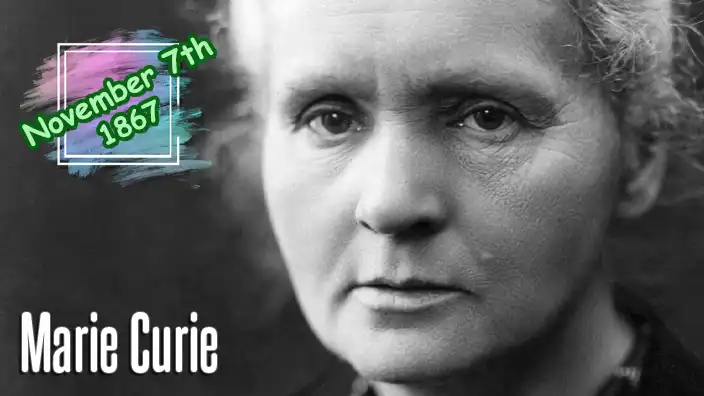
November 7, 1867, in Warsaw, Poland
 July 4, 1934, in Haute-Savoie, France

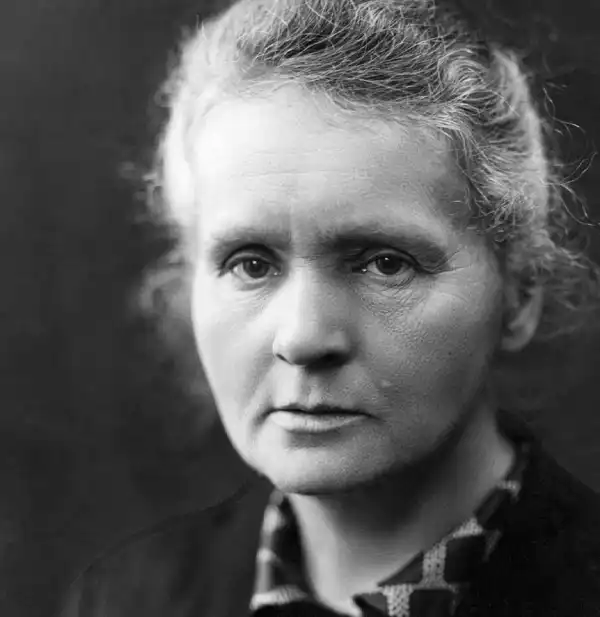
Born Maria Salomea Skłodowska on November 7, 1867, in Warsaw, Poland, then part of the Russian Empire, Marie Curie became one of the most influential scientists in history. Her groundbreaking research into radioactivity transformed modern physics and chemistry, opened new possibilities for medical treatment, and established her as a pioneer for women in science. Curie became the first woman to receive a Nobel Prize, the first person to win two Nobel Prizes, and the only individual to receive Nobel Prizes in two different natural sciences. Her achievements were extraordinary by any standard, particularly considering the educational and professional barriers women faced during her lifetime.
Marie Curie grew up in an intellectually ambitious Polish family that valued education, science, and national identity. Her father, Władysław Skłodowski, taught mathematics and physics, while her mother, Bronisława, was the headmistress of a girls' school. Both parents encouraged learning, although the family experienced financial difficulties and personal tragedies during Marie's childhood. Her older sister Zofia died of typhus, and her mother died of tuberculosis when Marie was still young. Despite these hardships, she excelled academically and developed an enduring fascination with scientific discovery. Unfortunately, being an exceptionally gifted young woman in nineteenth-century Poland did not automatically provide access to a university education.
At the time, women were excluded from regular university studies in Warsaw, so Curie participated in the clandestine Flying University, an underground educational movement that offered advanced instruction to Polish students, including women. Determined to continue her education, she worked as a governess to help finance the studies of her older sister Bronisława in Paris. The sisters had agreed to support one another's ambitions, and Marie eventually followed her sister to France in 1891. Arriving in Paris, she adopted the French form of her name, Marie, and enrolled at the Sorbonne, where she studied physics and mathematics under demanding financial circumstances.
Life as a student in Paris was far from comfortable. Curie lived frugally in modest accommodation, often struggling to afford sufficient food and heating while dedicating herself to her studies. She earned a degree in physics in 1893 and another in mathematics in 1894, demonstrating remarkable determination and intellectual ability. Her academic achievements brought her into contact with the French physicist Pierre Curie, whose research interests closely matched her own. The two developed a relationship founded on mutual admiration, scientific curiosity, and an unusually strong partnership for their era. They married in July 1895, beginning one of the most productive collaborations in scientific history.
The scientific breakthrough that would define Marie Curie's career began with the mysterious rays discovered by French physicist Henri Becquerel in 1896. Becquerel had observed that uranium compounds emitted penetrating radiation without requiring an external energy source. Fascinated by this phenomenon, Curie selected it as the subject of her doctoral research and began conducting systematic experiments to understand its properties. Using a sensitive electrometer developed by Pierre Curie and his brother Jacques, she measured the electrical effects produced by radioactive materials and discovered that the intensity of radiation depended on the amount of uranium present rather than its chemical arrangement.
This observation led Curie toward a revolutionary conclusion: radioactivity was an intrinsic property of certain atoms, not simply the result of chemical reactions between substances. At a time when scientists were still developing their understanding of atomic structure, the idea challenged established assumptions about the nature of matter. Curie introduced the term radioactivity to describe the phenomenon and expanded her investigations to other minerals. She found that thorium also emitted radiation and that certain uranium-rich minerals were significantly more radioactive than their known uranium content could explain. Something previously unknown was hiding within those minerals, and Curie was determined to find it.
Working together, Marie and Pierre Curie investigated pitchblende, a uranium-bearing mineral that contained extraordinarily active substances. In July 1898, they announced the discovery of a new chemical element, which Marie named polonium in honor of her native Poland. The name carried personal and political significance because Poland did not exist as an independent country at the time. Later that year, the couple announced evidence of another new element, radium, whose name reflected the remarkable radiation it emitted. These discoveries transformed scientific understanding and opened an entirely new field of investigation into the structure and behavior of matter.
Extracting radioactive substances from pitchblende was an exhausting and painstaking process. The Curies worked in a poorly equipped shed that offered little protection from extreme temperatures or chemical hazards. Marie processed large quantities of mineral residue, repeatedly dissolving, filtering, crystallizing, and separating materials in her efforts to isolate radioactive compounds. The work required extraordinary patience, physical endurance, and precision. In 1902, she succeeded in isolating a small quantity of radium chloride, providing strong evidence for the existence of the new element. The achievement was remarkable considering the primitive laboratory conditions and the enormous quantities of material required to produce such a tiny sample.
In 1903, Marie Curie completed her doctoral thesis and became the first woman in France to receive a doctorate in physics. That same year, she shared the Nobel Prize in Physics with Pierre Curie and Henri Becquerel for their investigations into radiation phenomena. The award made her the first woman ever to receive a Nobel Prize, an extraordinary accomplishment in a scientific establishment dominated by men. Her inclusion was not initially assured; Pierre insisted that Marie's contributions receive proper recognition when her name was omitted from an early nomination. Their shared award acknowledged the importance of research that would ultimately reshape both theoretical science and practical medicine.
The Curies' scientific partnership was accompanied by a busy family life. Their first daughter, Irène, was born in 1897, followed by their second daughter, Ève, in 1904. Balancing motherhood, laboratory research, and academic responsibilities was difficult, but Marie remained deeply committed to both her family and scientific work. Irène would eventually follow her parents into nuclear science, while Ève pursued a career in writing and public service. The family would become closely associated with scientific achievement, although the household's relationship with radioactive materials was far more hazardous than anyone fully appreciated at the time.
Tragedy struck in April 1906 when Pierre Curie was killed in a street accident in Paris after being struck by a horse-drawn vehicle. His sudden death devastated Marie, leaving her to raise their daughters while continuing the research they had pursued together. Rather than abandoning her scientific career, she accepted the teaching position Pierre had held at the Sorbonne, becoming the first woman to serve as a professor at the prestigious university. Her appointment represented another historic milestone, demonstrating that her professional standing rested on her own scientific accomplishments rather than simply her association with her husband.
Curie's determination produced further discoveries and recognition. In 1910, working with André-Louis Debierne, she succeeded in obtaining metallic radium, strengthening the scientific understanding of the element's properties. The following year, she received the 1911 Nobel Prize in Chemistry for the discovery of radium and polonium, the isolation of radium, and her investigations into its compounds. This second Nobel Prize established her as the first person to win the award twice and remains especially notable because her prizes recognized achievements in two distinct scientific disciplines. Few scientists have influenced both physics and chemistry so profoundly.
Despite her international recognition, Curie continued to encounter prejudice and personal controversy. Her relationship with physicist Paul Langevin became the subject of a sensational press scandal in 1911, provoking hostility that was intensified by sexism and xenophobia. Some critics even questioned whether she should accept her second Nobel Prize amid the controversy. Curie refused to allow public gossip to diminish the importance of her scientific work, and she traveled to Stockholm to receive the award. Her response reflected a lifelong conviction that scientific achievements should be judged on their merits rather than on the personal circumstances of the people responsible for them.
When World War I began in 1914, Curie redirected much of her attention toward helping wounded soldiers. Recognizing the value of X-ray imaging for locating bullets, shrapnel, and fractures, she organized mobile radiography units that could operate near military hospitals and battlefield medical facilities. These vehicles became popularly known as petites Curies, or little Curies, and provided doctors with diagnostic capabilities that were otherwise difficult to obtain near the front lines. Curie helped secure equipment, train personnel, and develop practical systems for using radiography under wartime conditions.
Her wartime efforts were not limited to laboratory planning. Curie learned to drive and assisted with the operation of mobile X-ray units, while her daughter Irène also contributed to radiological services. The program expanded to include numerous mobile and fixed radiography installations, helping medical teams examine wounded soldiers more accurately and avoid unnecessary exploratory surgery. Curie's practical involvement demonstrated that her commitment to science extended beyond academic discovery. She understood that scientific knowledge could save lives when translated into useful technology, particularly during a conflict that produced devastating numbers of casualties.
Following the war, Curie continued her research and worked to strengthen the scientific institutions needed for future discoveries. She directed the Radium Institute in Paris, which became an important center for research into radioactivity, nuclear physics, and medical applications. She also supported the development of a radium research institute in Warsaw, maintaining her connection with Poland despite spending much of her professional life in France. Her international reputation helped attract financial support for scientific work, including a 1921 visit to the United States, where she received a gram of radium purchased through donations organized by American women.
The medical applications of radioactive substances became an increasingly important part of Curie's legacy. Radium was used in early forms of cancer treatment, and research into radiation eventually contributed to the development of modern radiotherapy. Although the methods and safety standards of Curie's era differed considerably from those used today, her discoveries laid essential groundwork for technologies that continue to benefit patients. Radioactive isotopes have since become valuable tools in medical imaging, cancer treatment, industrial measurement, and scientific investigation, illustrating the extraordinary reach of the research that began in a modest laboratory.
Unfortunately, the dangers of prolonged radiation exposure were poorly understood during much of Curie's career. She routinely handled radioactive materials without the protective equipment that modern scientists consider essential, and she was fascinated by the faint glow produced by certain radium preparations. Years of exposure contributed to serious damage to her health. Marie Curie died on July 4, 1934, at the Sancellemoz sanatorium in Passy, France, from aplastic anemia, a condition generally attributed to prolonged exposure to ionizing radiation. Her death highlighted the risks associated with radioactive substances, even as her discoveries continued to provide important benefits to science and medicine.
Curie's scientific influence extended into the next generation through her daughter Irène Joliot-Curie and son-in-law Frédéric Joliot-Curie, who jointly received the 1935 Nobel Prize in Chemistry for their discovery of artificial radioactivity. The family thus became associated with five Nobel Prize awards shared among Marie, Pierre, Irène, and Frédéric. Meanwhile, Ève Curie preserved her mother's story through her influential biography Madame Curie, published in 1937. The family's achievements illustrate how one generation of scientific curiosity can inspire discoveries that reach far beyond the original laboratory.
In 1995, Marie and Pierre Curie's remains were transferred to the Panthéon in Paris, where France honors individuals who have made exceptional contributions to the nation. Marie became the first woman to be interred there on the basis of her own achievements. Her name is also preserved in the chemical element curium, atomic number 96, named in honor of Marie and Pierre Curie. Scientific institutions, educational programs, streets, museums, and research centers around the world continue to commemorate her accomplishments, ensuring that her contributions remain familiar to generations of students and researchers.
Marie Curie's legacy extends far beyond her Nobel Prizes and the discovery of two chemical elements. She challenged the exclusion of women from higher education, advanced understanding of atomic phenomena, demonstrated the medical potential of radiation, and helped establish research institutions that continued producing discoveries after her death. Her life combined intellectual brilliance with persistence, personal sacrifice, and a profound belief in the value of scientific investigation. For those celebrating Marie Curie's birthday on November 7, her story offers an enduring reminder that curiosity, discipline, and determination can transform human knowledge. She did not merely make history twice with her Nobel Prizes; she helped change the course of modern science.
References & Sources