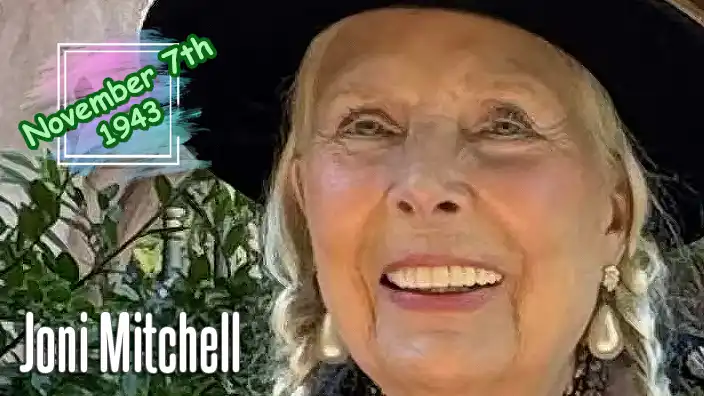
November 7, 1943, in Alberta, Canada

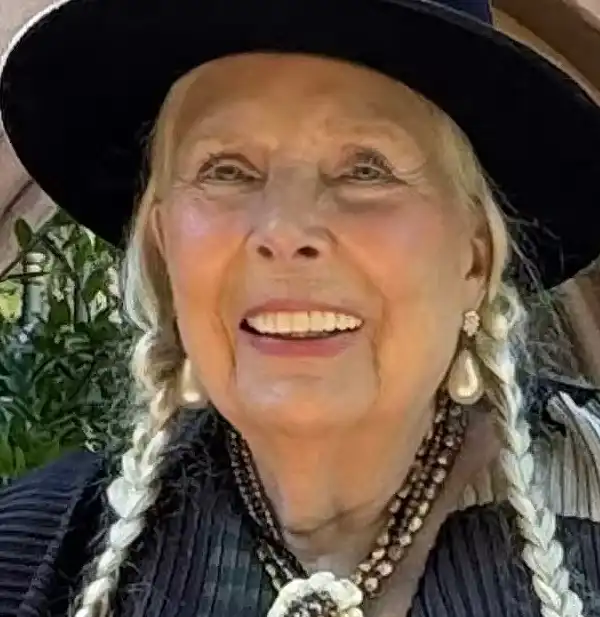
Born Roberta Joan Anderson on November 7, 1943, in Fort Macleod, Alberta, Canada, Joni Mitchell became one of the most influential singer-songwriters in modern music history. Renowned for her poetic lyrics, distinctive vocal style, unconventional guitar tunings, and adventurous musical arrangements, Mitchell helped redefine folk, rock, and jazz-influenced popular music during the late 1960s and 1970s. Her songs, including "Big Yellow Taxi," "Both Sides, Now," "Woodstock," "A Case of You," and "River," have become enduring classics, while albums such as Blue, Court and Spark, and Hejira established her reputation as an artist unwilling to compromise her creative independence. Her extraordinary career has earned multiple Grammy Awards, induction into the Rock and Roll Hall of Fame, and recognition as one of the most important musical voices of her generation.
Mitchell grew up in the Canadian prairie provinces, where her childhood was influenced by wide-open landscapes, changing seasons, and the cultural traditions of western Canada. Her father, William Anderson, served in the Royal Canadian Air Force during World War II before working in the grocery business, while her mother, Myrtle, was a schoolteacher. The family eventually settled in Saskatoon, Saskatchewan, which Mitchell came to regard as her hometown. Her early interests included drawing, painting, poetry, and music, although visual art initially occupied a particularly important place in her creative ambitions. The relationship between painting and songwriting would remain central to her artistic identity throughout her career.
At the age of nine, Mitchell contracted polio during an outbreak that affected thousands of children across North America. The illness required hospitalization and a difficult period of recovery, during which she developed an enduring appreciation for determination and personal independence. Although she recovered sufficiently to resume ordinary activities, the experience left lasting physical effects. Mitchell later reflected on how overcoming childhood illness influenced her outlook and strengthened her desire to pursue a creative life. Her early experiences also contributed to the emotional depth that would eventually characterize her songwriting, although her path toward becoming a professional musician was still far from obvious.
As a teenager, Mitchell developed an interest in folk music and began learning to play the ukulele before turning to the guitar. Her musical education was largely self-directed, and she experimented with unusual chord shapes and alternative tunings that allowed her to create sounds different from conventional folk arrangements. These techniques eventually became defining characteristics of her musical style, enabling her to develop rich harmonic textures that complemented her distinctive melodies. Her unconventional approach was partly influenced by physical limitations affecting her hands following polio, but it also reflected a natural curiosity about musical possibilities beyond standard guitar techniques.
Mitchell attended the Alberta College of Art in Calgary, intending to pursue a career in visual art. However, her growing interest in music led her to perform in coffeehouses and small venues, where folk singers could develop their skills before intimate audiences. She eventually moved to Toronto, becoming involved in the city's developing folk music scene. During this period, she faced considerable personal and financial difficulties while attempting to establish herself as a professional performer. Her experiences provided material for songs that would later explore relationships, independence, social expectations, and the complicated choices people make while searching for meaningful lives.
In 1965, Mitchell gave birth to a daughter, whom she named Kelly Dale Anderson, during a period when unmarried motherhood carried significant social stigma and financial challenges. Unable to provide the stability she wanted for her child, Mitchell placed her daughter for adoption. The experience remained deeply personal and influenced several of her later songs, including "Little Green," which appeared on Blue. Mitchell and her daughter, renamed Kilauren Gibb, were reunited in 1997 after decades apart. Their reunion became an important event in Mitchell's personal life and brought renewed public attention to the emotional experiences that had shaped some of her most intimate songwriting.
Mitchell married American folk singer Chuck Mitchell in 1965, and the couple performed together in coffeehouses and clubs, particularly in the Detroit area. During their marriage, she adopted the surname Mitchell, which she retained professionally after their divorce in 1967. Their musical partnership introduced her to wider audiences, but Joni increasingly sought independence as a songwriter and performer. She eventually moved to New York City, where her original compositions attracted the attention of established folk musicians and recording industry figures. Her songs were soon being performed by other artists, helping establish her reputation before she had achieved widespread recognition through her own recordings.
Among the musicians who recognized Mitchell's songwriting talent was David Crosby, who became an important supporter of her early career. Crosby helped introduce her to the Los Angeles music scene and produced her debut studio album, Song to a Seagull, released in 1968. The album featured intimate arrangements and poetic songs that demonstrated her emerging artistic identity. Although it did not immediately achieve enormous commercial success, it introduced listeners to a performer whose approach to melody, harmony, and lyrical storytelling differed significantly from many of her contemporaries.
Her second album, Clouds, released in 1969, included "Both Sides, Now" and "Chelsea Morning," two songs that became important parts of her early repertoire. "Both Sides, Now" had already achieved widespread recognition through Judy Collins's successful recording, but Mitchell's own interpretation revealed the emotional subtlety of her songwriting. The song examined love, life, and changing perceptions through a series of poetic images, capturing the uncertainty that accompanies personal experience. Its enduring appeal reflects Mitchell's ability to express complex emotions through language that remains accessible and deeply affecting.
The late 1960s also brought Mitchell into contact with the emerging counterculture and the musicians associated with California's Laurel Canyon community. The neighborhood became an important gathering place for singer-songwriters and rock performers, including Crosby, Stephen Stills, Graham Nash, and other influential artists. Mitchell's personal relationships and creative collaborations helped shape the music of the period, although she maintained an independent artistic perspective that frequently distinguished her from the broader counterculture movement. Her songwriting explored the ideals and contradictions of the era without automatically accepting its fashionable assumptions.
One of Mitchell's most celebrated compositions, "Woodstock," emerged from the legendary 1969 music festival, even though she did not attend the event herself. She had been scheduled to appear on television and was advised that traveling to the festival might jeopardize her appearance because of severe traffic congestion. Watching coverage of the gathering from a distance, she wrote a song that captured the hopes, communal spirit, and idealism associated with the event. The composition became particularly famous through recordings by Crosby, Stills, Nash & Young and Matthews Southern Comfort, while Mitchell's own version appeared on her 1970 album Ladies of the Canyon. Writing one of the defining songs about a festival she never attended was a remarkable achievement, although it probably saved her from several hours of traffic and an extraordinary amount of mud.
Ladies of the Canyon marked an important stage in Mitchell's artistic development, featuring songs that explored relationships, social observations, and the cultural atmosphere of the period. Among its most enduring tracks was "Big Yellow Taxi," a lively environmental protest song inspired by Mitchell's observations of commercial development and the destruction of natural landscapes. Its memorable imagery and catchy melody helped transform environmental concerns into a widely recognized popular song. The composition became one of her signature recordings and has been covered by numerous artists, demonstrating that a cheerful musical arrangement can carry a serious message about the consequences of human activity.
In 1971, Mitchell released Blue, widely regarded as one of the greatest singer-songwriter albums ever recorded. Featuring songs such as "A Case of You," "River," "California," "Carey," and "All I Want," the album presented an unusually intimate exploration of love, heartbreak, independence, loneliness, and emotional vulnerability. Its sparse arrangements placed Mitchell's voice, guitar, piano, and Appalachian dulcimer at the center of the music, allowing the lyrics to carry extraordinary emotional weight. The album reflected her willingness to examine personal experiences without disguising their contradictions or uncomfortable truths.
Blue became a landmark recording because of its emotional directness and sophisticated songwriting. At a time when popular music frequently relied on conventional romantic themes, Mitchell presented relationships as complicated experiences involving desire, disappointment, freedom, and uncertainty. Her lyrics explored the difficulty of balancing personal independence with emotional attachment, while her melodies moved through unexpected harmonic patterns. The album's influence extended across generations of musicians, and its reputation continued to grow long after its original release. In 2020, Rolling Stone ranked Blue third on its list of the 500 Greatest Albums of All Time, reflecting its enduring cultural importance.
Mitchell continued experimenting with musical styles throughout the early 1970s, gradually incorporating more sophisticated arrangements and jazz influences into her recordings. Her 1972 album For the Roses featured the song "You Turn Me On, I'm a Radio," which became a successful single, while also exploring the pressures of fame and the commercial expectations surrounding popular music. Mitchell increasingly questioned the recording industry's tendency to treat musicians as products, expressing a desire to preserve her artistic independence even as her audience expanded.
Her commercial breakthrough as an album artist reached another level with the release of Court and Spark in 1974. The album combined Mitchell's intricate songwriting with polished arrangements influenced by jazz, pop, and rock. Songs such as "Help Me," "Free Man in Paris," and "Raised on Robbery" demonstrated her ability to create accessible recordings without abandoning musical sophistication. "Help Me" became her highest-charting single on the Billboard Hot 100, reaching number seven, while the album itself achieved substantial commercial success and introduced her music to an even broader audience.
The success of Court and Spark was followed by the live album Miles of Aisles, recorded during performances with the jazz-influenced group L.A. Express. These concerts demonstrated Mitchell's increasing interest in expanding her musical arrangements beyond the acoustic folk traditions associated with her early career. Working with accomplished instrumentalists allowed her to explore more complex rhythms, improvisational passages, and sophisticated harmonic structures. Although some listeners preferred the simplicity of her earlier recordings, Mitchell remained determined to follow her evolving musical interests rather than repeat a familiar formula.
Her experimentation continued with The Hissing of Summer Lawns, released in 1975. The album examined suburban life, wealth, relationships, and social expectations through elaborate musical arrangements and carefully observed character studies. Its incorporation of jazz influences, unconventional rhythms, and atmospheric production initially divided critics, but the recording later gained recognition as one of her most ambitious achievements. Mitchell's willingness to challenge audiences reflected her belief that artistic growth required experimentation, even when new ideas were not immediately understood or commercially rewarded.
In 1976, Mitchell released Hejira, an introspective album influenced by extensive travel and her experiences of independence, loneliness, and personal reflection. The recording featured contributions from acclaimed bassist Jaco Pastorius, whose distinctive fretless bass playing complemented Mitchell's unusual guitar tunings and atmospheric compositions. Songs such as "Coyote," "Amelia," and "Song for Sharon" explored emotional distance, romantic uncertainty, and the search for personal meaning. The album's sophisticated arrangements and poetic imagery made it a favorite among musicians and listeners who appreciated her increasingly adventurous approach to songwriting.
Mitchell's interest in jazz led to further collaborations with prominent musicians, including Charles Mingus, one of the most influential composers and bassists in jazz history. Her 1979 album Mingus emerged from a creative partnership with the legendary musician during the final period of his life. The project incorporated compositions developed with Mingus and featured performances by accomplished jazz instrumentalists. Although the album represented a significant departure from Mitchell's earlier folk recordings, it demonstrated her respect for jazz traditions and her determination to explore musical possibilities beyond conventional genre boundaries.
During the 1980s, Mitchell continued recording and experimenting with contemporary production techniques. Albums including Wild Things Run Fast, Dog Eat Dog, and Chalk Mark in a Rain Storm incorporated elements of rock, electronic instrumentation, and socially conscious songwriting. Her work during this period frequently addressed political and environmental concerns, consumer culture, and the changing nature of personal relationships. Although these recordings did not consistently achieve the commercial success of her earlier albums, they reflected her ongoing interest in responding creatively to the world around her.
Mitchell returned to a more intimate musical approach with Night Ride Home, released in 1991, and Turbulent Indigo, released in 1994. The latter album received the Grammy Award for Best Pop Album and featured songs examining relationships, social injustice, and artistic identity. Its cover artwork referenced Vincent van Gogh, reflecting Mitchell's continuing engagement with visual art. Throughout her career, she had maintained a serious commitment to painting, frequently creating artwork for her album covers and exhibitions. Her dual identity as a musician and visual artist became an essential part of her creative philosophy.
In 2000, Mitchell released Both Sides Now, featuring orchestral interpretations of jazz standards and two of her own compositions. The album included a mature reinterpretation of her classic song "Both Sides, Now," demonstrating how the meaning of a familiar composition can change when performed from a different stage of life. Her deeper vocal tone and emotionally nuanced delivery brought new dimensions to the lyrics, transforming a song originally written during her early career into a reflection on decades of experience.
Her later recordings included Travelogue, released in 2002, and Shine, which continued her interest in orchestral arrangements, environmental concerns, and personal reflection. Although Mitchell became increasingly selective about public performances, her musical influence remained substantial. Younger artists frequently cited her songwriting as an inspiration, while established musicians continued recording interpretations of her compositions. Her ability to combine literary imagery, emotional complexity, and unconventional musical structures helped establish standards that subsequent generations of songwriters sought to emulate.
In 2015, Mitchell experienced a serious health crisis when she suffered a brain aneurysm, requiring extensive medical care and rehabilitation. The event significantly affected her mobility and ability to communicate, leading to a lengthy period away from public performances. Her recovery involved considerable determination and support from friends, family, and fellow musicians. Although the circumstances raised concerns about whether she would ever perform publicly again, Mitchell gradually regained important abilities and eventually began participating in private musical gatherings at her home.
These informal gatherings, sometimes referred to as Joni Jams, brought together musicians who admired her work and wanted to support her recovery through music. Among those involved was singer-songwriter Brandi Carlile, who became an important collaborator and advocate for Mitchell's return to performance. The gatherings allowed Mitchell to reconnect with music in a supportive environment, gradually rebuilding the confidence and physical abilities needed for singing and playing. What began as intimate sessions among friends eventually developed into one of the most celebrated comeback stories in contemporary music.
In July 2022, Mitchell surprised audiences by appearing at the Newport Folk Festival in Rhode Island, performing alongside Carlile and other musicians. The appearance marked her first full public concert performance in approximately two decades and attracted widespread attention. Seated among fellow performers, Mitchell sang several songs from her catalog, including "Both Sides, Now," and demonstrated that her connection with music remained extraordinarily powerful. The performance became an emotional celebration of resilience, friendship, and artistic endurance, with audiences witnessing the return of a musician whose influence had shaped popular music for generations.
Her return to public performance continued with additional concerts and appearances, including a headline performance at the Gorge Amphitheatre in Washington state in 2023. In February 2024, Mitchell performed at the Grammy Awards ceremony for the first time, delivering a moving rendition of "Both Sides, Now." The performance attracted considerable praise and introduced her music to younger viewers who may have known her primarily through recordings and the influence she exerted on contemporary artists. Her appearance also coincided with another Grammy victory, as Joni Mitchell at Newport received the award for Best Folk Album.
Mitchell's extraordinary contributions to music have received numerous prestigious honors. She was inducted into the Rock and Roll Hall of Fame in 1997 and received the Grammy Lifetime Achievement Award in 2002. In 2021, she was recognized as a Kennedy Center Honoree, celebrating her influence on American culture and the performing arts. She also received the Library of Congress Gershwin Prize for Popular Song in 2023, an honor recognizing songwriters whose work has made an enduring contribution to popular music. These distinctions reflect the breadth of her achievements across folk, rock, jazz, and contemporary songwriting.
Beyond awards and commercial recognition, Mitchell's influence can be heard in the work of countless musicians who have followed her. Artists across genres have drawn inspiration from her lyrical honesty, complex harmonic arrangements, unusual guitar tunings, and determination to maintain creative independence. Her songs have been covered by performers ranging from folk singers to jazz musicians and contemporary pop stars, demonstrating their remarkable adaptability. The continued popularity of recordings such as "Both Sides, Now," "Big Yellow Taxi," and "A Case of You" reflects their ability to communicate emotions and observations that remain relevant across generations.
Joni Mitchell's career is particularly notable for her refusal to remain confined within a single musical category. Beginning as a folk singer, she expanded into rock, jazz, orchestral arrangements, and experimental popular music, continually challenging both herself and her audience. Her creative decisions sometimes confused critics or disappointed listeners who preferred her earlier work, but they also established her as an artist whose achievements cannot be adequately measured by commercial success alone. Her influence rests on the originality of her ideas, the emotional depth of her writing, and the musical sophistication that distinguishes her recordings.
For those celebrating Joni Mitchell's birthday on November 7, her life offers a remarkable story of artistic independence, perseverance, and enduring creativity. From her childhood on the Canadian prairies to the coffeehouses of the 1960s, the influential albums of the 1970s, and her celebrated return to performance following serious illness, Mitchell has repeatedly demonstrated the power of music to express the complexities of human experience. Her songs have explored love, disappointment, freedom, environmental responsibility, and the passage of time with extraordinary honesty and imagination. And although she once warned that humanity was paving paradise to put up a parking lot, Joni Mitchell has spent her career creating music that remains far too beautiful to pave over.
Joni Mitchell – Official Biography, Career History, and Awards. Detailed biographical information, discography, and major honors. Recording Academy – Joni Mitchell: Grammy Awards and Nominations. Official recording industry awards and nominations. Rock & Roll Hall of Fame – Joni Mitchell. Her induction and lasting musical influence. Canadian Music Hall of Fame – Joni Mitchell. Canadian musical heritage, songwriting, and career achievements. Library of Congress – Joni Mitchell: Gershwin Prize for Popular Song. Official recognition of her contributions to American popular music. HISTORY – Singer-Songwriter Joni Mitchell Is Born. Verified November 7 birthday and historical background. Biography – Joni Mitchell: Life, Music, and Career. Personal history, influential recordings, and return to performing.References & Sources