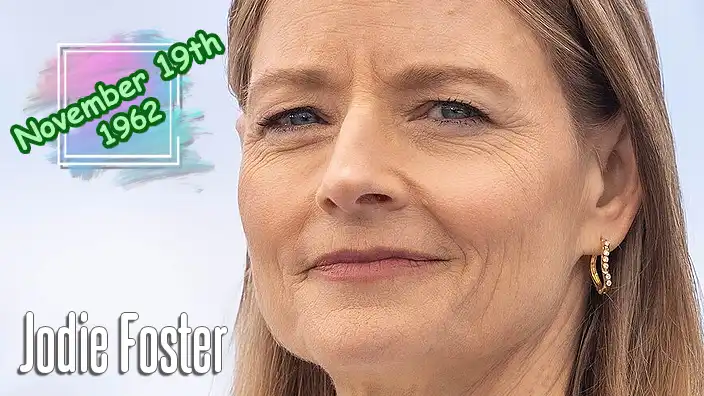
November 19, 1962, in Los Angeles, California

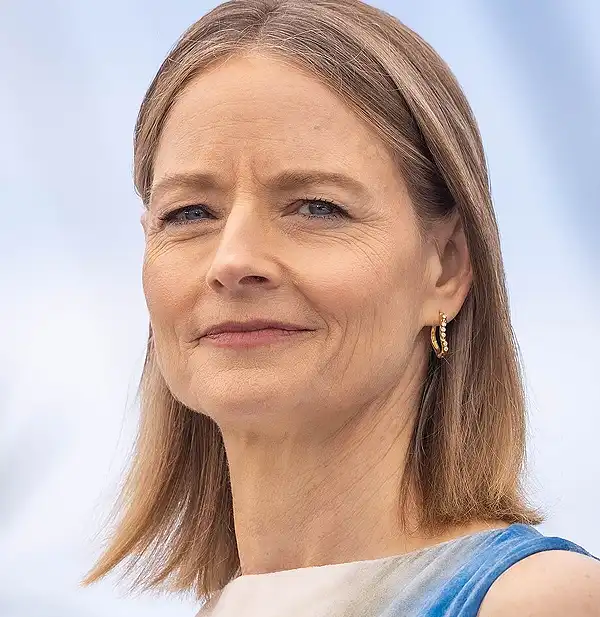
Jodie Foster, born Alicia Christian Foster on November 19, 1962, in Los Angeles, California, is an Academy Award-winning American actress, film director, and producer whose extraordinary career has spanned more than six decades. Best known for her unforgettable portrayal of FBI trainee Clarice Starling in The Silence of the Lambs and her powerful performance in The Accused, Foster has earned a reputation as one of Hollywood's most intelligent, versatile, and accomplished performers. Her career includes critically acclaimed dramatic films, psychological thrillers, science-fiction adventures, television productions, and successful directing projects. Remarkably, she began working in entertainment before most children had mastered the difficult business of tying their own shoelaces.
Foster was raised primarily by her mother, Evelyn "Brandy" Foster, who worked in the entertainment industry and encouraged her children's involvement in acting. The youngest of four children, Jodie displayed unusual intelligence and independence from an early age. She reportedly learned to read while still very young and developed an interest in languages, literature, and education alongside her growing entertainment career. Her childhood was considerably different from that of most American youngsters, involving television studios, commercial shoots, film sets, and professional responsibilities at an age when other children were principally concerned with playground politics and avoiding vegetables.
Her acting career began with television commercials, including an appearance as the Coppertone Girl in an advertisement for sunscreen. By 1968, Foster had begun appearing in television programs, including Mayberry R.F.D., followed by appearances in The Courtship of Eddie's Father, My Three Sons, and other popular series. Her early performances demonstrated an unusual degree of confidence and professionalism, allowing her to work alongside experienced adult actors without appearing overwhelmed by the environment. Hollywood had discovered a remarkably capable young performer, although it would take several more years before audiences fully appreciated the extraordinary career developing before them.
Foster's early film appearances included the Disney adventure Napoleon and Samantha (1972), in which she starred alongside Johnny Whitaker and a young Michael Douglas. She subsequently appeared in Tom Sawyer (1973) and Martin Scorsese's Alice Doesn't Live Here Anymore (1974), gradually moving beyond conventional child roles into more demanding material. These productions helped establish her as a serious young actress whose performances possessed an emotional depth rarely associated with performers so early in their careers. While other young stars were concentrating on becoming household names, Foster was quietly developing the skills that would eventually make her one of the most respected actresses in American cinema.
Foster's major breakthrough came in 1976 with Martin Scorsese's psychological drama Taxi Driver, starring Robert De Niro as Travis Bickle, a deeply disturbed Vietnam War veteran working as a New York City taxi driver. Foster portrayed Iris Steensma, a vulnerable teenage girl being sexually exploited in the city's criminal underworld. The disturbing role required considerable emotional maturity and professional discipline, particularly because Foster was still a young teenager during production. Her performance attracted widespread critical acclaim and demonstrated an extraordinary ability to portray difficult subjects with sensitivity and conviction.
Taxi Driver became one of the most influential American films of the 1970s, earning four Academy Award nominations, including Best Supporting Actress for Foster. Her nomination represented a remarkable achievement for such a young performer and immediately established her as an actress capable of handling serious dramatic material. The film's dark themes and unsettling characters also created an enduring association between Foster and psychologically complex stories, although her subsequent career would demonstrate that she was equally comfortable working in comedy, science fiction, and family entertainment.
That same year, Foster appeared in the musical gangster comedy Bugsy Malone, directed by Alan Parker, alongside a cast of child actors portraying characters inspired by Prohibition-era gangsters. Instead of conventional firearms, the film's young criminals used weapons that fired whipped cream and other harmless substances, creating a thoroughly unusual interpretation of organized crime. Foster portrayed Tallulah, a sophisticated nightclub performer whose confident personality provided an entertaining contrast to the film's youthful cast. Moving between the grim realism of Taxi Driver and the playful absurdity of Bugsy Malone demonstrated an impressive range, particularly for someone who was still required to complete her schoolwork.
Foster also starred in Disney's Freaky Friday (1976), portraying Annabel Andrews, a teenager who mysteriously exchanges bodies with her mother, played by Barbara Harris. The family comedy became a popular favorite and demonstrated Foster's ability to handle lighthearted material with the same confidence she brought to serious drama. Her character's bewilderment at suddenly assuming adult responsibilities provided much of the film's humor, while the story explored generational misunderstandings and family relationships. For a young actress already managing a demanding professional career, pretending to be an overwhelmed adult may have required slightly less imagination than the filmmakers anticipated.
Despite her considerable success in Hollywood, Jodie Foster remained committed to her education. She attended the Lycée Français de Los Angeles, where she became fluent in French, and subsequently enrolled at Yale University in 1980 to study literature. Her decision to pursue a university education while already established as a successful actress reflected her intellectual curiosity and determination to maintain interests beyond the entertainment industry. Foster graduated magna cum laude in 1985 with a bachelor's degree in literature, demonstrating that academic achievement and Hollywood success were not necessarily incompatible. While many performers spend years attempting to obtain an Academy Award, Foster was apparently determined to collect a prestigious university degree along the way.
Her years at Yale were unfortunately affected by an extremely disturbing incident involving John Hinckley Jr., a man who had developed an obsession with Foster after watching Taxi Driver. In March 1981, Hinckley attempted to assassinate President Ronald Reagan, later claiming that his actions were intended to impress the actress. Foster had no involvement in the crime and was subjected to intense and unwanted public attention because of Hinckley's fixation. The experience reinforced her determination to protect her privacy and maintain boundaries between her professional achievements and personal life. Throughout her career, Foster has generally preferred to allow her work to speak for itself rather than embrace the constant publicity frequently associated with Hollywood celebrity.
Following her graduation from Yale, Foster faced the challenge of transitioning from a successful child actress into an established adult performer. Hollywood has historically been less than generous to former child stars attempting to reinvent themselves, and Foster initially encountered difficulties finding roles that matched her abilities and ambitions. She appeared in several films during the mid-1980s, including The Hotel New Hampshire (1984), The Blood of Others (1984), and Siesta (1987). Although these productions received varying critical responses, they allowed Foster to continue developing her craft while searching for the role that would establish her adult career.
That opportunity arrived with the 1988 legal drama The Accused, directed by Jonathan Kaplan. Foster portrayed Sarah Tobias, a young woman seeking justice after being sexually assaulted in a bar. The film examined the legal system's treatment of sexual assault survivors, the difficulties victims encounter when pursuing criminal charges, and the social attitudes that can complicate their efforts to obtain justice. Foster delivered a powerful and emotionally demanding performance, portraying Sarah's trauma, anger, vulnerability, and determination without reducing the character to a simple symbol of victimhood.
Her performance in The Accused earned Foster the Academy Award for Best Actress at the 1989 ceremony, along with a Golden Globe Award. The victory established her as one of Hollywood's leading dramatic actresses and represented a major turning point in her professional career. After years of working to move beyond her childhood fame, Foster had achieved recognition at the highest level of the film industry. The award also demonstrated that her extraordinary early success had not been a temporary phenomenon. Hollywood had discovered that the talented child actress from Taxi Driver had grown into an even more formidable adult performer.
Foster's most widely recognized role arrived in 1991 with Jonathan Demme's psychological thriller The Silence of the Lambs, based on the novel by Thomas Harris. She portrayed Clarice Starling, a determined FBI trainee assigned to interview the brilliant but imprisoned psychiatrist and serial killer Dr. Hannibal Lecter, played by Anthony Hopkins. Clarice hopes to obtain information that will help investigators capture another serial killer known as Buffalo Bill. The film's suspenseful story explores psychological manipulation, criminal investigation, personal trauma, and the complicated relationship between an inexperienced investigator and a dangerously intelligent prisoner.
Foster's portrayal of Clarice Starling became one of the defining performances of her career. Rather than presenting Clarice as an invulnerable action hero, she emphasized the character's intelligence, determination, emotional vulnerability, and willingness to confront intimidating situations. Her scenes opposite Anthony Hopkins became particularly memorable, with the two performers creating an extraordinary psychological confrontation through carefully controlled dialogue, facial expressions, and subtle changes in behavior. Clarice frequently found herself facing a man who appeared capable of analyzing her entire personality before she had finished introducing herself. Fortunately, she possessed considerably more determination than the average person attempting to conduct a polite conversation with a cannibalistic psychiatrist.
The Silence of the Lambs became a major critical and commercial success, winning five Academy Awards at the 1992 ceremony: Best Picture, Best Director, Best Actor, Best Actress, and Best Adapted Screenplay. Foster received her second Academy Award for Best Actress, while Hopkins won Best Actor for his portrayal of Hannibal Lecter. The film became only the third production in Academy Awards history to win all five major categories, joining It Happened One Night and One Flew Over the Cuckoo's Nest. Foster's performance helped establish Clarice Starling as one of cinema's most memorable female investigators, while demonstrating that intelligence and emotional resilience could be every bit as compelling as physical strength.
The success of The Silence of the Lambs elevated Foster to an exceptional position within Hollywood. Having won two Academy Awards for Best Actress before her thirtieth birthday, she possessed both the professional recognition and creative freedom to pursue projects that interested her. Rather than concentrating exclusively on commercially predictable films, Foster continued selecting roles that explored complex characters and challenging themes. She also began expanding her involvement in filmmaking behind the camera, demonstrating an interest in directing and producing that would become increasingly important throughout her career.
Foster made her feature-film directorial debut with Little Man Tate (1991), a drama about a gifted young boy struggling to find his place in a world that does not fully understand his intellectual abilities. Foster also portrayed the boy's mother, Dede Tate, a working-class woman attempting to balance her son's extraordinary talents with his emotional needs. The film reflected Foster's interest in intelligence, childhood development, family relationships, and the challenges faced by individuals whose abilities distinguish them from their peers. Given her own experiences as an unusually gifted child working in an adult-dominated industry, the subject held an understandable personal significance.
Her directing career continued with Home for the Holidays (1995), a comedy-drama starring Holly Hunter, Robert Downey Jr., Anne Bancroft, and Charles Durning. The film explored the emotional chaos surrounding a family Thanksgiving gathering, where unresolved disagreements, eccentric relatives, and long-standing frustrations threaten to overwhelm the holiday celebrations. Foster's direction balanced humor with genuine emotional insight, demonstrating her ability to examine complicated family relationships without losing sight of their absurdities. Anyone who has survived a particularly eventful Thanksgiving dinner may recognize the film as less of a comedy and more of a documentary with better lighting.
Throughout the 1990s, Foster continued appearing in a variety of successful films. In Sommersby (1993), she starred opposite Richard Gere in a romantic drama set after the American Civil War. She also appeared in the western comedy Maverick (1994), alongside Mel Gibson and James Garner, portraying the clever and resourceful con artist Annabelle Bransford. The role allowed Foster to demonstrate her comedic abilities in a lively adventure filled with deception, gambling, and entertaining misunderstandings. After confronting Hannibal Lecter, dealing with a collection of dishonest poker players must have seemed like a relatively relaxing professional assignment.
In 1994, Foster starred in Nell, portraying a young woman who has grown up in isolation in the forests of North Carolina and developed an unusual form of communication. The film explored language, human development, social isolation, and the challenges of understanding someone whose experiences differ dramatically from conventional society. Foster's demanding performance required her to develop distinctive speech patterns and physical mannerisms while conveying complex emotions through limited conventional dialogue. Her work earned another Academy Award nomination for Best Actress, reinforcing her reputation for portraying psychologically and emotionally challenging characters.
Foster subsequently starred in the 1997 science-fiction drama Contact, directed by Robert Zemeckis and based on the novel by astronomer Carl Sagan. She portrayed Dr. Eleanor "Ellie" Arroway, a dedicated scientist searching for evidence of extraterrestrial intelligence. When a mysterious signal arrives from a distant star system, Ellie becomes involved in an extraordinary international effort to understand its meaning and investigate the possibility of communication with an advanced civilization. The film explored scientific curiosity, faith, skepticism, and humanity's place in the universe, providing Foster with another intelligent and determined character whose convictions are repeatedly challenged.
Contact became particularly memorable for its thoughtful treatment of scientific discovery and the philosophical questions surrounding extraterrestrial life. Foster's performance captured Ellie's passion for scientific investigation and her determination to pursue evidence despite political opposition and public skepticism. The character's commitment to rational inquiry reflected qualities frequently associated with Foster herself, including intellectual curiosity, independence, and a willingness to challenge conventional assumptions. The film also demonstrated that Hollywood could create a compelling science-fiction story without requiring its leading actress to spend the entire production running away from enormous explosions.
In 2002, Foster starred in David Fincher's psychological thriller Panic Room, portraying Meg Altman, a recently divorced mother who moves into a Manhattan townhouse with her daughter, played by Kristen Stewart. When burglars invade the property, the pair retreat into a fortified security room, only to discover that the intruders are searching for something hidden inside their supposedly secure refuge. The film became a major commercial success and demonstrated Foster's ability to sustain suspense through a performance built around fear, determination, and quick thinking. It also provided a useful reminder that expensive home security systems are considerably less reassuring when the criminals already know where the valuables are hidden.
Foster continued exploring suspenseful material with Flightplan (2005), portraying an aircraft engineer whose young daughter mysteriously disappears during an international flight. The story follows her increasingly desperate efforts to locate the child while other passengers and crew members question whether the girl was ever aboard the aircraft. Foster's performance captured the terror and determination of a mother refusing to accept explanations that contradict her own experiences. The film's confined setting and escalating psychological tension created an effective thriller, although it probably did little to improve the confidence of nervous airline passengers.
In 2006, Foster appeared in Spike Lee's crime thriller Inside Man, starring Denzel Washington and Clive Owen. She portrayed Madeleine White, a mysterious and influential professional fixer whose involvement complicates a tense bank hostage situation. Her character was sophisticated, calculating, and remarkably comfortable navigating the uncomfortable intersection of money, power, and political influence. The performance allowed Foster to portray someone considerably more morally ambiguous than many of her previous characters, demonstrating that she could be just as convincing as a manipulative power broker as she was playing a determined investigator.
Her subsequent film work included The Brave One (2007), in which she portrayed a New York radio host who becomes a vigilante following a violent attack, and Nim's Island (2008), a family adventure in which she played an anxious author unexpectedly drawn into a real-life rescue mission. These dramatically different productions illustrated Foster's willingness to alternate between intense psychological stories and lighter entertainment. She also appeared in Carnage (2011), Elysium (2013), and Hotel Artemis (2018), continuing to explore varied characters and filmmaking styles.
Foster returned to directing with The Beaver (2011), starring Mel Gibson as a troubled businessman who begins communicating through a hand puppet as he struggles with severe depression. The unusual premise allowed Foster to examine mental health, family relationships, and emotional isolation through a combination of dark humor and drama. She also appeared in the film as the protagonist's wife, balancing her responsibilities as director and performer. The production demonstrated her willingness to tackle unconventional material, even when the central character's primary method of communication involved a furry puppet with an unexpectedly strong personality.
In 2016, Foster directed Money Monster, a financial thriller starring George Clooney and Julia Roberts. The film follows a television financial adviser who is taken hostage during a live broadcast by a man who has suffered devastating investment losses. Foster used the story to explore financial irresponsibility, media sensationalism, corporate accountability, and the dangers of turning complex economic decisions into entertainment. The film combined suspense with social commentary, illustrating her continued interest in stories that examine contemporary institutions and the individuals affected by their failures. It also served as a useful warning that taking financial advice from someone who spends most of his television program dancing may not always produce the desired retirement outcome.
Alongside her feature-film directing career, Foster directed episodes of acclaimed television series including Orange Is the New Black, House of Cards, and Black Mirror. These projects allowed her to work with different production teams and storytelling formats while exploring subjects ranging from institutional power and personal relationships to the consequences of technological change. Her directing work earned critical recognition, including a Primetime Emmy nomination for her direction of an episode of Orange Is the New Black. Foster's accomplishments behind the camera reinforced her reputation as a filmmaker interested in the entire creative process rather than simply appearing in front of an audience.
In 2021, Foster appeared in the legal drama The Mauritanian, portraying defense attorney Nancy Hollander, who represents Mohamedou Ould Slahi, a man detained at Guantanamo Bay without charges for many years. The film examined questions of justice, government accountability, legal rights, and the consequences of national security policies. Foster's performance emphasized Hollander's determination to uphold legal principles despite enormous political and institutional obstacles. Her work earned a Golden Globe Award for Best Supporting Actress, adding another major honor to an already distinguished career.
Foster received further critical acclaim for her performance in Nyad (2023), starring alongside Annette Bening. The biographical sports drama tells the story of long-distance swimmer Diana Nyad's determination to complete a challenging swim from Cuba to Florida. Foster portrayed Bonnie Stoll, Nyad's longtime friend and coach, whose practical judgment, loyalty, and occasional frustration helped balance the swimmer's extraordinary ambition. The role earned Foster an Academy Award nomination for Best Supporting Actress, demonstrating that her talent remained every bit as compelling in a supporting performance as it had been in her celebrated leading roles.
In 2024, Foster returned to a major television acting role in True Detective: Night Country, the fourth installment of HBO's acclaimed crime anthology series. She portrayed Liz Danvers, a tough, experienced police chief investigating the mysterious disappearance of researchers from an Arctic facility in Alaska. The series combined a complex murder investigation with the harsh realities of life in an isolated northern community, exploring grief, unresolved trauma, cultural tensions, and unsettling mysteries. Foster's performance brought intelligence, cynicism, emotional complexity, and a wonderfully dry sense of humor to a character whose professional responsibilities were considerably more demanding than the average police department's annual paperwork.
Her performance in True Detective: Night Country earned Foster her first Primetime Emmy Award for acting in 2024, followed by a Golden Globe Award in 2025. The achievement represented another significant milestone in a career that had already included two Academy Awards and numerous other major honors. Her portrayal of Liz Danvers also created an entertaining connection to her earlier role as Clarice Starling, with both characters investigating disturbing crimes while confronting people who were not particularly enthusiastic about cooperating. The principal difference was that Clarice conducted her investigation in comparatively comfortable surroundings, while Danvers had to contend with freezing temperatures, endless darkness, and the sort of weather that makes Florida's rainy season look positively inviting.
Foster has also received significant recognition for her overall contributions to cinema. In 2013, she was honored with the Cecil B. DeMille Award at the Golden Globes, recognizing her exceptional achievements in entertainment. She subsequently received the Honorary Palme d'Or at the 2021 Cannes Film Festival, celebrating her distinguished international career as an actress and filmmaker. These honors reflected not only her individual performances but also her influence on generations of actors, directors, and audiences who admire her intelligence, independence, and commitment to challenging material.
Away from the screen, Foster has maintained a relatively private personal life despite spending most of her existence in the public eye. She has two sons, Charles and Christopher, and married photographer and actress Alexandra Hedison in 2014. Foster has frequently emphasized the importance of family, personal independence, and maintaining a separation between professional responsibilities and private relationships. Her ability to preserve a degree of normality while navigating decades of Hollywood attention has become an important part of her public identity, particularly in an entertainment industry where even an ordinary trip to the supermarket can occasionally become a media event.
One of Foster's most distinctive qualities is her intellectual approach to acting and filmmaking. Fluent in French and comfortable working in international productions, she has consistently demonstrated an interest in literature, language, psychology, and the complexities of human behavior. Her characters frequently possess intelligence and determination, but they are rarely presented as flawless individuals. Instead, Foster explores their vulnerabilities, contradictions, fears, and personal motivations, creating performances that feel convincing even when the circumstances surrounding them are extraordinary.
Jodie Foster's remarkable career has demonstrated that early fame need not prevent long-term artistic growth. From television commercials and Disney adventures to psychologically demanding dramas, Academy Award-winning performances, international film festivals, and acclaimed television productions, she has continually reinvented herself while maintaining an extraordinary level of professional respect. Her work as both an actress and director has helped establish a standard of intelligent, emotionally compelling storytelling that continues to influence modern cinema.
Few Hollywood performers can claim to have played a child gangster, an FBI trainee, a scientist searching for extraterrestrial intelligence, a frightened mother defending her daughter, and an Arctic police chief investigating mysterious deaths. Even fewer can add two Academy Awards, an Emmy, and an impressive directing career to that collection. Jodie Foster has accomplished all of it while remaining one of the entertainment industry's most thoughtful and independent figures. And after surviving Hannibal Lecter, international conspiracies, dangerous criminals, and the frozen wilderness of Alaska, one suspects that the only thing capable of genuinely frightening her might be a Hollywood producer suggesting a completely unnecessary sequel.
References & Sources