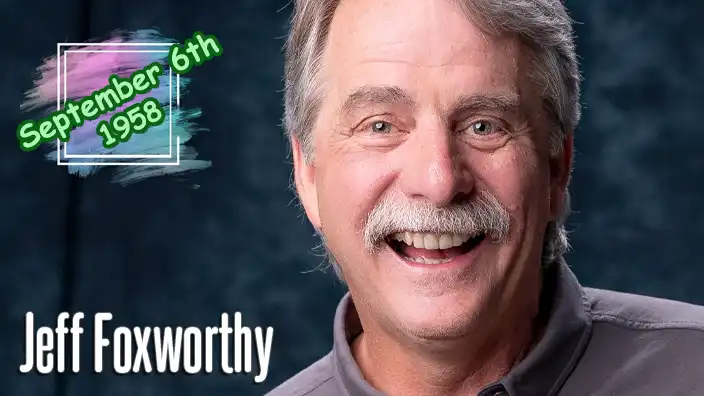
September 6, 1958, in Atlanta, Georgia

Jeffrey Marshall Foxworthy was born on September 6, 1958, in Atlanta, Georgia. He grew up in the Atlanta area and developed the Southern accent, observational humor and familiarity with everyday working-class life that would eventually become central to his comedy.
His father, Jimmy Foxworthy, worked for IBM, and Jeff initially appeared destined for a considerably more conventional career. After graduating from Hapeville High School, he attended the Georgia Institute of Technology in Atlanta but did not graduate. He eventually followed his father into IBM, working in mainframe computer maintenance.
There is something wonderfully appropriate about one of America's most famous redneck comedians beginning his professional life repairing IBM computers.
Comedy, however, was already lurking.
Foxworthy's co-workers recognized his ability to make people laugh and encouraged him to enter the Great Southeastern Laugh-off at Atlanta's Punchline comedy club in 1984. He won the competition.
That victory changed his life.
Foxworthy left IBM and began pursuing stand-up comedy professionally. It was hardly a guaranteed career improvement. IBM offered a paycheck and benefits. Stand-up offered late nights in comedy clubs filled with strangers who might or might not laugh. Fortunately, they laughed.
His comedy developed around observations of Southern life, family behavior and the peculiar things ordinary people do without realizing how peculiar they are. Rather than constructing an exaggerated stage character, Foxworthy drew heavily from his own upbringing and the people he knew.
Then came the routine that changed everything.
Foxworthy has explained that the idea for “You might be a redneck” emerged after performing at a comedy club where someone described the audience as rednecks. Looking around the room, Foxworthy realized that many of the characteristics being mocked applied equally well to his own family.
He began developing a series of jokes built around a simple formula.
If you did something particularly rural, improvised, eccentric or gloriously questionable, “you might be a redneck.”
The possibilities were practically endless.
The jokes weren't simply attacks on rural Southerners. Foxworthy included himself and his own family among the targets, which gave the routine much of its warmth. The audience wasn't being invited to laugh at some mysterious group living elsewhere. Foxworthy was effectively saying, “These are my people—and apparently some of yours too.”
His breakthrough album, You Might Be a Redneck If..., was released in 1993 and became enormously successful. The recording helped transform Foxworthy from a popular touring comedian into a nationally recognized entertainer.
The accompanying book of the same name became a bestseller, and the phrase escaped from comedy clubs into American popular culture. Soon there were redneck calendars, books, merchandise and enough variations on the joke to keep front porches across the South adequately supplied for years.
Foxworthy's comedy albums became major sellers. His follow-up, Games Rednecks Play, released in 1995, received a Grammy nomination for Best Spoken Comedy Album. Other recordings included Crank It Up: The Music Album, Totally Committed and Big Funny.
He also achieved something unusual for a stand-up comedian: success on the country music charts. The novelty song “Redneck 12 Days of Christmas” became a seasonal favorite, proving that Christmas music had apparently been waiting for someone to introduce it properly to camouflage and automotive accessories.
Television inevitably followed.
The Jeff Foxworthy Show premiered in 1995. The sitcom was loosely based on Foxworthy's stand-up persona and family experiences. It originally aired on ABC before moving to NBC for its second season.
The series included performers who would become very familiar faces. Haley Joel Osment appeared during the first season as Foxworthy's son, while Jonathan Lipnicki joined the second season. The program lasted two seasons, ending in 1997.
Foxworthy continued touring and recording, but another major chapter of his career began when he joined fellow comedians Bill Engvall, Ron White and Larry the Cable Guy for the Blue Collar Comedy Tour.
Beginning in 2000, the tour brought four distinct styles of working-class and Southern-flavored comedy together. Foxworthy was the established star who helped organize the project, Engvall specialized in everyday frustrations, Ron White brought cigars, Scotch and considerably less concern about keeping things clean, while Larry the Cable Guy arrived with “Git-R-Done” and enough sleeveless shirts to alarm the textile industry.
The tour became an enormous success.
Its popularity produced the concert film Blue Collar Comedy Tour: The Movie in 2003, followed by additional films and recordings. The comedians became closely associated with one another, although each maintained an independent career.
Foxworthy's comparatively clean approach remained one of his defining characteristics. His humor frequently involved marriage, parenting, relatives, Southern customs and the strange logic of ordinary life rather than explicit material. That made his performances accessible to unusually broad audiences.
He has often joked about his wife, Pamela Gregg, whom he married in 1985, and about raising their two daughters. Marriage provided an enormous supply of material, which is one of the traditional advantages of matrimony that rarely appears in wedding vows.
Foxworthy's comedy about family generally works because he makes himself the loser of the argument remarkably often. Husbands, fathers and middle-aged men frequently emerge from his stories as creatures who confidently make poor decisions and then seem surprised when their wives notice.
In 2007, Foxworthy unexpectedly added game-show host to his résumé with Are You Smarter than a 5th Grader?
The premise was beautifully cruel.
Adult contestants were asked questions based on elementary-school subjects while actual fifth-grade students stood nearby providing assistance and, occasionally, silently demonstrating that the grown-ups had forgotten almost everything they once learned.
Foxworthy proved a natural host. His friendly style kept contestants comfortable even while they discovered on national television that an eleven-year-old knew more about geography than they did.
The show became a major hit for Fox and generated international versions. Foxworthy hosted the original network run and later returned for syndicated and revival versions.
He subsequently hosted The American Bible Challenge on Game Show Network beginning in 2012. Contestants answered questions about the Bible while competing for money donated to charities. The series allowed Foxworthy to combine hosting with a subject connected to his Christian faith.
His faith has long been an important part of his personal life, although he generally avoided turning his mainstream comedy performances into sermons. Instead, Foxworthy built a reputation for humor that families could often watch together without somebody suddenly lunging desperately for the remote control.
He has also written extensively.
The enormous success of You Might Be a Redneck If... led to numerous humor books, calendars and collections. He later wrote children's books, including Dirt on My Shirt, a collection of poems for younger readers.
Foxworthy also ventured into animated entertainment. He voiced Handy Smurf in The Smurfs and The Smurfs 2, adding “tiny blue handyman” to a career already containing comedian, author, television host and former IBM technician.
His longevity in comedy is particularly notable because his most famous routine could easily have become a trap. “You might be a redneck” was so successful that Foxworthy might have spent the remainder of his career repeating variations of it.
Instead, he broadened his material while keeping the observational storytelling that made the original jokes successful. Family, aging, technology, marriage and the increasingly confusing experience of being an ordinary human being all became dependable subjects.
Foxworthy has also maintained a connection to outdoor life. Hunting, fishing and the outdoors have frequently appeared in both his personal interests and entertainment projects. For a comedian whose career was built partly around Southern culture, nobody was particularly shocked to discover that he actually knew what to do outside once the pavement ended.
One reason Foxworthy's redneck jokes endured is that they were never really about geography. The details might have been Southern, but the underlying joke concerned human ingenuity and our extraordinary ability to solve simple problems in unnecessarily strange ways.
A lawn chair serving permanently as household furniture? Possibly evidence.
A vehicle repaired with an item normally found in a kitchen drawer? Evidence is mounting.
A family member whose final words before an emergency-room visit were, “Hey, y'all, watch this”? The prosecution may rest.
Foxworthy turned those recognizable moments into affectionate social observation. He laughed at Southern stereotypes while simultaneously reminding audiences that he grew up among the people he was describing.
The routine also gave the word “redneck” a somewhat different place in popular culture. Foxworthy treated it less as an insult and more as a collection of habits, attitudes and improvised engineering solutions. Being a redneck in his comedy didn't necessarily mean being unintelligent. Sometimes it meant being extremely inventive, although perhaps not in a manner approved by the manufacturer.
His influence became particularly visible during the Blue Collar Comedy era, when Southern and working-class comedy found an enormous national audience. The success of Foxworthy, Engvall, White and Larry the Cable Guy demonstrated that audiences outside the traditional comedy centers of New York and Los Angeles were hungry for material reflecting their own lives.
Decades after leaving IBM, Jeff Foxworthy remains closely associated with the phrase that made him famous. That might annoy a performer who wanted to escape his early material, but Foxworthy has generally embraced it. After all, very few comedians create a routine so recognizable that simply hearing its opening words tells an audience exactly who originated it.
His career also demonstrates something wonderfully old-fashioned about comedy: you don't necessarily need profanity, controversy or shock value to make people laugh. Sometimes you merely need to pay attention to families, marriages and neighbors long enough to notice that ordinary people are already supplying better material than you could possibly invent.
Jeff Foxworthy found that material in Georgia, took it onto a comedy-club stage and eventually carried it across America.
And if you've ever used a butter knife as a screwdriver because the toolbox was all the way out in the garage...
Well, Jeff probably has some news for you.