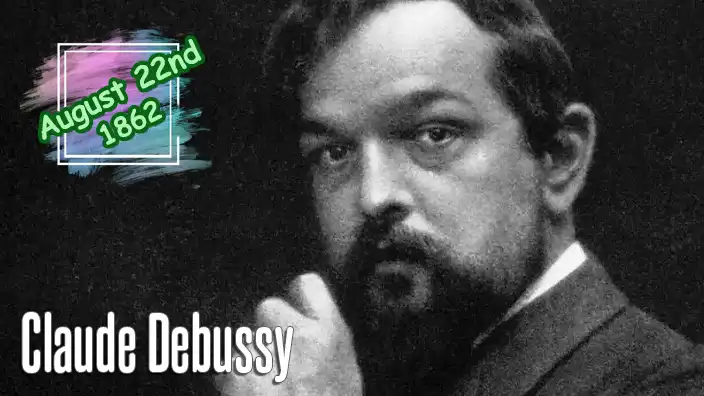
August 22, 1862, in Saint-Germain-en-Laye, France
 March 25, 1918, in Paris, France
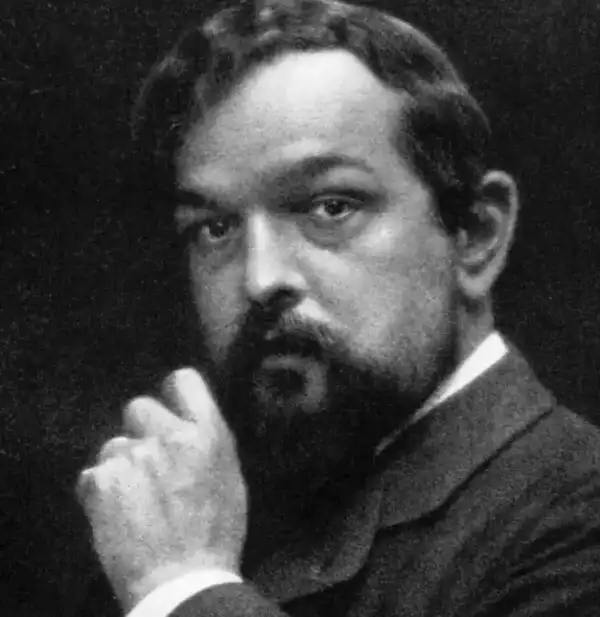
Claude Debussy did not merely write beautiful music; he changed what composers believed music was allowed to sound like. At a time when European concert halls were still heavily influenced by the monumental traditions of Beethoven, Wagner, and their successors, Debussy began loosening the rules, blurring the edges of harmony, experimenting with unusual scales, and using orchestral color almost as a painter uses light. The result was music that could shimmer, drift, suggest, tease, and occasionally make established musical authorities wonder whether somebody had quietly misplaced the rulebook.
Born Achille-Claude Debussy on August 22, 1862, in Saint-Germain-en-Laye, France, Debussy was the eldest of five children in a family of modest means. His father, Manuel-Achille Debussy, had operated a china shop, while his mother, Victorine, worked as a seamstress. There was little in the family background to suggest that their eldest son would eventually become one of the most influential composers in Western music.
Debussy showed musical ability early enough to attract serious attention. After receiving piano lessons as a child, he was admitted to the Paris Conservatoire in 1872, when he was only 10 years old. There he studied piano, harmony, theory, accompaniment, and eventually composition under teachers including Antoine Marmontel, Albert Lavignac, Émile Durand, and Ernest Guiraud.
His relationship with formal musical education was productive but hardly obedient. Debussy was talented enough to succeed within the Conservatoire system, yet his harmonic ideas increasingly puzzled instructors accustomed to more conventional methods. He experimented with progressions and sonorities that did not necessarily behave according to the respectable customs of traditional harmony. The faculty could recognize that the young man was gifted; persuading him to use that gift in the approved manner was another matter.
During his youth, Debussy also found employment as a pianist in the household of Nadezhda von Meck, the wealthy Russian patron best known for supporting Pyotr Ilyich Tchaikovsky. Traveling with her household exposed Debussy to new musical environments and gave him opportunities beyond the Conservatoire classroom. These experiences formed part of a remarkably broad musical education that would eventually include Russian music, Wagner, Symbolist poetry, visual art, and music from cultures outside Western Europe.
In 1884, Debussy achieved one of the greatest traditional honors available to a young French composer: the Prix de Rome, awarded for his cantata L'Enfant prodigue. The prize provided financial support and required him to spend time at the Villa Medici in Rome, theoretically giving him the ideal environment in which to develop according to the standards of the French musical establishment.
There was only one difficulty. Debussy did not particularly enjoy Rome.
He disliked the institutional expectations surrounding the prize and found the required artistic environment restrictive. His submissions from Rome did not always please the authorities back in Paris, and he returned to France earlier than expected. Winning the establishment's most prestigious award and then discovering that he was not terribly interested in becoming the composer the establishment expected was wonderfully characteristic of the career that followed.
Back in Paris, Debussy entered the artistic and literary circles that would prove decisive to his development. He became associated with poets and writers connected with Symbolism, particularly Stéphane Mallarmé, and absorbed ideas from literature and painting that emphasized suggestion, atmosphere, ambiguity, and impressions rather than blunt declarations.
He also encountered the music of Richard Wagner, whose immense influence dominated European musical culture during the late 19th century. Debussy traveled to Bayreuth and initially admired Wagner deeply, but he eventually became determined to develop a musical language that did not simply imitate German Romantic traditions. His search for something more distinctly French became one of the central forces shaping his mature music.
Another crucial encounter occurred at the 1889 Paris Exposition Universelle, where Debussy heard music from Asia, particularly Javanese gamelan. The unfamiliar scales, rhythms, textures, and approach to musical structure made a profound impression upon him. Rather than simply borrowing exotic effects, Debussy absorbed the larger lesson that Western European harmonic practice was not the only possible way to organize musical sound.
That realization helped encourage his experiments with whole-tone scales, pentatonic scales, parallel chords, unresolved harmonies, unusual orchestral colors, and fluid rhythms. Instead of treating harmony primarily as a mechanism pushing music toward a destination, Debussy often allowed chords to exist for their color and atmosphere.
The effect could be extraordinary.
One of the works that announced his mature style was Prélude à l'après-midi d'un faune, first performed in Paris in 1894 and inspired by a poem by Stéphane Mallarmé. The piece opens with one of the most recognizable flute passages in orchestral music, seemingly drifting into existence rather than beginning with the emphatic declaration expected of a traditional symphonic work.
The music unfolds in shifting colors and sensual textures, avoiding many of the conventional expectations of late Romantic orchestral writing. The Philharmonia has described the work's dreamy flute writing as creating a world of fantasy and pleasure, while historians routinely identify it as a milestone in the development of modern music.
French conductor and composer Pierre Boulez would later view the work as a turning point in modern music. Debussy had demonstrated that orchestral writing could be organized around timbre, atmosphere, and subtle transformation rather than the traditional architectural methods inherited from the 19th century.
The label most frequently attached to Debussy's music is Impressionism, borrowed from the visual arts and associated with painters such as Claude Monet and Pierre-Auguste Renoir. There are obvious reasons for the comparison: Debussy's music frequently emphasizes atmosphere, shifting light, suggestion, and fleeting sensations.
Debussy himself, however, was not especially fond of being called an Impressionist.
Like many artists who become permanently attached to a convenient label, he preferred not to have his entire musical philosophy reduced to one word invented by somebody else. His connections with Symbolist poetry were arguably just as important as his relationship with contemporary painting, and his influences extended from French literature to Russian music and Asian musical traditions.
His only completed opera, Pelléas et Mélisande, became another major landmark. Based on Maurice Maeterlinck's Symbolist play, Debussy worked on the opera for years before its premiere at the Opéra-Comique in Paris in 1902.
Instead of using the massive arias and dramatic orchestral gestures associated with much 19th-century opera, Debussy created an unusually restrained musical world. The vocal lines frequently follow the natural rhythms of speech, while the orchestra provides atmosphere, psychological suggestion, and subtle emotional commentary.
The opera initially generated controversy, but its importance soon became apparent. Pelléas et Mélisande established Debussy internationally and demonstrated that opera could move in directions radically different from the enormous influence of Wagner. The Paris Opera notes that its 1902 premiere made Debussy famous, and the work remains his only completed opera.
Debussy's piano music became equally important to his reputation. Among his most famous works is the Suite bergamasque, which contains the extraordinarily popular “Clair de lune.” Although the suite had early origins in the 1890s, Debussy revised it before publication in the early 20th century.
“Clair de lune,” meaning “moonlight,” is probably the piece most likely to introduce casual listeners to Debussy. Its flowing piano textures, delicate harmonies, and gradual emotional expansion have made it one of the most frequently performed and recorded piano works in the classical repertoire.
The popularity is so enormous that “Clair de lune” sometimes threatens to overshadow the rest of Debussy's output. That would be rather like judging an entire French bakery based upon one particularly excellent croissant. There is considerably more inside.
Collections such as Estampes, Images, the two books of Préludes, and the later Études demonstrate an astonishing range of piano writing. Debussy used the instrument to imitate bells, wind, water, distant landscapes, Spanish rhythms, fireworks, and even eccentric fictional characters while expanding what pianists and composers believed the instrument could express.
Titles often provided listeners with hints rather than precise narratives. In the Préludes, Debussy sometimes placed titles at the end of individual pieces rather than the beginning, encouraging performers and listeners to encounter the musical experience before being told what image had inspired it.
His fascination with sound and visual suggestion is particularly obvious in works involving water, one of Debussy's recurring inspirations. Pieces such as Reflets dans l'eau—“Reflections in the Water”—use constantly shifting figures and harmonies to evoke movement and changing light without attempting anything as simple as musical imitation.
This approach reached monumental proportions in La Mer, composed between 1903 and 1905. Debussy subtitled the orchestral work “three symphonic sketches,” and its three movements depict shifting impressions of the sea rather than presenting a conventional symphony.
Curiously, Debussy composed much of La Mer away from the ocean. His relationship with the sea was partly imaginative, shaped by memory, art, and literature as much as direct observation. When the piece premiered in Paris in 1905, the reception was mixed, and at least one critic complained that he could neither hear nor see nor smell the sea in it.
History has been rather kinder.
La Mer is now considered one of the great orchestral works of the early 20th century, admired for its extraordinary orchestration and its ability to make an orchestra appear almost liquid. Musical ideas emerge, dissolve, return altered, and collide like currents rather than proceeding through predictable traditional development.
Debussy's orchestration was one of his greatest innovations. Rather than treating the orchestra primarily as groups of instruments reinforcing harmonic structure, he often used individual instrumental colors almost independently. Flutes, harps, muted strings, horns, percussion, and woodwinds could create fleeting combinations that changed the apparent texture from moment to moment.
The influence of this approach spread rapidly.
Composers throughout the 20th century studied Debussy's harmony, orchestration, rhythm, and treatment of musical form. His influence can be heard in figures as different as Maurice Ravel, Igor Stravinsky, Béla Bartók, Olivier Messiaen, Pierre Boulez, Henri Dutilleux, and numerous composers working far beyond France. Radio France specifically notes the importance of his legacy to later French composers including Boulez and Dutilleux.
Even Debussy's only String Quartet in G minor, completed in 1893, demonstrated his willingness to stretch traditional form. The Philharmonia describes the work as an example of his movement toward the style later called Impressionism, noting how he stretched established ideas of classical structure and harmony while pointing toward the future.
Debussy could also be playful.
His Children's Corner suite, completed in 1908, was dedicated to his beloved daughter Claude-Emma, nicknamed “Chouchou.” The collection includes pieces such as “Doctor Gradus ad Parnassum,” “Jimbo's Lullaby,” “Serenade for the Doll,” “The Snow Is Dancing,” “The Little Shepherd,” and “Golliwogg's Cakewalk.”
The suite demonstrates that revolutionary harmony did not require permanent solemnity. Debussy could parody piano exercises, capture childhood play, imitate dancing, and poke gentle fun at musical conventions while maintaining the sophistication found in his larger works.
His personal life was considerably less serene than much of his music.
Debussy's romantic relationships generated scandal, broken friendships, and considerable distress among the people involved. He married Rosalie “Lilly” Texier in 1899, but later began a relationship with Emma Bardac, whom he eventually married. Their daughter Claude-Emma was born in 1905 and became deeply important to him.
Biographers have frequently described Debussy as difficult, private, witty, stubborn, and sometimes cruel in his personal dealings. The dreamy elegance of his music should not be mistaken for evidence that its composer drifted through life surrounded entirely by moonlight and tasteful water lilies.
He also possessed a sharp critical voice.
Writing music criticism under the persona Monsieur Croche, Debussy expressed strong and frequently unconventional opinions about composers, performances, musical institutions, and the state of contemporary music. The Paris Opera describes these writings as revealing his absolute anti-conformism and merciless sense of humor.
By the early 20th century, Debussy had become a central figure in French musical life. Works such as Nocturnes, La Mer, Images, Children's Corner, Préludes, Jeux, and numerous songs and piano pieces continued expanding his reputation. He remained determined to explore new sounds rather than settling comfortably into the style that had already made him famous.
His ballet Jeux, premiered in 1913, was particularly forward-looking in rhythm and structure. Unfortunately for Debussy, it appeared at almost exactly the moment when another ballet was preparing to create one of the most famous disturbances in musical history: Stravinsky's The Rite of Spring premiered only weeks later.
That is rather unfortunate scheduling.
Debussy's late years were increasingly difficult. He developed cancer and underwent surgery, but continued composing despite deteriorating health. World War I also deeply affected him, and his late works sometimes appeared under the proudly national designation “Claude Debussy, musicien français”—Claude Debussy, French musician.
Among his final major achievements were the Études for piano, En blanc et noir for two pianos, and a planned set of six sonatas for various instruments. Illness prevented him from completing the full series, but three sonatas were finished, including works for cello, violin, and combinations involving flute, viola, and harp.
Debussy died in Paris on March 25, 1918, at age 55, while the First World War was still raging and Paris was under German bombardment. The circumstances meant that his funeral was relatively subdued, far removed from the grand public ceremony one might expect for a composer who had transformed French music.
His daughter Chouchou survived him only briefly, dying during the diphtheria epidemic in 1919. She had been one of the strongest emotional attachments of Debussy's later life, making the short interval between their deaths especially poignant.
The musical revolution Debussy helped create continued long after both were gone.
His greatest contribution may have been demonstrating that harmony did not always need to explain where it was going. A chord could possess value simply because of its sound. Rhythm could float rather than march. Orchestration could suggest light and texture. Musical form could develop through atmosphere and transformation rather than conventional argument.
These ideas became foundational to enormous portions of 20th-century music.
Debussy's influence also extended beyond classical composition. Jazz musicians became fascinated with the expanded harmonies he helped popularize, while film composers found his emphasis on atmosphere and instrumental color extraordinarily useful. Ambient music, modern orchestral scoring, jazz harmony, and numerous experimental traditions owe at least some debt to musical doors Debussy helped open.
Yet listeners do not need to understand whole-tone scales, parallel fifths, unresolved seventh chords, or Symbolist aesthetics to enjoy him.
That may ultimately explain the durability of his music.
“Clair de lune” still feels intimate. La Mer still moves. The opening flute of Prélude à l'après-midi d'un faune still seems to suspend ordinary time for a moment. More than a century after Debussy's death, music that once startled conservative listeners has become some of the most beloved in the classical repertoire.
Claude Debussy spent much of his career resisting labels, academic expectations, inherited musical structures, and anybody inclined to tell him precisely how a composer was supposed to behave. The result was not musical chaos but a new form of order—one based upon color, suggestion, freedom, and the possibilities hidden inside sound itself.
He did not destroy the old musical world.
He simply opened the windows, changed the light, moved the furniture around, and made everybody realize the room could look entirely different.