
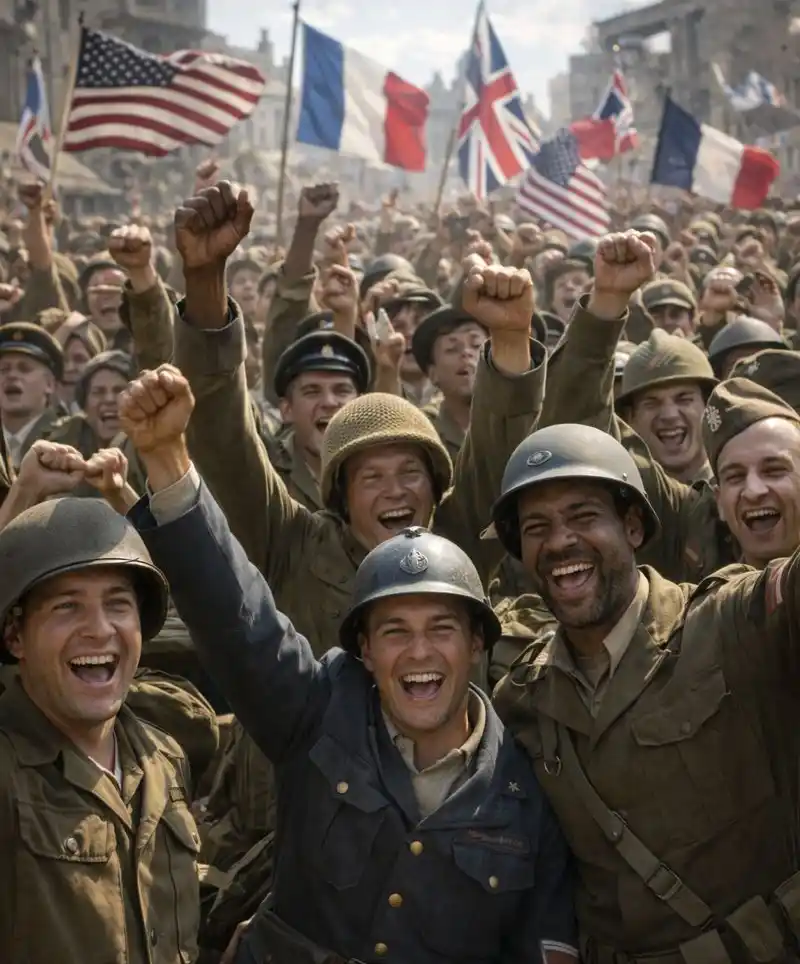
The Day That War Ended
Victory in Europe Day, known as VE Day, marks a pivotal moment in world history. Celebrated on May 8th, this day commemorates the unconditional surrender of Nazi Germany's armed forces in 1945, effectively bringing an end to World War II in Europe. This article provides a detailed look at the historical context, the events leading up to the surrender, and the global impact of this monumental day.
Historical Context
The lead-up to Victory in Europe Day finds its roots deeply embedded in the interwar period, following the Treaty of Versailles in 1919. This treaty, which formally ended World War I, imposed severe economic sanctions and territorial reductions on Germany. These conditions, combined with the global economic downturn during the Great Depression, created a fertile ground for political unrest. It was under these circumstances that Adolf Hitler and the Nazi Party rose to power in 1933, promising to restore Germany's former glory and overturn the Versailles Treaty.
As Nazi Germany aggressively expanded its territory through Europe in the late 1930s, the policy of appeasement adopted by Britain and France failed to prevent the outbreak of conflict. The invasion of Poland by Germany on September 1, 1939, prompted Britain and France to declare war on Germany, marking the beginning of World War II. This conflict would expand far beyond Europe, with battles fought in North Africa, the Atlantic and Pacific oceans, and throughout Asia.
During the war, the ideological clash between the Axis powers—Germany, Italy, and Japan—and the Allied forces centered around opposing visions for the world's future. The Axis sought to establish dominant empires based on territorial expansion and subjugation of peoples, while the Allies fought to restore peace and international order. This ideological battle was underscored by unprecedented levels of propaganda, technological and scientific advancements, and the mobilization of national economies geared toward war production.
The war also saw the tragic implementation of the Holocaust, where six million Jews, along with millions of others deemed undesirable by the Nazi regime, were systematically exterminated in an attempt to conduct ethnic cleansing on an industrial scale. This genocide revealed the horrifying capabilities of modern state machinery and has left an indelible mark on human history.
In this historical context, VE Day not only symbolizes the triumph over Nazi tyranny but also marks a significant shift in the geopolitical landscape. The end of World War II in Europe led directly to the reorganization of the continent, the emergence of the United States and the Soviet Union as superpowers, and set the stage for the Cold War, which would define global relations for much of the second half of the 20th century.
The relief at the war's end was tempered by the massive human, cultural, and economic losses, which would take decades to fully comprehend and address. VE Day, thus, is a complex tapestry of victory, relief, and profound loss, reflecting the multifaceted impact of the war on Europe and the world.
The Final Push for Victory
In Europe, the final year of the war was marked by significant territorial gains against Nazi Germany by both Western Allies, comprising the United States, the United Kingdom, and France, and the Eastern Soviet forces. The Western Allies successfully executed Operation Overlord (commonly known as D-Day) in June 1944, which involved a massive amphibious invasion of Normandy, France. Meanwhile, the Soviet Union pushed from the east, inflicting heavy losses on German forces.

As the Allies pushed towards Germany from both sides, the German war machine began to crumble. Early in 1945, Allied forces crossed the Rhine after the Battle of the Bulge, and the Soviets captured Warsaw and later stormed Berlin.
The Surrender
The actual act of surrender took place in several stages. Adolf Hitler's suicide on April 30, 1945, left Karl Dönitz as the head of the German government. Realizing the futility of continued resistance, Dönitz authorized General Alfred Jodl to negotiate terms of surrender with the Allies. The first act of surrender was signed in Reims, France, on May 7, 1945. General Jodl signed the document that stipulated the cessation of hostilities to take effect at 23:01 Central European Time on May 8, 1945.
Due to a variety of political considerations, a subsequent ceremony was required in Berlin, where the surrender was ratified at midnight on May 8/9. The Soviet Union commemorates Victory Day on May 9th due to the time zone difference at the moment of the signing in Berlin.
Celebrations and Commemorations
The announcement of Germany's surrender prompted widespread celebrations across the Allied countries, with people flooding the streets in jubilation. In the United States and the United Kingdom, massive crowds gathered in major cities to celebrate the victory and the end of the European war. Iconic images from these celebrations, such as the Times Square kiss in New York City, have epitomized the day's joyous overtones.
VE Day remains a significant day for reflecting on the cost of war and the value of peace. In many nations, it is a day of memorial services, wreath-laying, and remembering the millions who lost their lives. The day serves as a reminder of the horrors of war and the value of peace and unity in Europe and worldwide.
Victory in Europe Day marked the end of a long and brutal conflict in Europe, setting the stage for a post-war world that would see dramatic shifts in global power structures and the onset of the Cold War. Today, VE Day is a reflection of victory and a solemn remembrance of all those who sacrificed their lives for freedom. It is a day that stands as a testament to the resilience and determination of the human spirit in the face of tyranny.