September 13, 1969, in New Orleans, Louisiana
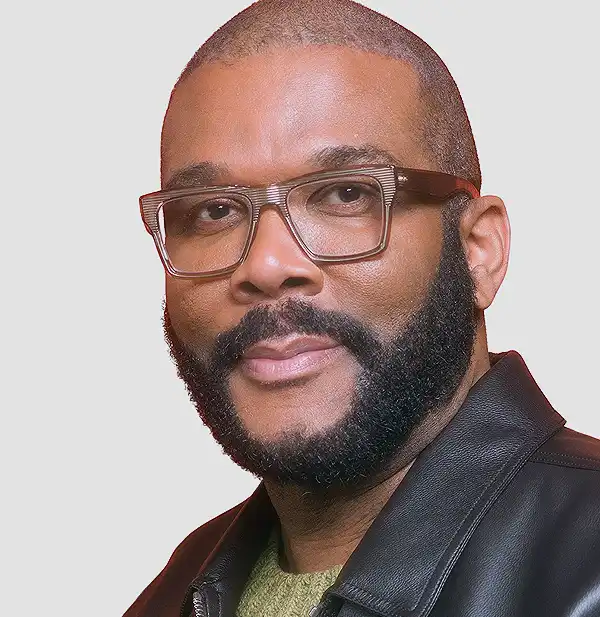
Born Emmitt Perry Jr. in New Orleans, Louisiana, on September 13, 1969, Perry grew up under circumstances far removed from the enormous entertainment operation he would eventually control. His childhood was marked by poverty and abuse, experiences he has discussed openly throughout his career. Writing became an outlet after he heard advice on The Oprah Winfrey Show about the therapeutic value of recording personal experiences. Rather than keeping a conventional journal, Perry began writing letters to himself, changing names and details along the way. Those writings eventually helped inspire his first play, I Know I've Been Changed.
Perry moved to Atlanta determined to stage that play, investing his own limited savings into the production. The 1992 premiere was not the triumphant beginning one might expect from the opening scene of a future billionaire's biography. Very few people came. Perry revised the play and tried again. And again. Financial hardship followed, including periods of homelessness, but he continued rewriting and restaging the production until I Know I've Been Changed finally found its audience in 1998. The production became successful enough to move to Atlanta's Fox Theatre.
That persistence established the pattern Perry would follow throughout his career. Instead of waiting for the established entertainment industry to decide whether his stories had an audience, he went directly to that audience. His stage productions toured what was sometimes called the urban theater circuit, attracting large, predominantly Black audiences that mainstream Hollywood had frequently underserved. Perry learned not only how to write and perform for that audience but also how to market directly to it.
During this period, Perry created the character who would become inseparable from his name: Mabel “Madea” Simmons. Madea first appeared in the stage production I Can Do Bad All by Myself. Played by Perry in wig, glasses, dress, and formidable padding, she was an elderly woman with an enormous personality, strong religious convictions, questionable respect for certain provisions of the criminal code, and a remarkably straightforward approach to family discipline.
Madea became enormously popular. Perry blended broad comedy with family conflict, faith, romance, domestic problems, forgiveness, and serious social issues. Audiences could spend one moment laughing at Madea threatening somebody with bodily harm and the next watching characters confront abuse, betrayal, addiction, or broken relationships. Critics didn't always embrace the mixture, but Perry's audiences most certainly did.
Hollywood eventually noticed.
Perry's first feature film, Diary of a Mad Black Woman, arrived in 2005, adapted from his stage work. Perry wrote and produced the movie and played Madea, while Darren Grant directed. The film opened at number one at the U.S. box office. Made for roughly $5.5 million, it ultimately earned about $51 million theatrically, demonstrating rather emphatically that Perry's theater audience was willing to follow him into movie theaters.
He followed it with Madea's Family Reunion in 2006, this time directing as well as writing, producing, and performing. More films followed at an extraordinary pace, including Daddy's Little Girls, Why Did I Get Married?, Meet the Browns, The Family That Preys, I Can Do Bad All by Myself, Madea Goes to Jail, Why Did I Get Married Too?, Madea's Big Happy Family, Madea's Witness Protection, A Madea Christmas, Boo! A Madea Halloween and numerous later projects.
Madea repeatedly retired without demonstrating much enthusiasm for remaining retired. Perry announced a farewell to the character around the release of A Madea Family Funeral in 2019, but Madea subsequently returned in Netflix's A Madea Homecoming. Apparently retirement is considerably easier when you don't have several million fans wondering what Grandma is doing.
Behind the comedy was a remarkably disciplined business strategy. Perry became known for maintaining control of his productions, working quickly, keeping budgets manageable, and—most importantly—retaining ownership of his intellectual property. Forbes has credited that ownership model as a fundamental reason he became a billionaire. Rather than simply collecting salaries for creating successful programs and films owned by somebody else, Perry built a library of content whose long-term value largely belonged to him.
Television became another major part of the operation. Tyler Perry's House of Payne developed into a long-running sitcom, followed by programs including Meet the Browns, For Better or Worse, The Haves and the Have Nots, If Loving You Is Wrong, The Oval, Sistas, Assisted Living, Ruthless, Zatima and others. His official biography credits him with creating numerous television series alongside his extensive catalog of films and stage productions.
Perry's partnership with Oprah Winfrey's OWN was particularly important. Beginning in 2013, The Haves and the Have Nots and Love Thy Neighbor provided original scripted programming for the network. He later entered a major agreement with Viacom, now Paramount, encompassing television, film, and streaming content. His relationship with BET and BET+ further expanded an already enormous production operation.
And then there is Tyler Perry Studios.
Perry officially opened the massive Atlanta production facility in 2019 on property that had once been part of Fort McPherson, a former Confederate Army base. The studio occupies more than 330 acres and includes 12 soundstages as well as extensive standing sets. Productions other than Perry's own have also used the facility. The symbolism of a Black filmmaker owning one of America's major film studios on land formerly occupied by a Confederate military installation was impossible to miss.
Ownership has always been central to Perry's story. He didn't merely become a successful performer who eventually earned enough money to purchase impressive property. He built infrastructure capable of producing movies and television on his own terms. Forbes has reported that Perry owns 100 percent of the content he has created and estimated his real-time net worth at approximately $1.4 billion in September 2026.
Perry has also stepped outside the universe he created for himself. In 2012, he took over the role of detective and psychologist Alex Cross in Alex Cross, following Morgan Freeman's earlier portrayals of the James Patterson character. He appeared as attorney Tanner Bolt in David Fincher's Gone Girl, a performance that reminded audiences who knew him primarily as Madea that Perry could comfortably occupy somebody else's cinematic world without bringing a handbag full of questionable weapons with him.
He also appeared in Teenage Mutant Ninja Turtles: Out of the Shadows as scientist Baxter Stockman and portrayed former Secretary of State Colin Powell in Adam McKay's Vice. These roles provided an interesting counterpoint to Perry's reputation as a filmmaker who writes, directs, produces, and occasionally seems in danger of performing every other job before lunch.
His work has increasingly included dramatic projects without Madea. Perry wrote and directed films including Acrimony, A Fall from Grace, A Jazzman's Blues, Mea Culpa and The Six Triple Eight. The latter dramatized the story of the 6888th Central Postal Directory Battalion, the predominantly Black Women's Army Corps unit that served overseas during World War II.
Critical reaction to Perry's work has often been divided. Reviewers have criticized aspects of his filmmaking, characterization, melodrama, pacing, and prodigious output. Perry, meanwhile, has continued making projects for an audience that has supported him for decades. Whatever one thinks of individual Tyler Perry productions, his ability to identify, reach, and retain that audience fundamentally altered the economics of his career.
His accomplishments have also been recognized well beyond the box office. Perry and The Perry Foundation received the Television Academy's Governors Award in 2020 for achievements in television and philanthropy. The following year, the Academy of Motion Picture Arts and Sciences presented Perry with the Jean Hersholt Humanitarian Award, recognizing charitable and humanitarian work addressing issues including homelessness, economic hardship, and social justice.
His philanthropy has frequently attracted attention precisely because some of it has been remarkably direct. Over the years, Perry has helped individuals facing financial hardship, supported disaster relief, assisted families and communities, and contributed to charitable causes through The Perry Foundation. His official organization describes its mission as helping economically disadvantaged people through initiatives involving health, clean water, education, technology, arts, culture, and sustainable development.
Perry's career is ultimately about considerably more than Madea, although Madea remains the enormous, handbag-swinging figure standing cheerfully in the middle of it. He transformed success in touring theater into movies, television, books, streaming productions, an enormous content library, and one of America's significant privately owned production facilities.
There is a useful lesson buried beneath all those wigs.
Tyler Perry spent years being told, directly or indirectly, that the audience he wanted to serve wasn't sufficiently important to the traditional entertainment establishment. Instead of continuing to ask for permission, he found the audience himself, learned the business, retained ownership, and eventually built his own studio.
Hollywood didn't give Tyler Perry an empire. He built one—and Madea presumably made sure nobody wandered off with it.