
Make a Splash, Catch a Wave, and Blame Gravity
National Waterpark Day, celebrated every year on July 28, is an invitation to put on a swimsuit, grab a towel, apply plenty of sunscreen, and spend the day discovering just how many different ways engineers have invented to throw human beings into water.
Waterparks have come a long way from the neighborhood swimming pool. Today's parks can feature towering water slides, enormous wave pools, winding lazy rivers, splash areas for children, racing slides, raft rides, water coasters, and attractions specifically designed for people who look at a perfectly respectable staircase and think, "I'd like to climb that so I can fall six stories through a plastic tube."
National Waterpark Day celebrates all of it. Whether your idea of aquatic adventure involves a near-vertical drop or quietly drifting around a lazy river while everyone else exhausts themselves, July 28 is a day for making a splash.
What Is National Waterpark Day?
National Waterpark Day is celebrated every year on July 28 as a day devoted to waterparks and the wonderfully wet combination of recreation, family entertainment, and summer adventure they provide. The observance was founded by Kalahari Resorts & Conventions in 2017, giving waterpark enthusiasts an official excuse to spend a summer day racing down slides, bouncing through wave pools, drifting along lazy rivers, and repeatedly climbing enormous staircases while pretending the climb is worth what is waiting at the top.
National Waterpark Day celebrates more than the biggest and fastest attractions. Modern waterparks are designed for visitors with very different ideas about what constitutes a good time. Thrill seekers may head directly for towering slides and dramatic drops, while younger visitors can enjoy splash areas, fountains, shallow pools, and smaller attractions created specifically for them. Families can tackle raft rides together, while those seeking a quieter experience can happily float around a lazy river and accomplish almost nothing for an impressively long period of time.
The celebration also recognizes how much waterparks have evolved. What began with relatively simple pools and water slides has developed into an entertainment industry featuring wave pools, water coasters, racing slides, giant funnels, interactive play structures, surf attractions, and enormous indoor waterparks capable of providing tropical-looking recreation even when the weather outside has other ideas.
At its heart, however, National Waterpark Day is about having fun in the water. It encourages families and friends to spend some time together, cool down during the summer, try an attraction they haven't ridden before, or rediscover the peculiar pleasure of voluntarily being propelled through a tube filled with rushing water.
And participation doesn't require being brave enough to tackle the tallest slide in the park. National Waterpark Day welcomes the courageous, the cautious, and those sensible souls who take one look at the near-vertical drop slide and announce:
“I'll be in the lazy river. Come and find me when you've recovered.”
The Rise of the Modern Waterpark
People have been finding ways to cool off in pools, rivers, lakes, and other convenient bodies of water for thousands of years, but the modern waterpark is a comparatively recent addition to the world of recreation. Swimming pools and simple slides had existed long before anyone thought of combining multiple water attractions into a destination devoted almost entirely to aquatic entertainment.
There is some disagreement over exactly which facility should receive the title of the world's first waterpark. Early swimming facilities gradually added slides and other recreational features, making it difficult to point to one particular opening day and announce that the waterpark had officially been invented. What is much clearer is that the concept began developing rapidly during the second half of the 20th century.
One of the most important names in that development is George Millay. Already known for helping create SeaWorld, Millay turned his attention toward an attraction where water recreation itself would be the main event. In 1977, Wet 'n Wild opened in Orlando, Florida, bringing together pools, slides, and water-based attractions in a park specifically designed around them. The World Waterpark Association would later recognize Millay as the Father of the Waterpark.
The timing and location proved particularly suitable. Orlando was already becoming one of America's leading vacation destinations, and Florida provided plenty of warm weather in which an attraction involving swimsuits and large quantities of water made perfect sense. Wet 'n Wild helped demonstrate that a waterpark could be much more than a municipal swimming pool with an adventurous slide attached to one end.
The idea spread. During the 1980s and 1990s, waterparks appeared throughout the United States and around the world. Existing amusement parks added water attractions, while dedicated waterparks competed by introducing larger slides, longer rides, wave pools, lazy rivers, children's play areas, and increasingly imaginative ways of getting visitors from somewhere high to somewhere considerably lower.
The growing industry also became more organized. The World Waterpark Association was established in 1981, bringing together waterpark operators, developers, manufacturers, suppliers, and other professionals involved in aquatic recreation. What had once been a collection of individual attractions was becoming a recognizable international entertainment industry.
Technology helped push waterparks far beyond their early designs. Fiberglass slides allowed increasingly elaborate courses filled with curves and drops. Pumps could move enormous quantities of water, wave-making systems could turn otherwise peaceful pools into artificial seas, and raft rides allowed families and groups to experience attractions together. Eventually, water coasters and sophisticated propulsion systems even challenged one of the oldest rules of the water slide: riders no longer necessarily had to travel downhill for the entire journey.
Waterparks also began developing distinct personalities. Some emphasized extreme thrills, while others concentrated on families and younger children. Resort waterparks combined aquatic entertainment with accommodations, restaurants, arcades, and other activities, turning a few hours at the pool into an entire vacation.
Today, waterparks range from relatively modest community attractions to enormous destination resorts containing dozens of slides, pools, rivers, and specialized attractions. The basic appeal, however, hasn't changed very much.
Give people some water, build something they can slide down, and sooner or later somebody will look at it and ask:
“Can you make it taller?”
Indoor Waterparks Changed the Game
For much of waterpark history, there was one rather obvious limitation: waterparks and cold weather were not particularly good friends. Outdoor parks could thrive during warm summer months, but once temperatures dropped, the slides emptied, the pools closed, and everyone went home to wait for swimsuit weather to return.
Then somebody had the wonderfully sensible idea of putting the waterpark inside.
The American indoor waterpark trend began gaining momentum in Wisconsin Dells, Wisconsin, a destination already well known for tourism and outdoor water attractions. In 1994, resort owner Stan Anderson added an indoor water attraction to the Polynesian Resort as a way to extend a business that had traditionally depended heavily on the summer season. The idea worked, other resorts followed, and Wisconsin Dells became closely associated with the growth of the indoor waterpark resort.
Moving water attractions indoors solved one of the industry's biggest problems almost immediately. The weather stopped deciding when people could go swimming. An indoor waterpark could maintain warm air and water temperatures while rain, snow, wind, or freezing temperatures carried on outside.
That transformed waterparks from predominantly seasonal attractions into potential year-round destinations.
It also changed the economics of the resort business. Instead of attracting families primarily during summer vacations, resorts with indoor waterparks could offer weekend getaways, school-break trips, birthday celebrations, and winter vacations throughout the year. A family no longer had to choose between waiting for July or accepting that February simply wasn't designed for water slides.
Indoor waterparks soon became more ambitious. What might once have been a swimming pool accompanied by a few slides developed into enormous enclosed recreation areas containing wave pools, lazy rivers, children's play structures, raft rides, body slides, activity pools, water coasters, and other attractions beneath climate-controlled roofs.
Many became part of larger resort complexes. Hotels, restaurants, arcades, shops, meeting facilities, spas, and other entertainment could all surround the waterpark, allowing families to arrive for a weekend and find most of what they needed without leaving the property.
The indoor concept also expanded where waterparks could realistically operate. Warm-weather destinations such as Florida had an obvious natural advantage for outdoor aquatic attractions, but indoor facilities could flourish in places where winter temperatures made year-round outdoor swimming impractical. Suddenly, snow on the ground was no obstacle to spending the afternoon in a wave pool.
Indoor waterparks aren't completely immune to the outside world, of course. They require substantial systems for heating, ventilation, humidity control, water treatment, and maintenance. Keeping an enormous enclosed space warm and comfortable while thousands of gallons of water are being splashed, sprayed, pumped, and occasionally launched into the air is rather more complicated than turning up the thermostat.
But the fundamental idea proved remarkably effective: bring the summer experience indoors and make it available regardless of the season.
Today, indoor waterpark resorts allow visitors to enjoy aquatic recreation throughout the year. Families can arrive wearing winter coats, change into swimsuits, spend several hours floating beneath palm-tree decorations, and then put their coats back on before venturing outside again.
There are few better demonstrations of humanity's refusal to accept the weather's opinion.
Outside: 18 degrees and snowing.
Inside: Grab a tube. We're going around the lazy river again.
There's More Than One Way to Get Wet
One of the reasons waterparks appeal to such a wide range of visitors is that there is no single correct way to enjoy one. Some people arrive determined to find the tallest slide in the park. Others take one look at it, make a thoughtful assessment of their remaining life expectancy, and head directly for the lazy river.
Fortunately, modern waterparks have attractions for both.
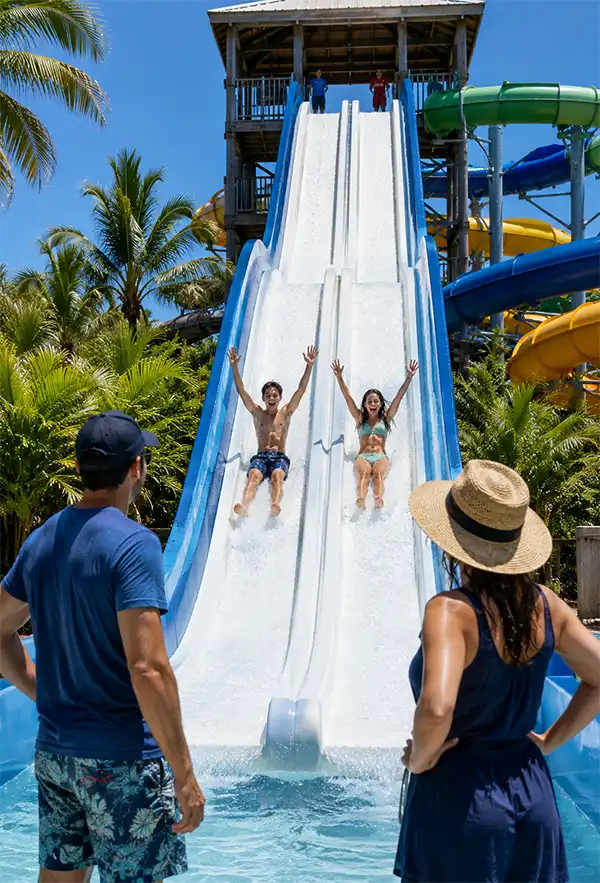
For thrill seekers, water slides are usually the main event. High-speed body slides can send riders plunging down steep drops with very little between them and gravity except a thin stream of water and several questionable decisions. Enclosed tube slides add darkness and unexpected turns, while racing slides allow friends and family members to discover just how competitive they can become while wearing bathing suits.
Raft rides make the experience more social. Instead of facing the twists, turns, drops, and splashes alone, several riders can climb aboard together. This has the added benefit of providing witnesses when somebody who insisted they weren't frightened produces a noise normally associated with a startled peacock.
Then there are wave pools, which recreate some of the movement of the ocean inside a controlled swimming environment. Mechanical systems generate waves at scheduled intervals, transforming a relatively calm pool into rolling water. Different areas of the pool provide different experiences, from gentler water near the shallow end to stronger wave action farther out.
Wave pools also provide one significant advantage over swimming in the ocean: considerably fewer visitors spend their time wondering whether the mysterious object brushing against their ankle has teeth.
For younger visitors, waterparks commonly provide splash pads, shallow pools, fountains, miniature slides, tipping buckets, spraying structures, and interactive play areas. These attractions give children their own aquatic adventures without requiring them to meet the height requirements of larger rides.
Family-oriented parks may also offer activity pools with climbing features, floating obstacles, basketball hoops, or other water games. These provide a useful alternative for visitors who want to do something in the water without repeatedly climbing staircases to reach another slide.
And then we arrive at perhaps the most civilized waterpark invention of them all: the lazy river.
Lazy rivers use a gentle current to carry swimmers or people floating in tubes around a winding course. Some include waterfalls, fountains, tunnels, or other features along the way, but the fundamental attraction is beautifully simple.
You sit down. The river does the work.
After spending half the morning climbing towers to reach water slides, this can begin to feel less like an attraction and more like an important technological achievement.
Some modern parks have even developed variations such as faster action rivers, where stronger currents, waves, and other features provide considerably more excitement. These are for people who apparently looked at the lazy river and decided it suffered from an unacceptable shortage of peril.
Waterparks may also include surf simulators, water playgrounds, tubing attractions, interactive games, water coasters, and pools intended simply for swimming and relaxing. Large resorts can offer enough variety that two people can spend the same day at the same waterpark and have completely different experiences.
That's really the beauty of it.
You can race down a slide, battle artificial waves, ride a raft with the family, chase children through a splash area, or spend an embarrassingly large portion of the afternoon floating slowly in circles.
National Waterpark Day doesn't care how you get wet. It just seems rather important that eventually you do.
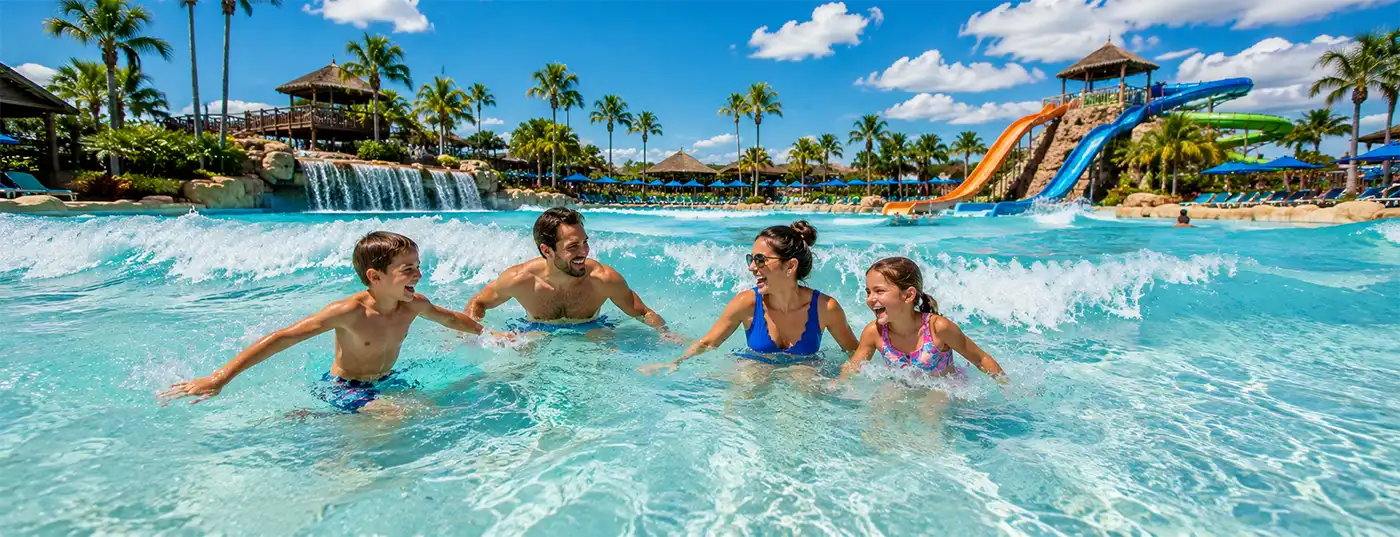
Waterpark Safety Matters
Waterparks are designed for fun, but all that rushing water, slippery pavement, deep pools, moving currents, and enthusiastic humanity means safety has to come along for the ride. Fortunately, waterparks employ lifeguards, ride attendants, safety systems, and clearly posted rules to help visitors enjoy themselves without turning National Waterpark Day into National Visit the Emergency Room Day.
The simplest rule is also one of the most important: pay attention to the people running the attraction. Lifeguards and ride attendants know when it is safe to enter a pool, launch down a slide, board a raft, or begin the next ride. Wait for their instructions rather than deciding that the person ahead of you has probably had enough time to get out of the way.
Height, weight, age, and swimming-ability requirements should also be taken seriously. Restrictions vary between attractions because different slides and rides produce different speeds and forces and use different restraint or flotation systems. If a child is too short for a particular attraction, promising that they're very mature for their age isn't going to add the missing three inches.
Children and inexperienced swimmers require particularly close supervision. Lifeguards provide an important layer of protection, but they don't replace attentive parents or responsible adults. Young children should remain within appropriate reach around water, and properly fitted life jackets should be used whenever required or recommended.
Visitors should also know their own swimming abilities. A strong swimmer may be perfectly comfortable in deeper sections of a wave pool, while someone less confident in the water may be happier remaining in shallower areas or wearing an approved flotation device. There is no prize for venturing farther into the pool than you can safely handle.
Then there is one of the oldest rules around swimming pools: don't run on wet surfaces.
Waterparks contain an impressive amount of water, and not all of it remains politely inside the pools. Walkways, stairs, and areas surrounding attractions can become slippery. Walking rather than running may not be terribly exciting, but neither is spending the afternoon explaining how you were defeated by a puddle.
Protect Yourself From the Sun: Outdoor waterparks can mean spending several hours exposed to strong summer sunshine. Sunscreen, protective clothing, shade, and regular breaks can make the difference between remembering a wonderful day at the waterpark and remembering the following three days because sitting down hurt.
Apply appropriate broad-spectrum sunscreen before spending extended time outdoors and reapply it according to the product directions, particularly after swimming or toweling off. Remember easily forgotten areas such as ears, shoulders, the tops of feet, and the back of the neck.
Even on cloudy days, sun protection remains important.
Don't Forget to Drink Water: Being surrounded by water doesn't mean you're drinking any of it — and, for several excellent reasons, you shouldn't be drinking the water you're surrounded by. Hot weather, physical activity, long walks around the park, and repeated trips up slide towers can contribute to dehydration. Drink water regularly throughout the day rather than waiting until you're extremely thirsty.
Take occasional breaks as well. Waterparks can be surprisingly tiring, particularly for children who have spent several hours enthusiastically treating every staircase as an invitation to do it again.
Follow the Rules of Each Attraction: Every attraction is different. Some slides require riders to sit in a particular position. Others prohibit loose objects, footwear, glasses, jewelry, cameras, or other items that could become hazards during the ride. Raft attractions may have specific seating instructions and capacity limits.
Read the posted signs and follow the attendant's directions. Those rules aren't there because the waterpark has developed an unhealthy interest in telling people what to do. They're based on the design and operation of the attraction and are intended to keep riders safe.
And if you have a medical condition or physical limitation that could affect your ability to safely use a particular attraction, check the park's guidance before riding and seek appropriate professional advice when necessary.
A Little Common Sense Goes a Long Way: Most waterpark safety comes down to a combination of supervision, following instructions, knowing your abilities, staying hydrated, protecting yourself from the sun, and using ordinary common sense. Waterparks are built so people can have an exciting day in and around water. Respect the rules and there's no reason safety has to interfere with the fun.
Besides, there are plenty of perfectly legitimate opportunities to frighten yourself at a waterpark. Running across a slippery pool deck doesn't need to be one of them.
How to Celebrate National Waterpark Day
There is no great mystery surrounding how to celebrate National Waterpark Day on July 28. Find a waterpark, put on something suitable for swimming, and prepare to spend considerably more time wet than dry.
A visit to a local waterpark is the obvious choice, whether it is a large destination park filled with towering slides and wave pools or a smaller community facility with pools, splash areas, and a few favorite attractions. You don't need the world's tallest water slide to celebrate properly. You just need somewhere designed for having fun in the water.
If you're making a full day of it, do a little planning before leaving home. Check the park's opening hours, admission prices, parking arrangements, attraction restrictions, and policies concerning outside food, drinks, towels, flotation devices, and other belongings. A few minutes of preparation can prevent the traditional family-vacation ritual of discovering that something important is still sitting on the kitchen table.
Pack the essentials: swimsuits, towels, sunscreen, suitable footwear, dry clothes, and anything else your particular group needs for a day around water. A waterproof pouch or secure locker can also be useful for phones, wallets, keys, and other possessions that generally perform better when they aren't sent through a wave pool.
Try Something New: National Waterpark Day is a fine excuse to try an attraction you've been avoiding. Maybe there is a water slide you've looked at several times before deciding that gravity seemed particularly aggressive that day. Perhaps you've never ridden a family raft ride, tackled a water coaster, tried a surf simulator, or ventured into the wave pool. You don't have to conquer the most extreme attraction in the park. Pick something new that suits your abilities and comfort level. Of course, if you do decide to tackle the enormous slide you've been avoiding, there will probably be a wonderful moment halfway up the staircase when you remember that going back down the stairs was always an option. By then, pride usually takes over.
Have a Water Slide Challenge: If you're visiting with family or friends, add a little friendly competition. Race one another on multi-lane slides where the attraction permits it. Decide who is brave enough to ride the biggest slide. See who can complete the most different attractions during the day, or let everyone choose one ride that the whole group has to experience together. Parents should exercise caution with this idea. Children have considerably less concern for your dignity than you do.
Take the Lazy Route: Celebrating National Waterpark Day does not require spending eight consecutive hours being fired through pipes. Find the lazy river, grab a tube, and enjoy doing absolutely nothing for a while. Float past the scenery. Wave cheerfully at exhausted people climbing another flight of stairs. Complete an entire circuit and then, through an unfortunate administrative oversight, fail to get out. Repeat as necessary. The lazy river is particularly useful when visiting a waterpark with a group because it provides a natural meeting place between more energetic adventures. It also allows adults to recover sufficiently to make another series of poor decisions later.
Let the Kids Lead the Way: For families with younger children, National Waterpark Day can be less about enormous slides and more about simply letting children enjoy the water. Splash areas, fountains, tipping buckets, shallow pools, miniature slides, and interactive water playgrounds can provide hours of entertainment. Let the children choose some of the day's activities while keeping appropriate supervision and water safety firmly in place. You may discover that the attraction you walked halfway across the park to find is nowhere near as fascinating to a five-year-old as a pipe that unexpectedly dumps a bucket of water on Dad. Accept defeat gracefully.
Make It a Family Tradition National Waterpark Day can also become an annual family outing. Return to a favorite park every July 28, visit a different waterpark each year, or take a photograph in the same location every time you celebrate. Families with children can end up with a wonderful collection of memories showing youngsters progressing from splash areas to children's slides and eventually to the enormous attractions their parents secretly hoped they would never notice. Traditions don't have to be complicated. Sometimes "Every July 28, we go to the waterpark" is quite enough.
No Waterpark Nearby? Get Creative: Not everyone lives within convenient reach of a waterpark, but that doesn't mean National Waterpark Day has to pass unnoticed. Visit a community swimming pool, aquatic center, splash pad, or another appropriate recreational swimming facility. At home, families can set up sprinklers, water games, inflatable pools, or other age-appropriate backyard activities. A garden hose has entertained generations of children despite having absolutely no marketing department. You could even create a miniature backyard "waterpark" with different water activities and give each attraction a suitably ridiculous name. The ordinary lawn sprinkler becomes The Hydro Tornado. The kiddie pool becomes The Great Blue Lagoon. The garden hose becomes Poseidon's Revenge. Admittedly, the neighbors may have questions.
Share the Splash: Take photographs of your National Waterpark Day adventures, provided photography is permitted where you are visiting, and share the fun with friends and family. You can also use #NationalWaterparkDay when posting about the celebration on social media. Just remember that not every photograph taken at a waterpark needs to survive for posterity. Some things that happen while exiting an inner tube should remain between you and the lifeguard.
Finish the Day Properly: After hours of slides, swimming, waves, stairs, sunshine, and repeated soaking, finish National Waterpark Day with something relaxing. Have dinner together, grab some ice cream, compare everyone's favorite attraction, and determine which family member produced the day's most impressive scream. Then go home, put the wet towels somewhere sensible, and discover the following morning that somebody left one in the car anyway.
However you celebrate, National Waterpark Day is ultimately about enjoying the water and spending time having fun with people you care about. Go fast. Go slow. Make a splash. Ride the waves. Or simply climb into the lazy river and allow July 28 to float gently past.
National Waterpark Day Trivia
Before you head for the nearest lazy river, here are a few facts worth splashing around. National Waterpark Day trivia takes us from the early days of modern waterparks to indoor aquatic resorts and the attractions that have turned getting thoroughly soaked into an international entertainment industry. Consider these useful facts to remember while you're standing at the top of a water slide wondering why the pool suddenly looks so very far away.
- National Waterpark Day is celebrated on July 28 each year.
- Kalahari Resorts founded National Waterpark Day in 2017.
- George Millay opened Wet 'n Wild in Orlando in 1977 and was later recognized by the World Waterpark Association as the Father of the Waterpark.
- The World Waterpark Association was established in 1981.
- The American indoor waterpark trend took off in Wisconsin Dells during the 1990s.
- Waterpark attractions can range from splash areas and lazy rivers to wave pools, high-speed slides, raft rides, and elaborate water-play structures.
- Indoor waterparks allow visitors to enjoy aquatic attractions throughout the year, regardless of outdoor temperatures.
National Waterpark Day FAQ
Still have a few questions before grabbing your swimsuit and heading for the slides? Our National Waterpark Day FAQ covers the date, history, origins, waterpark attractions, and ways to celebrate. Whether you prefer towering water slides or believe the lazy river represents the pinnacle of human achievement, here are some answers worth knowing.
When is National Waterpark Day?
National Waterpark Day is celebrated annually on July 28. The celebration falls during the height of summer in the United States, making it an excellent time for families and friends to cool off at a waterpark.
Who created National Waterpark Day?
Kalahari Resorts & Conventions founded National Waterpark Day in 2017. The observance was created to celebrate waterparks and the recreation, entertainment, and family experiences they provide.
When was the first National Waterpark Day?
The first National Waterpark Day was celebrated on July 28, 2017. It has continued as an annual observance on July 28.
What is National Waterpark Day?
National Waterpark Day is a celebration of waterparks, water slides, wave pools, lazy rivers, splash areas, and other forms of aquatic recreation. It encourages people to visit a waterpark or enjoy another safe water-based activity with family and friends.
Who is known as the Father of the Waterpark?
George Millay is widely recognized as the Father of the Waterpark. Millay, who was also involved in the development of SeaWorld, opened Wet 'n Wild in Orlando, Florida, in 1977 and played an important role in establishing the modern waterpark concept.
Where did indoor waterparks become popular in the United States?
Wisconsin Dells, Wisconsin, played an important role in the development of the American indoor waterpark industry. An indoor water attraction added to the Polynesian Resort in 1994 helped demonstrate that waterpark recreation could attract visitors throughout the year rather than only during the traditional summer season.
What attractions are found at waterparks?
Waterparks can include body slides, tube slides, raft rides, racing slides, wave pools, lazy rivers, water coasters, splash pads, children's play areas, activity pools, surf attractions, and interactive water features. Attractions vary considerably depending on the size and style of the park.
Are waterparks only open during summer?
No. Outdoor waterparks are often seasonal, particularly in areas with cold winters, but indoor waterparks can operate throughout the year. Climate-controlled indoor resorts allow visitors to enjoy swimming pools and water attractions even when outdoor temperatures make swimming considerably less appealing.
How can I celebrate National Waterpark Day?
Visit a waterpark on July 28 and enjoy your favorite attractions. You could try a new water slide, spend time in the wave pool, race friends down a multi-lane slide, or simply relax in the lazy river. If there isn't a waterpark nearby, a community pool, aquatic center, splash pad, or safe backyard water activity can provide an alternative way to celebrate.
Is National Waterpark Day just for children?
Certainly not. Waterparks commonly provide attractions for children, teenagers, adults, families, thrill seekers, and visitors who simply want to relax. You are never too old for a water slide. You may, however, eventually reach an age when you become considerably more interested in how many stairs are involved before committing yourself.
What should I bring to a waterpark?
Useful items generally include a swimsuit, towels, sunscreen, suitable footwear, dry clothes, and any permitted personal necessities. Check the individual waterpark's policies before visiting because rules concerning outside food, flotation devices, coolers, cameras, and other belongings can vary.
Why are waterpark height and weight restrictions important?
Ride restrictions are established according to the design and safe operation of individual attractions. Always follow posted height, weight, riding-position, and other safety requirements, along with instructions from lifeguards and ride attendants. The attendant measuring your child isn't trying to ruin National Waterpark Day. They're trying to make sure everyone gets to celebrate it again next year.
One More Trip Down the Slide
National Waterpark Day celebrates an entertainment idea that sounds almost absurd when properly described: build an enormous structure, pump thousands of gallons of water through it, send people hurtling down it in their bathing suits, and charge admission. Naturally, millions of us think this is marvelous.
Waterparks offer something for nearly everyone. Children can splash, thrill seekers can scream, families can ride together, and those with absolutely nothing left to prove can spend the afternoon floating peacefully around the lazy river.
So on July 28, grab your swimsuit, find some water, and celebrate National Waterpark Day. And if you're standing at the top of an enormous water slide wondering why you agreed to this, don't worry. The person behind you will probably help with the decision.