Scotland's Spectacular New Year's Eve Celebration
Every December 31, Scotland prepares to bid farewell to the old year and welcome the new with Hogmanay, a centuries-old New Year's Eve celebration filled with music, fireworks, traditional customs, family gatherings, and an impressive determination to keep the festivities going long after midnight. Although New Year's Eve is celebrated around the world, Scottish Hogmanay has developed a distinctive identity rooted in the country's history, folklore, and sense of community. From the bustling streets of Edinburgh to small Highland villages and cozy family homes, Hogmanay brings people together to reflect on the year that has passed and greet the possibilities of the year ahead. The celebrations can include torchlight processions, traditional Scottish dancing, spectacular fireworks, and the familiar sound of Auld Lang Syne ringing through the night. Of course, Scotland's weather occasionally contributes its own entertainment, usually involving horizontal rain and winds strong enough to rearrange a perfectly respectable hairstyle.
What Is Hogmanay, and When Is It Celebrated?
Hogmanay is the Scottish name for New Year's Eve, celebrated annually on December 31, although the festivities frequently continue into January 1 and sometimes January 2. The word itself has an uncertain origin, with historians and linguists suggesting possible connections to older French and northern European expressions associated with New Year's gifts and celebrations. Whatever its precise linguistic ancestry, Hogmanay has been part of Scottish cultural life for centuries and remains one of the country's most recognizable traditions. Unlike an ordinary New Year's Eve party, Hogmanay combines public festivities with customs that have been passed down through generations, many of them intended to encourage good fortune, prosperity, friendship, and a fresh beginning.
The importance of Hogmanay in Scotland is closely connected to the country's religious and social history. Following the Scottish Reformation in the 16th century, traditional Christmas festivities were discouraged by the Presbyterian Kirk, which regarded many seasonal customs as unsuitable religious practices. Christmas Day did not become a public holiday in Scotland until 1958, and for generations New Year celebrations occupied a particularly important place in the Scottish winter calendar. Families and communities concentrated much of their seasonal merrymaking around Hogmanay, creating traditions that became deeply embedded in Scottish life. Today, Christmas is widely celebrated throughout Scotland, but Hogmanay retains its special status, with January 1 and January 2 recognized as Scottish bank holidays.
Although Hogmanay officially falls on December 31, the Scottish New Year's celebration is not necessarily restricted to a single evening. In many communities, the festive atmosphere builds during the final days of December, with concerts, Ceilidhs, parties, family gatherings, and other Hogmanay-related activities taking place before the traditional midnight celebrations. Scotland's enthusiasm for welcoming the New Year has helped turn Hogmanay into an extended festive season, particularly in cities that organize major public events. Edinburgh, for example, traditionally begins its multi-day Hogmanay festival on December 29 with a spectacular torchlight procession, followed by additional entertainment on December 30 before the main New Year's Eve street party and midnight fireworks. The celebrations continue into January 1, while January 2 is also a Scottish bank holiday. It is therefore entirely possible to arrive in Scotland several days before New Year's Eve and discover that the festivities are already well underway. The Scots have apparently decided that if one evening of celebration is enjoyable, several days must be considerably better.
The History and Origins of Hogmanay
The history of Hogmanay reflects a mixture of Scottish traditions and wider European midwinter customs. Some popular accounts connect elements of the celebration with ancient winter festivals, including Norse observances associated with the darkest part of the year. Viking influence was particularly strong in parts of Scotland, including the Northern Isles, and seasonal customs involving feasting, fire, and community gatherings developed across northern Europe. However, the precise origins of individual Hogmanay practices are not always documented, and it would be misleading to attribute every modern tradition directly to the Vikings. What is clear is that Scotland developed its own distinctive way of marking the transition between years, combining older folk customs with changing religious practices and the enduring importance of family and neighborhood relationships.
For centuries, Hogmanay was an occasion for visiting friends, sharing food and drink, exchanging good wishes, and ensuring that the coming year began under favorable circumstances. Many households traditionally cleaned their homes, settled outstanding debts where possible, and completed unfinished business before midnight. These activities reflected the belief that the old year's troubles should not be carried unnecessarily into the new one. Although modern Scots are considerably less likely to believe that an untidy kitchen will ruin their fortunes, the tradition of starting the year with a clean house remains appealing. Besides, nothing encourages a thorough cleaning quite like the possibility that half the neighborhood may arrive at your door shortly after midnight.
First-Footing: The Famous Scottish Hogmanay Tradition
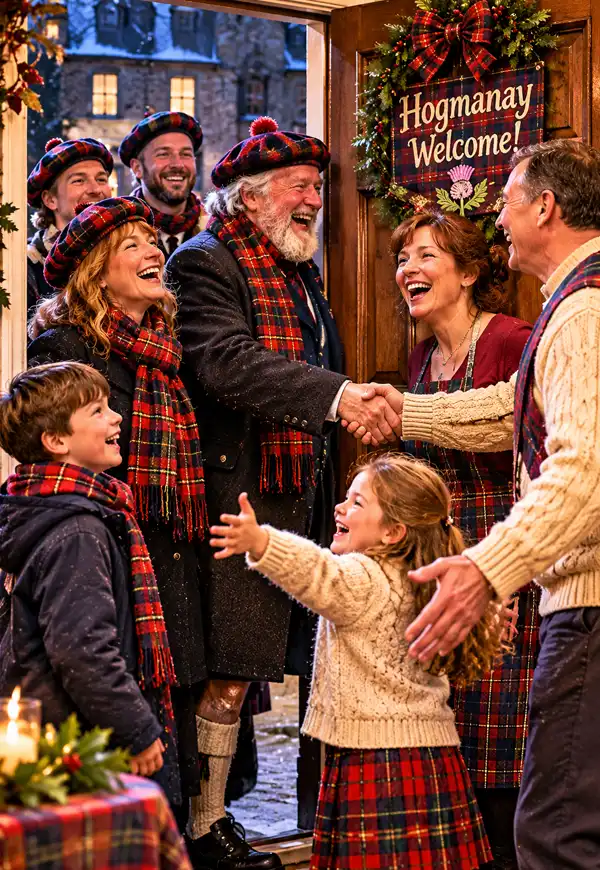
One of the best-known Scottish Hogmanay traditions is first-footing, the custom of welcoming the first person to cross a home's threshold after midnight on New Year's Eve. Traditionally, the identity of this first visitor was believed to influence the household's fortunes during the coming year. In many Scottish communities, a tall, dark-haired man was considered a particularly fortunate first-footer, although beliefs and preferences varied between regions and families. Popular explanations sometimes connect this preference with historical fears of fair-haired Viking raiders, but that interpretation is more folklore than established historical fact. Whatever the origin, the custom remains a delightful example of how an ordinary social visit can acquire extraordinary importance when the clock strikes twelve.
A proper first-footer traditionally arrives bearing symbolic gifts intended to bring good luck and prosperity. These may include coal for warmth, shortbread or black bun for food, salt for prosperity, and whisky for hospitality and good cheer. Black bun is a rich Scottish fruitcake enclosed in pastry, traditionally associated with the New Year season. The visitor offers good wishes, shares refreshments, and helps begin the year on a friendly note. Modern first-footing is generally less concerned with strict rules and more focused on companionship, although some households still enjoy observing the traditional details. Anyone arriving empty-handed may discover that Scottish hospitality is generous but not entirely without expectations. A bottle of whisky, for example, has a remarkable ability to improve one's standing as a welcome visitor.
 Auld Lang Syne and the Midnight Celebration
Few Hogmanay traditions are as internationally recognized as the singing of Auld Lang Syne, the famous song associated with Scottish poet Robert Burns. Burns sent a version of the song to the Scots Musical Museum in 1788, drawing on older Scottish words and traditions. Its title can be understood approximately as “old long since,” and its lyrics celebrate friendship, shared memories, and the enduring bonds between people. Over time, Auld Lang Syne became closely associated with New Year's celebrations, spreading far beyond Scotland to become a familiar musical farewell to the departing year in countries around the world. Its message is especially appropriate for Hogmanay, when people gather to remember old friends and welcome new beginnings.
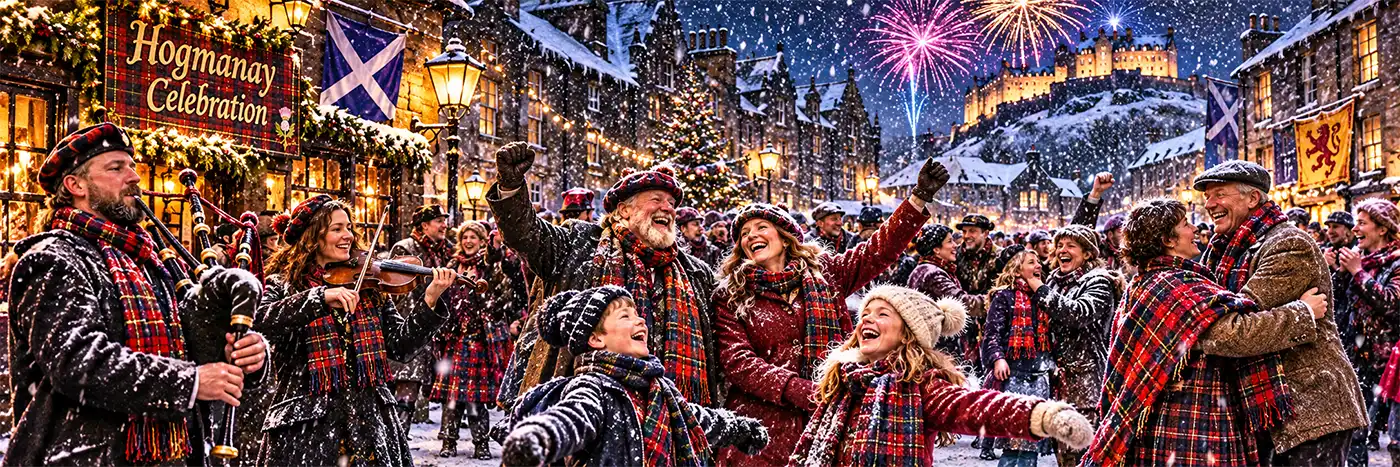
At midnight, many Scottish gatherings join hands and sing Auld Lang Syne, sometimes forming a circle before crossing arms and linking hands during the song, following a familiar Scottish custom. The result can be wonderfully moving, particularly when families and friends who have spent the year apart come together again. It can also become mildly chaotic when enthusiastic participants forget which hand belongs to whom or attempt to sing Scots-language lyrics they have never quite mastered. Nevertheless, the sentiment remains unmistakable: old friendships deserve to be remembered, and the arrival of a new year is an opportunity to strengthen the connections that matter most.
Edinburgh's Hogmanay: Scotland's World-Famous New Year Celebration
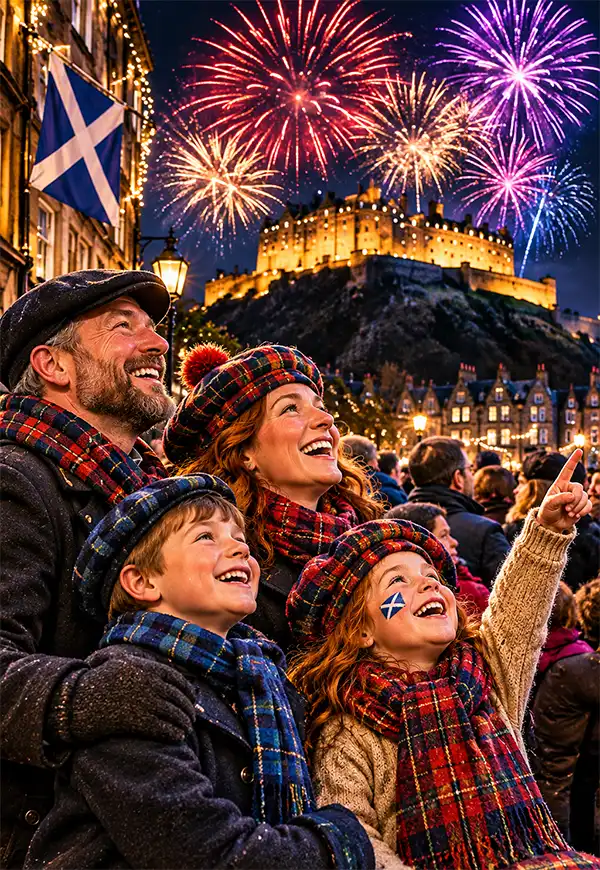
The Scottish capital of Edinburgh hosts one of the world's best-known Hogmanay celebrations, attracting visitors eager to experience Scottish hospitality on a spectacular scale. Edinburgh's organized Hogmanay festival began in 1993 and has grown into a multi-day event featuring live music, street entertainment, torchlight processions, traditional dancing, and fireworks above the city's historic skyline. Princes Street and the surrounding city center become gathering places for thousands of revelers, while Edinburgh Castle provides a dramatic backdrop for the midnight celebrations. The event's international reputation has made Edinburgh's Hogmanay festival an important part of Scotland's winter tourism calendar. Naturally, anyone planning to attend should dress warmly, because Scottish winter weather has never considered a visitor's carefully chosen party outfit a compelling reason to behave itself.
The celebrations extend beyond Edinburgh's famous street party. Concerts, ceilidhs, cultural performances, and community gatherings offer visitors opportunities to experience Scottish traditions in different settings. A ceilidh, pronounced approximately KAY-lee, is a social gathering featuring traditional music and dancing, often involving energetic group dances that require enthusiasm more than professional skill. Popular Scottish dances include the Gay Gordons, the Dashing White Sergeant, and Strip the Willow, each providing an excellent opportunity to meet new people while discovering muscles that have remained comfortably unemployed for the previous twelve months. Whether participating in a formal celebration or enjoying a small gathering at a neighborhood pub, the emphasis remains on welcoming the New Year together.
Fire Festivals and Unusual Hogmanay Customs Across Scotland
Fire has long played an important role in Scottish New Year celebrations, symbolizing renewal, light, and the departure of the old year's troubles. One of the most dramatic examples takes place in Stonehaven, where the famous Stonehaven Fireballs Ceremony transforms the streets into a remarkable spectacle shortly after midnight. Participants swing specially constructed flaming balls attached to chains as they parade through the town, eventually extinguishing them at the harbor. The tradition has been practiced for generations and is commonly associated with the symbolic cleansing of the old year and the welcoming of a brighter future. It is a breathtaking display of Scottish heritage, although definitely not something to attempt in the backyard after a couple of celebratory drinks.
Other communities maintain equally distinctive New Year customs. In Biggar, South Lanarkshire, a large bonfire traditionally marks the arrival of the New Year, bringing residents and visitors together around its warmth and light. Farther north, the town of Burghead in Moray celebrates Old Hogmanay on January 11 with the Burning of the Clavie, a ceremony involving a flaming barrel carried through the community. The unusual date reflects the difference between the old Julian calendar and the Gregorian calendar adopted in Britain in the 18th century. These regional customs demonstrate that Hogmanay is much more than one enormous party in Edinburgh. Across Scotland, individual communities have preserved their own ways of marking the New Year, often with enough flames to make the local fire brigade pay particularly close attention.
Traditional Hogmanay Food and Drink
Food and hospitality are central to the Scottish Hogmanay celebration, with traditional dishes and treats offering both nourishment and symbolic good wishes. Scottish shortbread, made with butter, sugar, and flour, is a familiar favorite, while black bun provides a richer alternative with its dense mixture of dried fruit and spices enclosed in pastry. Fruitcake, oatcakes, and hearty family meals also feature in seasonal gatherings, with individual traditions varying between households and regions. Steak pie is particularly associated with New Year's Day meals in many Scottish homes, often accompanied by potatoes and vegetables. These dishes reflect the practical comforts of a winter celebration: good food, generous portions, and enough sustenance to keep everyone cheerful through a long evening of visiting, dancing, and conversation.
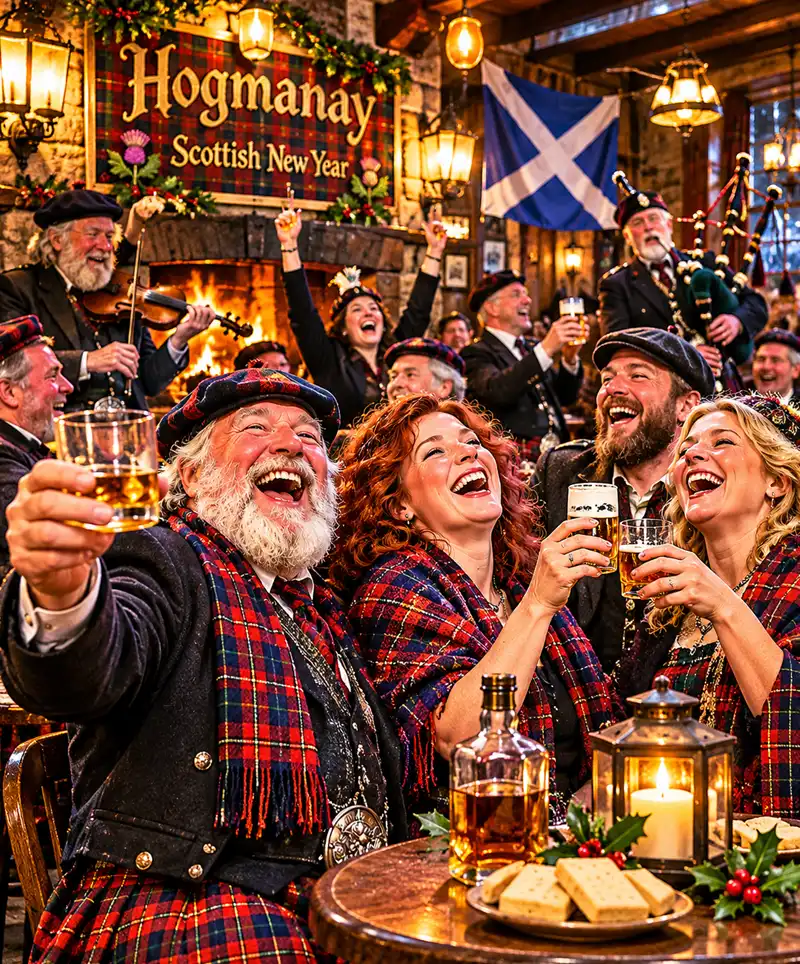
For adults who choose to drink, Scotch whisky has a traditional place in Hogmanay hospitality, particularly when welcoming first-footers or raising a toast at midnight. Champagne and other celebratory drinks are also common, while nonalcoholic alternatives ensure everyone can join the occasion. The important element is not what fills the glass but the goodwill shared between family, friends, and neighbors. Hogmanay has always placed considerable value on hospitality, and a welcoming home is often more memorable than the most elaborate public celebration. That said, anyone presenting a plate of homemade Scottish shortbread is unlikely to encounter much resistance, particularly if the biscuits are still warm.
How to Celebrate Hogmanay at Home
You don't have to travel to Scotland to enjoy Hogmanay on December 31. Families and friends around the world can embrace the celebration by incorporating traditional Scottish customs into their New Year's Eve plans. Begin by giving the house a thorough cleaning, an old practice sometimes called redding the hoose, which symbolizes leaving behind the previous year's difficulties. Prepare a meal featuring Scottish-inspired dishes, arrange a gathering with friends, and learn a little about the history of first-footing. As midnight approaches, encourage everyone to share a favorite memory from the past year or offer a good wish for the year ahead. When the clock strikes twelve, join hands and sing Auld Lang Syne, even if the group only knows the opening words and spends the remainder humming with great conviction.
For a more adventurous celebration, organize a Scottish-themed evening featuring traditional music, a beginner-friendly ceilidh dance, and homemade shortbread. Children can participate by learning about Scottish culture, creating decorations, and preparing symbolic first-footing gifts. Families might also watch footage of Edinburgh's Hogmanay fireworks or explore the fascinating customs practiced in different Scottish towns. Those who enjoy outdoor activities could welcome New Year's Day with a brisk walk, while particularly courageous individuals might take inspiration from Scotland's Loony Dook, a modern tradition involving a chilly New Year's Day dip. Such activities should only be attempted where conditions are safe and appropriate supervision is available. For everyone else, standing beside a warm fireplace with a mug of something comforting remains a perfectly respectable Scottish-inspired alternative.
Why Hogmanay Remains an Important Scottish Tradition
Although modern Hogmanay celebrations include international performers, spectacular fireworks, and major tourist events, the heart of the occasion remains remarkably unchanged. Hogmanay celebrates friendship, hospitality, renewal, and the shared experience of welcoming a new year. Its traditions encourage people to remember those who have shaped their lives, extend kindness to neighbors, and approach the future with optimism. The continued popularity of first-footing, traditional dancing, and Auld Lang Syne illustrates how customs can evolve without losing their original sense of community. For Scots living overseas, Hogmanay also provides an opportunity to maintain cultural connections and introduce younger generations to a distinctive part of their heritage.
Ultimately, the appeal of Hogmanay lies in its combination of ancient customs and modern celebration. Whether standing among thousands of revelers beneath Edinburgh Castle, watching fireballs illuminate a Scottish harbor, or sharing shortbread with friends around a kitchen table, the occasion offers a meaningful way to close one chapter and begin another. It reminds us that the New Year is not simply a change of date but an opportunity to renew friendships, appreciate life's blessings, and face the future with a little more hope. And if the first visitor through the door happens to be carrying whisky, shortbread, and a lump of coal, there's every possibility the coming year is already off to an excellent start.