Look! Up in the Sky!
Every June 12, Superman Day celebrates one of the most influential fictional characters ever created. Superman has been flying—or, initially, leaping—through popular culture since his debut in Action Comics #1 in 1938, appearing in comic books, newspapers, radio programs, animated cartoons, television series, movies, novels, toys and enough merchandise to fill the Fortress of Solitude several times over.
Superman is simultaneously Kal-El, the survivor of the doomed planet Krypton; Clark Kent, the reporter raised in Kansas; and Superman, the hero who uses his extraordinary abilities to protect others. That combination helped establish a formula subsequently followed, modified, dismantled and occasionally turned completely upside down by generations of superheroes.
Yet Superman has survived while thousands of other fictional heroes have disappeared because there is more to him than strength and flight. At his best, Superman represents hope, compassion, restraint and the idea that possessing power doesn't automatically entitle someone to use it however they please.
He could rule the world. Instead, he gets a job at a newspaper. That's commitment to blending in.
The Origins of Superman Day
Superman Day is celebrated annually on June 12, although the observance is considerably younger than Superman himself. The modern celebration grew from promotional events associated with DC Comics and eventually developed into an annual occasion for fans, comic-book retailers and the wider Superman community to celebrate the Man of Steel and his enormous cultural legacy.
The date has sometimes caused confusion because Superman has several other important dates associated with him. Action Comics #1 carries a June 1938 cover date, but copies actually reached newsstands earlier that year. Various Superman anniversaries and promotional celebrations have therefore occurred on different dates over the decades. June 12, however, has become established as Superman Day.
The celebration isn't simply an excuse to watch Superman movies or wear a shirt bearing the famous shield, although both are perfectly respectable uses of a June afternoon. Superman Day also celebrates the ideals that became attached to the character: helping people, standing against injustice, showing compassion and choosing hope when cynicism would be considerably easier.
It is, in other words, a superhero holiday with homework. Fortunately, the homework mostly involves being nice to people.
Two Cleveland Kids Create a Superhero
The Superman story begins not on Krypton but in Cleveland, Ohio, with two young men named Jerry Siegel and Joe Shuster. Siegel was the writer and Shuster the artist, and both were enthusiastic science-fiction fans. Their earliest conception of a character called Superman was very different from the hero we recognize today. In a 1933 story titled The Reign of the Superman, their Superman was actually a bald villain possessing telepathic powers.
Fortunately, they reconsidered.
Siegel subsequently reworked the idea into a heroic character while Shuster developed the visual appearance. The pair spent years attempting to interest publishers in their creation. Eventually Superman was accepted for a new comic-book title being prepared by the company that would become DC Comics. The result was Action Comics #1, published in 1938. Its cover has become one of the most recognizable images in comic-book history: Superman lifting an automobile over his head while terrified men scatter around him. There was no lengthy cinematic introduction, no orchestral fanfare and certainly no post-credit scene. Superman simply arrived holding a car.
The issue was enormously successful, and publishers quickly realized that readers wanted more. Lots more.
Superman's popularity helped ignite what became the Golden Age of Comic Books, and the superhero genre rapidly expanded. Batman debuted the following year, while characters including the Flash, Green Lantern, Captain Marvel, Captain America and Wonder Woman soon joined the rapidly growing population of costumed heroes. Siegel and Shuster hadn't merely created another comic-book character. They had helped establish an entirely new entertainment genre.

From Krypton to Kansas
The story of Superman begins on Krypton, a distant world whose destruction has become one of the most famous origin stories in popular culture. Although the details have been revised many times since Superman first appeared in 1938, the essential tragedy remains the same. Scientist Jor-El discovers that Krypton is doomed and desperately tries to warn his people, only to find that his predictions are ignored or that there is simply no longer enough time to save the planet. Unable to rescue everyone, Jor-El and his wife Lara make the agonizing decision to save their infant son, Kal-El, placing him aboard a small spacecraft bound for the distant planet Earth. Their world dies behind him, leaving the child as one of Krypton's few survivors and giving generations of parents something considerably more dramatic to remember whenever they complain about putting a baby into a car seat.
Kal-El's spacecraft eventually reaches Earth, where the infant is discovered by Jonathan and Martha Kent, a farming couple who take him into their home and raise him as their son, Clark Kent. In most modern versions of the Superman story, Clark grows up near Smallville, Kansas, surrounded by fields, neighbors and a community about as far removed from an advanced alien civilization as Jor-El could possibly have selected. As Clark grows, his extraordinary abilities gradually become apparent. Strength, speed, enhanced senses and eventually the power of flight make it obvious that he isn't an ordinary Kansas farm boy, although explaining some of the resulting household accidents must have required considerable creativity.
Smallville is far more than a convenient place for Superman to spend his childhood. Jonathan and Martha Kent provide the moral foundation upon which Superman is built. Clark receives his extraordinary physical abilities from his Kryptonian heritage, but the Kents teach him how those abilities should be used. They encourage compassion, humility, responsibility and respect for human life while helping him understand that being able to do something doesn't necessarily mean that he should. A boy capable of becoming vastly more powerful than the people around him instead learns to consider himself one of them. The farm, the family and the ordinary community surrounding Clark therefore become every bit as important to the Superman mythology as Krypton itself.
That combination of two worlds is central to Superman's identity. Kal-El is Kryptonian, but Clark Kent is also very much a product of Kansas. He carries the history of a civilization he never had the opportunity to know while embracing the family and world that gave him a home. Later versions of the mythology have explored that balance in considerable depth, with Clark learning more about Krypton without abandoning the values instilled by his adoptive parents. He doesn't have to choose between being Kal-El and Clark Kent; both identities contribute to the person he becomes.
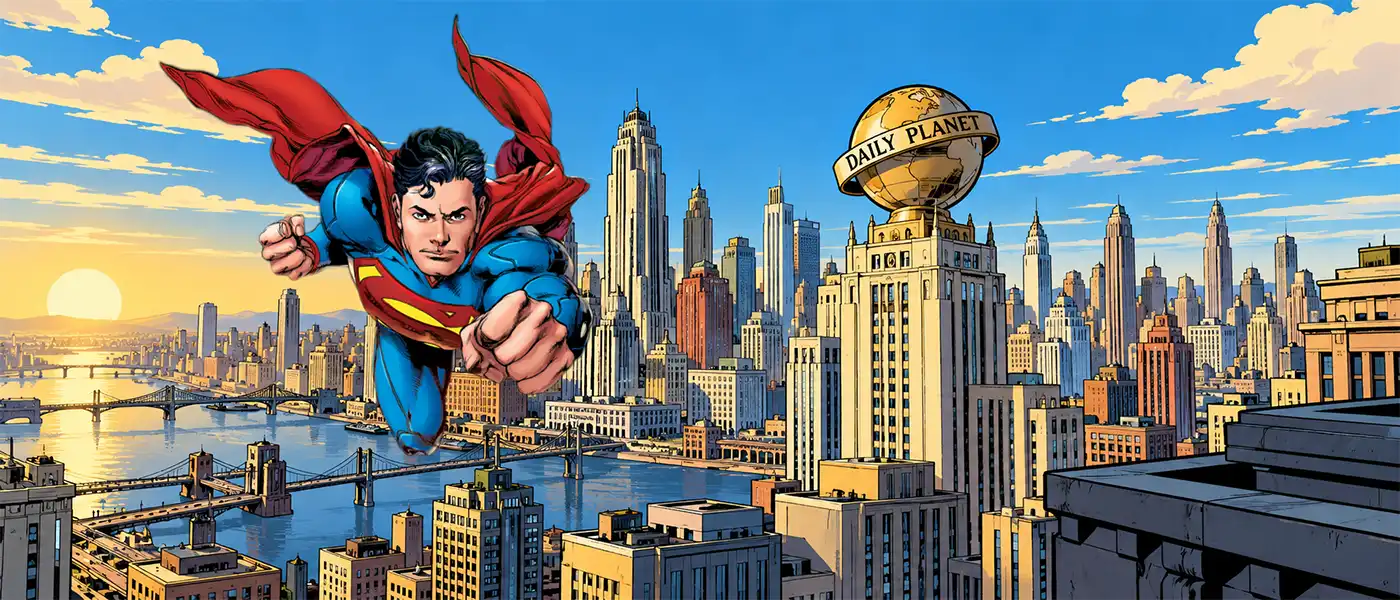
Eventually, Clark leaves Smallville and makes his way to Metropolis, where he becomes a reporter for the Daily Planet and begins publicly operating as Superman. The move places him in a much larger world, but he takes Kansas with him in everything that matters. Beneath the cape, extraordinary powers and Kryptonian heritage remains the young man Jonathan and Martha Kent raised to help when someone needed helping and to do the right thing when he could. Krypton gave Earth Superman's power; Smallville taught him what to do with it.
Clark Kent: The Other Half of Superman
Clark Kent is sometimes treated as merely Superman's disguise, but the relationship between the two identities has become considerably more interesting over the decades.
At the Daily Planet, Clark works alongside characters including Lois Lane, Jimmy Olsen and editor Perry White. Journalism allows him to investigate wrongdoing without punching it through a wall, while his deliberately ordinary appearance helps conceal his extraordinary identity.
The famous disguise consists primarily of glasses, different clothing, altered posture and behavior. This has inspired generations of people to ask how nobody recognizes him.
The answer varies between versions, but the basic idea is that Clark deliberately presents himself differently. He changes his posture, mannerisms and voice and avoids behaving like Superman. More importantly, most people aren't expecting Superman to have a day job. If the most powerful person on Earth walked past carrying a briefcase and complaining about an editorial deadline, you might not immediately assume he spent lunch diverting an asteroid.
Lois Lane has been particularly important to the mythology since the beginning. Created alongside Superman by Siegel and Shuster, she appeared in Action Comics #1 and developed into far more than simply Superman's romantic interest. Lois became one of popular culture's best-known fictional journalists, frequently pursuing dangerous stories with a determination that suggests self-preservation never featured prominently in her employee training.
Depending upon the continuity, Lois eventually learns Clark's secret, becomes his wife and builds a life with him in which extraterrestrial invasions presumably make scheduling dinner unusually complicated.
Faster Than a Speeding Bullet
Modern audiences know Superman as one of the most powerful superheroes ever created, but the Superman who appeared in Action Comics #1 in 1938 was considerably more restrained. He possessed extraordinary strength, tremendous speed and remarkable durability, but he couldn't originally fly. Instead, Superman could leap enormous distances, famously described as being able to “leap tall buildings in a single bound.” His earliest adventures presented a hero who could lift automobiles, outrun trains and survive injuries that would stop an ordinary person rather permanently, but he was still a long way from the almost godlike figure later generations would recognize. If early Superman wanted to reach the top of a skyscraper, he jumped. It was certainly impressive, although landings presumably required considerably more planning.
Superman's abilities expanded rapidly as the character became more popular and moved beyond comic books. His famous power of flight developed during the early 1940s, with animation playing an important role in establishing the image of Superman soaring gracefully through the air rather than repeatedly bouncing across the landscape. As comic-book writers continued creating larger threats and increasingly spectacular adventures, Superman accumulated additional abilities. X-ray vision, heat vision, super hearing, super breath and greatly enhanced senses joined his already formidable strength and speed. His physical durability increased as well, eventually allowing stories to send him into space, through enormous explosions and against opponents capable of turning downtown Metropolis into an insurance adjuster's worst nightmare.
The mythology eventually explained many of these abilities through Superman's Kryptonian biology and exposure to Earth's yellow sun. Under Earth's conditions, Kal-El can absorb and store solar energy, which powers many of his extraordinary abilities. Different eras and continuities have explained the mechanics in different ways, and precisely how powerful Superman happens to be has always depended upon the writers and the needs of a particular story. At various points he has demonstrated strength and speed on a truly astonishing scale, survived environments that should be impossible and accomplished feats that cause the laws of physics to quietly gather their belongings and leave the room.
Yet Superman's enormous power creates an interesting problem that has become central to the character: he must constantly exercise restraint. Everyday life takes place in a world built for people considerably more fragile than he is. Opening a door, shaking someone's hand or catching a falling person requires control when you possess enough strength to bend steel. Superman therefore isn't simply powerful; he has spent a lifetime learning how not to use all that power. Some of his best stories recognize that restraint as an ability in its own right. Throwing a tremendous punch is easy when you're Superman. Knowing when not to throw one is considerably more important.
Of course, a superhero who can fly, move at incredible speeds, see through walls, withstand enormous impacts and lift objects of staggering weight presents storytellers with a fairly obvious difficulty: how do you put him in danger? Over the decades, writers found plenty of answers, including villains capable of matching his strength, threats involving magic and situations in which innocent lives were at risk. But one particular weakness became so closely associated with Superman that its name eventually entered everyday language.
That troublesome little souvenir from his destroyed home planet is kryptonite—because even the Man of Steel occasionally needs to have a very bad day.
Kryptonite: Because Even Superman Needed a Bad Day
Creating a superhero who can survive enormous explosions, bend steel and fly through the sky presents writers with a fairly obvious problem: sooner or later, somebody has to be able to spoil his afternoon. Kryptonite became the solution. The radioactive remains of Superman's destroyed home planet are his most famous weakness, but kryptonite wasn't part of the original 1938 Superman mythology. The concept emerged during the Adventures of Superman radio series in the 1940s before making its way into the comic books and becoming permanently associated with the Man of Steel.
The best-known variety is green kryptonite, which weakens Superman and causes intense pain, with prolonged exposure potentially proving fatal. Writers subsequently introduced numerous other forms, particularly during the wonderfully inventive years when comic books rarely encountered an idea they considered too strange to print. Red kryptonite became famous for producing unpredictable temporary effects, while other varieties have appeared with powers ranging from removing Kryptonian abilities to affecting different members of Superman's extended family. The precise rules have changed repeatedly as DC's continuity has been revised, but green kryptonite has remained the classic substance Superman would rather not discover glowing ominously in someone's pocket.
Kryptonite isn't Superman's only vulnerability. Magic can affect him, and beings possessing comparable strength can injure him perfectly well without bringing radioactive rocks to the fight. His compassion for other people can also be used against him; threatening innocent lives is an extremely reliable method of forcing Superman to abandon whatever else he happens to be doing. His enemies have exploited that particular weakness almost as often as kryptonite, which says something important about the character: Superman's greatest vulnerability is sometimes the very quality that makes him heroic.
Kryptonite became so deeply embedded in popular culture that its name eventually escaped the Superman universe altogether. Calling something “my kryptonite” now means admitting to a particular weakness or irresistible temptation, whether that's chocolate, doughnuts, shoes, classic cars or the inability to walk past a bakery without conducting an immediate quality-control inspection. Few fictional substances have achieved that kind of recognition—and Superman probably wishes this particular one had remained on Krypton.
Cape, Shield and a Surprisingly Complicated Pair of Trunks
Few superhero costumes are as instantly recognizable as Superman's blue suit, red cape and chest emblem.
Joe Shuster's original design drew upon several influences familiar to audiences of the 1930s, including circus strongmen whose costumes often featured tight-fitting clothing with trunks worn over leggings. What can look unusual to modern eyes therefore made considerably more visual sense when Superman first appeared.
The costume changed repeatedly as artists and filmmakers reinterpreted Superman. The shade of blue changed. The cape changed. The boots changed. The trunks disappeared, returned, disappeared again and became the subject of more discussion than any pair of underpants could reasonably have anticipated.
The famous S-shield evolved too.
Originally, the emblem was essentially an identifying symbol for Superman, and its design changed substantially during the character's earliest appearances. The now-familiar diamond-shaped shield gradually emerged and became one of the most recognizable symbols in popular culture.
Later interpretations added Kryptonian meaning to the emblem. Most famously, modern versions of the Superman mythology have presented the symbol as representing hope on Krypton or as the crest of the House of El.
That explanation wasn't part of the original 1938 character, but it fits Superman so neatly that it has become deeply associated with him.
And it certainly sounds more impressive than, “It's an S because my name starts with S.”
Superman Takes to the Airwaves
Superman escaped comic books remarkably quickly.
The Adventures of Superman radio serial began in 1940, introducing the character to an enormous audience and adding important elements to his mythology. The program helped popularize familiar phrases associated with Superman and introduced characters and concepts that subsequently migrated into other media.
The radio series is also associated with Superman's opposition to the Ku Klux Klan in the 1946 storyline Clan of the Fiery Cross. The story portrayed a Klan-like organization as villains and used Superman's enormous popularity with young listeners to challenge prejudice and intolerance.
Animation followed as Fleischer Studios produced a celebrated series of Superman theatrical cartoons beginning in 1941. The cartoons were technically ambitious, beautifully animated and enormously influential in establishing how Superman looked and moved on screen.
The famous introduction describing Superman as “faster than a speeding bullet” and “more powerful than a locomotive” became embedded in popular culture.
By then, Superman wasn't simply a comic-book success. He was everywhere.
Superman Conquers Television and Hollywood
Superman's screen career stretches across generations.
Kirk Alyn became the first actor to portray Superman in live action in theatrical serials beginning in 1948. George Reeves subsequently became closely identified with the character through the television series Adventures of Superman, which became a major success during the 1950s.
Then, in 1978, Christopher Reeve put on the cape.
Richard Donner's Superman treated the character as the centerpiece of a major motion picture rather than a novelty. Reeve's performance distinguished beautifully between the confident Superman and awkward Clark Kent, sometimes appearing to transform between the two simply by changing posture and expression.
The film's advertising famously promised: “You'll believe a man can fly.” Audiences did.
Reeve's Superman became a defining interpretation of the character and influenced portrayals for decades.
Television continued experimenting with the mythology through programs including Lois & Clark: The New Adventures of Superman and Smallville, the latter concentrating on Clark Kent's life before fully becoming Superman.
Animation produced several acclaimed versions, while later feature films offered new interpretations of the Man of Steel. Henry Cavill portrayed Superman beginning with Man of Steel in 2013, presenting a version wrestling with his place in the world and the enormous consequences of his abilities.
Each generation seems to rediscover Superman and then asks essentially the same question: What would the most powerful man in the world choose to do with all that power?
More Than a Man of Steel
That question helps explain why Superman still matters. Superman's powers are spectacular, but his restraint is arguably more important. He possesses enough strength to dominate ordinary human beings effortlessly, yet chooses instead to live among them, help them and consider himself part of their world. There is also an unmistakable immigrant dimension to the Superman story.
Kal-El is sent from a doomed homeland by parents who hope their child will find safety and a future somewhere else. He arrives in a new country, is raised within its culture and eventually combines the heritage of the world he lost with the values of the world that adopted him. Siegel and Shuster were themselves the children of Jewish immigrants, and scholars and writers have frequently examined Superman through that cultural and historical context. Whether every parallel was consciously intended from the beginning remains a matter of interpretation, but themes of immigration, identity, assimilation and belonging have become an enduring part of Superman scholarship.
Superman also represents an unusual and enduring fantasy about power and responsibility. What makes him admirable isn't simply that he can lift impossible weights, fly across the world or stand unharmed against forces that would overwhelm almost anyone else; it is that someone possessing such extraordinary power continually chooses to use it with restraint and compassion. Superman doesn't have to be kind, patient or concerned about people far weaker than himself, and very little could physically force him to behave that way. He chooses to be. That choice lies at the heart of the character: his greatest strength isn't what he is capable of doing, but the principles that guide him when deciding what he should do.
Truth, Justice and a Changing Motto
Few phrases are as closely associated with Superman as “truth, justice and the American way,” but like much of the Superman mythology, the famous motto evolved over time. It wasn't part of the character's original introduction in 1938. Variations emphasizing truth and justice emerged during Superman's early adventures in other media, particularly the enormously popular Adventures of Superman radio series. The reference to the “American way” became more prominent during the patriotic atmosphere surrounding World War II and was later firmly embedded in popular culture through the Adventures of Superman television series of the 1950s. For generations, the phrase became almost inseparable from the Man of Steel, neatly summarizing the ideals audiences were encouraged to associate with him.
Superman, however, long ago grew beyond the borders of the country in which Jerry Siegel and Joe Shuster created him. His stories became international, his audience spread around the world, and the character increasingly represented ideals intended to transcend nationality. In 2021, DC announced that Superman's mission would be expressed as “Truth, Justice and a Better Tomorrow,” language intended to reflect his status as a hero whose concern extends to humanity as a whole. The change generated plenty of discussion among fans—as almost any alteration involving a character who has existed since 1938 inevitably will—but it also reflected something Superman stories had already demonstrated for decades: when somebody needs saving, Clark Kent generally doesn't ask to see a passport first.
Whatever wording happens to accompany Superman in a particular era, the principle behind it has remained remarkably consistent. Superman believes that extraordinary power carries an obligation to help rather than dominate. He doesn't protect people because they worship him, because a government commands him or because there is anything in it for him. He does it because he believes protecting life, opposing injustice and helping those who cannot help themselves are simply the right things to do. The motto may have changed as Superman and his audience changed, but the moral compass beneath the cape has remained pointed in much the same direction.
That may ultimately be why phrases about truth, justice and hope fit Superman so comfortably. His stories aren't really asking us to believe that a man can fly; they ask us to imagine what a person with almost unlimited power might do if he were fundamentally decent. For a hero capable of bending steel, outrunning disasters and occasionally rearranging the local skyline, Superman's guiding philosophy is surprisingly simple: be strong enough to help, restrained enough not to abuse that strength, and hopeful enough to believe that tomorrow can be better than today.
Why Superman Still Matters
Modern superhero fiction contains plenty of antiheroes, reluctant heroes, damaged heroes and characters whose moral compass apparently requires fresh batteries. Superman offers something different. He can certainly become angry, make mistakes and struggle with difficult decisions, but his fundamental optimism remains one of his defining qualities. He believes people are worth saving even when they aren't behaving particularly well.
That can make writing Superman surprisingly difficult. A story about an invulnerable man defeating somebody in a fistfight isn't necessarily interesting. A story about someone with almost unlimited power deciding how and when that power should be used can be fascinating.
His greatest victories don't always involve defeating villains. Sometimes Superman's most memorable moments involve rescuing one frightened person, offering encouragement or demonstrating compassion when brute strength would be easier.
The world's most powerful superhero is frequently at his best when the story reminds us that his greatest strength isn't located in his muscles.
How to Celebrate Superman Day
There are plenty of ways to celebrate Superman Day on June 12, and almost none require exposure to Earth's yellow sun.
Start with a Superman comic. Action Comics #1 is historically important, although acquiring an original copy may require selling the house, the car and possibly several cooperative relatives. Fortunately, reprints and digital editions are considerably more affordable.
A Superman movie marathon offers another possibility. Christopher Reeve's films provide classic superhero cinema, while later movies offer very different interpretations. Television provides even more choices, from Adventures of Superman and Lois & Clark to Smallville, animated productions and newer Superman adventures.
Superman Day is also a good opportunity to learn about Jerry Siegel and Joe Shuster, whose creation transformed popular entertainment. Their story includes tremendous creativity, early success and lengthy disputes concerning ownership and compensation, making the history behind Superman almost as complicated as some of his fictional adventures.
Wear a Superman shirt. Put on a cape. Introduce a child to a Superman story. Visit a comic-book shop. Dig out the Superman figure that has been sitting on a shelf gathering dust since approximately the Bronze Age.
Or celebrate the idea behind the character. Help somebody. Donate to a charity. Check on a neighbor. Volunteer. Encourage someone who needs it. Perform a good deed without posting photographic evidence that you performed a good deed. You won't become faster than a speeding bullet. But Clark would probably approve.
Superman FAQ
Superman has accumulated an enormous mythology since 1938, and nearly nine decades of comic books, movies, television programs and alternate universes can make even apparently simple questions surprisingly complicated. Fortunately, answering them doesn't require access to the Fortress of Solitude.
When is Superman Day?
Superman Day is celebrated annually on June 12. The observance honors Superman, his history and the ideals associated with the character.
Who created Superman?
Jerry Siegel and Joe Shuster created Superman. Siegel wrote the stories and Shuster developed the artwork and visual design. Both were young men from Cleveland, Ohio, when they developed the character.
When did Superman first appear?
Superman made his published comic-book debut in Action Comics #1 in 1938. The issue became one of the most historically important comic books ever published.
What is Superman's real name?
Superman's Kryptonian birth name is Kal-El, while his adoptive Earth identity is Clark Kent. He was raised by Jonathan and Martha Kent after arriving on Earth from Krypton.
Where did Superman grow up?
In most modern versions of the story, Clark Kent grows up in Smallville, Kansas, where he is raised by Jonathan and Martha Kent before eventually moving to Metropolis.
Was Superman always able to fly?
No. Early Superman could leap enormous distances but wasn't originally depicted with the unrestricted power of flight familiar today. His abilities evolved as the character moved through comics, animation and other media.
What does Superman's S symbol mean?
Originally, the emblem functioned primarily as Superman's identifying insignia. Later interpretations transformed it into a Kryptonian symbol, often associated with hope or the House of El. The exact explanation depends upon the version of the Superman story.
What is Superman's weakness?
Kryptonite is Superman's most famous weakness, particularly green kryptonite. He can also be vulnerable to magic and sufficiently powerful opponents, depending upon the continuity.
Why is Superman called the Man of Steel?
The Man of Steel became one of Superman's best-known nicknames, emphasizing his extraordinary strength and near-invulnerability. The phrase has been associated with the character for generations and has been used as the title of comics and films.
How can I celebrate Superman Day?
Read Superman comics, watch a favorite Superman movie or television series, wear the famous shield, learn about Siegel and Shuster or celebrate Superman's ideals by helping someone else. Attempting to fly from the garage roof remains strongly discouraged.
Up, Up and Away!
Superman has survived nearly every change popular culture could throw at him. Comic books have evolved, movies have transformed into enormous global productions, television has reinvented itself several times, and generations of audiences have developed very different ideas about what a superhero should be. Superman himself has been rewritten, redesigned, depowered, repowered, killed, resurrected and scattered across enough alternate universes to give even the most dedicated comic-book historian a headache. Yet beneath all those changes, the essential character introduced by Jerry Siegel and Joe Shuster in 1938 remains remarkably recognizable.
At the heart of Superman's story is a child sent away from a dying world by parents desperate to give him a future. He arrives on Earth and is welcomed by another family, whose love and guidance teach him that strength means very little without compassion. Krypton gives Kal-El his heritage, Earth's yellow sun gives him extraordinary abilities, and Jonathan and Martha Kent teach Clark Kent what to do with them. Eventually, that combination produces Superman—not simply because he can fly or bend steel, but because he repeatedly chooses to place his abilities at the service of people who could never hope to match his strength.
That is why Superman Day on June 12 celebrates more than a famous comic-book character in a blue suit and red cape. Superman represents an enduring idea that power and kindness can exist together, that optimism doesn't have to mean naivety, and that doing the right thing remains worthwhile even when nobody is watching. Most of us will never stop a runaway locomotive, catch a falling helicopter or redirect an asteroid before breakfast, which is probably fortunate for local insurance premiums. We can, however, help someone who needs it, stand up for somebody who cannot stand alone, offer encouragement, show restraint when anger would be easier and leave our little corner of the world slightly better than we found it.
After generations of adventures, perhaps that is Superman's most impressive achievement. He began as an astonishing figure lifting a car above his head on the cover of Action Comics #1, but became a symbol recognized around the world. His powers have changed, his costume has changed and even the words used to describe his mission have changed, yet hope, compassion and responsibility continue to hold the character together. The Man of Steel endures because the most important thing about Superman was never that he could do the impossible; it was that he believed ordinary people were worth doing the impossible for.
So, on Superman Day, read a comic, watch a movie, wear the shield, let the cape out of the closet or simply do something decent for another person without expecting anything in return. And if someone suddenly points toward the heavens and shouts, “Look! Up in the sky!”, go ahead and look.
After all these years, it would be terribly embarrassing to miss him.