
Celebrating the Invention That Saved Faces, Time, and Quite Possibly a Few Bathroom Mirrors
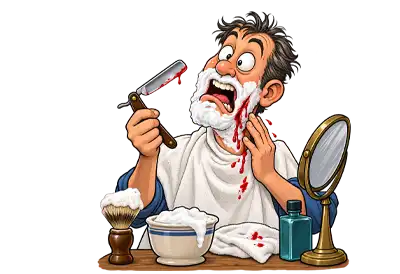
There was a time when shaving your face required a steady hand, a dangerously sharp blade, and enough courage to make a medieval knight reconsider his career choices. One wrong move with a traditional straight razor, and your peaceful morning routine could turn into a minor medical emergency. Fortunately, someone eventually decided that removing facial hair shouldn't involve quite so much personal risk. Welcome to Safety Razor Day, a celebration of the humble invention that transformed personal grooming, made shaving more accessible, and allowed millions of people to face the world without looking as though they'd just lost an argument with a kitchen knife.
Observed on December 2, Safety Razor Day recognizes one of the most influential innovations in the history of shaving. The safety razor made it easier for ordinary people to shave at home, reducing their dependence on professional barbers and the intimidating straight razors that had dominated grooming for generations. Although modern bathrooms are filled with electric shavers, disposable razors, and cartridge systems boasting more blades than seems entirely necessary, the traditional safety razor continues to enjoy a loyal following. Its simple design, replaceable blades, and remarkably close shave have helped it survive more than a century of technological progress. Sometimes the old ways really are worth keeping, especially when they don't require batteries, charging cables, or a subscription service to remove your whiskers.
What Is Safety Razor Day?
Safety Razor Day celebrates the development, history, and continuing usefulness of the safety razor, a shaving instrument designed to reduce the amount of exposed blade that comes into contact with the skin. Unlike a traditional straight razor, which features a long, completely exposed cutting edge, a safety razor uses a protective guard and carefully positioned blade to make shaving more controlled. The design does not eliminate the possibility of cuts, but it helps make the process more manageable for people shaving themselves at home.
The holiday also provides an opportunity to appreciate how everyday inventions can dramatically change ordinary routines. Shaving might not seem like a particularly important historical subject, especially when compared with electricity, aviation, or the invention of indoor plumbing. However, the safety razor changed personal hygiene practices, influenced fashion, created an enormous consumer-products industry, and contributed to the development of modern disposable goods. It also helped eliminate the need for millions of people to begin each morning sharpening a razor blade on a leather strap, which must have been especially welcome before the first cup of coffee.
Although Safety Razor Day is an informal observance rather than an official public holiday, it has found an appreciative audience among traditional shaving enthusiasts, collectors, barbers, and people who prefer classic grooming equipment. It offers an excuse to examine the history of shaving, learn how safety razors work, and perhaps reconsider the collection of expensive plastic cartridges accumulating in the bathroom cabinet. Nobody is suggesting that you abandon modern conveniences entirely, but there is something satisfying about a tool that performs its intended function without requiring an instruction manual thicker than a telephone directory.
Before the Safety Razor: Shaving Was a Risky Business
The history of shaving stretches back thousands of years, long before modern steel blades, shaving cream, or heated bathroom mirrors existed. Archaeological evidence indicates that ancient civilizations used sharpened stones, shells, and metal implements to remove facial and body hair. The ancient Egyptians were particularly concerned with grooming and cleanliness, and razors made from copper and bronze have been discovered among their surviving artifacts. Hair removal could reflect religious customs, social status, personal hygiene, or prevailing standards of appearance. Apparently, humanity has been arguing about whether to grow a beard or shave it off for almost as long as humanity has had beards.
Over the centuries, shaving instruments became increasingly sophisticated, eventually leading to the development of the familiar straight razor. These razors featured a long steel blade that folded into a protective handle, allowing the cutting edge to be stored safely when not in use. Straight razors became particularly popular during the eighteenth and nineteenth centuries, when professional barbers provided shaving services alongside haircuts and other grooming treatments. For many men, visiting the barber was an established part of social life, offering an opportunity for conversation, local news, and the occasional unsolicited opinion about politics.
However, straight razors required considerable skill and regular maintenance. Their cutting edges needed to be sharpened on a hone and maintained with a leather strop, a process that demanded patience and practice. Using one effectively also required careful control of the blade's angle and pressure against the skin. Professional barbers developed the necessary expertise through experience, but people attempting to shave themselves faced a more challenging task. Shaving around the chin, jawline, and neck could be particularly awkward, especially when relying on the limited mirrors and lighting available in many nineteenth-century homes.
The desire for a safer alternative encouraged inventors to experiment with protective guards and modified razor designs. Contrary to a popular misconception, safety razors existed before King Camp Gillette developed his famous disposable-blade system. During the nineteenth century, inventors introduced razors featuring protective combs and guards intended to reduce the risks associated with exposed blades. These early safety razors represented an important step forward, although many still required users to sharpen their blades regularly. The shaving revolution was underway, but the finishing touches would require an inventor with a particularly sharp business idea.
King Camp Gillette: The Man Who Changed Shaving Forever
One of the most important figures in safety razor history was King Camp Gillette, an American inventor and businessman born on January 5, 1855, in Fond du Lac, Wisconsin. Despite his magnificent first name, Gillette was not royalty, although he eventually became something of a monarch in the shaving industry. His early career involved working as a traveling salesman, an occupation that exposed him to numerous products, manufacturing processes, and opportunities for invention. He was fascinated by the possibility of creating useful consumer goods and understood that a successful invention could transform both everyday life and its inventor's financial circumstances.
Gillette's breakthrough idea developed during the 1890s, partly through the influence of William Painter, the inventor associated with the modern crown bottle cap. Painter had demonstrated the commercial potential of inexpensive products that consumers used and repeatedly replaced. Gillette recognized that a similar principle might apply to shaving. Instead of requiring people to maintain and sharpen relatively expensive blades, why not manufacture thin, inexpensive steel blades that could simply be replaced when they became dull? The idea was wonderfully practical, although it also introduced a business arrangement that manufacturers have appreciated ever since: sell the equipment, then keep selling the parts.
Around 1895, Gillette began developing his concept for a razor that would hold a thin, replaceable blade securely between protective components. The proposed design offered several advantages over existing shaving instruments. Users would no longer need to sharpen their blades, the cutting edge could be replaced relatively inexpensively, and the protective razor head would help control the blade's contact with the skin. Unfortunately, turning the concept into a commercially successful product proved considerably more difficult than imagining it. Manufacturing extremely thin steel blades with consistently sharp edges presented serious technical challenges, and Gillette struggled to find engineers capable of producing the design economically.
The breakthrough came through his collaboration with William Emery Nickerson, an engineer trained at the Massachusetts Institute of Technology. Nickerson helped develop the manufacturing techniques needed to produce Gillette's thin steel blades reliably and in large quantities. In 1901, Gillette and his associates established the American Safety Razor Company, which was renamed the Gillette Safety Razor Company in 1902. Commercial production began in 1903, and on November 15, 1904, Gillette received important United States patents covering his razor design. The invention helped establish the replaceable-blade safety razor as a practical consumer product, changing the shaving habits of millions of people.
The company's success was remarkable, particularly considering the manufacturing difficulties that had initially threatened the entire enterprise. Gillette's razors became widely recognized, and the inventor's portrait appeared on blade packaging, turning his face into a familiar sight in bathrooms and shops around the world. There was a certain irony in this arrangement: the man who made his fortune helping other people remove facial hair became famous partly because his own face appeared on millions of razor packages. It was a marketing achievement that modern advertising executives would probably describe as outstanding brand recognition, although Gillette himself might simply have called it good business.
How the Safety Razor Works
The traditional safety razor operates through a relatively simple mechanical principle. A sharp blade is secured within a razor head that includes a protective guard, allowing only a controlled portion of the cutting edge to reach the skin. This arrangement helps limit the blade's exposure while allowing it to cut hair close to the skin's surface. The user guides the razor across the skin using short, controlled movements, allowing the sharp blade to do the cutting rather than applying excessive pressure.
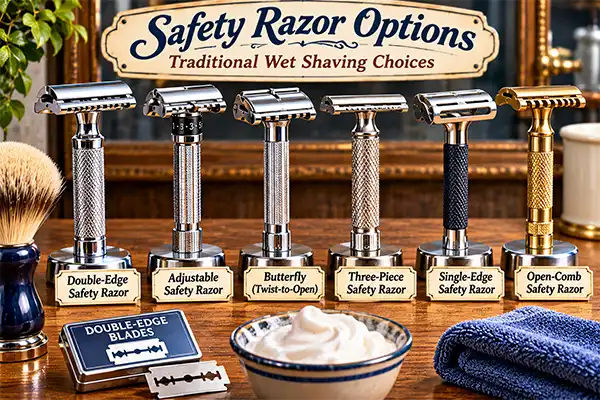
Many classic safety razors use double-edge blades, meaning the thin metal blade has a sharpened edge on both sides. This design allows users to shave with either side of the razor head, reducing the need to rinse the blade after every individual stroke. Double-edge safety razors remain popular because their replacement blades are generally inexpensive and widely available. The razor itself may be manufactured from brass, stainless steel, zinc alloy, or other durable materials, and a well-maintained example can remain serviceable for many years.
Safety razors are available in several different designs, including closed-comb, open-comb, adjustable, and single-edge models. A closed-comb safety razor typically features a continuous or scalloped protective bar beneath the blade, making it a common choice for beginners. Open-comb razors have a toothed guard that can help manage longer facial hair, although their shaving characteristics depend on the overall design. Adjustable safety razors allow users to change certain aspects of blade exposure or the gap between the blade and guard, providing different shaving characteristics without requiring a completely different razor.
Despite their name, safety razors are not entirely risk-free. An exposed cutting edge remains sharp enough to cause cuts, irritation, or other injuries if handled carelessly. Proper shaving technique involves preparing the skin, using suitable lubrication, maintaining an appropriate blade angle, and avoiding unnecessary pressure. The razor should also be kept clean, with blades replaced when they become dull or damaged. A safety razor is an excellent grooming instrument, but it is not a magic wand, and attempting to shave while simultaneously answering the telephone is unlikely to improve the experience.
The Safety Razor and the Rise of Modern Shaving
The introduction of the replaceable-blade safety razor coincided with major changes in manufacturing, advertising, and consumer culture during the early twentieth century. As industrial production became more efficient, manufacturers could produce razor blades in enormous quantities and distribute them through shops and pharmacies. This made regular shaving more convenient and helped establish the daily grooming routines familiar to modern consumers. The safety razor was no longer merely an interesting invention; it was becoming an essential household product.
The First World War contributed to the growing popularity of safety razors. Military personnel often needed to maintain personal hygiene under difficult conditions, and compact shaving equipment was easier to carry than traditional straight razors and their sharpening accessories. Gillette supplied large quantities of shaving equipment to American servicemen during the war, introducing many soldiers to the company's products. Returning veterans helped reinforce the popularity of safety razors in civilian life, contributing to their widespread adoption during the following decades.
The development of the safety razor also influenced changing attitudes toward personal appearance. During the nineteenth century, elaborate beards and mustaches had been fashionable among many European and American men. By the early twentieth century, clean-shaven faces were becoming increasingly common, particularly in business, military, and professional settings. Advertising campaigns promoted smooth skin as a sign of cleanliness, sophistication, and modern masculinity. Whether facial hair actually reflected a person's character was another matter entirely, but advertisers have never been particularly reluctant to offer opinions about what respectable people should look like.
Safety razor manufacturers eventually expanded their marketing beyond men's facial hair. During the early twentieth century, companies introduced products specifically intended for women, reflecting changing clothing fashions and beauty standards. As sleeveless dresses and shorter hemlines became increasingly popular, advertisements encouraged women to remove underarm and leg hair. These campaigns helped establish new grooming expectations, demonstrating how manufacturers could influence social customs as well as respond to them. The safety razor became part of a much larger personal-care industry, serving customers with different preferences, needs, and shaving routines.
Safety Razors Versus Modern Cartridge Razors
The traditional safety razor has faced considerable competition since its introduction. During the twentieth century, manufacturers developed disposable plastic razors, cartridge systems, pivoting heads, lubricating strips, and increasingly elaborate combinations of multiple blades. Modern shaving advertisements frequently suggest that the secret to a perfect shave involves adding yet another blade to an already crowded razor head. At this rate, someone may eventually produce a razor with enough blades to qualify as a small agricultural implement.
Cartridge razors offer several practical advantages, particularly for people who appreciate convenience and ease of use. Their pivoting heads can help maintain contact with the skin, while protective features may make them more forgiving of imperfect technique. Many consumers find them particularly convenient for shaving legs, underarms, and other areas where body contours can make blade control challenging. However, replacement cartridges can be expensive, and the plastic components contribute to the waste associated with disposable grooming products.
Traditional safety razors offer a different approach. Their handles are often designed for long-term use, while the replaceable blades contain relatively little material compared with complete disposable razors or plastic cartridges. Depending on the product, local recycling arrangements, and how used blades are collected, this can reduce certain types of shaving-related waste. Nevertheless, safety razors are not automatically environmentally harmless, and their overall environmental impact depends on manufacturing, transportation, product longevity, and disposal practices.
Cost is another reason people return to traditional safety razors. Although a quality metal razor may require a larger initial investment than an inexpensive disposable model, replacement double-edge blades are often considerably cheaper than proprietary cartridge refills. Over several years, regular users may save money, particularly if they maintain their razor properly and avoid buying every attractive shaving accessory that appears online. Of course, traditional shaving enthusiasts sometimes develop impressive collections of razors, brushes, soaps, and shaving bowls, proving that even an economical hobby can become expensive when enthusiasm gets involved.

The Art of the Traditional Wet Shave
For many enthusiasts, using a safety razor is about more than simply removing unwanted hair. Traditional wet shaving has developed into a grooming ritual involving warm water, shaving soap or cream, a quality brush, and careful shaving technique. The process encourages users to slow down, prepare their skin properly, and pay attention to the direction of hair growth. In a world increasingly dominated by rushed mornings and electronic distractions, spending a few peaceful minutes on an ordinary grooming routine can be surprisingly satisfying.
A traditional wet shave generally begins by washing the area with warm water to soften the hair and remove surface dirt and oils. Shaving cream or soap is then applied to provide lubrication and help the blade move smoothly across the skin. Some enthusiasts use a shaving brush to create a rich lather, although a brush is not essential for achieving a comfortable shave. The razor is guided gently over the skin, usually beginning in the direction of hair growth to reduce the likelihood of irritation.
Unlike many modern cartridge razors, traditional safety razors generally require users to pay closer attention to the angle of the blade. Applying too much pressure can increase the risk of cuts, razor burn, and irritation. Beginners often benefit from practicing with short, gentle strokes and resisting the temptation to achieve a perfectly smooth shave in a single pass. It is worth remembering that the purpose of shaving is to remove hair, not the top layer of your face.
After shaving, the skin should be rinsed and treated with a suitable moisturizer or aftershave product if desired. The razor should be cleaned and allowed to dry, while used blades must be disposed of safely in a suitable blade container rather than placed loose in household rubbish. This final precaution is particularly important because discarded razor blades can injure anyone handling waste. The shaving process may be traditional, but there is no reason to preserve the less desirable historical custom of accidentally cutting yourself.
Why Traditional Safety Razors Are Still Popular
Despite more than a century of competition and technological innovation, the traditional safety razor has maintained a dedicated following. Some people appreciate the simplicity of a mechanical device with relatively few components, while others enjoy the quality of the shave or the opportunity to reduce their reliance on disposable plastic products. Collectors are also attracted to the history, craftsmanship, and distinctive designs of vintage razors, many of which remain functional decades after their manufacture.
The growing interest in traditional shaving reflects a broader appreciation for durable, repairable, and reusable everyday products. Safety razors appeal to people who prefer equipment that performs a specific task without unnecessary complexity. There are no batteries to replace, no electronic displays to configure, and no software updates arriving halfway through the morning routine. A safety razor simply waits patiently until someone needs a shave, which is a level of cooperation not always encountered with modern technology.
Vintage safety razors have also become collectible objects, particularly models produced during the early and middle decades of the twentieth century. Collectors seek examples from manufacturers such as Gillette, Schick, and other historical shaving companies, sometimes paying considerable sums for rare designs or well-preserved original packaging. Certain models feature intricate metalwork, unusual adjustment mechanisms, or distinctive handles that reflect the manufacturing styles of their era. A razor that once occupied an ordinary bathroom cabinet can therefore become an interesting piece of industrial history.
For professional barbers, traditional shaving equipment continues to represent an important part of the trade's heritage. Although many modern barbers use replaceable-blade straight-style razors for professional shaving services, the principles of careful blade control, proper skin preparation, and skilled technique remain closely connected with the history of safety razors. The renewed popularity of traditional barbershops has also encouraged interest in classic grooming products and the craftsmanship associated with earlier generations.
Interesting Facts About Safety Razors
The history of the safety razor contains several surprising details, demonstrating that even an ordinary bathroom accessory can have an extraordinary past.
- King Camp Gillette did not invent the first safety razor. Earlier inventors had already developed razors with protective guards. His major achievement was making thin, replaceable blades commercially practical.
- Gillette's invention was inspired partly by bottle caps. William Painter's success with disposable crown bottle caps helped demonstrate the commercial potential of inexpensive replacement products.
- The original Gillette company began in 1901. Commercial razor production followed in 1903, with important patents granted in 1904.
- Safety razors traveled into space. Apollo 11 astronaut Michael Collins carried Gillette shaving equipment aboard the historic 1969 mission. Apparently, even traveling to the Moon was no excuse for neglecting personal grooming.
- Double-edge blades have two cutting edges. Their design allows users to shave with either side of the razor head.
- Vintage safety razors can remain usable for generations. Many well-maintained metal models continue to function long after their original owners have retired them.
- The safety razor helped change men's fashion. Convenient home shaving contributed to the growing popularity of clean-shaven faces during the twentieth century.
King Gillette had unusual political ideas. Despite building a successful consumer-products business, he advocated ambitious utopian schemes for reorganizing society. His plans for civilization proved rather less successful than his plans for removing whiskers.
How to Celebrate Safety Razor Day
Celebrating Safety Razor Day on December 2 offers an opportunity to appreciate an invention that most people rarely consider, despite its influence on everyday life. Those who already use a traditional safety razor might mark the occasion by enjoying a carefully prepared wet shave, cleaning their shaving equipment, or learning more about the history of their favorite razor. It is also a good excuse to replace an aging blade, although this particular activity should probably be undertaken with greater care than the average holiday celebration.
People unfamiliar with traditional safety razors might enjoy exploring the differences between double-edge razors, cartridge systems, and electric shavers. Learning about the development of shaving equipment reveals how manufacturing innovations changed personal hygiene over the centuries. Museums, historical collections, and online archives contain fascinating examples of early razors, advertising materials, and patent drawings. Some of the original advertisements are particularly entertaining, especially those suggesting that a clean-shaven face could practically guarantee professional success, romantic happiness, and the admiration of everyone within a ten-mile radius.
Safety Razor Day is also an excellent opportunity to appreciate the work of professional barbers. A visit to a traditional barbershop can provide an enjoyable grooming experience while supporting a skilled trade with centuries of history. Barbers have long played an important role in communities, providing personal services and creating places where customers exchange news, discuss local events, and occasionally solve all the world's problems before lunchtime. Whether those solutions are ever implemented is another matter.
Anyone interested in trying a traditional safety razor should begin with a suitable beginner-friendly model and take time to learn proper technique. A quality shaving cream, gentle pressure, and careful attention to blade angle can make the experience more comfortable. There is no requirement to abandon existing grooming equipment, and people with sensitive skin or particular shaving needs may find that other methods suit them better. The best shaving system is ultimately the one that works comfortably, safely, and reliably for the individual using it.
For those who prefer facial hair, Safety Razor Day does not require a dramatic change in appearance. Beards, mustaches, and carefully cultivated stubble have their own proud traditions, and a safety razor can still be useful for maintaining clean edges around facial hair. There is no need to sacrifice a magnificent beard simply because someone has declared a holiday in honor of shaving equipment. After all, a celebration of technological innovation should not become an excuse for unnecessary destruction.
A Close Shave Worth Celebrating
Safety Razor Day reminds us that some of history's most influential inventions are not enormous machines, complicated electronic devices, or dramatic scientific discoveries. Sometimes an innovation consists of a small piece of sharpened steel, a practical handle, and a clever idea that makes an ordinary task easier. The safety razor helped transform personal grooming, encouraged new manufacturing techniques, influenced consumer habits, and established a product category that continues to serve millions of people.
From early protective razor designs to King Camp Gillette's replaceable-blade system, the history of the safety razor demonstrates how inventors can improve familiar tools through persistence and practical thinking. The invention did not eliminate every inconvenience associated with shaving, and it certainly did not end humanity's long-running disagreements about facial hair. However, it made routine shaving more accessible and helped establish the modern grooming industry.
More than a century after Gillette's famous patents, traditional safety razors continue to prove that an effective design does not necessarily need constant reinvention. Their enduring popularity reflects the appeal of straightforward engineering, durable construction, and a close shave achieved through skill rather than technological extravagance.
So, on December 2, raise your shaving brush, admire that freshly polished razor, and spare a thought for the inventors who helped make morning grooming a little less hazardous.
And remember, whether you prefer a perfectly smooth chin or a beard worthy of a nineteenth-century sea captain, the most important rule remains unchanged: shave carefully, take your time, and never attempt precision grooming during an earthquake.
Your face will thank you.