Rain, Snow, Gloom—and Probably an Angry Dog
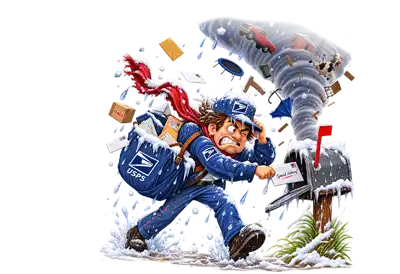
Neither Snow Nor Rain Day celebrates the men and women who deliver the mail despite weather that would make the rest of us look through the window, reconsider our plans and decide that whatever we needed can probably wait until tomorrow. Observed every September 7, the day honors postal workers, mail carriers and the long history of dependable mail delivery while celebrating one of the most famous sentences ever associated with the United States Postal Service. There is only one small complication: the famous Postal Service motto isn't actually the Postal Service motto.
When Is Neither Snow Nor Rain Day?
Neither Snow Nor Rain Day is celebrated annually on September 7. The date commemorates the opening of New York City's magnificent General Post Office building on September 7, 1914. Today known as the James A. Farley Building, the enormous Beaux-Arts structure stands on Eighth Avenue in Manhattan, directly across from Pennsylvania Station.
Stretching across its imposing façade is the inscription that inspired Neither Snow Nor Rain Day: “Neither snow nor rain nor heat nor gloom of night stays these couriers from the swift completion of their appointed rounds.” Those words have become so thoroughly associated with American mail carriers that generations of people have assumed they are the official motto of the United States Postal Service. They aren't. The USPS has repeatedly pointed out that it has no official motto.
Apparently nobody told the inscription. It has been doing a remarkably convincing impression of one for more than a century.
A Post Office Built to Make an Impression
The building associated with Neither Snow Nor Rain Day was designed by the celebrated architectural firm McKim, Mead & White and constructed during an era when major public buildings were expected to look suitably important. New York City's General Post Office certainly fulfilled that requirement. Built in the grand Beaux-Arts style, the enormous structure occupied two city blocks along Eighth Avenue, directly across from the original Pennsylvania Station, another monumental McKim, Mead & White creation. With its sweeping staircase, long granite façade and impressive row of Corinthian columns, the post office looked less like somewhere to buy a stamp and more like somewhere the Roman Senate might meet to discuss the price of one.
The location was also extremely practical. Pennsylvania Station was one of the busiest transportation centers in the country, and placing a major postal facility immediately beside its railroad tracks allowed enormous quantities of mail to move efficiently between trains and the postal system. At a time when railroads carried much of America's long-distance mail, the building was not simply an architectural statement; it was an important piece of transportation infrastructure. Letters, newspapers, business correspondence, catalogs and parcels passed through the facility on their way throughout New York and across the United States.
The post office opened for postal business on September 7, 1914, which is why Neither Snow Nor Rain Day is observed on that date. Its most memorable feature became the inscription stretching across the building's façade: “Neither snow nor rain nor heat nor gloom of night stays these couriers from the swift completion of their appointed rounds.” Positioned prominently above the columns, the words were almost impossible to overlook and gradually became inseparable from the public image of American postal workers.
The building was eventually renamed the James A. Farley Building in honor of James A. Farley, who served as U.S. Postmaster General from 1933 to 1940 and was an influential political ally of President Franklin D. Roosevelt. Much of the historic building remains standing today, although significant portions have been transformed for new uses, including the Moynihan Train Hall serving Pennsylvania Station. More than a century after the post office opened, however, those famous words remain carved across the Eighth Avenue façade.
Farley didn't write them and neither did the United States Postal Service, for that, we need to travel considerably farther back than 1914. About 2,400 years farther.
The Famous Postal Motto That Isn't a Postal Motto
The words associated with Neither Snow Nor Rain Day originated with the ancient Greek historian Herodotus, who lived during the fifth century B.C.
Herodotus described the remarkably efficient system of mounted couriers operated by the Persian Empire. Messages traveled through a relay network in which riders and fresh horses were stationed along established routes. Instead of one exhausted messenger attempting an enormous journey, messages could continue rapidly from station to station. Herodotus was impressed.
In his Histories, he described Persian couriers continuing their appointed journeys despite snow, rain, heat and darkness. More than two millennia later, architect William Mitchell Kendall of McKim, Mead & White encountered a translation of the passage and recognized that words praising ancient Persian messengers would look rather splendid carved into an enormous American post office. He was right.
The wording was adapted and placed prominently across the New York building, where millions of people saw it. Gradually, the inscription became so closely associated with American postal workers that it effectively became an unofficial creed.
Not bad longevity for what amounts to a 2,400-year-old positive performance review.
Ancient Persia Invented a Very Good Delivery System
The connection between Herodotus and modern postal service isn't quite as peculiar as it initially sounds. The Persian Empire governed an enormous territory, and rulers faced the same problem that governments, businesses and families have faced throughout history: information isn't terribly useful if it arrives six months late, so Persian rulers developed sophisticated roads and courier networks that allowed official messages to travel quickly across great distances. Relay stations supplied riders with fresh horses, allowing communications to continue without waiting for either animal or messenger to recover.
The system demonstrated a principle that remains fundamental to postal and delivery networks today: divide an enormous journey into manageable sections and coordinate them efficiently.
Modern mail might travel aboard trucks and airplanes rather than Persian horses, but the underlying idea would be instantly recognizable to an ancient courier, although the tracking number might require some explanation.
America's Postal Story Began Before America
Neither Snow Nor Rain Day also provides an opportunity to appreciate the extraordinary history of the American postal system.
Postal services existed in the colonies long before the United States became an independent nation. In 1775, the Second Continental Congress appointed Benjamin Franklin as the first Postmaster General under the emerging American government. Franklin was particularly well suited to the job, having previously served as a colonial postmaster and helped improve postal routes and delivery times.
As the United States expanded, the postal network expanded with it.
Post offices became essential institutions in towns and settlements across the country. Mail carried personal correspondence, newspapers, government information, business transactions and news from distant relatives. Before telephones, email, text messages and social media, receiving a letter could genuinely be the only way to discover what was happening hundreds or thousands of miles away.
A letter from home wasn't merely pleasant, sometimes it was the only connection to home.
Delivering America
The history of United States mail delivery is also a history of adapting transportation to an enormous and frequently inconvenient country. As the nation expanded westward, the postal system had to find ways of reaching settlements separated by mountains, deserts, rivers, forests and hundreds of miles of territory containing absolutely no convenient place to stop for coffee. Mail traveled by foot, horseback, stagecoach, steamboat and railroad before automobiles and airplanes transformed the system. The method mattered less than the objective: somehow, letters and packages had to reach people wherever Americans decided to build their homes.
Stagecoaches became an important part of long-distance mail transportation during the 18th and 19th centuries, carrying sacks of correspondence alongside passengers over roads that could be muddy, dangerous and spectacularly uncomfortable. Steamboats helped move mail along America's great rivers, while expanding railroad networks dramatically increased the speed and volume of postal transportation. Railway Mail Service clerks eventually sorted letters aboard moving trains, preparing mail for delivery while traveling between cities. It was an extraordinarily efficient system, although sorting hundreds of letters inside a swaying railroad car presumably required excellent handwriting recognition and an unusually cooperative stomach.
The Pony Express became perhaps America's most romanticized mail service. Beginning in April 1860, young riders carried mail between St. Joseph, Missouri, and Sacramento, California, using a carefully organized network of relay stations where exhausted horses could quickly be exchanged for fresh ones. Riders covered sections of the roughly 1,900-mile route at considerable speed, helping messages cross the country in around ten days under favorable conditions. The service captured the public imagination with its image of fearless riders racing across the frontier, but its actual career was remarkably brief. The Pony Express operated for only about 18 months before the completion of the transcontinental telegraph in 1861 made its expensive high-speed delivery system largely unnecessary.
Technology continued changing the way America's mail traveled. Railroads became the backbone of long-distance postal transportation, automobiles gradually replaced horses on many local routes, and aircraft opened an entirely new chapter with the development of U.S. airmail during the early 20th century. Early airmail pilots flew relatively primitive aircraft through unpredictable weather with limited navigation equipment, sometimes following railroad tracks and landmarks to find their destinations. Eventually, commercial aviation and sophisticated transportation networks made moving mail thousands of miles in a matter of hours an ordinary part of the postal system.
Yet some American communities still require decidedly unconventional delivery methods. Depending on geography, mail has been transported by boats, small aircraft and other specialized means to reach isolated locations. The machinery surrounding the mail has changed enormously since Benjamin Franklin's day, but the basic challenge remains remarkably familiar: somebody has something that needs to reach somebody else.
Technology changes. Horses give way to trains, trains give way to airplanes, and handwritten letters increasingly share the journey with mountains of online shopping packages.
People still expect their mail.
From Letters to Packages
For much of American history, the mail meant letters. Families separated by hundreds of miles exchanged news through handwritten correspondence, businesses sent invoices and orders through the post, newspapers carried information between communities, and government agencies depended upon the postal network to communicate with citizens. A letter arriving from a distant relative could be an important event, particularly when weeks or months might have passed since the previous communication. Before telephones, email, text messages and social media made instant contact routine, the mailbox was quite literally a connection with the wider world.
The contents of the average American mailbox have changed considerably. Personal letters haven't disappeared, but much of the everyday conversation once entrusted to paper now travels electronically. Birthday wishes arrive through social media, photographs appear instantly on phones, bills can be paid online and a message that once required several days to cross the country can now arrive before its sender has finished wondering whether they should have added an emoji. Yet rather than making postal delivery obsolete, the digital revolution created an entirely new reason for carriers to visit our homes: online shopping.
Packages have become an increasingly familiar part of modern postal delivery. The same internet that reduced the number of personal letters made it possible to order almost anything without leaving the sofa. Postal workers now deliver clothing, books, household supplies, gifts, electronics, prescription medications and countless other purchases alongside traditional letters, magazines and documents. The modern mail carrier may begin the morning with a vehicle packed with parcels destined for hundreds of addresses, including at least one surprisingly enormous box containing something the recipient apparently couldn't possibly have purchased locally.
That transformation has required the postal network to adapt once again. Sorting facilities increasingly handle parcels of widely varying shapes and sizes, while carriers must balance traditional letter delivery with packages destined for porches, apartment buildings and businesses. The familiar mailbox remains important, but the front doorstep has effectively become its considerably larger relative. During busy shopping periods and the holiday season, the sheer volume of packages moving through the system demonstrates just how closely modern e-commerce has become connected with physical delivery.
The United States Postal Service also maintains something particularly important in a country of more than three million square miles: an enormous nationwide delivery network reaching cities, suburbs, small towns and remote rural communities. That reach allows physical correspondence and merchandise to travel to places where providing regular commercial delivery might otherwise be difficult or uneconomical. The contents of the mailbag may have changed dramatically since the days of stagecoaches and handwritten letters, but the fundamental job has not.
Someone, somewhere, has something that needs delivering.
These days, there's a reasonably good chance they ordered it online at 1:17 in the morning after suddenly deciding that life was impossible without it.
Does the Mail Really Come Through Snow and Rain?
The famous inscription sounds wonderfully heroic: neither snow nor rain nor heat nor gloom of night will prevent the couriers from completing their appointed rounds. It conjures images of determined letter carriers battling through blizzards, wading across flooded streets and marching beneath a blazing summer sun while clutching somebody's electric bill with grim determination. There is considerable truth behind the reputation for reliability, but Neither Snow Nor Rain Day shouldn't be interpreted as an instruction requiring postal workers to challenge Mother Nature to single combat.
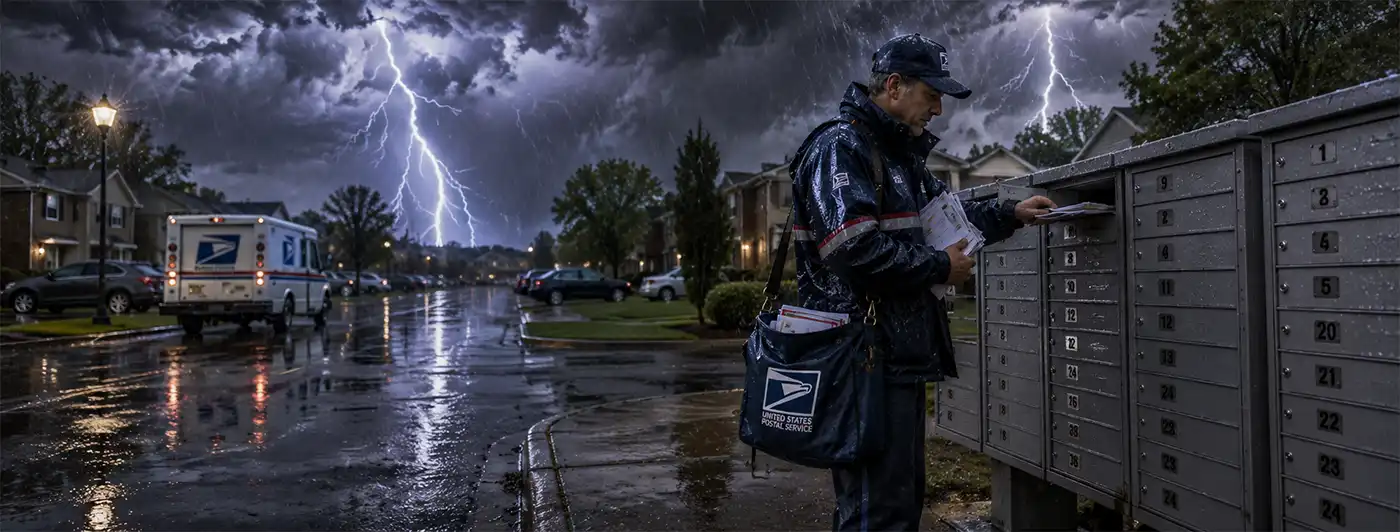
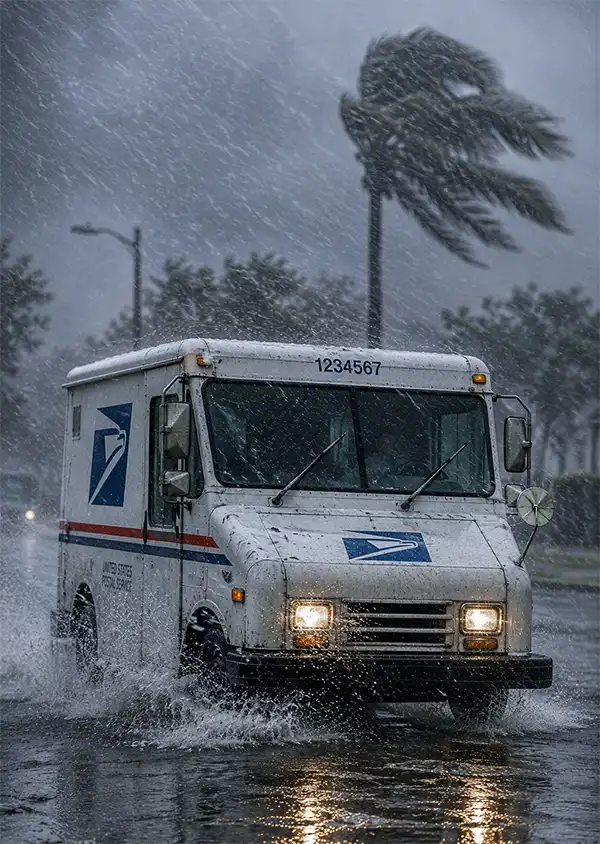
Severe weather can and does interrupt mail service. Hurricanes, tornadoes, floods, wildfires, ice storms and major snowstorms can make roads impassable, damage postal facilities or create conditions in which attempting normal delivery would be dangerous. The United States Postal Service can temporarily suspend or modify operations when circumstances require it, just as transportation networks and other public services respond to emergencies. Delivering the mail is important, but no birthday card, catalog or package of replacement vacuum-cleaner filters is worth somebody being injured trying to reach a mailbox.
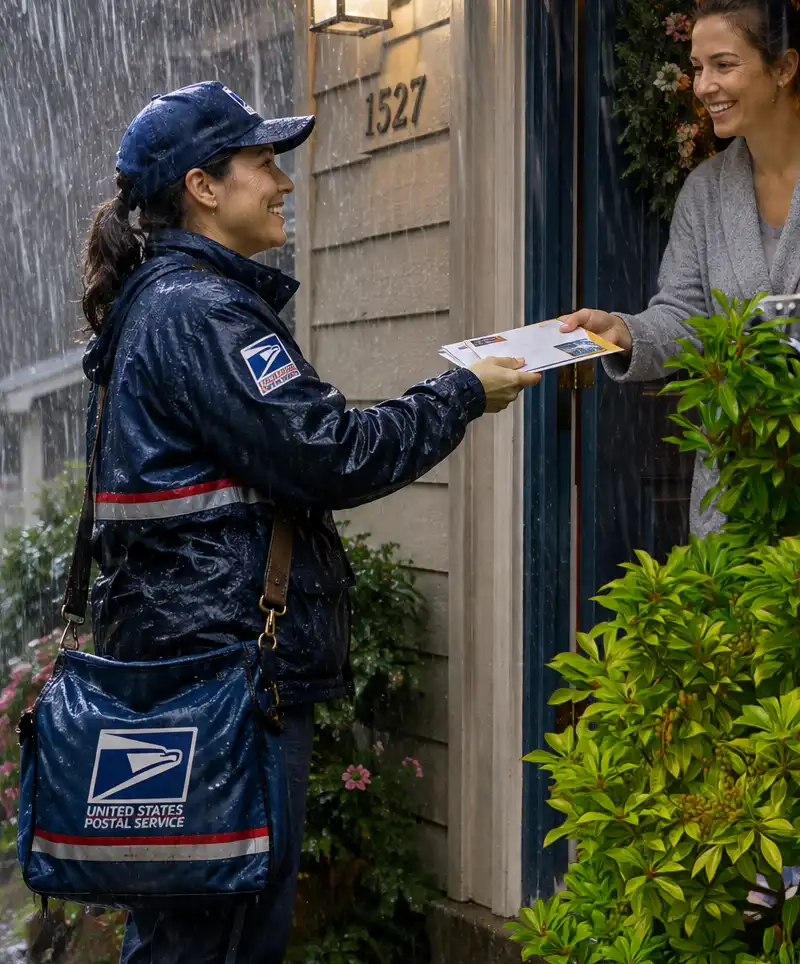
More ordinary weather presents its own challenges. Letter carriers routinely work through rain, snow, summer heat and bitter winter temperatures, spending hours outdoors while moving between hundreds of addresses. In northern communities, snow and ice can make sidewalks, steps and approaches to mailboxes hazardous. During extreme heat, carriers must contend with prolonged exposure to high temperatures while continuing physically demanding routes. Rain can turn an ordinary delivery round into several hours of attempting to keep thousands of pieces of paper dry while becoming considerably less successful at keeping the person carrying them dry.
Customers therefore have an important part to play in keeping mail delivery safe. Walkways and steps should be kept clear of snow, ice and other obstacles, while vegetation shouldn't block access to mailboxes. Rural mailboxes need to remain accessible from the road, particularly after storms or heavy snowfall. Dogs should also be properly secured when a carrier approaches. Even the world's friendliest dog can become territorial when a uniformed stranger arrives at the same time every afternoon carrying a suspicious-looking bag apparently filled with messages from the outside world.
The spirit of the famous inscription is not that postal workers should ignore dangerous conditions. It celebrates something far more practical and impressive: reliability. Every day, an enormous network of employees, vehicles, sorting facilities and transportation systems adjusts to changing conditions so that mail continues moving toward its destination. A storm affecting one region can disrupt roads, flights and distribution centers hundreds of miles from the person waiting beside the mailbox, yet most of the time the system adapts and the mail continues its journey.
That is what Neither Snow Nor Rain Day really celebrates. Postal workers aren't expected to defeat the weather. They simply have an exceptionally long history of refusing to let it win easily.
The Postal Worker at Your Door
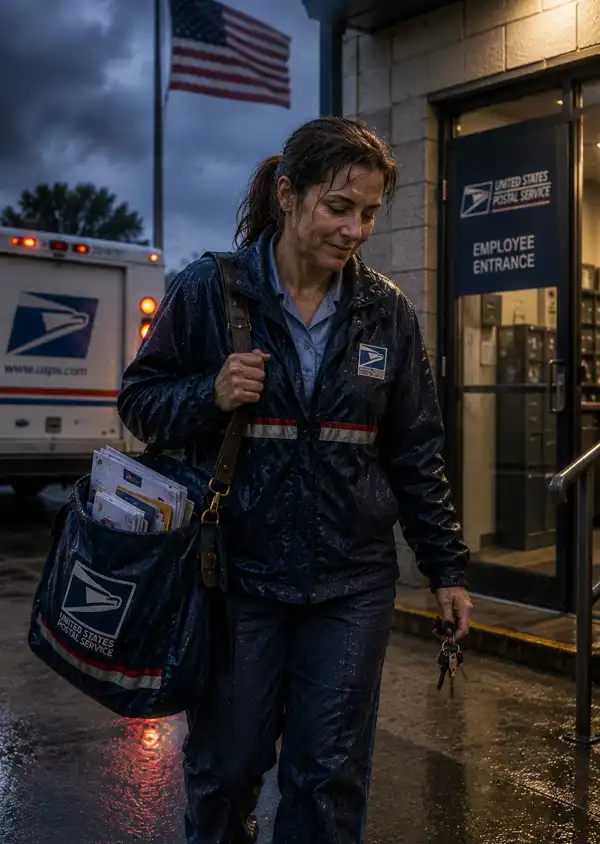
Neither Snow Nor Rain Day ultimately celebrates people rather than buildings, ancient quotations or impressive transportation networks. For most Americans, the human face of the postal system is the letter carrier who arrives at the house day after day. Carriers walk neighborhood routes, drive rural roads, climb apartment stairs and make hundreds of stops while dealing with summer heat, winter cold, pouring rain and all the ordinary inconveniences that come with spending much of a working day outdoors. Their arrival is so familiar that it is easy to forget they represent the final few yards of a journey that may have carried a letter or package thousands of miles.
Long before anything reaches the carrier's bag or delivery vehicle, however, an enormous operation has already taken place. Postal clerks accept and process mail, automated equipment sorts it at remarkable speed, employees move containers through distribution facilities, aircraft carry shipments across the country, and trucks haul enormous trailer loads of mail between processing centers. Mechanics keep vehicles operating, technicians maintain sorting equipment, dispatchers coordinate transportation and countless other employees work behind the scenes. Much of this activity happens overnight, while the eventual recipient is comfortably asleep and completely unaware that their mail is racing along an interstate highway somewhere several states away.
Once mail reaches its destination area, the local carrier becomes responsible for that last crucial stage. Letters must be sorted into delivery sequence, packages organized and an entire route completed as efficiently and safely as possible. On an ordinary day that may involve hundreds of addresses and a surprising amount of physical work. Add heavy rain, oppressive heat, icy sidewalks, road construction, holiday package volumes or an unexpectedly territorial dog, and an apparently simple journey from the local post office to the mailbox becomes considerably more complicated.
Rural letter carriers face challenges of their own. Their routes can stretch across many miles of country roads where homes are widely separated and mailboxes may be considerable distances apart. In remote communities, postal delivery provides something more important than convenience. Medicines, financial documents, government correspondence, newspapers, packages and personal letters may all arrive through the same dependable connection. The carrier isn't merely dropping envelopes into boxes; that route is part of a nationwide system linking even relatively isolated households with the rest of the country.
Most of this happens so routinely that we barely notice the extraordinary logistics involved. Place a properly addressed letter into the mail in Florida and an enormous network of people, machines, trucks, aircraft and sorting facilities begins moving it toward somebody in Oregon, Maine, Alaska or thousands of destinations in between. Eventually, after perhaps traveling farther in a few days than many people travel in a year, it reaches one particular postal worker who carries it through the final stage of its journey and puts it into the correct mailbox.
And then we walk outside, pick it up and think nothing remarkable has happened.
Perhaps that is the greatest compliment the postal system and its workers have earned. Reliable mail delivery has become so ordinary that we generally notice the enormous machine behind our mailbox only when something goes wrong.
Neither Snow Nor Rain Day gives us one day to notice when everything goes right.
How to Celebrate Neither Snow Nor Rain Day
Celebrating Neither Snow Nor Rain Day doesn't require purchasing a horse, memorizing Herodotus or attempting to deliver an urgent message across the Persian Empire before sunset. The easiest way to observe the day is simply to recognize the postal workers who keep the mail moving. If you happen to see your letter carrier, a friendly thank-you costs nothing and acknowledges a job that most of us barely think about until the mailbox is unexpectedly empty. Postal employees perform an enormous amount of work every day without fanfare, so September 7 provides an excellent excuse to let them know that somebody notices.
You could also celebrate by sending an actual handwritten letter or card. Choose somebody you haven't contacted in a while, find a piece of paper, locate a pen that still works and write something by hand. Then place it in an envelope, address it, attach a stamp and drop it into the mail. The entire procedure may seem almost archaeological to anyone raised on smartphones, but there is something wonderfully personal about receiving a message somebody physically wrote, mailed and waited for you to receive. An email can cross the country in seconds, but nobody has ever discovered an old text message tucked inside a box of family photographs and spent the next hour reading it again.
Neither Snow Nor Rain Day is also an excellent opportunity to explore postal history. Visit a historic post office, investigate the development of mail delivery in your community or learn about the remarkable transportation systems that have carried American mail over the centuries. From horseback riders and stagecoaches to Railway Post Office cars, airmail pilots, tractor-trailers and modern automated sorting facilities, the story of the mail is closely connected with the development of the United States itself. Stamp collecting offers another route into that history, since postage stamps have commemorated presidents, explorers, artists, scientists, wildlife, historic events and enough other subjects to turn a small album into a miniature illustrated history of the country.
Families can use the day to introduce children to the mysterious technology known as the mailbox. Let them write a letter to a grandparent, relative or friend and involve them in addressing the envelope, attaching the stamp and mailing it. Then wait for a reply. For children accustomed to instant communication, discovering that a message can physically travel hundreds of miles and arrive several days later can be surprisingly fascinating. There is also something rather satisfying about explaining that the tiny rectangle stuck in the corner of the envelope pays for an entire nationwide transportation operation.
Perhaps the most practical way to celebrate is to make your own mailbox an easier place to serve. Keep walkways and steps clear, trim vegetation that obstructs access and make sure rural mailboxes can be reached safely from the road. During winter weather, remove snow and ice from the carrier's approach. If you have dogs, keep them properly controlled when postal workers are nearby. Your carrier may genuinely adore dogs, but discovering whether yours feels the same way shouldn't be part of the daily delivery schedule.
However you choose to observe Neither Snow Nor Rain Day, the purpose is wonderfully simple: appreciate the people and the system responsible for getting things where they need to go.
After all, your letter carrier already has snow, rain, heat and gloom of night to contend with, so there is no reason to add your overgrown hedge and an enthusiastic Labrador to the ancient prophecy.
Why Neither Snow Nor Rain Day Matters
Neither Snow Nor Rain Day recognizes something easily overlooked in an age of instantaneous electronic communication: physical delivery still matters.
Medicines cannot be emailed. A birthday present cannot be texted. Legal documents, packages, ballots, magazines and countless other physical items still need to travel from one human being to another. Behind every one of those deliveries is infrastructure developed over centuries and people responsible for making it work.
The famous words carved into the James A. Farley Building may never have been an official United States Postal Service motto, but perhaps that makes them even more meaningful. Nobody ordered generations of postal workers to adopt the phrase. Their reputation for persistence made the public adopt it for them. Snow, rain, heat and darkness have changed remarkably little since Herodotus watched Persian couriers more than two thousand years ago. Fortunately, neither has our determination to get the message through.
Neither Snow Nor Rain Day Trivia
Neither Snow Nor Rain Day has accumulated an impressive collection of historical baggage for a celebration about delivering the mail. Its story involves Benjamin Franklin, an enormous New York post office, trains, airplanes, the Pony Express and a famous “motto” that isn't actually a motto. Most remarkably, its best-known words can be traced back roughly 2,400 years to an ancient Greek historian describing Persian couriers. So, before we stamp this one, seal it and send it on its way, here are a few pieces of Neither Snow Nor Rain Day trivia worth delivering.
- Neither Snow Nor Rain Day is celebrated every year on September 7.
- The date commemorates the 1914 opening of New York City's main post office building.
- The famous “Neither snow nor rain” inscription is not the official motto of the USPS.
- In fact, the United States Postal Service has no official motto.
- The inscription was inspired by the writings of ancient Greek historian Herodotus.
- Herodotus was describing mounted couriers of the Persian Empire, not American mail carriers.
- Benjamin Franklin became Postmaster General under the Continental Congress in 1775.
- The New York post office was renamed the James A. Farley Building in 1982.
Rain and Snow FAQ
From ancient Persian couriers galloping across an empire to Pony Express riders racing across the American frontier and today's postal workers arriving at our mailboxes, Neither Snow Nor Rain Day has accumulated plenty of questions along its 2,400-year journey. So, before the next horse is saddled, truck is loaded or mailbag heads out the door, here are the answers to some frequently asked questions about the history, traditions and remarkably enduring ideas behind Neither Snow Nor Rain Day.
When is Neither Snow Nor Rain Day?
Neither Snow Nor Rain Day is observed annually on September 7. The date commemorates the opening of New York City's General Post Office building on September 7, 1914. Today known as the James A. Farley Building, its enormous Eighth Avenue façade carries the famous inscription beginning, “Neither snow nor rain nor heat nor gloom of night.”
Is “Neither snow nor rain” really the official motto of the United States Postal Service?
No. Despite being one of the most recognizable phrases associated with American mail delivery, it has never been the official motto of the United States Postal Service. In fact, the USPS has no official motto. The inscription became so closely associated with American letter carriers that the public effectively adopted it on their behalf.
Where did the words “Neither snow nor rain nor heat nor gloom of night” come from?
Their origins can be traced back roughly 2,400 years to the ancient Greek historian Herodotus. In The Histories, Herodotus praised the speed and reliability of mounted couriers serving the Persian Empire. His description explained that snow, rain, heat and darkness did not prevent the couriers from completing their journeys as quickly as possible.
Why are the words of Herodotus written on a New York post office?
Architect William Mitchell Kendall of McKim, Mead & White encountered a translation of Herodotus describing the Persian courier system and believed the passage was particularly appropriate for a major post office. An adapted version was therefore carved prominently across the façade of New York's General Post Office. Millions of people subsequently saw the inscription, helping turn the ancient description into an unofficial symbol of American postal service.
How did the ancient Persian courier system work?
The Persian Empire maintained roads and relay stations that allowed official messages to travel rapidly across enormous distances. Riders covered sections of a route and could obtain fresh horses at established stations, allowing the message to continue without requiring one exhausted horse to make the entire journey. It was an extraordinarily effective communications system for the ancient world.
Was the Pony Express based on the same idea as the Persian courier system?
The two systems were separated by more than two thousand years and developed under very different circumstances, but the underlying principle was remarkably similar. Pony Express riders carried mail along sections of a roughly 1,900-mile route between Missouri and California, changing horses frequently at relay stations. Just as the Persian system kept the message moving by supplying fresh horses and couriers along an established route, the Pony Express used relays to move mail much faster than a single horse and rider could manage. The technology had changed surprisingly little: good roads, fresh horses and somebody willing to ride them very quickly.
How long did the Pony Express operate?
Surprisingly, the legendary Pony Express operated for only about 18 months, from April 1860 until October 1861. Despite its enormous place in American folklore, technological progress quickly overtook it. Completion of the transcontinental telegraph allowed messages to cross the country electronically, making an expensive network of galloping horses considerably less competitive.
Does the United States Postal Service deliver mail during severe weather?
Postal workers routinely deliver through rain, snow, heat and other difficult conditions, but safety comes first. Hurricanes, floods, wildfires, severe winter storms and other dangerous situations can cause deliveries to be delayed, modified or temporarily suspended. The famous inscription celebrates determination and reliability; it isn't an instruction requiring postal workers to challenge a hurricane over somebody's electric bill.
Who was America's first Postmaster General?
Benjamin Franklin was appointed Postmaster General by the Second Continental Congress in 1775. Franklin already possessed considerable postal experience and helped establish an efficient communication network among the colonies. The postal system he helped develop became an important part of the infrastructure of the emerging United States.
What does Neither Snow Nor Rain Day celebrate?
Neither Snow Nor Rain Day celebrates postal workers and the enormous transportation and distribution network that keeps America's mail moving. It recognizes everyone involved in the journey, from employees processing and sorting the mail to truck drivers and transportation workers moving it across the country and the letter carrier completing those final few yards to your mailbox.
So the next time a letter arrives, consider its ancestry. Modern postal delivery has computers, airplanes, tractor-trailers and automated sorting machines behind it, but one of its fundamental ideas would have made perfect sense to a Persian courier 2,400 years ago:
Keep the message moving.