Three Flavors, One Dessert, No Decisions Required
August 21 brings us National Spumoni Day, a celebration of the Italian frozen dessert that looked at an ordinary bowl of ice cream and apparently decided it wasn't trying hard enough. Spumoni brings together contrasting flavors, colorful layers, nuts and candied fruit in one wonderfully elaborate dessert. It isn't quite ice cream, isn't simply gelato, and definitely isn't Neapolitan with a more impressive name. Spumoni has a character—and a history—of its own.
What Is Spumoni?
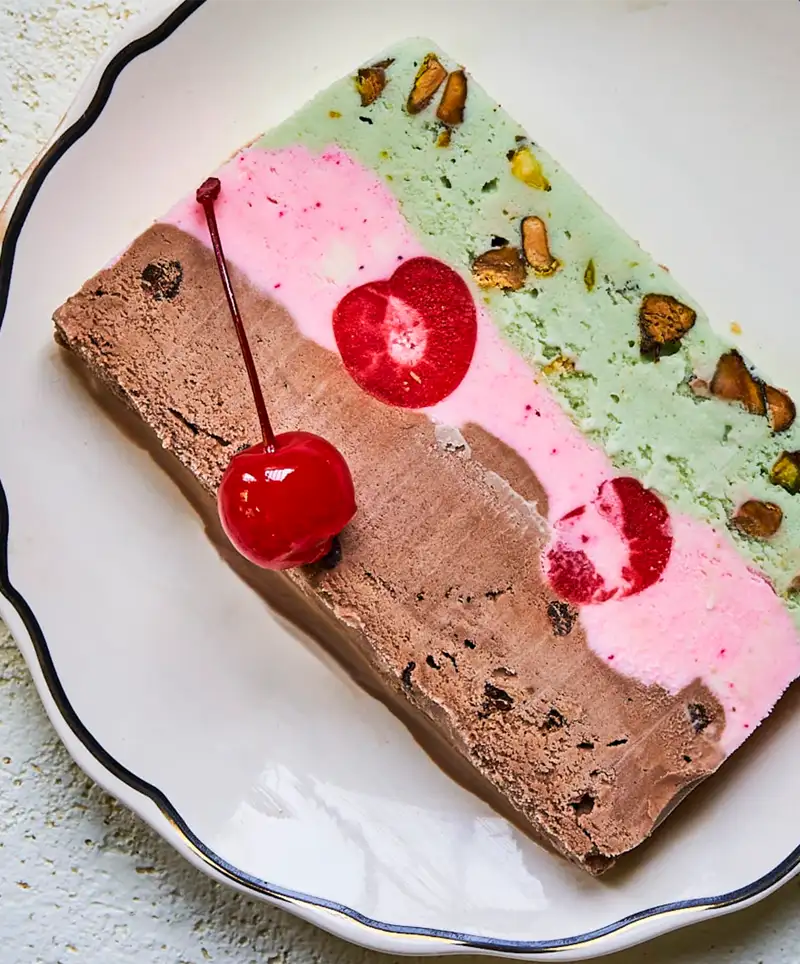
At its heart, spumoni is a layered frozen dessert with Italian roots. Rather than serving several separate scoops, the different flavors are traditionally arranged in layers, frequently with chopped nuts and pieces of candied fruit incorporated into the mixture. It can be frozen in a mold and sliced for serving, allowing each portion to contain several flavors and textures at once.
That last detail matters. Spumoni isn't merely about choosing between chocolate, fruit and pistachio. The idea is to experience the combination. Creamy, fruity, nutty, sweet and occasionally crunchy elements arrive together, which makes spumoni considerably more interesting than a freezer carton containing three colored stripes.
The precise flavors vary, particularly between Italian and Italian-American versions. Pistachio is strongly associated with spumoni, as are cherry and chocolate in many American recipes. Other versions use vanilla, strawberry or different fruit flavors, and traditional preparations may include candied cherries, citrus peel or assorted nuts.
In other words, there is no international Spumoni Police Department waiting outside the kitchen if somebody substitutes one flavor for another.
At least, we hope there isn't.
Spumoni Has Italian Roots
Spumoni is generally associated with southern Italy, particularly Naples, where elaborate frozen desserts developed alongside Italy's long tradition of making gelato and other chilled sweets. Its name comes from spuma, an Italian word meaning foam, reflecting the light or whipped character historically associated with some versions of the dessert.
Traditional Italian spumoni could be considerably more elaborate than the three-colored version many Americans recognize today. Different gelato or cream mixtures might be combined with fruit and nuts, packed into molds and frozen before being sliced. Presentation was part of the attraction: cutting into the dessert revealed the contrasting colors and ingredients hidden inside.
Spumoni traveled to the United States with the enormous waves of Italian immigration during the late 19th and early 20th centuries. Italian immigrants brought their food traditions with them, and frozen desserts naturally became part of the growing Italian-American restaurant and confectionery culture.
The dessert became especially familiar in Italian-American communities, where it could appear after Sunday dinners, at restaurants, weddings, holidays and other family gatherings. Eventually, spumoni escaped the boundaries of Italian neighborhoods and found its way into American ice cream parlors, restaurants and grocery-store freezers.
Fortunately, no passport was required.
The Classic Spumoni Combination
Ask most Americans to picture a slice of spumoni and three colors are likely to appear: deep chocolate brown, cheerful cherry pink or red, and unmistakable pistachio green. Together, chocolate, cherry and pistachio have become the classic Italian-American spumoni combination. They may seem like unlikely roommates at first, but each brings something different to the dessert, and the contrast is precisely what makes spumoni work.
The chocolate layer provides richness and familiarity. Depending on the recipe, it can range from a mild milk-chocolate flavor to something darker and more intense. Chocolate also provides a useful counterweight to the brighter fruit and nut flavors around it. Just when the cherry begins getting enthusiastic and the pistachio starts showing off, chocolate arrives to restore order.
The cherry layer brings fruitiness, sweetness and a little tartness to the mixture. Some versions use cherry-flavored ice cream or gelato, while others incorporate chopped or candied cherries directly into the frozen base. Traditional recipes may also include additional candied fruits, giving the layer both flavor and texture. Those little pieces of fruit are part of what separates proper spumoni from an ordinary carton of striped ice cream.
Then comes pistachio, perhaps the flavor most closely associated with spumoni's Italian heritage. Its mild, slightly earthy nuttiness contrasts beautifully with sweet cherry and rich chocolate. Chopped pistachios may also be folded into the layer, producing little bits of crunch among all that creaminess. The pale green color makes the finished dessert instantly recognizable, although naturally colored pistachio is usually considerably more subdued than the enthusiastic green sometimes encountered in commercial ice cream.
The real fun begins when nuts and candied fruits enter the picture. Chopped pistachios are the obvious choice, but almonds and other nuts sometimes appear as well. Candied cherries are particularly common, while some traditional preparations incorporate pieces of candied citrus peel or other preserved fruits. These additions aren't merely decoration. They create changes in texture from one bite to another, giving spumoni considerably more personality than three smooth flavors simply sitting beside each other.
There is also plenty of room for variation. Some American spumoni substitutes vanilla for chocolate, while other recipes use strawberry or another fruit flavor instead of cherry. Italian versions can differ even more, reflecting regional recipes, individual gelaterias and family traditions. Spumoni has been around far too long and traveled far too widely to have one recipe guarded by an elderly gentleman standing outside Naples with a clipboard.
What matters most is the combination. Spumoni is intended to bring contrasting flavors and textures together rather than force the diner to select a favorite. A properly cut slice gives you creamy chocolate, bright fruit, nutty pistachio and occasional pieces of fruit or nuts in the same serving. You can certainly eat each layer separately if you insist, but that rather misses the point.
The Italians have already saved you from making a difficult dessert decision.
The least you can do is eat all three.
Spumoni and Neapolitan Ice Cream Are Not the Same Thing
The resemblance is obvious. Both desserts commonly contain three flavors presented together, and both have historical connections to Naples. That has understandably caused generations of people staring into supermarket freezers to wonder whether spumoni and Neapolitan ice cream are basically the same thing.
They aren't.
The familiar American Neapolitan ice cream generally consists of chocolate, vanilla and strawberry placed side by side in the same container. Each section is ordinary ice cream, and there are typically no nuts, candied fruit or other ingredients mixed throughout it.
Spumoni traditionally has more going on. Its flavors may be layered rather than simply arranged in adjacent blocks, and fruit and nuts are often essential parts of the dessert. Depending upon the recipe, the texture can also differ from conventional American ice cream.
There is, however, a historical relationship between them. Neapolitan-style frozen desserts were inspired by the elaborate multi-flavored frozen creations associated with Naples. As those ideas were adapted elsewhere, particularly in the United States, the combination gradually became standardized into the chocolate, vanilla and strawberry Neapolitan ice cream familiar today.
So it is probably fair to think of the two as relatives.
Spumoni is simply the relative who arrives at the family reunion wearing pistachio green, carrying candied cherries and insisting that three plain tubs of ice cream would have been terribly boring.
Why Pistachio Belongs in Spumoni
Pistachio isn't simply the green section included so spumoni looks impressive when somebody cuts into it. Its distinctive flavor provides an important balance between the sweetness of the fruit layer and the richness of chocolate. Pistachios have a mild, slightly earthy and buttery character that works particularly well in frozen desserts because they add flavor without overwhelming everything around them. In a classic chocolate, cherry and pistachio spumoni, chocolate brings the richness, cherry supplies the bright sweetness, and pistachio calmly occupies the middle ground making sure everybody gets along.
The connection between pistachios and Italian desserts also goes back considerably further than spumoni. Pistachios originated in western and central Asia and spread throughout the Mediterranean world over centuries of trade and cultivation. They became particularly important in Sicily, where Arab influence during the Middle Ages helped establish pistachio cultivation. The volcanic soil and climate around Mount Etna proved especially suitable for the trees, and the town of Bronte eventually became famous for producing highly prized pistachios.
That Italian tradition found its way naturally into confectionery. Pistachios appear in gelato, pastries, cakes, cookies, cannoli fillings, creams and other sweets throughout Italy, particularly in Sicily and southern regions. Long before anybody in America opened a carton containing something bright green and called it pistachio ice cream, Italian cooks and confectioners had already discovered that finely ground pistachios and sweetened cream were extremely good company.
In spumoni, pistachio can contribute both flavor and texture. The frozen pistachio layer provides the characteristic nutty taste, while chopped pistachios may be mixed into the dessert to add a gentle crunch. That change in texture is important because traditional spumoni is supposed to offer more than several smooth frozen flavors. Along with candied fruit, the nuts make each bite slightly different from the one before it.
And then there is that famous green color. Real pistachios are naturally green, thanks partly to pigments including chlorophyll, but genuine pistachio gelato is often a much softer, more muted shade than the almost fluorescent green sometimes found in commercial frozen desserts. A pale green or even slightly brownish-green pistachio layer may therefore be a better indication of the real ingredient than something resembling frozen lawn paint.
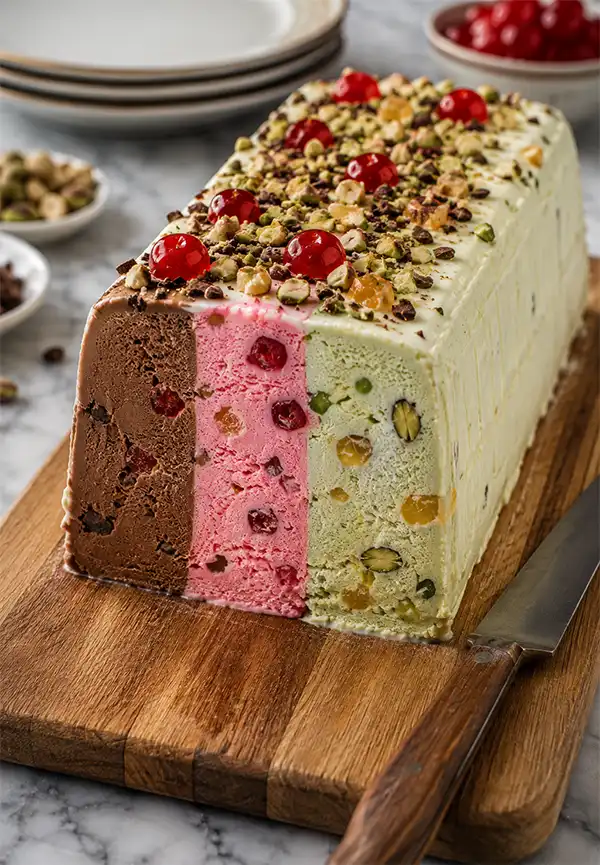
Pistachio also gives spumoni much of its visual identity. Cut through a molded loaf containing chocolate, cherry and pistachio and the contrasting brown, pink or red, and green layers immediately announce that this isn't an ordinary bowl of ice cream. Add the occasional red candied cherry and pieces of chopped nuts, and the dessert becomes almost as enjoyable to look at as it is to eat. Almost. We should remember our priorities.
Most importantly, pistachio keeps spumoni from becoming predictable. Chocolate and cherry are familiar dessert companions, but pistachio changes the conversation. Its subtle nuttiness makes the sweeter flavors more interesting while providing a distinctly Mediterranean connection to the dessert's Italian heritage.
Take away the pistachio and you could still have a perfectly enjoyable frozen dessert, but you'd have to explain what happened to the spumoni.
Spumoni Is Traditionally Sliced
One of the characteristics that separates traditional spumoni from an ordinary bowl of ice cream is the way it can be served. Although modern versions are frequently scooped from a container, classic spumoni is often assembled in a mold, frozen until firm and cut into slices. That method isn't merely an attractive presentation trick. Slicing ensures that each serving contains the different flavors, fruits and nuts that were carefully arranged throughout the dessert rather than leaving everyone fighting over whichever flavor happens to be most popular.
Preparing spumoni in a mold also gives the dessert its distinctive layered appearance. Different flavored mixtures are added separately, with each layer usually allowed to firm before the next one is introduced. Depending on the recipe, candied cherries, chopped pistachios, almonds or pieces of candied citrus may be folded into individual layers. Once completely frozen, the spumoni can be removed from its mold and sliced across the layers, revealing the colorful pattern inside. It is the frozen-dessert equivalent of cutting into a beautifully decorated cake and discovering that somebody remembered to make the inside interesting too.
The shape of the mold can vary considerably. A simple loaf pan works perfectly well for homemade spumoni, while traditional confectioners and restaurants may use rounded, rectangular or more decorative molds. Whatever the shape, the principle remains the same: the flavors are arranged so that a single cut passes through several of them. A well-made slice might contain pistachio gelato with chopped nuts, a cherry or fruit layer dotted with candied pieces and a rich chocolate section, all sitting together on the same plate and waiting for someone with a spoon.
Serving spumoni this way also makes sense when we consider its history. Molded frozen desserts were once considerably more elaborate affairs than the half-gallon cartons we casually pull from modern freezers. Before mechanical refrigeration became commonplace, producing frozen desserts required time, ice, salt and a fair amount of labor. When such a dessert appeared at the end of a meal or celebration, presentation mattered. A molded creation containing several colors, flavors and textures demonstrated both the skill of the maker and the importance of the occasion.
Slicing also changes the way spumoni is eaten. With three separate scoops, it is easy to finish one flavor and then move to the next. A slice encourages you to take a little from several layers at once, which is exactly where spumoni becomes most interesting. Chocolate can meet cherry, pistachio can arrive with a piece of candied fruit, and a chopped nut can provide an unexpected bit of crunch. The dessert was designed around combinations, and slicing helps make sure those combinations actually reach the spoon.
Of course, nobody needs to summon the dessert authorities if their spumoni arrives in a scoop. Italian-American ice cream parlors and commercial producers have long sold scoopable versions, and they contain the same familiar flavors and ingredients. Scooping is convenient, particularly when serving individual cones or bowls, while slicing emphasizes the more traditional molded presentation. Both methods eventually accomplish the important objective, which is getting the spumoni from the freezer to the person waiting for it.
Still, there is something especially satisfying about placing an entire molded spumoni on the table and cutting the first piece. Until the knife passes through it, much of the dessert remains hidden. Then the layers appear, along with the fruit and nuts tucked inside, and suddenly everyone can see why considerably more effort went into this than opening three cartons of ice cream.
It also settles the question of who gets which flavor. Everybody gets everything, which is exactly how spumoni intended it.
Italian-American Spumoni Developed Its Own Tradition
When Italian immigrants began arriving in the United States in large numbers during the late 19th and early 20th centuries, they brought much more than luggage. They brought regional recipes, cooking techniques and food traditions that had been handed down through families for generations. Spumoni was among the frozen desserts that crossed the Atlantic, particularly with immigrants from southern Italy, but like many Italian foods in America, it began to change once it settled into its new surroundings.
That process happened throughout Italian-American cooking. Ingredients available in the United States were different, American customers developed preferences of their own, and restaurant owners adapted traditional dishes to feed larger crowds. Recipes also crossed regional boundaries that had been much more distinct in Italy. A Sicilian family, a Neapolitan family and a Calabrian family might have arrived with different ways of preparing familiar foods, only to find those traditions gradually mingling in Italian neighborhoods in New York, Philadelphia, Boston, Chicago and other American cities.

Spumoni fit comfortably into this new Italian-American food culture. Italian confectioners, ice cream parlors and restaurants could offer a dessert that was colorful, distinctive and easily served after a substantial meal. The familiar American combination of chocolate, cherry and pistachio became increasingly associated with spumoni, along with chopped nuts and pieces of candied fruit. While recipes varied from one establishment to another, those flavors became recognizable enough that generations of Americans came to think of them as the classic spumoni combination.
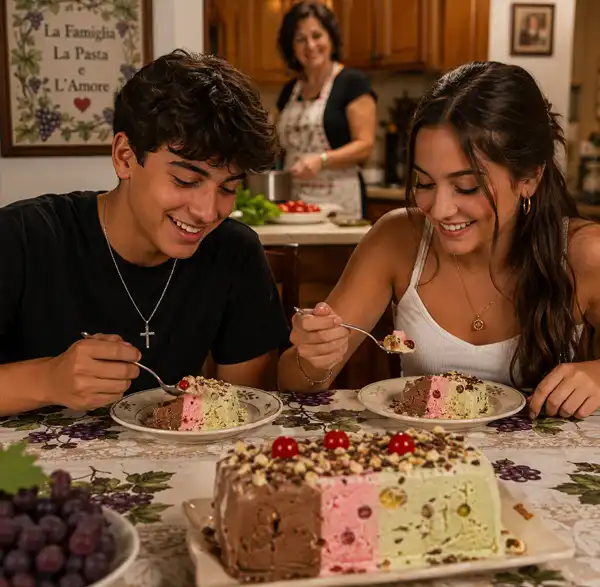
The dessert also became closely connected with the Italian-American restaurant experience. After plates of pasta, chicken parmigiana, lasagna or other hearty favorites had been cleared away, spumoni offered a colorful finish to the meal. It might arrive as a neat slice showing its layers or as a generous scoop from a restaurant freezer. Either way, it became one of those desserts that people associated not simply with flavor but with a particular kind of evening—family gathered around a table, plenty of conversation, and somebody insisting they were far too full for dessert approximately 30 seconds before accepting dessert.
Spumoni also found a natural home at family celebrations and holidays. Weddings, birthdays, anniversaries, Sunday dinners and festive gatherings provided exactly the sort of occasions where a molded, multi-layered dessert could make an appearance. Because it could be prepared ahead of time and sliced into individual portions, it was practical as well as decorative. More importantly, serving the same dessert year after year allowed spumoni to become part of family tradition. Eventually people weren't merely eating it because they liked pistachio or candied cherries; they were eating it because Grandma always served spumoni after Christmas dinner.
As Italian-American communities became established and their food became increasingly popular outside those neighborhoods, spumoni traveled with it. Italian restaurants introduced generations of diners with no Italian ancestry whatsoever to foods that had once been associated primarily with immigrant communities. Pizza provides the most spectacular example of that transformation, but pasta dishes, Italian breads, pastries, gelato and spumoni all became increasingly familiar parts of the American food landscape.
Commercial ice cream manufacturers also helped reshape the dessert. A traditional molded spumoni could require several preparation stages, while American consumers increasingly wanted frozen desserts that could simply be scooped from a carton. Producers adapted accordingly, combining the familiar flavors and mix-ins in containers that could sit beside chocolate, vanilla and strawberry in supermarket freezers. The presentation might have changed, but the recognizable combination of colorful flavors, nuts and fruit remained.
Those adaptations occasionally create arguments about whether Italian-American foods are genuinely “Italian.” The more useful answer is that they represent their own culinary tradition. Italian-American cooking developed from Italian foundations but was shaped by immigration, American ingredients, economic circumstances and generations of families building new lives in another country. A dish does not stop having history simply because somebody's grandmother changed the recipe after arriving in New York.
Spumoni is a particularly cheerful example of that evolution. What began within Italy's rich tradition of frozen desserts crossed an ocean, adapted to a different country and became something generations of Americans associated with Italian restaurants and family celebrations. The chocolate-cherry-pistachio version familiar in the United States may not duplicate every spumoni once made in Naples, but it tells another part of the same story.
And that may be one reason spumoni has lasted. People rarely become sentimental about something merely because it contains ice cream. They become sentimental because they remember where they ate it, who was sitting beside them and who always asked for another piece.
Make Your Own Spumoni
Making spumoni at home sounds like the sort of undertaking that should require an Italian grandmother, specialized equipment and several years of apprenticeship, but it can actually be quite manageable. You can certainly make each frozen component from scratch if homemade gelato is your idea of a relaxing afternoon, but there is no shame in starting with good-quality prepared ice cream or gelato. The real work is in assembling the flavors, adding the traditional fruits and nuts, and giving each layer enough time in the freezer to behave itself.
A loaf pan makes an excellent mold for homemade spumoni because it creates neat layers and produces slices that display all the flavors. Line the pan with plastic wrap or parchment paper, leaving enough extending over the sides to help lift the finished dessert out later. You can also use a bowl, cake pan or decorative mold if you prefer a different shape. The freezer is remarkably unconcerned with architecture, provided whatever you choose fits through the door.
For a classic Italian-American version, gather chocolate, cherry and pistachio ice cream or gelato, along with chopped pistachios and candied cherries. Other candied fruits can be added if you enjoy them, and chopped almonds are another possibility. Allow the first frozen flavor to soften just enough to become spreadable without actually melting. Press it evenly into the bottom of the prepared mold, smooth the surface and return the pan to the freezer until the layer becomes firm again.
Once that first layer has set, repeat the process with the second flavor and then the third. This is where patience becomes the most important ingredient in the recipe. If a layer is too soft when the next one is added, the colors can blend together and those beautiful stripes will begin looking less like traditional spumoni and more like something created during an unfortunate freezer accident. It will still be edible, of course, but explaining the artistic concept to dinner guests may require confidence.
The chopped nuts and candied fruits can be incorporated in several ways. Fold pistachios into the pistachio layer, mix chopped candied cherries into the cherry portion, or distribute small amounts of fruit and nuts between layers. The objective is to create the changes in flavor and texture that distinguish spumoni from ordinary multi-flavored ice cream. Don't overload the mixture, though. You still want a frozen dessert, not a fruitcake that wandered into the freezer.
After all the layers have been assembled, cover the mold and freeze the spumoni thoroughly. Several hours may be sufficient, but leaving it overnight is often the easiest approach, particularly if you are preparing it for a dinner or celebration. A completely firm spumoni will hold its shape better when removed from the mold and produce cleaner, more attractive slices.
When serving time arrives, remove the mold from the freezer and use the overhanging liner to lift the spumoni onto a chilled serving plate. If it refuses to cooperate, briefly warming the outside of the pan can help loosen it, but use restraint. There is a very narrow distance between “helpfully loosened” and “we seem to have made soup.” Once released, remove the lining and use a sturdy knife dipped in warm water to cut the spumoni into slices.
Each serving should reveal the contrasting layers along with little pieces of fruit and nuts scattered throughout. You can serve it exactly as it is or add a few chopped pistachios, cherries or a small amount of chocolate on top. Spumoni is already colorful and elaborate, so it doesn't require much additional decoration. Putting whipped cream, six sauces, sprinkles and a sparkler on top may be technically possible, but at some point the dessert should be allowed to speak for itself.
Making your own spumoni also gives you permission to experiment. Once you've tried the familiar chocolate, cherry and pistachio combination, substitute another fruit flavor, use dark chocolate instead of milk chocolate, add candied citrus peel or explore different nuts. Family recipes and Italian-American versions have varied for generations, so there is plenty of room for personal preference without turning the dessert into something completely unrecognizable.
Better still, homemade spumoni can be prepared well before guests arrive. There is no frantic last-minute baking, no cake refusing to rise and no pie crust suddenly deciding it has philosophical objections to remaining in one piece. When dessert time arrives, you simply open the freezer, remove your carefully prepared creation and slice it.
Then accept the compliments as though the whole thing had been terribly difficult. There is no reason to tell everyone you started with three cartons of ice cream.
How to Celebrate National Spumoni Day
The most obvious way to celebrate National Spumoni Day requires very little explanation: find some spumoni and eat it. August 21 is not a holiday demanding elaborate decorations, ceremonial speeches or a parade through town carrying an enormous pistachio. It is an excellent excuse to enjoy a dessert that many people recognize but don't encounter nearly as often as ordinary ice cream. If it has been years since you last had spumoni—or you've never tried it at all—this is the day to correct the situation.
Start by checking local Italian restaurants, gelaterias and traditional ice cream parlors. Spumoni is still served at many old-school Italian-American establishments, sometimes as a slice from a molded dessert and sometimes by the scoop. Finding a restaurant that has been serving it for decades adds something to the experience because these are often the places where recipes and traditions have survived while flashier desserts have come and gone. Order a serving after dinner, preferably with coffee, and give yourself enough room to appreciate all three flavors instead of attempting to squeeze it into the tiny remaining corner after an heroic quantity of lasagna.
If you cannot find spumoni nearby, National Spumoni Day provides an excellent reason to make your own. The easiest method uses prepared chocolate, cherry and pistachio ice cream or gelato layered in a loaf pan with chopped pistachios and candied fruit. More ambitious cooks can make the frozen components from scratch and experiment with traditional ingredients. Either approach counts. The holiday committee has not announced any plans for kitchen inspections.
You could also turn the occasion into an Italian-American family dinner. Prepare a favorite pasta dish, pizza or another meal with Italian roots, gather everyone around the table and make spumoni the grand finale. Food traditions are at their best when they're shared, and spumoni has a long association with restaurants, Sunday dinners, holidays and family celebrations. If older relatives remember eating it when they were young, ask where they had it and how it was served. You may discover that the dessert comes with a family story you haven't heard before.
For a larger gathering, create a spumoni tasting. Serve a traditional chocolate-cherry-pistachio version alongside one or two variations and let everyone decide which combination works best. You might compare homemade spumoni with a commercially prepared version or try recipes containing different candied fruits and nuts. Just remember that asking several people to agree on the correct version of an Italian-American food can turn a pleasant dessert tasting into an international diplomatic conference.
National Spumoni Day is also a good opportunity to introduce children to something beyond the standard chocolate-vanilla-strawberry lineup. The colorful layers make spumoni immediately interesting, while the nuts and candied fruit provide textures they may not expect in ice cream. Let children help assemble a homemade version by spreading softened layers and adding fruit or nuts. They may produce stripes that aren't quite straight, but frozen desserts are wonderfully forgiving. Nobody has ever refused a delicious piece of spumoni because the pistachio layer was leaning slightly to the left.
If you enjoy experimenting in the kitchen, take the flavors beyond the traditional frozen dessert. Chocolate, cherry and pistachio work well together in cakes, cookies, cupcakes, cheesecakes and other spumoni-inspired sweets. A layered cake using the familiar colors can make an impressive centerpiece, while cookies incorporating pistachios, cherries and chocolate offer a simpler way to borrow the flavor combination. Purists may point out that these creations aren't technically spumoni, and they would be correct. Fortunately, you can hand them an actual piece of spumoni until they become less concerned.
A cup of espresso or strong coffee makes a particularly good companion to spumoni because its slight bitterness balances the sweetness and richness of the dessert. Adults who enjoy pairing desserts with drinks might also choose an Italian liqueur or another after-dinner beverage that complements the flavors. There is no requirement to pair spumoni with anything, however. A spoon remains the only genuinely essential accessory.
You can also use the day to support a local Italian restaurant, independent ice cream shop or gelateria. Ask whether they make their own spumoni and, if they do, give it a try. Small restaurants and ice cream shops are often the places keeping older regional and immigrant food traditions alive, and ordering something beyond the usual choices helps ensure there is a reason to keep it on the menu.
Finally, don't worry about celebrating National Spumoni Day correctly. There is no official serving size, mandatory recipe or prescribed order for eating the layers. Have a scoop, cut yourself a slice, make a homemade batch, invite friends over or quietly enjoy some after dinner while everybody else wonders why they didn't think of buying spumoni. The important thing is to give this colorful old dessert its day in the freezer, and if August 21 happens to require a second helping, we can reasonably classify that as historical research.
More Than Three Colors in a Bowl
Spumoni has survived for generations because it offers something more interesting than another frozen sweet. Its colorful layers carry a piece of Italian culinary history and a larger story about what happens when food traditions travel across oceans, settle into new communities and gradually become part of another culture. What began within Italy's rich tradition of frozen desserts traveled with immigrants to America, where recipes changed, new combinations became familiar and spumoni earned a permanent place at Italian-American tables.
That journey is part of what makes traditional foods so fascinating. Recipes are rarely frozen in time, even when the dessert itself certainly is. Families adapt them, restaurants put their own stamp on them, ingredients change and one generation teaches the next how things are “supposed” to be made—often conveniently forgetting that Grandma changed the recipe herself 40 years earlier. Spumoni's familiar chocolate, cherry and pistachio combination reflects that continuing evolution.
The dessert also offers something increasingly valuable: variety without requiring a decision. Chocolate brings richness, cherry contributes fruit and sweetness, pistachio adds nuttiness, and the candied fruit and chopped nuts provide texture. Rather than asking you to select one flavor and spend the next ten minutes wondering whether you should have ordered another, spumoni places the argument directly on the plate and declares everybody a winner.
Perhaps most importantly, spumoni has become connected with memories. For some people, it recalls an old neighborhood Italian restaurant; for others, a Sunday family dinner, holiday gathering or grandparent who always kept a particular dessert in the freezer. Foods endure partly because of flavor, but they become traditions because of the people and occasions we associate with them.
That may be the finest reason to celebrate National Spumoni Day. On August 21, find yourself a proper piece of spumoni, make sure the serving includes a little of everything and enjoy the combination of flavors, textures and history one colorful bite at a time. After all, choosing between chocolate, cherry and pistachio is completely unnecessary. Some thoughtful Italians solved that problem for us a long time ago.
Spumoni Day FAQ
Spumoni has been around for generations, crossed an ocean, changed along the way and still manages to leave people wondering exactly what separates it from the three-colored ice cream sitting beside it in the freezer. National Spumoni Day is therefore a fine opportunity to settle some of the most common questions about this Italian and Italian-American favorite. Besides, understanding your dessert before eating it makes the second helping educational.
When is National Spumoni Day?
National Spumoni Day is celebrated annually on August 21 in the United States. It is a day devoted to enjoying and learning about the colorful layered frozen dessert with Italian roots.
What is spumoni?
Spumoni is a layered frozen dessert traditionally made with several flavors and containing nuts, candied fruit or both. It originated in Italy and developed a particularly strong following in Italian-American communities. Traditional spumoni may be frozen in a mold and sliced rather than simply served as individual scoops.
What are the traditional flavors of spumoni?
In the United States, the classic combination is usually chocolate, cherry and pistachio. Recipes vary, however, and some versions substitute vanilla or another fruit flavor. Italian preparations can differ considerably depending on the recipe and region.
Is spumoni the same as Neapolitan ice cream?
No. American Neapolitan ice cream usually contains chocolate, vanilla and strawberry arranged side by side, without nuts or candied fruit. Spumoni traditionally contains more varied flavors and textures, often including pistachios, candied cherries or other fruits. The two desserts are related through traditions associated with Naples, but they are not interchangeable.
Why does spumoni contain pistachio?
Pistachio has a long history in Italian confectionery and frozen desserts, particularly in southern Italy and Sicily. Its mild, nutty flavor provides a contrast to sweeter fruit and richer chocolate flavors, while chopped pistachios can also give spumoni some of its characteristic texture.
Is spumoni ice cream or gelato?
It can be described as a frozen dessert related to Italian gelato, although many modern American versions are made using ice cream. Traditional recipes and contemporary commercial products vary in their ingredients and preparation, so not every spumoni will have exactly the same texture.
Why is spumoni sometimes served in slices?
Traditional spumoni can be assembled in a mold with its different flavors arranged in layers and then frozen until firm. Slicing across the finished mold gives each serving several flavors as well as any nuts or candied fruit incorporated into them. It also reveals those attractive contrasting colors—which is considerably more impressive than dropping three scoops into a bowl and hoping nobody notices.
Can you make spumoni at home?
Absolutely. An easy homemade version can be made by layering softened chocolate, cherry and pistachio ice cream or gelato in a lined loaf pan, adding chopped pistachios and candied fruit as desired. Freeze each layer sufficiently before adding the next, then freeze the completed dessert until firm enough to remove from the mold and slice.
Does spumoni always contain nuts?
Not necessarily. Nuts, particularly pistachios, are strongly associated with traditional spumoni, but recipes vary. Anyone with a nut allergy should always check the ingredients rather than assuming a particular version is nut-free.
How should you celebrate National Spumoni Day?
Eating spumoni is an excellent beginning and, frankly, accomplishes most of the assignment. Visit an Italian restaurant or gelateria, find some at an ice cream shop, make a homemade version or serve it after an Italian-American family dinner. For additional historical research, have another slice.
One More Spoonful
National Spumoni Day gives us a good excuse to appreciate a dessert that has accomplished something rather remarkable. Spumoni began within Italy's long tradition of frozen sweets, crossed the Atlantic with generations of immigrants, adapted to life in America and became part of the Italian-American table. Along the way, recipes changed and serving styles evolved, but those colorful layers, bits of fruit and crunchy nuts continued making the trip from one generation to the next.
Perhaps that is why spumoni deserves a little more attention than simply calling it three flavors of ice cream. Chocolate, cherry and pistachio each bring something different, but the dessert works because they are meant to be enjoyed together. Add candied fruit and chopped nuts, freeze everything into beautiful layers and slice through the finished creation, and suddenly an ordinary frozen dessert has acquired considerably more personality.
There is something pleasantly old-fashioned about spumoni as well. It recalls neighborhood Italian restaurants, big family dinners and the days when dessert arrived without needing to be deconstructed, infused with smoke or balanced precariously on a plate with six decorative dots of sauce. Spumoni knows exactly what it is. It has been doing this for generations and sees no particular reason to start taking culinary advice now.
So on August 21, celebrate National Spumoni Day with a slice from an Italian restaurant, a scoop from the local ice cream shop or a homemade version assembled in your own freezer. Take a little chocolate, a little cherry and a little pistachio together, and make sure a candied cherry or crunchy piece of pistachio finds its way onto the spoon.
Then, before putting the bowl in the sink, take one last scrape, strictly for historical research, of course.