Cold, Crisp, and Kicking Like a Mule Since the 1940s
Some drinks are complicated, layered, and require a small instruction manual. The Moscow Mule is not one of those drinks. It’s simple, bold, and served in a copper mug that practically announces, “Yes, I’m here to have a good time.” National Moscow Mule Day, celebrated on March 3, raises a chilled copper cup to one of the most recognizable cocktails around—and gives everyone a perfectly good excuse to enjoy one.
The Moscow Mule is a classic cocktail made with vodka, ginger beer, and lime juice, typically served over ice in its signature copper mug. That mug isn’t just for show—it helps keep the drink icy cold and adds to the experience. Crisp, slightly spicy, and refreshingly tart, the Moscow Mule has managed to stay popular for decades without needing to reinvent itself every five minutes.
The Origins of the Moscow Mule
Despite its name, the Moscow Mule is about as Russian as a roadside diner. The cocktail was created in the United States during the early 1940s, when vodka was still something of an outsider in American bars. Whiskey, gin, and rum were familiar territory, but vodka had yet to become the enormously popular spirit it would later be. The Moscow Mule helped change that, although exactly who deserves credit for inventing it has become one of those cocktail-history questions where several people appear to have been standing near the shaker when lightning struck.
The traditional story begins with John G. Martin, an executive with G.F. Heublein & Brothers, the company that had acquired the American rights to Smirnoff vodka. Martin had a problem: Americans weren't particularly interested in vodka. The spirit was unfamiliar to many drinkers, lacked the long American traditions surrounding whiskey and gin, and needed something memorable to introduce it to a wider audience. Selling vodka required more than simply putting bottles behind bars and waiting hopefully.
Enter Jack Morgan, proprietor of the Cock 'n' Bull, a popular British-style pub on Hollywood's Sunset Strip. Morgan had his own beverage problem. He had developed a ginger beer, but apparently wasn't selling enough of it to inspire anyone to start ordering yachts. Martin had vodka that needed customers; Morgan had ginger beer that needed customers. Somewhere in this arrangement was the beginning of an excellent cocktail—or at least a very efficient way of clearing two storerooms at once.
According to the familiar version of events, Martin and Morgan combined vodka with Morgan's spicy ginger beer and fresh lime. The result was refreshing, uncomplicated, and quite unlike many cocktails Americans were accustomed to drinking. Vodka provided the alcoholic backbone without overwhelming the other ingredients, lime supplied tartness and brightness, and ginger beer delivered the sharp bite that would ultimately provide half of the drink's memorable name.
There is, however, another claimant to the Moscow Mule throne. Wes Price, who worked as head bartender at the Cock 'n' Bull, later said that he created the drink himself while trying to use up excess supplies of vodka and ginger beer. According to Price's account, one of the first Moscow Mules he served went to actor Broderick Crawford, who would later win an Academy Award for All the King's Men. If Price's version is correct, one of America's most famous cocktails may have begun not during a carefully planned marketing meeting but behind a bar with somebody thinking, essentially, We've got too much of this stuff. What happens if I pour these together?
Then there is the famous copper mug, which brings another name into the story. A widely repeated account credits Sophie Berezinski, a Russian immigrant whose family manufactured copper goods. According to the history promoted by Moscow Copper Co., Berezinski came to the United States with approximately 2,000 copper mugs made at her father's factory and needed to find somebody willing to buy them. Her search supposedly brought her to the Cock 'n' Bull at precisely the right moment, where vodka, ginger beer, lime, and copper suddenly found themselves sharing a very profitable future.
Whether all three parts of that story happened exactly as later retellings describe is difficult to establish. Cocktail history has a habit of becoming more colorful with every passing decade, particularly when the people involved have bottles, bars, or copper mugs to sell. Martin and Morgan are firmly associated with the Moscow Mule's early commercial success, Price offered his own credible account of creating the mixture, and the Berezinski family tradition provides the best-known explanation for the copper vessel. Rather than spoiling the story, the uncertainty has become part of the Mule's history.
What is much clearer is the brilliance of the combination. The drink didn't merely taste good—it looked different. A Moscow Mule arriving across a crowded bar in a gleaming copper mug immediately attracted attention. People wanted to know what it was, and that curiosity provided Martin with an opportunity to introduce them to vodka. In marketing terms, the copper mug effectively became the cocktail's billboard.
Martin apparently understood the value of that visual distinction extremely well. He traveled around promoting Smirnoff vodka and the Moscow Mule, famously using a Polaroid camera to photograph bartenders holding a bottle of Smirnoff alongside a copper mug. He could then show the photograph at the next establishment as evidence that other bars were already serving the fashionable new cocktail. It was a wonderfully simple piece of salesmanship: Look what everybody else is drinking. Decades before Instagram, the Moscow Mule was already benefiting from photographs of people posing with their drinks.
The name was equally effective. “Moscow” gave the cocktail an immediate association with vodka and its Russian heritage, while “Mule” captured the noticeable kick of the ginger beer. The name was short, amusing, easy to remember, and considerably more marketable than something like Morgan and Martin's Attempt to Get Rid of Surplus Inventory.
By the late 1940s and into the 1950s, the Moscow Mule had become a recognizable American cocktail and an important part of vodka's growing popularity. Smirnoff's marketing famously promoted vodka as leaving drinkers “breathless,” emphasizing that the relatively neutral spirit didn't announce itself as obviously as some traditional liquors. The Mule gave consumers an approachable and flavorful way to try it, helping vodka move from curiosity to increasingly common barroom fixture.
There was even an unexpected obstacle along the way. As Cold War tensions intensified, the cocktail's Russian-sounding name occasionally became politically inconvenient. In 1950, reports circulated about bartenders organizing a boycott of Moscow Mules because of the name and vodka's association with Russia. Smirnoff's owners responded by emphasizing that their vodka was being produced in the United States. The drink survived the controversy quite comfortably; apparently even Cold War politics had difficulty separating Americans from ginger beer and a shiny mug.
The Moscow Mule therefore wasn't simply another cocktail invented during a lively evening behind a bar. It became a remarkably successful marriage of flavor, presentation, timing, and marketing. Vodka needed an introduction to American drinkers, ginger beer needed somewhere to go, copper mugs needed customers, and somebody needed to squeeze a lime.
Whether that somebody was Martin, Morgan, Price, Berezinski—or a little bit of all of them—is still debated. But whoever deserves the final credit certainly gave the cocktail world one heck of a kick.
The Copper Mug: More Than Good Looks
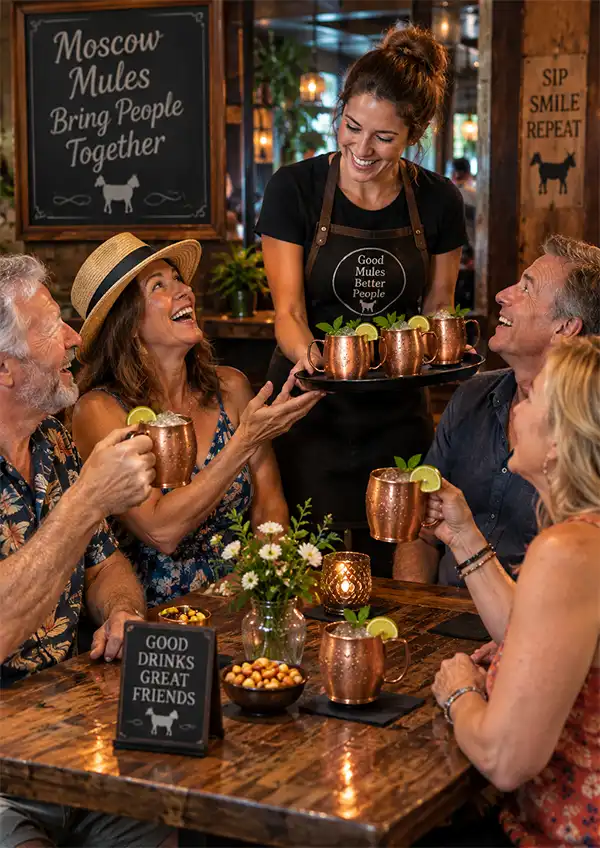
The copper mug has become so closely associated with the Moscow Mule that serving one in an ordinary glass can feel slightly wrong. The cocktail will still taste perfectly good, of course, but something is missing. Part of that is tradition, but there is also a practical reason the mug works so well: copper is an excellent conductor of heat. Fill a copper mug with ice and a cold drink, and the metal rapidly takes on that temperature, giving the outside of the mug an almost immediate frosty chill.
That sensation is an important part of drinking a Moscow Mule. Your hand feels the cold metal before you've even taken the first sip, while condensation quickly forms across the outside. Bring the mug to your mouth and the chilled rim reinforces the impression of a particularly cold, refreshing drink. None of this magically makes the ingredients colder than the ice already has, but it does make the temperature much more noticeable to the person holding the mug. In other words, the copper isn't performing cocktail wizardry; it's very good at making sure you know the drink is cold.
There are also plenty of claims that copper improves the flavor of a Moscow Mule by intensifying the ginger, sharpening the lime, or somehow interacting beneficially with the vodka. Those claims should be treated cautiously. The character of a good Mule comes overwhelmingly from the quality and proportions of its ingredients, particularly the ginger beer and fresh lime. A beautiful copper mug cannot rescue flat ginger beer, tired lime juice, or a bartender whose measuring technique consists of closing one eye and hoping for the best.
Modern copper mugs also raise an important food-safety consideration. Unlined copper should not generally be used with acidic drinks, because acids can cause copper to leach into beverages. Lime juice makes a Moscow Mule acidic, so mugs intended for regular cocktail use are commonly lined on the inside with a less reactive material such as stainless steel or nickel. That allows drinkers to enjoy the appearance and cold feel of copper without having the cocktail sitting directly against bare copper.
This distinction isn't always obvious when buying a mug. Some products are solid copper, some are copper-plated, and others use stainless-steel interiors with copper exteriors. For somebody who simply wants a dependable Moscow Mule mug, a food-safe lined version offers the traditional appearance without requiring an advanced course in metallurgy before happy hour.
Copper mugs do require a little more care than ordinary glassware. Depending upon their construction and finish, they may be better washed by hand rather than sent through the dishwasher, and genuine copper naturally develops a darker patina over time. Some owners polish their mugs until they gleam like new pennies; others prefer the aged appearance. Either approach is fine, provided the drinking surface remains clean and the mug itself is suitable for beverages.
The handle deserves a little appreciation as well. Because copper conducts temperature so readily, holding the body of an ice-filled mug can become decidedly chilly. The handle gives your fingers somewhere more comfortable to live while helping preserve that wonderfully frosty exterior. It is one of those simple design features that becomes considerably more impressive after you've tried clutching an ice-cold metal cylinder for twenty minutes.
So, while the copper mug has undoubtedly become part of the Moscow Mule's visual identity, it isn't merely decorative packaging. It contributes temperature, texture, tradition, and a little ceremony to an otherwise wonderfully simple cocktail.
Could you drink a Moscow Mule from a regular glass? Absolutely. But somehow it just doesn't kick quite the same way.

Why the Moscow Mule Still Kicks
The Moscow Mule has stuck around for a reason: it works. The combination of vodka's relatively clean profile, the spicy bite of ginger beer, and the brightness of fresh lime produces a cocktail that is refreshing without becoming bland and flavorful without requiring a dozen ingredients. There is sweetness, acidity, fizz, and heat from the ginger, all working together in a drink that remains remarkably easy to make.
That simplicity has helped the Mule survive changing drinking fashions. Cocktails have gone through plenty of phases since the 1940s, from elaborate tropical creations and brightly colored concoctions to the modern revival of carefully crafted classics. Through all of it, the Moscow Mule has required little more than three principal ingredients, plenty of ice, and preferably that familiar copper mug. A bartender can prepare one quickly, while somebody mixing drinks at home doesn't need an overflowing liquor cabinet or equipment that resembles a chemistry laboratory.
The quality of those few ingredients can also change the personality of the drink considerably. A mild ginger beer creates a lighter, easier Mule, while a strongly spiced version can deliver enough ginger heat to explain exactly where the “Mule” part of the name came from. Fresh lime adds a sharp citrus edge, and adjusting the proportions slightly allows the drink to range from gentle and refreshing to something with considerably more bite.
Another reason for its longevity is versatility. The basic Mule formula is wonderfully adaptable, and bartenders have spent decades demonstrating that vodka doesn't necessarily have to remain in charge. Bourbon produces the Kentucky Mule, tequila creates a Mexican Mule, and other spirits have inspired an entire extended Mule family. Fruit, herbs, flavored syrups, and different varieties of ginger beer can also be introduced without completely disguising the original idea.
The Moscow Mule also benefited enormously from the modern cocktail revival. As bartenders and drinkers rediscovered classic recipes during the early 21st century, the Mule was perfectly positioned for a comeback. It had history, recognizable presentation, straightforward ingredients, and enough room for experimentation to keep cocktail menus interesting. The copper mug didn't hurt either; long before people began photographing everything they ordered and putting it online, the Moscow Mule was already unusually photogenic.
Perhaps most importantly, it occupies a comfortable middle ground. It can be served at a sophisticated cocktail bar without looking out of place, mixed at a backyard gathering without requiring professional bartending skills, or enjoyed on a hot afternoon when something cold, fizzy, and gingery sounds considerably more appealing than studying a cocktail menu for twenty minutes.
More than eight decades after its creation, the Moscow Mule hasn't needed a dramatic reinvention. Vodka, ginger beer, lime, ice, and a cold mug continue doing exactly what they were brought together to do in the first place.
Sometimes longevity isn't about constantly changing with the times. Sometimes you simply keep kicking.
How to Make a Classic Moscow Mule
One of the great attractions of the Moscow Mule is that you don't need bartending qualifications, specialized equipment, or the ability to toss bottles theatrically behind your back. The classic recipe uses just three principal ingredients, and the whole thing can be built directly in the mug.
For one classic Moscow Mule, you'll need:
- 2 ounces vodka
- ½ ounce freshly squeezed lime juice
- 4 to 6 ounces ginger beer, depending on taste and the size of the mug
- Plenty of ice
- 1 lime wedge or lime wheel, for garnish
- Fresh mint, optional
Fill a copper mug generously with ice, then pour in the vodka and fresh lime juice. Top with the ginger beer and give everything a gentle stir. There's no need to attack it with a cocktail shaker—the carbonation in the ginger beer is part of the experience, and shaking that is an excellent way to turn cocktail preparation into kitchen cleaning.
The amount of ginger beer is deliberately flexible. Start with around four ounces if you prefer a stronger cocktail with a pronounced vodka and lime character, or increase it toward six ounces for a longer, lighter drink with more fizz. Ginger beers also vary considerably in sweetness and heat, so a little experimentation is perfectly acceptable. A fiery ginger beer can produce a Mule with a substantial kick, while a milder variety makes something softer and more refreshing.
Fresh lime juice makes a noticeable difference. Bottled lime juice will work in an emergency, but squeezing half a lime takes only a few seconds and provides the bright acidity that helps balance the sweetness of the ginger beer. Garnish with a lime wedge or wheel, add a sprig of mint if you like, and serve immediately while everything is thoroughly cold.
And that's it: vodka, lime, ginger beer, ice, and a copper mug. No obscure ingredients hiding at the back of the liquor cabinet and no instructions requiring the phrase “prepare three days in advance.”
Just remember that its refreshing taste and generous helping of ginger beer can make the Moscow Mule seem rather more innocent than it actually is. Two ounces of vodka are still two ounces of vodka, even when they're wearing a jaunty lime wedge.
A Whole Stable of Mules
Once bartenders discovered how well the Moscow Mule's basic formula worked, it was probably inevitable that vodka would eventually be asked to move over and make room for the rest of the liquor cabinet. The combination of a spirit, ginger beer, citrus, and ice is remarkably adaptable, and changing the base spirit can produce a noticeably different drink without losing the refreshing character that makes a Mule a Mule.

The Kentucky Mule replaces vodka with bourbon. That single substitution changes the drink considerably, bringing bourbon's notes of vanilla, oak, caramel, and spice into the sharp ginger-and-lime combination. It tends to be richer and warmer in character than the original Moscow Mule, but the ginger beer keeps everything lively. It's an especially natural combination because bourbon and ginger have been getting along quite happily in other drinks for generations.
Head south of the border—at least as far as the liquor cabinet is concerned—and you'll find the Mexican Mule. Here, tequila takes vodka's place, adding the distinctive earthy and vegetal character of agave. Blanco tequila is a particularly popular choice because its brighter flavor works beautifully with lime and ginger beer. Some versions add jalapeño or another chile for extra heat, although ginger beer is perfectly capable of providing a respectable kick without additional assistance.
The Irish Mule uses Irish whiskey and is another wonderfully straightforward variation. Irish whiskey's generally smooth, approachable character combines easily with ginger beer, while lime prevents the drink from becoming overly sweet. Depending on the whiskey chosen, there may be touches of fruit, grain, vanilla, or spice underneath all that ginger. It's essentially the Moscow Mule wearing a different passport and insisting that everybody stay for one more round.
Gin gets its turn with what is commonly called a London Mule or Gin-Gin Mule, although cocktail naming becomes a little less orderly here. Replacing vodka with gin introduces botanicals—juniper, citrus peel, herbs, spices, and whatever else the distiller has decided belongs in the bottle. Those flavors can make the drink noticeably more aromatic than the vodka original. The well-known Gin-Gin Mule, associated with bartender Audrey Saunders, is a more specific modern cocktail incorporating gin, ginger beer, lime, fresh mint, and additional ginger character, so not every gin-based Mule is necessarily the same drink.
Rum also seems like an obvious candidate for Mule treatment, and you'll certainly encounter Rum Mules, usually combining rum, lime, and ginger beer. At this point, however, it's worth stopping before casually calling every rum-and-ginger drink a variation of the Moscow Mule, because sitting nearby is a famous cocktail with an identity—and legal history—of its own.
The Dark 'n Stormy traditionally combines Goslings Black Seal Rum with ginger beer and is closely associated with Bermuda. It may resemble a rum-based Mule on paper, but it isn't simply another member of the Mule family with a different spirit poured into the mug. Dark 'n Stormy is a trademark associated with Goslings, and the company has long protected the name in connection with the cocktail. Lime is sometimes added or used as a garnish, but the classic identity centers on Goslings dark rum and ginger beer. If you're using some other rum, calling your creation a Rum Mule is both perfectly respectable and considerably less likely to attract the attention of somebody carrying a trademark attorney's briefcase.
Other members of the extended Mule family are limited mainly by imagination and the willingness of bartenders to experiment. Scotch, Canadian whisky, mezcal, flavored vodkas, fruit infusions, berries, cucumber, herbs, and various citrus fruits have all found their way into Mule-style cocktails. Some are thoughtful variations that genuinely complement the ginger beer; others occasionally give the impression that somebody found six things in the refrigerator and became dangerously confident.
What makes all of these variations possible is the strength of the original formula. Ginger beer brings sweetness, carbonation, and spice; citrus supplies acidity and freshness; and the chosen spirit provides the underlying personality. Change one component and the drink can head in an entirely different direction while remaining recognizably related to the Moscow Mule.
So, if the original Mule isn't quite your animal, don't worry. There's a whole stable of them waiting at the bar.
How to Celebrate National Moscow Mule Day
National Moscow Mule Day doesn't require elaborate preparations. In fact, arranging a twelve-course banquet in its honor would rather miss the point. The Moscow Mule became famous because it is straightforward, refreshing, and sociable, so the best celebrations follow much the same philosophy. Pick up some fresh limes, choose a good ginger beer, make sure there's plenty of ice in the freezer, and give the copper mugs a polish. You're already most of the way there.
Naturally, the simplest way to celebrate is by making a classic Moscow Mule. Use the traditional combination of vodka, fresh lime juice, and ginger beer and take the opportunity to experiment with the proportions until you find the balance you prefer. Ginger beers vary enormously, from relatively mild and sweet varieties to versions with enough ginger heat to clear the sinuses of somebody sitting at the next table. National Moscow Mule Day is an excellent excuse to try a couple side by side and discover just how much that one ingredient can change the drink.
If you're celebrating with friends, turn the occasion into a Mule tasting evening. Start everyone with the classic Moscow version, then introduce a few members of the extended family. Bourbon can come out for a Kentucky Mule, tequila for a Mexican Mule, Irish whiskey for an Irish Mule, and gin for a London-style variation. Keep the servings modest if you're tasting several versions; the objective is to compare cocktails, not discover whether the living-room carpet really is as comfortable as it looks.
You could also set up a small Moscow Mule bar and let guests build their own drinks. Provide vodka, ginger beer, fresh lime, ice, copper mugs or suitable glasses, and a selection of optional additions such as mint, cucumber, berries, orange slices, or jalapeño. A few different ginger beers can make things particularly interesting. Put the basic recipe where everyone can see it and then let experimentation take over. There will probably be one magnificent discovery, two perfectly respectable drinks, and at least one creation whose recipe should be destroyed before it escapes into the wider world.
For a more historical celebration, raise a mug to the cocktail's 1940s American beginnings. Put on some music from the period, learn a little about the Cock 'n' Bull and the people associated with the Mule's creation, and consider how unusual vodka still was to many American drinkers when the cocktail appeared. What now seems like one of the most familiar spirits behind the bar was once something that needed considerable marketing ingenuity to persuade Americans to try it.
National Moscow Mule Day is also a good opportunity to support a favorite local bar or restaurant. If they serve Moscow Mules, order one and see how their version compares with yours. Bars often have their own house variations using distinctive ginger beers, flavored syrups, fresh fruit, herbs, or different spirits. You might discover a combination worth attempting at home—or discover that your own three-ingredient version was doing perfectly well before somebody introduced passion fruit, rosemary, and smoke.
And there is no requirement to include alcohol in the celebration. A nonalcoholic Mule made with ginger beer, fresh lime juice, plenty of ice, and perhaps a splash of soda water or additional citrus retains much of what makes the original refreshing. Serve it in the same frosty mug with a lime garnish and it still feels like part of the occasion. Just remember that some ginger beers contain alcohol while many others do not, so check the label when preparing a genuinely alcohol-free version.
If you happen to own copper mugs that have spent the past year occupying the mysterious region at the back of a kitchen cabinet, March 3 is also their annual opportunity for parole. Give them a careful wash, polish the exterior if necessary, check that they're suitable for acidic beverages, and put them back to work.
However you choose to celebrate, keep the spirit of the day simple. Enjoy the company, appreciate the history, try something different if the mood strikes, and drink responsibly. The Moscow Mule has never needed much ceremony to make an impression.
A cold mug, good ginger beer, fresh lime, and someone to share the occasion with will do very nicely.
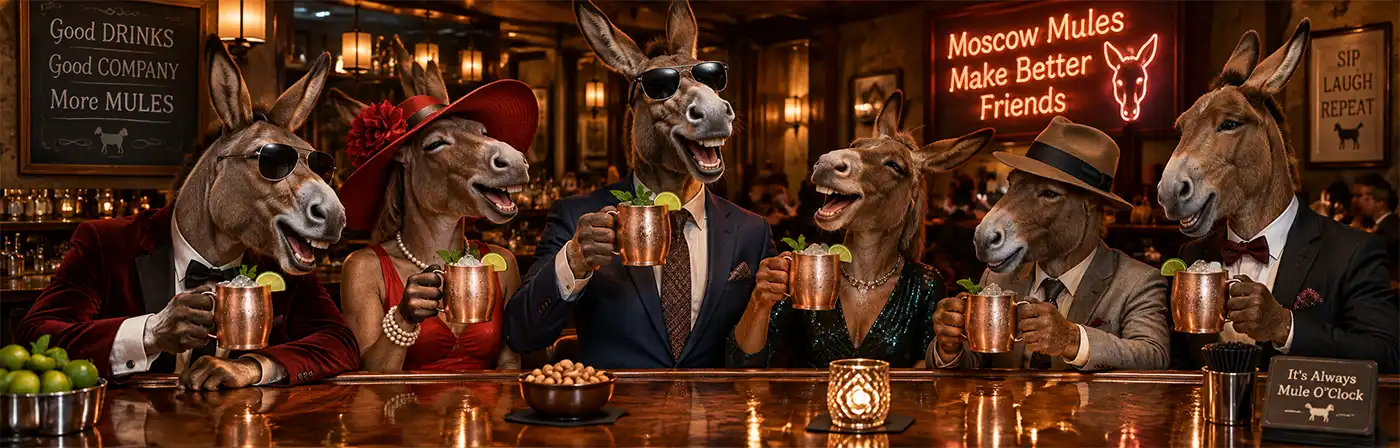
Moscow Mule Facts
The Moscow Mule may be wonderfully simple in the glass, but there is considerably more bubbling beneath the surface than vodka, ginger beer, and lime. Its history includes Hollywood bartenders, clever marketing, copper mugs, competing origin stories, and a surprisingly important role in America's growing enthusiasm for vodka. Before we saddle up and move along, here are a few quick facts about the cocktail that has been kicking around since the 1940s.
- The Moscow Mule was created in the United States, despite the distinctly Russian-sounding name.
- The cocktail emerged during the early 1940s, with Hollywood's Cock 'n' Bull pub playing a central role in its story.
- A classic Moscow Mule contains just three principal ingredients: vodka, ginger beer, and fresh lime juice.
- The word “Moscow” was chosen because of vodka's strong association with Russia, while “Mule” refers to the spicy kick of ginger beer.
- The Moscow Mule helped introduce vodka to a much wider American audience at a time when whiskey and gin were far more familiar choices.
- John G. Martin, Jack Morgan, and bartender Wes Price all feature in competing or overlapping accounts of how the cocktail originated.
- The famous copper mug became such an important part of the drink that it is now almost as recognizable as the cocktail itself.
- Early Moscow Mule promotion made clever use of instant photography, with bartenders photographed holding Smirnoff vodka and copper mugs to encourage other establishments to serve the drink.
- Changing the base spirit creates an entire family of Mule cocktails, including the Kentucky Mule with bourbon, Mexican Mule with tequila, and Irish Mule with Irish whiskey.
- The Moscow Mule has survived more than eight decades of changing cocktail fashions while keeping essentially the same simple formula—which proves that sometimes you don't need to teach an old Mule new tricks.
Why This Particular Date?
March 3 wasn't selected by throwing a dart at a calendar after a couple of Moscow Mules. The date was deliberately chosen as 3/3, and the number three is central to the celebration. The classic Moscow Mule is built around three principal ingredients—vodka, ginger beer, and lime—making the third day of the third month an unusually tidy fit for the cocktail.
National Moscow Mule Day itself is relatively young. Smirnoff declared March 3 National Moscow Mule Day in 2016, with the first official celebration taking place on March 3, 2017. The announcement coincided with celebrations surrounding the Moscow Mule's 75th anniversary and Smirnoff's historical connection with the cocktail.
There was another layer to the 3/3 theme. Smirnoff's announcement also emphasized three people associated with the traditional creation story: John G. Martin, Jack Morgan, and Ozeline Schmidt, who was credited in that particular version with supplying the copper mugs. As we've already seen, the complete history is more complicated than that neat account suggests, with Wes Price and Sophie Berezinski featuring prominently in other versions. The reason for choosing March 3, however, is much less mysterious: three ingredients, three principal characters in Smirnoff's telling, and a date containing two threes.
So, unlike some commemorative days whose dates appear to have been selected because somebody found an empty square on the calendar, National Moscow Mule Day has a little numerical logic behind it.
Three ingredients. Three traditional contributors. March 3—3/3. For once, cocktail history has given us something that can be explained before the ice melts.
The Mule FAQ
The Moscow Mule may have only a handful of ingredients, but that doesn't mean it can't raise a few questions. From copper mugs and ginger beer to vodka choices and the extended Mule family, there is more to this famous cocktail than simply pouring everything over ice. Here are answers to some of the most common questions about the Moscow Mule.
What is a Moscow Mule?
A Moscow Mule is a cocktail traditionally made with vodka, ginger beer, and fresh lime juice, served over ice. It is particularly recognizable because it is commonly served in a copper mug.
Why is it called a Moscow Mule?
“Moscow” refers to vodka's historical association with Russia, while “Mule” is generally understood to describe the sharp kick supplied by the ginger beer. Despite the name, the cocktail was created in the United States.
When was the Moscow Mule invented?
The Moscow Mule appeared in the United States during the early 1940s. The Cock 'n' Bull pub in Hollywood is closely associated with its creation and early popularity, although there are competing accounts concerning exactly who first mixed the drink.
Does a Moscow Mule have to be served in a copper mug?
No. A Moscow Mule can be made in an ordinary glass and will contain exactly the same cocktail. The copper mug is traditional and provides the distinctive cold sensation and presentation associated with the drink, but it isn't essential to the recipe.
Are copper Moscow Mule mugs safe to drink from?
Mugs intended for Moscow Mules should be suitable for acidic beverages because lime juice is acidic and can react with unlined copper. Many modern Moscow Mule mugs therefore have stainless-steel or other nonreactive linings. Always follow the manufacturer's instructions for the particular mug.
What is the difference between ginger beer and ginger ale?
Ginger beer generally has a stronger, spicier ginger flavor than ginger ale, which tends to be sweeter and milder. Ginger beer provides the characteristic bite of a Moscow Mule and is the traditional choice.
What vodka is best for a Moscow Mule?
There is no requirement to use an expensive vodka. A good-quality vodka with a clean, relatively neutral flavor works well because the ginger beer and lime provide much of the cocktail's character. Smirnoff has a particularly strong historical association with the original Moscow Mule.
Can you make a Moscow Mule without alcohol?
Absolutely. Leave out the vodka and combine nonalcoholic ginger beer with fresh lime juice, ice, and perhaps a splash of soda water. Check the ginger beer label if avoiding alcohol completely, since products can vary.
What other kinds of Mules are there?
Replacing vodka with another spirit has produced numerous variations. Bourbon creates a Kentucky Mule, tequila a Mexican Mule, Irish whiskey an Irish Mule, and gin can be used for a London-style Mule. Each keeps the ginger-and-citrus character while allowing the base spirit to change the personality of the drink.
Is a Dark 'n Stormy a rum Moscow Mule?
Not exactly. Although both use ginger beer and the flavor profiles overlap, the Dark 'n Stormy is a distinct cocktail traditionally associated with Goslings Black Seal Rum and Bermuda. The Dark 'n Stormy name is also a Goslings trademark, so it shouldn't simply be treated as another generic Mule variation.
Why is National Moscow Mule Day celebrated on March 3?
The March 3 date—3/3—was chosen around the number three. Smirnoff connected it with the three principal ingredients of a classic Moscow Mule and three figures in its traditional account of the cocktail's creation.
How strong is a Moscow Mule?
That depends on the recipe and amount of ginger beer used. A typical Mule containing two ounces of 80-proof vodka and four to six ounces of ginger beer is lighter by volume than drinking the vodka straight, but it still contains a full serving of spirits. Its cold, fizzy, refreshing character can make that rather easy to forget—which is why the Mule deserves the same respect as any other cocktail.
A Cocktail That Knows What It Is
The Moscow Mule has never needed to pretend to be sophisticated. It doesn't arrive with smoke pouring across the table, require ingredients gathered during a full moon, or expect the bartender to spend ten minutes explaining what you're about to drink. At its heart, it remains what it has been since the 1940s: vodka, ginger beer, lime, plenty of ice, and that unmistakable copper mug.
Perhaps that's the secret to its longevity. Each ingredient has a job and gets on with it. The vodka provides the foundation, fresh lime brings brightness and acidity, and ginger beer supplies sweetness, fizz, and enough spice to justify putting a kicking animal in the name. Put them together in the right proportions and there's remarkably little that needs improving.
That hasn't stopped generations of bartenders from experimenting, of course. Bourbon, tequila, Irish whiskey, gin, fruit, herbs, and spices have all taken their turn in the Mule stable, producing some excellent variations along the way. Yet the original continues to hold its own. You can dress up a Moscow Mule, but you don't have to—and that's increasingly unusual in a cocktail world where sometimes the garnish appears to have required more preparation than dinner.
National Moscow Mule Day gives us an opportunity to appreciate more than the drink itself. Behind that frosty mug is a wonderfully American story involving Hollywood, struggling products, disputed memories, clever salesmanship, instant photographs, and several people who may—or may not—have been responsible for putting the whole thing together. Even the familiar copper mug comes with enough competing history to keep cocktail historians arguing long after last call.
And somehow, none of that matters once the drink reaches the table. You don't need to settle who invented it, determine which origin story deserves the final word, or understand how a cocktail helped persuade Americans to embrace vodka. You just need a cold mug, good ginger beer, fresh lime, and perhaps some agreeable company.
More than eight decades after somebody first discovered that vodka and ginger beer got along remarkably well, the Moscow Mule is still being poured in bars, restaurants, kitchens, and backyards around the world. It survived changing fashions, political associations, cocktail trends, and countless attempts to reinvent it.
National Moscow Mule Day celebrates a cocktail that succeeded by being distinctive without being difficult, refreshing without being boring, and memorable without taking itself terribly seriously.
So on March 3, raise that frosty copper mug, squeeze in the lime, and give a nod to everyone who had a hand in creating, promoting, serving, and occasionally arguing about the Moscow Mule.
Some cocktails need to move with the times. This one just keeps kicking.