102 Passengers, 66 Days, and Not a Frequent-Flyer Mile in Sight
Every year on September 16, Mayflower Day remembers the departure of the Mayflower from Plymouth, England, in 1620 and the extraordinary transatlantic voyage that followed. The ship carried 102 passengers toward an uncertain future in North America, beginning a journey that would become one of the most familiar—and frequently simplified—stories in American history.
The passengers weren't boarding a cruise ship. There was no buffet, no cabin steward folding towels into swans and certainly no cheerful announcement inviting everyone to the Lido Deck. They faced weeks aboard a crowded merchant vessel crossing the North Atlantic with little idea what awaited them at the other end.
Mayflower Day provides an opportunity to look beyond the familiar pictures of buckled hats and Thanksgiving tables and consider the actual Mayflower voyage of 1620, the people aboard, the Wampanoag people whose homeland the colonists entered, and the complicated history that followed.
When Is Mayflower Day?
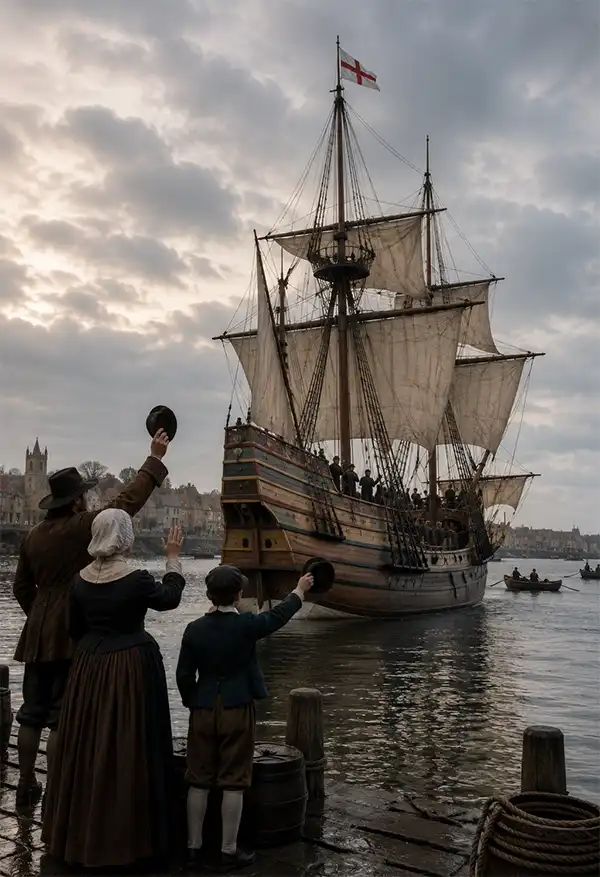
Mayflower Day is observed every year on September 16, commemorating the departure of the Mayflower from Plymouth, England, in 1620. It was the beginning of the ship's famous Atlantic crossing carrying 102 passengers who hoped to establish new lives in North America.
There is, however, a little calendar mischief involved. Contemporary English records date the Mayflower's departure from Plymouth as September 6, 1620, because England was still using the Julian calendar. Much of continental Europe had already adopted the Gregorian calendar, which was ten days ahead at the time. Converted to the Gregorian calendar used today, September 6 becomes September 16, giving us the modern date of Mayflower Day.
The September departure was also considerably later than originally planned. The Mayflower had initially set out with another vessel, the Speedwell, but persistent leaking forced the expedition to turn back more than once. Eventually the Speedwell was abandoned, some travelers were left behind, and the remaining passengers crowded aboard the Mayflower for another attempt.
That delay mattered. An Atlantic crossing beginning in mid-September meant the Mayflower would encounter increasingly difficult autumn weather and arrive in North America with winter rapidly approaching. After 66 days at sea, the passengers sighted Cape Cod in November, far north of their intended destination near the Hudson River.
Mayflower Day therefore commemorates more than a date on which a ship sailed from an English harbor. September 16 marks the beginning of the final, successful voyage—the moment when the delays were finally behind them, England began disappearing over the horizon, and 102 passengers faced thousands of miles of Atlantic Ocean aboard a merchant ship that wasn't designed for comfortable passenger travel.
They could hardly have known that more than four centuries later we would still remember the day they left. Although after the trouble they'd already had getting underway, they were probably just relieved that the Mayflower was finally pointing west.
The Mayflower Was Not Built for Passengers
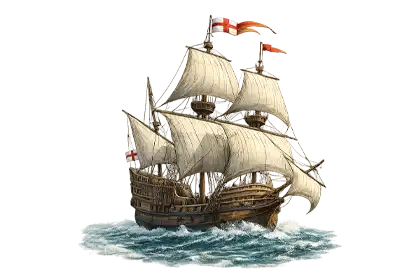
Anyone picturing the Mayflower as an early version of a passenger liner should abandon that idea immediately. The ship was a merchant vessel, designed primarily to transport cargo rather than families across the Atlantic. Before its famous 1620 voyage, the Mayflower had been involved in commercial trade, carrying goods between European ports. Comfort for more than 100 passengers was never part of the original design brief.
The ship was relatively small for the number of people making the crossing. Although its exact measurements are not known with certainty, the reproduction Mayflower II is approximately 106 feet long and 25 feet wide. Into a vessel of roughly that scale went 102 passengers, a crew numbering perhaps 20 to 30, provisions for the voyage, tools, weapons, personal belongings and supplies intended for establishing a settlement. Suddenly that middle seat on a modern airplane doesn't seem quite so unreasonable.
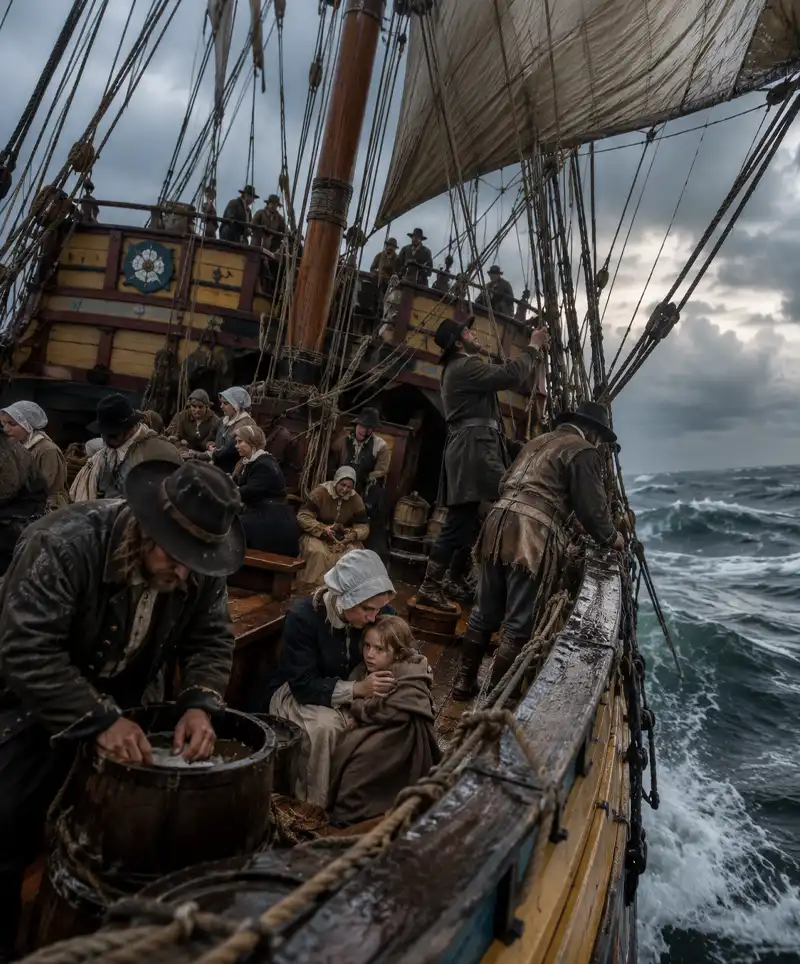
Most passengers spent much of the voyage in the area commonly called the between decks, or gun deck, rather than enjoying private cabins. The available passenger space was cramped, poorly ventilated and offered little privacy. Families essentially lived alongside one another, surrounded by their possessions and whatever supplies had been squeezed aboard with them. Standing headroom was limited in parts of the passenger area, and there was certainly no opportunity to wander off somewhere quiet when one's fellow travelers became irritating.
Conditions became particularly unpleasant during bad weather. When storms made the upper deck dangerous, passengers could be confined below while the ship pitched and rolled through heavy seas. Seasickness, damp clothing, stale air and the ordinary smells produced by a large number of people occupying a confined wooden vessel would have made the journey deeply uncomfortable. Washing facilities were extremely limited, sanitation was primitive and fresh water had to be carefully preserved for a voyage whose duration could not be predicted precisely.
Food presented another challenge. The passengers depended largely upon provisions capable of surviving weeks at sea, including preserved meat, dried foods, cheese and hard ship's biscuits. Fresh food became increasingly scarce as the voyage continued. Beer was also commonly carried aboard ships because it stored more reliably than some supplies of drinking water. Nobody was studying a laminated dinner menu and deciding between the chicken and the fish.
The Mayflower also had to endure the physical punishment of the Atlantic. During particularly severe weather, one of the ship's main structural beams cracked, creating understandable concern about whether the vessel could safely continue. Fortunately, the passengers had brought a large iron screw—probably intended for construction work in their new settlement—which was used to help raise the damaged beam so it could be secured. It was an ingenious piece of emergency repair performed when turning around was hardly an attractive option.
Despite the miserable conditions, only one passenger died during the Atlantic crossing itself, while one baby, Oceanus Hopkins, was born aboard the ship. Another child, Peregrine White, would be born later while the Mayflower lay off the coast of present-day Massachusetts. The greatest loss of life came after arrival, when disease, exposure and the brutal first winter devastated the settlers.
The remarkable thing about the Mayflower voyage is therefore not simply that the ship crossed the Atlantic. Ships had crossed the ocean before. It is that more than 100 passengers—including families with children—endured 66 days aboard a merchant vessel never intended to provide comfortable passenger accommodations, arrived thousands of miles from England and then attempted to establish a permanent settlement as winter approached.
For Mayflower Day, it is worth remembering the vessel as it really was: not a romantic wooden cruise ship sailing majestically toward destiny, but a crowded working ship carrying frightened, uncomfortable and probably thoroughly exhausted people across a very large ocean.
There was no swimming pool, no midnight buffet and no entertainment director. The Atlantic provided the entertainment, and apparently it favored thrill rides.
Who Were the Mayflower Passengers?
The 102 passengers aboard the Mayflower are usually described collectively as the Pilgrims, but the people crowded aboard the ship in 1620 were actually a much more varied group. They included religious Separatists, other English settlers seeking economic opportunity, servants, hired workers, families, single adults and children. They did not all share the same religious beliefs, backgrounds or reasons for making the journey.
The group most closely associated with the word Pilgrims consisted of English Separatists who believed the Church of England could not be sufficiently reformed and chose to establish independent congregations. Facing religious pressure in England, many had moved to the more tolerant Dutch Republic beginning in 1608 and eventually settled in Leiden, Holland. There they could practice their religion more freely, but life was not necessarily easy. Employment could be difficult, economic opportunities were limited, and some members worried that their children were becoming increasingly integrated into Dutch culture.
Eventually, members of the Leiden congregation began planning another move. They hoped to establish a community in North America where they could maintain their religious identity while improving their economic prospects. Obtaining financing and arranging such an expedition, however, required outside investors and additional settlers.
That is where the familiar image of a ship filled entirely with religious Pilgrims begins to fall apart.
Many of the Mayflower's passengers were not members of the Separatist congregation. The Separatists sometimes referred to these other passengers as "Strangers," while members of their own congregation were known as "Saints." The Strangers joined the expedition for various reasons and included people whose skills, labor and participation were necessary to make the proposed colony viable.
Among the passengers were several people whose names became prominent in the history of Plymouth Colony. William Bradford, a member of the Separatist congregation, later served for many years as governor of Plymouth Colony and wrote Of Plymouth Plantation, one of the most important surviving accounts of the settlement's early history.
William Brewster, another leading Separatist, served as the congregation's elder. Edward Winslow would become an important colonial leader and diplomat, while John Carver was chosen as the colony's first governor.
Then there was Myles Standish, a professional soldier whose military experience made him valuable to a community heading into unfamiliar territory. Standish was not a member of the Separatist congregation, but he became the colony's military leader and one of the better-known figures associated with early Plymouth.
The passenger list also included John Alden, who had been hired as a cooper—a craftsman responsible for making and repairing barrels. That may not sound particularly glamorous four centuries later, but barrels were essential for storing food, drink and other supplies. When your survival depends upon keeping provisions usable for months at a time, the fellow who knows how to stop the barrel leaking suddenly becomes a very important member of the team.
There were also entire families aboard. William and Mary Brewster traveled with children, as did William and Susanna White, Stephen and Elizabeth Hopkins, and others. The Hopkins family had the distinction of welcoming a new passenger during the voyage when Elizabeth gave birth to a son. Appropriately enough for a child born somewhere in the Atlantic Ocean, he was named Oceanus Hopkins.
Children made up a substantial portion of the passenger list. Some traveled with their parents, while others were servants or had been placed with other families. The voyage therefore wasn't simply an expedition of adult men seeking a new settlement. Women and children were aboard from the beginning, making the Mayflower migration different from some earlier English colonial ventures that had been dominated by male settlers.
One particularly complicated group consisted of four children from the More family—Ellen, Jasper, Richard and Mary More. Following a bitter domestic dispute in England, they were sent across the Atlantic and placed in the care of other Mayflower passengers. Only Richard More survived the first winter. His long life afterward provides one of the more remarkable individual stories connected with the voyage.
The passengers also included servants, some of whom were indentured. These individuals were an important part of the labor force the settlers expected would be needed to construct buildings, grow food and establish a functioning community. The colony wasn't going to build itself, and religious conviction was considerably more useful when accompanied by carpenters, farmers, craftsmen and people willing to swing an axe.
There were differences in wealth and social position as well. Some passengers brought servants and substantial possessions, while others possessed comparatively little. They came from different parts of England and had different expectations about what awaited them in America.
Those differences became especially important when the Mayflower arrived far north of its intended destination. Because the passengers were outside the territory covered by their original arrangements, concerns arose about whether everyone would remain subject to the colony's authority. The resulting need for an agreement contributed to the creation of the Mayflower Compact, signed by 41 adult male passengers before settlement began.
The term Pilgrim itself deserves some explanation. The passengers did not routinely use "Pilgrims" as the formal name for their entire group in the way we commonly do today. William Bradford later described the departing Leiden Separatists as pilgrims, drawing upon biblical language, and over time the term became increasingly associated with the Plymouth settlers. By the 19th century, "Pilgrims" had become the familiar name attached to the Mayflower story.
So, who were the Mayflower passengers?
They were not 102 identical people wearing black clothes, enormous buckles and matching hats. They were a complicated collection of religious Separatists and other settlers, adults and children, employers and servants, experienced leaders and ordinary families. Some were motivated by faith, others by opportunity, and many undoubtedly had several reasons for risking the voyage.
What united them most decisively was not that they all believed exactly the same things. It was that on September 16, 1620, all 102 of them were aboard the same small ship heading west.
And after 66 days sharing those cramped quarters, they probably knew considerably more about one another than anyone had originally intended.
Sixty-Six Days Across the Atlantic
Once the Mayflower finally left Plymouth, England, the passengers faced 66 days at sea before reaching Cape Cod. In an age when crossing the Atlantic meant surrendering yourself almost completely to wind and weather, there was no reliable arrival date. The ship could make good progress when conditions cooperated, crawl along when winds failed or be driven violently about when the North Atlantic decided to remind everyone who was actually in charge.
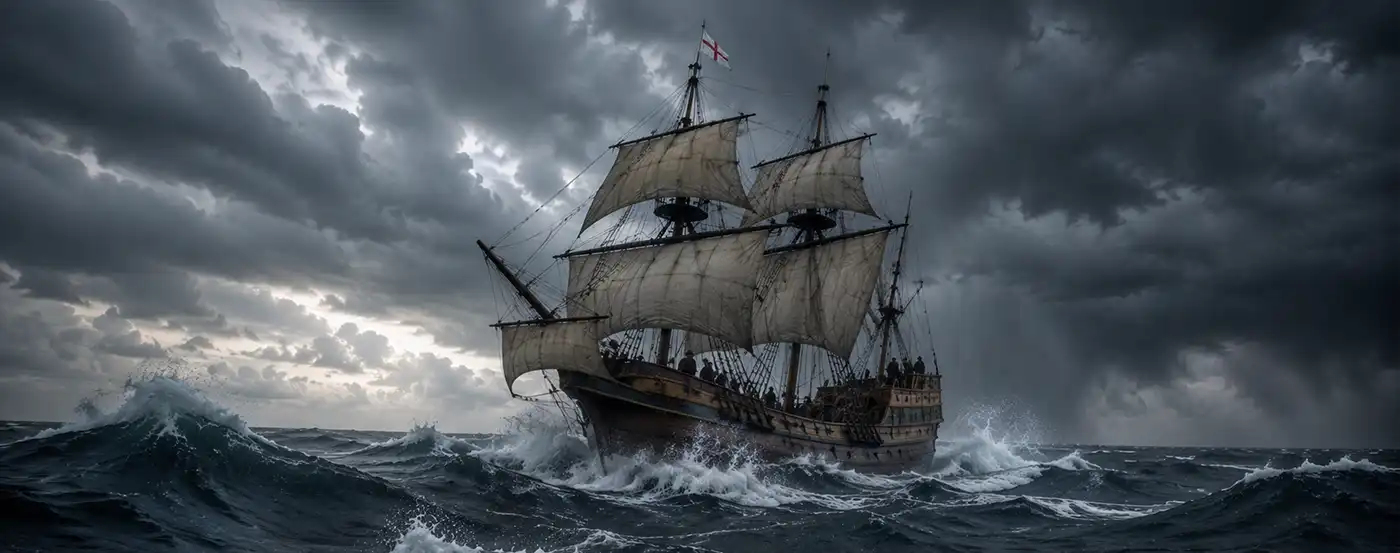
The voyage began reasonably well, but conditions deteriorated as the Mayflower traveled farther into the Atlantic. Autumn was not an ideal season for the crossing, and the delays caused by the troublesome Speedwell had pushed the departure dangerously late in the year. Strong winds and increasingly severe storms battered the ship, sometimes forcing the crew to reduce sail and simply concentrate on keeping the vessel safe.
For the passengers below deck, rough weather must have been miserable. Most were confined to cramped quarters while the ship rolled, pitched and plunged through heavy seas. Seasickness would have been common, and there was little opportunity for fresh air when conditions made the upper deck unsafe. Everything aboard moved unless it had been secured—and occasionally things probably moved even when everyone was quite certain they had been secured.
There were no comfortable beds waiting at the end of a difficult day. Families lived in close proximity with their belongings, food and supplies around them. Privacy was scarce, washing facilities were primitive and sanitation was nothing resembling modern standards. The longer the voyage continued, the less pleasant those crowded quarters must have become.
Meals were equally practical. The passengers depended upon provisions that could survive a long ocean crossing, including salted and preserved meats, dried peas and beans, cheese, grains and hard biscuits. Fresh food disappeared quickly, while water stored aboard ship could become unpleasant during a lengthy voyage. Beer was commonly carried because it kept comparatively well and provided another source of drink.
The Atlantic also presented a much more serious problem than discomfort. During one particularly violent storm, a major wooden beam supporting the ship cracked, raising fears about whether the Mayflower could continue safely. Turning back after traveling so far would have been extremely difficult, but continuing across the Atlantic aboard a structurally damaged wooden ship wasn't exactly reassuring either.
Fortunately, the passengers had brought a large iron screw or jack intended for use in constructing their new settlement. It was used to help raise the damaged beam back into position so the crew could secure it. After consultation, the ship was judged capable of continuing.
It was an extraordinary piece of improvisation. One of the tools packed for building houses in America may have helped ensure that the people carrying it actually reached America in the first place.
The voyage also produced moments of genuine danger for individual passengers. During another storm, John Howland was thrown overboard when the ship lurched violently. Somehow, he managed to grab a trailing rope and hold on while members of the crew hauled him back aboard. Howland survived not only the incident but the first winter and went on to raise a large family in New England.
His survival has had remarkable consequences. Because John Howland later had ten children and numerous descendants, millions of Americans can trace ancestry to him. One loose grip on that rope could therefore have altered an astonishing number of family trees.
Life continued even amid the storms. Elizabeth Hopkins gave birth during the crossing to a son who was appropriately named Oceanus. Delivering a baby in the confined quarters of a rolling 17th-century merchant vessel, without modern medical care and somewhere in the middle of the Atlantic, gives an entirely new meaning to an inconvenient place to go into labor.
Remarkably, despite the difficult voyage, only one passenger, William Butten, died while the Mayflower was crossing the Atlantic. The terrible loss of life associated with the expedition would come later, during the settlers' first winter in New England.
Navigation itself required skill and experience. The crew could estimate latitude using celestial observations and instruments available to mariners of the period, but accurately determining longitude remained extremely difficult. Navigators relied heavily upon courses, estimated speed, elapsed time and experience to determine where they believed the ship was.
There were no detailed weather forecasts coming over the radio, no satellite navigation and no Coast Guard waiting a telephone call away. Captain Christopher Jones and his crew were responsible for getting the ship across thousands of miles of ocean using the seamanship and navigational knowledge available in the early 17th century. The passengers originally intended to settle much farther south, near the Hudson River, within the northern limits of territory associated with the Virginia Company's colonial claims. Instead, after weeks of difficult sailing, the Mayflower approached the coast of what is now Massachusetts.
On November 9, 1620, according to the calendar being used by the English passengers, land was finally sighted. It was Cape Cod.
After 66 days aboard the Mayflower, the passengers had crossed the Atlantic successfully—but they were considerably north of where they had intended to be. Attempts to sail south encountered dangerous shoals and difficult seas, convincing the expedition to turn back toward Cape Cod. Their ocean voyage was over, but almost nothing had gone according to the original plan. They had departed late, crossed through severe autumn weather, repaired a damaged ship in mid-ocean, survived a man going overboard, welcomed a baby aboard and arrived hundreds of miles from their intended destination.
Considering all that, seeing land of any kind probably looked pretty good. After 66 days of Atlantic travel, nobody aboard was likely to complain that the hotel wasn't quite where the brochure said it would be.
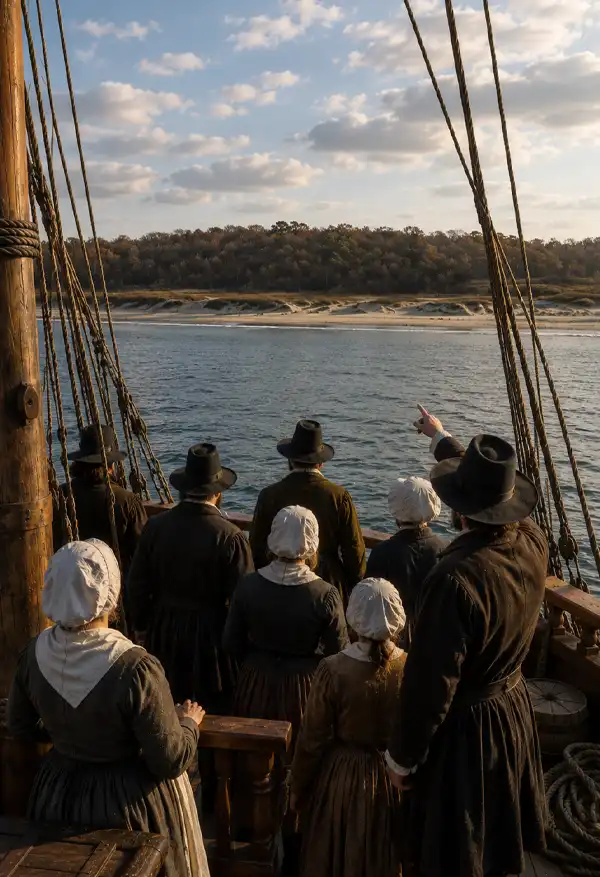
The Mayflower Arrives in New England
After reaching Cape Cod in November 1620, the Mayflower anchored in what is now Provincetown Harbor. Reaching land brought enormous relief, but the passengers couldn't simply march ashore and begin building Plymouth. They first needed to explore an unfamiliar coastline and find a location with fresh water, usable land and a harbor capable of supporting their settlement.
Exploring parties spent several weeks examining Cape Cod and the surrounding area. During these expeditions, the newcomers found unmistakable evidence that the region was already inhabited and used by Indigenous peoples, including stored corn and Native settlements. They also had an armed encounter with Native people at what became known to the English as First Encounter, although no one appears to have been seriously injured.
Eventually an exploring party crossed Cape Cod Bay and examined the area known to the Wampanoag as Patuxet. An Indigenous community had previously lived there, but epidemics introduced following earlier European contact had devastated its population. The location offered a sheltered harbor, freshwater sources and land that had already been cleared and cultivated, making it attractive to the settlers as winter rapidly approached.
In December 1620, the passengers selected the area for what would become Plymouth Colony and began constructing their settlement. The Mayflower remained anchored nearby, providing shelter while buildings were erected ashore.
Unfortunately, arriving in New England had solved only the problem of getting across the Atlantic. The settlers now faced a New England winter with inadequate housing, limited supplies and bodies already weakened by months aboard ship.
They had found their new home. Now came the considerably harder business of surviving in it.
The Mayflower Compact
Before the passengers began establishing their permanent settlement, they faced an unexpected problem of government. Because the Mayflower had arrived outside the area covered by the colonists' original arrangements, questions arose over whether everyone aboard would still recognize the authority of the expedition's leaders. The passengers were not one unified religious congregation, and some reportedly believed that arriving outside the intended territory released them from the rules under which the colony had been organized. After two months together aboard a crowded ship, discovering that nobody could agree about who was in charge was probably not the ideal way to begin life ashore.
The response was an agreement signed aboard the Mayflower on November 11, 1620, known today as the Mayflower Compact. Forty-one adult male passengers signed it, including both members of the Separatist congregation and other settlers. They agreed to join together as a political community and to create laws, ordinances and offices considered necessary for the general good of the colony. Those signing also promised to obey the decisions made under that system. It was a short document, but it provided a practical framework for maintaining order among people who were about to establish a community far from the institutions that had governed their lives in England.
The Mayflower Compact should not be mistaken for a declaration of independence or a constitution establishing democracy in the modern sense. The settlers continued to consider themselves subjects of King James I, whose authority was explicitly acknowledged in the agreement. Women could not sign it, nor could many other people who would live under the colony's government participate equally in its political decisions. Its importance comes instead from the principle that the settlers themselves agreed to establish a government and consented to live under laws created for their community.
The document subsequently became an important part of American political history because of its association with self-government and government by agreement. Plymouth Colony developed its own institutions after the settlement was established, and the Compact came to be remembered as an early example of colonists collectively establishing the rules under which they would govern themselves. The original document has been lost, but its wording survives through later accounts, including William Bradford's history of Plymouth Colony.
Interestingly, the passengers themselves did not call their agreement the Mayflower Compact. That familiar name came into use much later. To the people aboard the ship, it was less a grand historical document destined for school textbooks than a practical solution to an immediate problem: they needed an orderly government before more than 100 people began trying to establish a settlement together.
Considering the circumstances, drawing up some rules before everybody got off the boat was probably one of the wiser decisions made during the entire voyage.
The First Winter Was Devastating
Surviving the Atlantic crossing proved to be only the beginning of the Mayflower passengers' struggle. They arrived in New England as winter was setting in, with permanent shelter still to be constructed and many passengers already weakened by weeks aboard ship. During December 1620, work began on buildings at Plymouth, but severe weather meant that many settlers continued living aboard the Mayflower while construction proceeded ashore.
Disease soon spread through the group. Poor nutrition, exposure, inadequate shelter and the unhealthy conditions aboard the crowded ship contributed to what became known as the “General Sickness.” During the winter of 1620–1621, passengers died with alarming frequency, sometimes several within a short period. Members of the ship's crew were also affected. At the worst point, only a small number of healthier settlers were reportedly able to care for everyone else, tending the sick while also gathering firewood, preparing food and performing the work necessary to keep the settlement alive.
By the spring of 1621, roughly half of the 102 passengers who had sailed aboard the Mayflower were dead. Entire families had been changed by the losses. Of the adult women who had made the voyage, particularly few survived that first winter, leaving many children without their mothers. The death toll makes clear just how precarious the Plymouth settlement had become within only a few months of its establishment.
Those who survived gradually moved ashore as conditions improved and buildings became available. When the Mayflower finally departed for England in April 1621, remarkably, none of the surviving colonists chose to return with it. Whatever hardships they had endured, they remained committed to attempting to make Plymouth their home.
The famous harvest gathering later that year is often remembered as one of the happier episodes in the Plymouth story, but it came after months of extraordinary loss. For the survivors, simply reaching the autumn of 1621 was itself an achievement worth remembering.
What Happened to the Mayflower?
The Mayflower remained at Plymouth throughout the difficult winter of 1620–1621, providing shelter while the settlers constructed their new community ashore. The ship's crew suffered from illness alongside the passengers, delaying its return voyage until spring. On April 5, 1621, the Mayflower finally departed Plymouth for England. The return crossing was considerably faster than the outward journey, and the ship reached England in May.
Captain Christopher Jones continued to command the Mayflower after its famous voyage, but not for long. Jones died in March 1622, and the ship appears to have fallen out of regular service afterward. By 1624, the vessel was being described in records as being in poor condition and was appraised as part of Jones's estate.
After that, the historical trail becomes frustratingly thin. The Mayflower was probably broken up and its timbers sold or reused, which was a perfectly ordinary fate for an aging wooden merchant vessel. Various stories have subsequently claimed that pieces of the original ship survived in buildings in England, most famously the suggestion that timbers from the Mayflower were incorporated into a barn in Buckinghamshire. None of these claims has been conclusively proven.
So the ship that became one of the most recognizable vessels in American history simply disappeared. There was no ceremonial retirement, museum berth or carefully preserved hull waiting for future generations. The Mayflower had been a working merchant ship, and when its useful life ended, it was apparently treated like one.
Rather fittingly, the passengers became famous, the voyage became legendary, and the ship itself seems to have quietly wandered off before anybody thought to save it.
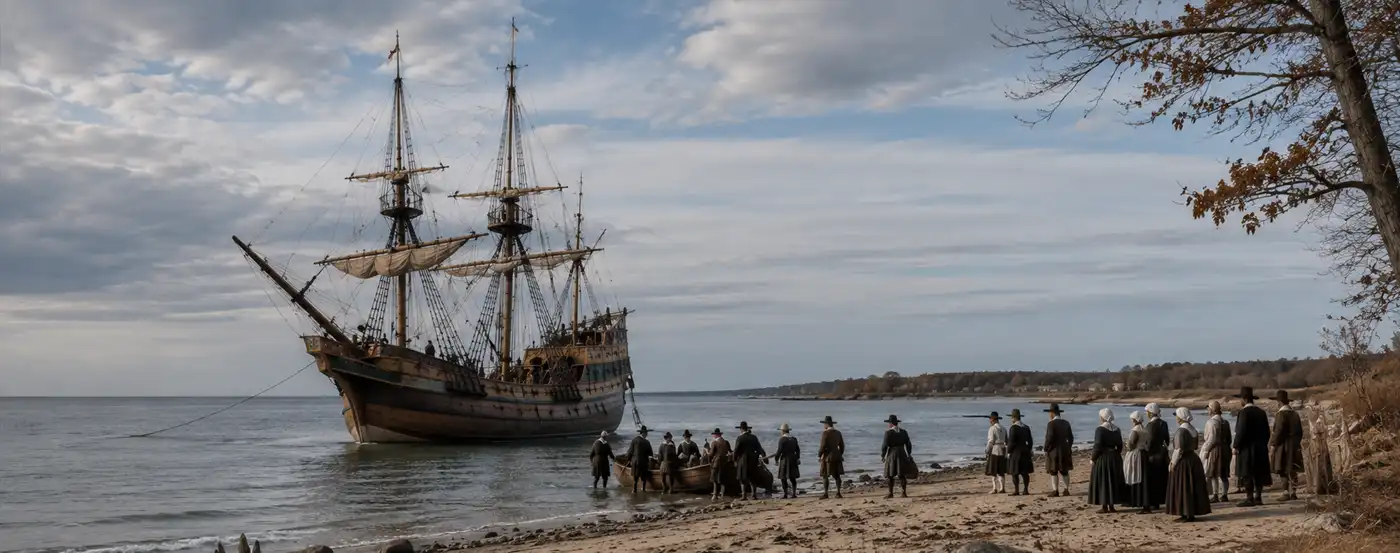
Mayflower II Keeps the Story Afloat
The original Mayflower may have disappeared, but visitors to Plymouth, Massachusetts, can still get an unusually close look at what life aboard the famous ship might have been like. Mayflower II is a full-scale reproduction of the 17th-century vessel, constructed in England during the 1950s using traditional shipbuilding techniques wherever practical. In 1957, she crossed the Atlantic under sail, following a route from Plymouth, England, to Plymouth, Massachusetts, and was greeted by thousands of people when she arrived.
Today, Mayflower II is operated by Plimoth Patuxet Museums and serves as a floating historical exhibit. Visitors can explore the vessel, examine its decks and cramped spaces, and gain a much better appreciation of what 102 passengers endured during their 66-day Atlantic crossing. The ship underwent an extensive restoration lasting several years before returning to Plymouth in 2020, and in 2020 she was also added to the National Register of Historic Places.
Standing aboard Mayflower II makes one fact particularly difficult to ignore: the original passengers crossed an ocean in something considerably smaller than our imaginations tend to make it. After seeing the available space firsthand, complaining about legroom on the flight home would require a certain amount of nerve.
Why Mayflower Day Matters
Mayflower Day remembers a voyage that became deeply connected with the history of Plymouth Colony and the development of colonial New England. The Mayflower's passengers crossed the Atlantic seeking new lives for a mixture of religious, economic and personal reasons, then attempted to establish a permanent community under extraordinarily difficult circumstances. Their story includes determination and survival, but also belongs to the much larger history of European colonization and its profound consequences for the Indigenous peoples already living in North America.
The observance also provides an opportunity to separate history from some of the comfortable legends that developed around the Pilgrims. The Mayflower did not arrive in an empty land, its passengers were not all religious Separatists, and their survival was far from assured. Remembering the Wampanoag people, the hardships of the first winter, the Mayflower Compact and the complicated relationships that followed gives us a fuller understanding of why the voyage remains historically significant.
More than four centuries later, the Mayflower continues to occupy an extraordinary place in American memory. Mayflower Day gives us a reason to examine the real people behind that familiar story—their ambitions, mistakes, hardships and achievements—rather than leaving them frozen forever in a schoolbook illustration wearing suspiciously large buckles.
How to Observe Mayflower Day
One of the best ways to observe Mayflower Day on September 16 is to explore the history beyond the familiar story. Learn about individual Mayflower passengers and discover why they made the journey, read the Mayflower Compact, investigate the experiences of women and children aboard the ship, or spend some time learning about the Wampanoag people and the world that existed in New England long before the newcomers arrived. The more closely you examine the story, the more interesting—and considerably more complicated—it becomes.
If you can visit Plymouth, Massachusetts, Mayflower Day provides an excellent excuse to explore the places associated with the colony and visit Mayflower II at Plimoth Patuxet Museums. Walking through a reproduction of the ship offers a perspective that photographs cannot quite provide. Those 102 passengers suddenly seem much more real when you're standing in the sort of confined space they shared for 66 days.
Mayflower Day can also become an opportunity for a little family-history research. Millions of people today trace their ancestry to passengers aboard the Mayflower, and the documented passenger list provides plenty of names to investigate. Even without a Mayflower connection, exploring your own family's migration story can be an interesting way to consider why people throughout history have left familiar homes and taken enormous risks to begin somewhere new.
For a quieter celebration, read a book or watch a documentary about the Mayflower, Plymouth Colony or early New England, visit a local history museum, or prepare a meal inspired by foods available in 17th-century New England. Just remember that the historical experience did not involve pumpkin pie, cranberry sauce from a can and falling asleep in front of a football game.
Whatever you choose, the best way to observe Mayflower Day is to spend a little time with the real history behind the famous voyage. Fortunately, commemorating it does not require recreating the journey itself. Sixty-six days in a cramped wooden ship with 101 other passengers seems an unnecessarily enthusiastic approach to historical accuracy.
Mayflower FAQ
The Mayflower may have sailed more than 400 years ago, but there are still plenty of questions surrounding its passengers, voyage and eventual fate. Our Mayflower FAQ provides quick answers to some of the most frequently asked questions about the ship that carried 102 passengers across the Atlantic and into American history.
When is Mayflower Day?
Mayflower Day is observed annually on September 16. It commemorates the Mayflower's final departure from Plymouth, England, in 1620. Contemporary English records give the departure as September 6 under the Julian calendar then used in England, corresponding to September 16 on the Gregorian calendar.
How many passengers were aboard the Mayflower?
The Mayflower carried 102 passengers on its famous 1620 voyage to North America. They included men, women and children from different backgrounds, and not everyone aboard belonged to the religious Separatist congregation commonly associated with the Pilgrims.
How long did the Mayflower take to cross the Atlantic?
The Mayflower's voyage across the Atlantic lasted 66 days. The ship departed Plymouth in September and sighted Cape Cod in November 1620 after enduring difficult autumn weather and several severe storms.
Where was the Mayflower originally supposed to go?
The passengers intended to establish their settlement much farther south, near the Hudson River and within territory connected with the Virginia Company's colonial claims. Instead, the ship reached Cape Cod and ultimately remained in what is now Massachusetts.
Why did the Mayflower sail without the Speedwell?
The Speedwell was originally supposed to accompany the Mayflower, but it repeatedly developed leaks during attempts to begin the Atlantic crossing. After returning to England for repairs more than once, the Speedwell was abandoned and the remaining travelers continued aboard the Mayflower alone.
What was the Mayflower Compact?
The Mayflower Compact was an agreement signed aboard the ship by 41 adult male passengers in November 1620. The signers agreed to form a political community, establish laws for the general good and abide by the resulting government. It later became an important early example of self-government by agreement in colonial America.
Did all of the Mayflower passengers survive?
No. Although only one passenger died during the Atlantic crossing itself, the first winter at Plymouth was devastating. Disease, exposure, inadequate shelter and poor nutrition contributed to the deaths of roughly half of the original 102 passengers by the spring of 1621.
What happened to the original Mayflower?
The Mayflower returned to England in 1621 and appears to have fallen out of regular service after the death of Captain Christopher Jones in 1622. By 1624 the ship was recorded as being in poor condition, and it was probably dismantled and its timber reused or sold. Its exact fate remains uncertain.
Does the Mayflower still exist?
The original Mayflower does not survive, but Mayflower II, a full-scale reproduction constructed in England during the 1950s, can be visited in Plymouth, Massachusetts. The vessel crossed the Atlantic under sail in 1957 and today serves as a floating historical exhibit operated by Plimoth Patuxet Museums.
Why is the Mayflower important to American history?
The Mayflower voyage became closely associated with the establishment of Plymouth Colony, the Mayflower Compact and the development of colonial New England. Its history also forms part of the larger and more complicated story of European colonization and its consequences for the Wampanoag and other Indigenous peoples already living in the region.
Remembering an Extraordinary Voyage
More than four centuries after the Mayflower crossed the Atlantic, the ship remains one of the most recognizable symbols of early American history. Yet the real story is far richer than the familiar image of Pilgrims stepping ashore. It was a story of 102 very different passengers crowded aboard a merchant vessel, an exhausting 66-day crossing, an unexpected arrival in New England and a first winter that claimed roughly half of those who had made the journey.
Mayflower Day gives us an opportunity to remember that history in its entirety. The passengers demonstrated remarkable determination in establishing Plymouth Colony, but they did not arrive in an empty land. Their story became intertwined with that of the Wampanoag people, whose homeland and history long preceded the arrival of the Mayflower. What followed included cooperation and diplomacy as well as growing tensions and conflict, making the legacy of Plymouth considerably more complicated than the comfortable version many of us first encountered in school.
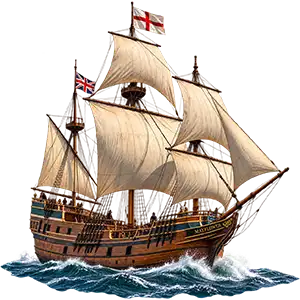
Perhaps that complexity is precisely why the story remains worth telling. The Mayflower voyage involved courage, faith, ambition, hardship, loss and consequences its passengers could never have imagined when they watched the English coastline disappear behind them.
On Mayflower Day, September 16, we remember an extraordinary voyage not because everything that followed was simple or perfect, but because understanding what actually happened helps us understand the history that came afterward.
And somewhere beneath all that history remains one wonderfully human achievement: 102 passengers spent 66 days together on a tiny wooden ship and still managed to establish a community afterward. That alone deserves a place in the record books.