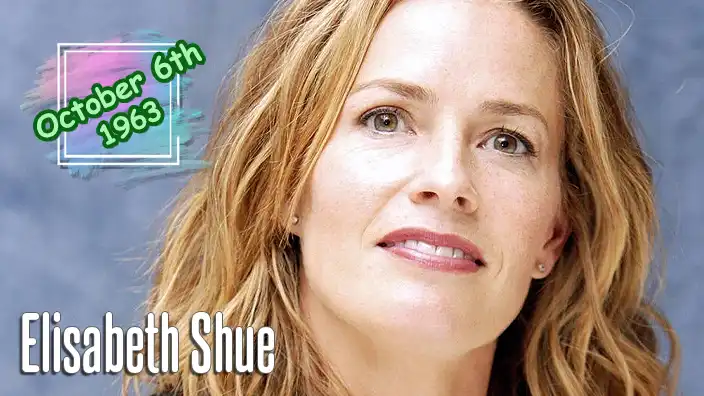
October 6, 1963, in Wilmington, Delaware
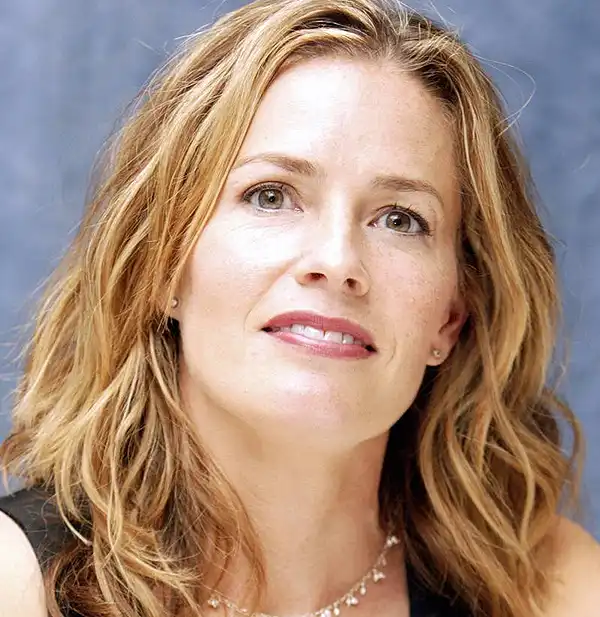
Elisabeth Judson Shue was born on October 6, 1963, in Wilmington, Delaware, and grew up in South Orange, New Jersey. Long before Hollywood came calling, Shue grew up surrounded by brothers and developed a fiercely competitive streak. Athletics played an important role in her childhood, particularly soccer and gymnastics, and she competed in soccer at a time when girls playing alongside boys was considerably less commonplace than it later became. Her younger brother Andrew Shue would eventually become an actor himself, best known for playing Billy Campbell on the television series Melrose Place.
Shue did not begin with some grand Hollywood master plan. While studying at Wellesley College, she began appearing in television commercials as a way of earning money. Her commercial work included advertisements for Burger King, Hellmann's mayonnaise and De Beers diamonds. It was a practical beginning to an acting career, although going from hamburgers and mayonnaise to major Hollywood movies in only a few years suggests the plan worked rather better than expected.
Her major breakthrough came in 1984 with The Karate Kid. Shue played Ali Mills, the high-school student who becomes romantically involved with Daniel LaRusso, played by Ralph Macchio. Daniel's arrival in California brings him into conflict with Ali's former boyfriend Johnny Lawrence, played by William Zabka, and eventually into the orbit of Pat Morita's Mr. Miyagi. The movie became one of the defining youth films of the 1980s and developed into a franchise that continued attracting audiences decades later.
Ali was considerably more than a decorative girlfriend inserted between karate matches. She was confident, independent and perfectly capable of challenging both Daniel and Johnny when necessary. Shue's relaxed performance helped make the character believable and gave her considerable visibility in her first major film role. The picture also provided an unusually durable introduction to Hollywood. Many actors spend years trying to escape an early role; Shue eventually returned to hers.
Education remained important even as her acting career accelerated. After attending Wellesley College, Shue transferred to Harvard University and studied government. Hollywood, however, was becoming increasingly demanding, and she left Harvard before completing her degree to concentrate on acting. She was only a few credits short of graduating, which must rank among the more irritating places to leave anything unfinished. Many years later, she returned and completed her degree in 2000.
By then, Shue had already established herself as a leading actress. In 1987 she starred as Chris Parker in Adventures in Babysitting, directed by Chris Columbus. What begins as an apparently straightforward evening of babysitting quickly turns into an increasingly ridiculous journey through Chicago involving car trouble, criminals, a blues club, a hospital and several children who would have been much safer staying home and watching television.
The movie allowed Shue to carry a film rather than simply play the romantic interest. Her Chris Parker had to be funny, frightened, resourceful and believable while the story became progressively more chaotic around her. Adventures in Babysitting became another enduring 1980s favorite and demonstrated that Shue could anchor a comedy herself. IMDb lists the film among the roles for which she remains best known.
The following year brought another enormous commercial production when Shue appeared opposite Tom Cruise in Cocktail. She played Jordan Mooney, who becomes involved with Cruise's ambitious bartender Brian Flanagan. The movie was a major popular success even though critics were considerably less enthusiastic. Shue herself later joked about discovering that the movie was rather more concerned with men theatrically throwing drinks around than she had anticipated. Nevertheless, Cocktail became another prominent entry in a remarkably successful run of 1980s films.
Shue then joined one of the decade's biggest franchises when she replaced Claudia Wells as Jennifer Parker in Back to the Future Part II and Back to the Future Part III. Jennifer was the girlfriend of Michael J. Fox's Marty McFly, and Shue stepped into a role audiences already knew from the original film. Suddenly her résumé included Mr. Miyagi, a disastrous babysitting assignment, Tom Cruise behind a bar and a DeLorean capable of time travel. There are actors with considerably less eventful decades.
During the early 1990s, Shue continued working in films including Soapdish, The Marrying Man and Heart and Souls. She had successfully established herself as a familiar Hollywood leading lady, but that success also carried the danger of typecasting. The friendly, attractive woman audiences knew from mainstream movies could easily have become the only sort of character Hollywood offered her.
Then came Leaving Las Vegas.
Released in 1995 and directed by Mike Figgis, Leaving Las Vegas could hardly have been further removed from the comfortable mainstream roles that had made Shue famous. Nicolas Cage played Ben Sanderson, an alcoholic screenwriter who goes to Las Vegas intending to drink himself to death. Shue played Sera, a sex worker who forms an unconventional and deeply troubled relationship with him.
It was difficult material, bleak and emotionally demanding, and Shue's performance transformed perceptions of what she could do as an actress. Sera was vulnerable without being helpless, hardened without becoming emotionally unreachable, and compassionate without the film pretending that affection could magically repair the people at its center. The role required Shue to discard much of the wholesome screen image audiences associated with her earlier career.
The gamble paid off spectacularly. Shue received an Academy Award nomination for Best Actress for Leaving Las Vegas, along with nominations from the Golden Globes, BAFTA and Screen Actors Guild. Her performance also received major critics' honors, including recognition from the Los Angeles Film Critics Association, Chicago Film Critics Association and National Society of Film Critics. Nicolas Cage won the Academy Award for Best Actor for his performance as Ben.
Rather than simply marking another successful movie, Leaving Las Vegas fundamentally altered Shue's professional reputation. The actress who had been associated with youthful romances and mainstream entertainment had demonstrated that she could handle exceptionally dark dramatic material. IMDb describes the film as a turning point in her career, and the description is difficult to argue with.
A succession of substantial roles followed. Shue appeared opposite Val Kilmer in the 1997 thriller The Saint, playing scientist Dr. Emma Russell. That same year she appeared in Woody Allen's Deconstructing Harry. Further credits included Palmetto, Cousin Bette and the 2000 science-fiction thriller Hollow Man, directed by Paul Verhoeven and starring Kevin Bacon.
Shue's life away from the screen also influenced one of her later projects. Her older brother William died in a tragic accident during a family vacation in 1988, an event that profoundly affected the Shue family. Elisabeth and her brother Andrew later became involved in Gracie, a 2007 film inspired partly by experiences from their childhood and their relationship with William. The movie centers on a teenage girl fighting for the opportunity to play competitive soccer in the 1970s, drawing upon a sport that had been important within the Shue family long before Elisabeth became an actress.
Television eventually became another substantial part of her career. Shue joined CSI: Crime Scene Investigation as Julie Finlay, a blood-spatter expert brought into the Las Vegas crime laboratory. Appearing on the long-running series gave Shue a regular television role after decades primarily associated with movies. It also returned her to Las Vegas under circumstances that, compared with Leaving Las Vegas, were considerably less emotionally ruinous.
Later projects demonstrated that Shue remained willing to move between genres. She appeared in the horror comedy Piranha 3D, played herself — or at least a wonderfully fictionalized version of herself — in the comedy Hamlet 2, and appeared in Battle of the Sexes, Death Wish and the Tom Hanks World War II drama Greyhound. She also joined the superhero series The Boys as Madelyn Stillwell, placing yet another very different sort of production on an already eclectic résumé.
One of the most satisfying later chapters came when Shue returned to the role that had introduced her to millions of moviegoers. She reprised Ali Mills in Cobra Kai, the television continuation of The Karate Kid story. Rather than merely dropping Ali into the series for a nostalgic wave at the audience, her appearance allowed the character to reconnect with both Daniel LaRusso and Johnny Lawrence many years after the teenage rivalry that helped start the whole business.
Her return demonstrated just how much affection remained for The Karate Kid and its characters. It also gave audiences the unusual opportunity to see Shue revisit a role from near the beginning of her career after she had accumulated decades of experience in between. Ali Mills had been part of Elisabeth Shue's introduction to Hollywood; returning to her provided a pleasing circle back to where much of the story began.
Shue's personal life has remained considerably more stable than the Hollywood stereotype might suggest. She married director and producer Davis Guggenheim in 1994, and they have three children. Guggenheim is known for directing documentary films including An Inconvenient Truth and Waiting for "Superman." Shue has balanced family life with a career that has continued across film and television.
And then there is that Harvard degree. Shue had walked away when Hollywood demanded her attention, but she never completely abandoned the unfinished business. She returned to Harvard and graduated in 2000 with a degree in government. It is a delightful addition to her biography because by the time she received the degree, she had already starred in numerous major films and earned an Academy Award nomination. Most people finish university and then try to establish a career. Elisabeth Shue apparently decided to rearrange the order.
The longevity of her career is particularly striking because Shue successfully escaped the image that initially made her famous. Audiences first embraced her as the approachable young woman in The Karate Kid and Adventures in Babysitting. She could easily have remained trapped in variations of that character. Instead, Leaving Las Vegas revealed a dramatic depth that substantially changed the direction of her career.
That gives Elisabeth Shue a particularly satisfying Hollywood story. She became part of several beloved 1980s movies, disappeared into one of the darkest performances of her career when people least expected it, earned an Academy Award nomination, returned to university, continued working across film and television, and eventually revisited the movie that helped introduce her to the world.
Not bad for someone whose early professional experience involved convincing television viewers to buy hamburgers.