October 6, 1942, in Stockholm, Sweden
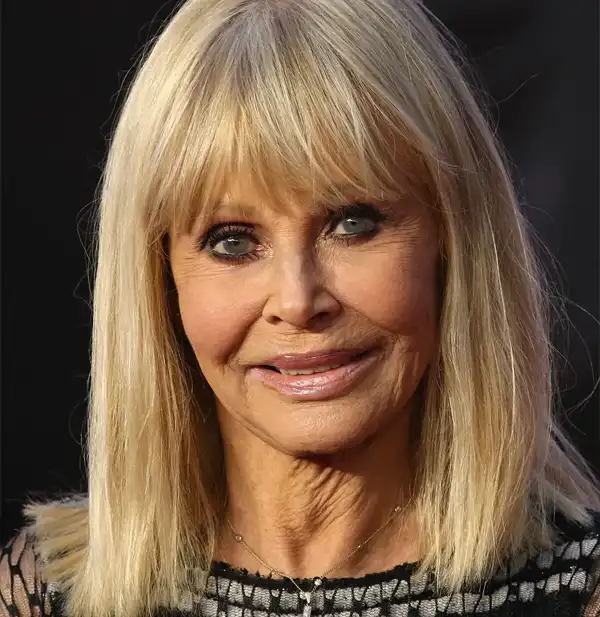
Born Britt-Marie Eklund in Stockholm, Sweden, on October 6, 1942, Britt Ekland became one of the most recognizable Swedish actresses of her generation. With platinum-blonde hair, striking looks and a distinctly European screen presence, she was almost tailor-made for the international cinema of the 1960s and 1970s. Yet behind the glamorous photographs and famous relationships was an actress whose career ranged from comedy and crime thrillers to horror, television, theater and, inevitably, the world of James Bond.
Ekland studied at drama school and worked with a traveling theater company before establishing herself on screen. Her early career included appearances in Swedish productions before opportunities took her into international filmmaking, including work in Italy. It was an era when European actors could move surprisingly freely between national film industries, and Ekland quickly developed the sort of international profile that made her equally at home in British, European and American productions.
Her fame accelerated dramatically after she met British actor and comedian Peter Sellers. The pair married in 1964 after a remarkably swift courtship, and suddenly Ekland found herself connected to one of the biggest comedy stars in the world. Their relationship generated enormous press attention, but it also produced professional collaborations. Ekland appeared alongside Sellers in After the Fox in 1966, a comedy directed by Vittorio De Sica and written by Neil Simon and Cesare Zavattini, and again in The Bobo the following year. Their marriage ended in divorce in 1968, but it remained an important and frequently discussed chapter of both their lives.
Ekland continued building a career independent of Sellers. She appeared with Jason Robards and Norman Wisdom in the 1968 musical comedy The Night They Raided Minsky's, directed by William Friedkin. The picture looked back at the world of American burlesque and gave Ekland another highly visible international role. During this period she appeared regularly in films on both sides of the Atlantic, becoming closely associated with the glamorous European style that was enormously popular during the late 1960s.
One of her most memorable performances arrived in 1971 when she appeared opposite Michael Caine in the British crime thriller Get Carter. Ekland played Anna, the mistress of Caine's character's brother. The film was hard, bleak and decidedly lacking in the cheerful escapism associated with many contemporary British productions. Initially receiving a mixed response, Get Carter subsequently acquired an enormous reputation and is now regarded as a landmark British crime film. Ekland's appearance consequently became part of a movie that continued gaining cultural importance long after its original theatrical run.
Two years later came another film whose reputation grew enormously with time. In Robin Hardy's The Wicker Man, Ekland played Willow MacGregor, the innkeeper's daughter on the mysterious Scottish island of Summerisle. The film starred Edward Woodward as the deeply religious police officer Sergeant Howie and Christopher Lee as Lord Summerisle. Its combination of folk traditions, sexuality, music, religion and creeping horror produced something unlike conventional horror films of the period.
Ekland's Willow became one of The Wicker Man's most memorable characters, particularly because of the famous sequence in which she attempts to lure Sergeant Howie from the adjoining room. Some movie magic was involved: Ekland was pregnant during production, and a body double was used for portions of the scene. Her dialogue was also dubbed in the finished film. None of that prevented Willow from becoming permanently associated with Ekland, and The Wicker Man eventually developed the sort of devoted cult following that filmmakers cannot manufacture no matter how many meetings they hold about it.
Then James Bond came calling.
Ekland played Mary Goodnight in The Man with the Golden Gun, released in 1974 and starring Roger Moore in his second outing as James Bond. Goodnight was Bond's assistant, and Ekland gave the character an appealing mixture of enthusiasm, glamour and comic exasperation. Goodnight might not always have been MI6's most formidable field operative, but she certainly had the distinction of becoming entangled in an adventure involving assassins, martial artists, solar-energy technology, a flying car and Christopher Lee carrying a golden pistol. There are quieter occupations.
Christopher Lee played Francisco Scaramanga, the extraordinarily expensive assassin whose weapon gave the film its title, while Ekland's fellow Swedish actress Maud Adams portrayed Andrea Anders. Ekland and Adams became friends while making the movie. Adams would later return to the Bond series in a much larger capacity as the title character in Octopussy in 1983, giving Sweden a particularly strong claim on the Bond-girl business.
For Ekland, receiving the role of Mary Goodnight was a memorable occasion. She has recalled being in producer Albert R. “Cubby” Broccoli's office and learning that the part belonged to her. Filming took her and her children to Bangkok and other exotic locations, and she later remembered Roger Moore particularly warmly. According to Ekland, Moore lacked the aloof behavior sometimes associated with major stars and remained approachable and humorous with the people around him during production.
The Man with the Golden Gun was not universally embraced by critics when released, but time has been rather kinder to many elements of the picture. Lee's Scaramanga remains one of the Bond series' most distinctive villains, and the film contains numerous memorable locations and sequences. Mary Goodnight likewise remains one of Ekland's defining roles. Decades later, photographs of Ekland in the film continue to immediately identify her with the Bond franchise.
Ekland's career, however, was considerably broader than Mary Goodnight. During the 1970s she appeared in productions including The Ultimate Thrill, Royal Flash, High Velocity and King Solomon's Treasure. Royal Flash, released in 1975, was based on George MacDonald Fraser's Flashman novel and starred Malcolm McDowell as the gloriously unreliable Harry Flashman. Ekland played Duchess Irma in a cast that also included Alan Bates, Oliver Reed and Christopher Cazenove.
Her private life remained almost as interesting to the press as her acting career. After her marriage to Peter Sellers, Ekland had several highly publicized relationships, including one with record producer Lou Adler and another with rock singer Rod Stewart. Her relationship with Stewart became a fixture of 1970s celebrity coverage. Ekland even contributed the French spoken words heard toward the end of Stewart's 1976 hit “Tonight's the Night (Gonna Be Alright),” an unusual little footnote linking a Bond girl to one of the decade's biggest rock records.
In 1984, Ekland married Slim Jim Phantom, drummer for the rockabilly band Stray Cats. They had a son together and later separated. Ekland has three children, including Victoria Sellers from her marriage to Peter Sellers and Nic Adler from her relationship with Lou Adler. Her family connections consequently stretch across film, music and entertainment almost as extensively as her own career.
Ekland also became an author. Her autobiography, True Britt, was published in 1980 and covered her career and highly publicized personal life. She subsequently wrote about beauty and fitness and entered the exercise-video business with Britt Fit. It was a natural extension of the glamorous public image that had followed her throughout much of her career, although one suspects Mary Goodnight never had to contend with an aerobics class while Scaramanga was shooting at her.
As film roles became less frequent, Ekland remained visible through television, theater, documentaries and appearances as herself. Her later screen credits included guest appearances and reality television, while British audiences also saw her in stage productions and pantomime. She appeared as herself in an episode of Absolutely Fabulous, an entirely suitable destination for somebody who had experienced several decades of fashion, celebrity and show-business excess firsthand.
Ekland also participated in I'm a Celebrity...Get Me Out of Here! in 2010 and later appeared in Swedish reality television. In 2020 she joined the cast of the BBC series The Real Marigold Hotel. Her continuing appearances introduced her to audiences who may not have been around when Scaramanga was charging a million dollars per assassination or when The Wicker Man first began making visitors suspicious of remote Scottish islands.
There is an interesting contradiction at the center of Britt Ekland's career. Her beauty unquestionably helped make her famous, and the entertainment industry frequently marketed her accordingly. Yet several of the films with which she is most strongly associated have enjoyed remarkable longevity. Get Carter became a classic of British crime cinema. The Wicker Man developed into one of Britain's most celebrated cult horror films. The Man with the Golden Gun remains part of one of cinema's longest-running franchises.
That is considerably more staying power than the average movie star receives.
For Bond enthusiasts, she will probably always be Mary Goodnight: the blonde MI6 operative caught up in Roger Moore's battle with Christopher Lee's golden-gun-wielding assassin. Horror enthusiasts remember Willow. Crime-film devotees know Anna from Get Carter. Students of 1960s celebrity culture inevitably encounter the extraordinary Peter Sellers years, while rock fans may discover her lurking unexpectedly in Rod Stewart history.
Britt Ekland managed to inhabit all of those worlds. Swedish actress, international movie star, Bond girl, horror icon, author, stage performer and enduring celebrity, she created a career spanning remarkably different corners of popular culture. And if one role must inevitably follow her forever, being remembered as the woman who accompanied James Bond into battle against Christopher Lee is hardly the worst line to have on the résumé.