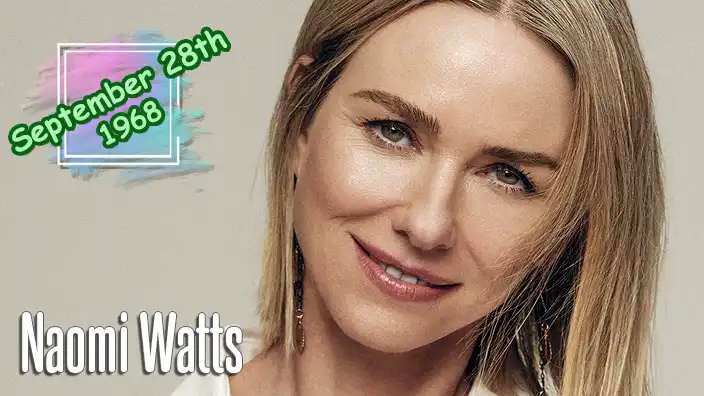
September 28, 1968, in Shoreham, Kent, England
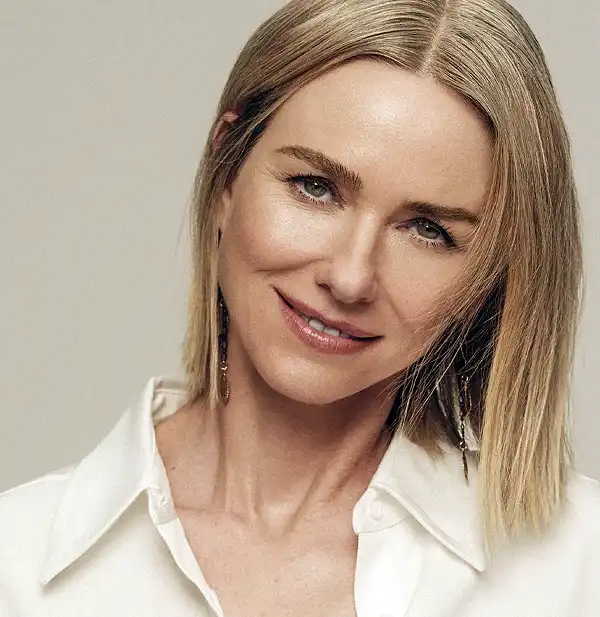
Naomi Watts built her reputation playing women confronted by circumstances that would cause most sensible people to lock the door, disconnect the telephone and refuse to participate any further. From the dreamlike mysteries of Mulholland Drive and supernatural terror of The Ring to the emotional devastation of 21 Grams and physical ordeal of The Impossible, Watts has demonstrated a remarkable ability to make extreme situations feel painfully human. Her performances frequently depend less upon grand speeches than upon expressions, hesitation and the gradual realization that whatever is happening is about to become considerably worse.
Naomi Ellen Watts was born on September 28, 1968, in Shoreham, Kent, England. Her mother, Myfanwy “Miv” Edwards, worked as an antiques dealer and costume and set designer, while her father, Peter Watts, worked with Pink Floyd as a road manager and sound engineer. Following her parents’ separation and her father’s death, Watts spent portions of her childhood moving around Britain with her mother and older brother, Ben. The family eventually settled in Australia, where Watts pursued acting and began the long process of becoming an overnight success that took considerably more than one night.
Her interest in performing had developed early, and after moving to Australia she took acting classes and found work in commercials before making her feature-film debut in the Australian drama For Love Alone in 1986. During these early years she also formed a lasting friendship with Nicole Kidman. The two actresses appeared together in John Duigan’s 1991 film Flirting, while Watts also appeared in the Australian television miniseries Brides of Christ. Kidman’s career accelerated rapidly, but Watts faced a much longer climb, enduring auditions, disappointments and roles that provided employment without providing the breakthrough she wanted.
Watts moved to the United States hoping to establish herself in Hollywood, where enthusiasm and talent were greeted by that venerable show-business tradition known as rejection. She accumulated appearances in films including Matinee, Tank Girl, Children of the Corn IV: The Gathering and Dangerous Beauty, as well as numerous television roles. Tank Girl later developed a cult following, but playing Jet Girl did not suddenly transform Watts into a major Hollywood star. She continued working, auditioning and waiting through a period she has subsequently described as far more difficult than her later success might suggest.
Then David Lynch found her photograph.
Lynch cast Watts in Mulholland Drive, originally conceived as a television pilot before being reworked and expanded into the 2001 feature film that became one of the director’s most acclaimed works. Watts plays Betty Elms, an apparently cheerful aspiring actress newly arrived in Los Angeles, before the film begins dismantling identities, expectations and perhaps reality itself. Explaining precisely what happens in Mulholland Drive has occupied critics and audiences ever since, but explaining what happened to Watts is much easier: people finally noticed just how good she was.
The performance allowed Watts to move between wide-eyed optimism, romantic vulnerability, desperation and emotional collapse, demonstrating a range that years of smaller roles had rarely allowed her to show. Mulholland Drive became a critical landmark and subsequently rose into the upper reaches of the British Film Institute’s Sight and Sound critics’ poll of the greatest films ever made. For Watts, it was the role that dramatically changed the direction of her career after years of uncertainty.
She followed it almost immediately with a very different sort of nightmare. Gore Verbinski’s 2002 horror film The Ring, an American adaptation of the Japanese film Ring, cast Watts as journalist Rachel Keller, who investigates a mysterious videotape supposedly responsible for the deaths of anyone unfortunate enough to watch it. The premise made videocassette ownership seem considerably more dangerous than anybody at Blockbuster had previously mentioned, and the film became a major commercial success.
Watts was crucial to making The Ring work. Rachel behaves like a determined journalist and protective mother rather than somebody who has wandered into a horror movie specifically to make poor decisions. Watts treated the increasingly supernatural events seriously, giving audiences an emotional anchor as the story progressed from investigation into full-blown nightmare. The film greatly expanded her international profile, and she returned as Rachel Keller in The Ring Two in 2005.
By then Watts had demonstrated that she could lead a commercially successful studio production, but Alejandro González Iñárritu’s 21 Grams in 2003 confirmed the dramatic power suggested by Mulholland Drive. Watts portrayed Cristina Peck, a woman whose life is shattered by catastrophic loss. The fractured drama also starred Sean Penn and Benicio del Toro and demanded an emotionally raw performance from Watts. Her work earned her first Academy Award nomination for Actress in a Leading Role.
Peter Jackson subsequently gave Watts one of cinema’s most famous roles when he cast her as Ann Darrow in his 2005 remake of King Kong. Following actresses including Fay Wray and Jessica Lange into the story, Watts had the unusual acting challenge of developing an emotional relationship with a gigantic ape who was largely absent while scenes were being filmed. Andy Serkis supplied Kong’s performance through motion-capture work, but Watts had to make Ann’s fear, sympathy and affection convincing from her side of the relationship. Against enormous sets, elaborate action sequences and state-of-the-art visual effects, she ensured that Ann remained more than simply the woman the ape carried around Manhattan.
Watts continued taking roles across an unusually broad collection of films. She starred opposite Edward Norton in The Painted Veil, appeared in David Cronenberg’s Eastern Promises, endured Michael Haneke’s deliberately disturbing Funny Games, entered international intrigue in The International and portrayed former CIA officer Valerie Plame in Fair Game. Her choices repeatedly demonstrated an attraction to complicated characters and uncomfortable stories rather than an obvious effort to follow a conventional movie-star formula.
One of her most physically and emotionally demanding performances arrived with The Impossible in 2012. Based on the experiences of a family caught in the devastating 2004 Indian Ocean tsunami, the film cast Watts as Maria Bennett opposite Ewan McGregor. Much of her performance takes place amid injury, exhaustion and chaos as Maria struggles to survive and reunite with her family. Watts received her second Academy Award nomination for Actress in a Leading Role for the performance.
She later joined the ensemble of Alejandro González Iñárritu’s Birdman or (The Unexpected Virtue of Ignorance), which won the Academy Award for Best Picture, and appeared opposite Bill Murray in St. Vincent. Other projects have included While We’re Young, Demolition, The Glass Castle, Luce, Penguin Bloom, Goodnight Mommy and the television series The Watcher. Her career has increasingly moved between film, limited series and producing, allowing Watts to take roles without being confined to the traditional boundaries between movie and television acting.
In 2024, Watts received renewed acclaim for portraying Barbara “Babe” Paley in Feud: Capote vs. The Swans. The FX limited series dramatized Truman Capote’s relationship with the wealthy and influential society women he called his “Swans” and the rupture caused when he exposed thinly disguised details of their private lives in his writing. Watts played Paley as a woman whose immaculate public presentation concealed considerable private pain, earning an Emmy nomination for the performance. It was precisely the sort of role at which Watts has long excelled: elegance on the surface with increasingly turbulent emotions underneath.
Watts has also moved behind the camera as a producer and executive producer on numerous projects. Her producing credits include The Friend, in which she starred alongside Bill Murray and a very large Great Dane, as well as Feud: Capote vs. The Swans, The Watcher and Goodnight Mommy. Producing represents another stage in a career that began with an actress waiting for somebody to give her an opportunity and developed into one in which she can help shape the opportunities herself.
Her personal life has inevitably attracted attention alongside her career. Watts had a long relationship with actor Liev Schreiber, with whom she has two children. The couple separated in 2016 while continuing to co-parent. Watts later began a relationship with actor Billy Crudup, whom she married in 2023. She has also remained closely associated with longtime friend Nicole Kidman, making their friendship one of the more durable relationships to emerge from the competitive world of acting.
What makes Watts particularly interesting as a performer is that she rarely appears to be displaying technique for its own sake. She can portray terror without reducing a character to screaming, grief without turning every scene into a demonstration, and vulnerability without making her characters helpless. Directors have repeatedly placed her in stories where normality fractures—sometimes psychologically, sometimes supernaturally and occasionally because an enormous wave or ape has arrived—and Watts has an unusual ability to make the audience experience that disruption alongside her.
There is also something satisfying about the shape of her career. Watts did not simply arrive in Hollywood, land an enormous role and proceed effortlessly toward stardom. She spent years working in productions that disappeared, auditioning for roles she did not receive and wondering whether persistence was becoming foolishness. When Mulholland Drive finally provided the opportunity she needed, she was prepared for it. The Ring proved she could carry a major commercial film, 21 Grams established her among the leading dramatic actresses of her generation, and The Impossible brought another Academy Award nomination.
Decades after that breakthrough, Watts continues to move between mainstream entertainment and challenging dramatic material. Her filmography contains horror, comedy, thrillers, literary adaptations, independent dramas, enormous studio productions and television, with enough emotionally traumatized characters to make one hope somebody occasionally sends her a script about a woman having a perfectly pleasant weekend.
For audiences, however, the difficult roles have produced memorable results. Naomi Watts has built a career around finding humanity in people facing fear, grief, uncertainty and upheaval. Whether she is staring at a cursed videotape, navigating David Lynch’s mysterious Los Angeles, fighting for survival after a tsunami or exchanging confidences with Truman Capote, she has a knack for making extraordinary circumstances feel remarkably real. Considering what usually happens to her characters, perhaps the greatest mystery is why any of them ever get out of bed in the morning.