Lumberjacks were the original tough guysâlong before fitness influencers started flipping tires...
Learning new skills is like assembling IKEA furniture: you start with enthusiasm and confidence, but soon...
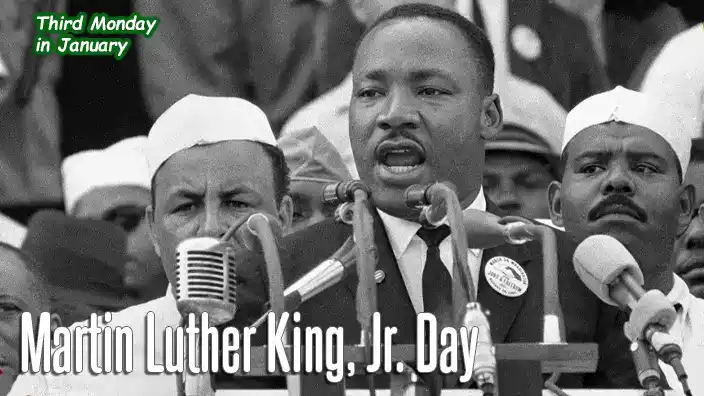
Dr. Martin Luther King, Jr. was the rare kind of leader who could command a crowd with the power of...
America the Beautiful Week is your official reminder that the country isnât just highways,...
Poinsettias are the divas of the plant worldâbeautiful, vibrant, and just a little bit...
This is the one day a year when you can shop till you drop and then wrestle a bargain-hunting...
On November 22, 1718, one of history's most notorious pirates, Edward Teach, better known as Blackbeard, met his violent end during a fierce naval battle near Ocracoke Island, off the coast of North Carolina. Believed to have been born in England, Blackbeard began his pirating career in the Caribbean, eventually serving under the experienced pirate Benjamin Hornigold. By 1717, Teach had established himself as a formidable pirate captain, commanding a captured French vessel he renamed the Queen Anne's Revenge. Armed with approximately 40 cannons, the ship became the centerpiece of his growing pirate fleet. With his enormous dark beard, intimidating appearance, and reputation for ruthlessness, Blackbeard became a nightmare for merchant sailors throughout the Caribbean and along the American coastline.
In 1718, Blackbeard's fortunes began to change. After the Queen Anne's Revenge ran aground near Beaufort, North Carolina, he abandoned much of his crew and sailed to the town of Bath, where he accepted a royal pardon administered by Governor Charles Eden. However, his retirement from piracy proved remarkably short-lived. Reports of renewed attacks and suspicions of corruption prompted Virginia Governor Alexander Spotswood to take action. Spotswood dispatched a naval expedition commanded by Lieutenant Robert Maynard to capture or eliminate the notorious pirate. Apparently, Blackbeard's idea of retirement involved considerably more armed robbery than the authorities considered acceptable.
On November 22, Maynard's forces confronted Blackbeard near Ocracoke Island, resulting in a brutal battle that ended with the pirate's death. According to contemporary accounts, Blackbeard suffered multiple gunshot and sword wounds before finally falling, although the exact number of injuries remains uncertain. His head was subsequently severed and displayed from Maynard's vessel as proof of the victory. Blackbeard's career had lasted only a few years, but his fearsome reputation, theatrical appearance, and dramatic demise secured his place among history's most legendary pirates. For a man who spent his career avoiding the law, Blackbeard certainly managed to make a spectacular final appearance before the authorities.
On November 22, 1900, the first automobile to carry the Mercedes name reportedly made its inaugural drive in Cannstatt, Germany, marking an important milestone in automotive history. The revolutionary vehicle was developed by Daimler-Motoren-Gesellschaft (DMG) for Emil Jellinek, a wealthy businessman and enthusiastic automobile promoter who believed that faster, lighter, and more powerful cars represented the future of transportation. Jellinek was so convinced of the new design's potential that he agreed to purchase 36 vehicles, an extraordinary order for the time. In return, the company agreed to name the automobile Mercedes, after his young daughter. It was an unusual naming arrangement, but considerably more elegant than calling the car the Jellinek Speedy Horseless Contraption.
The story began with German engineering pioneers Gottlieb Daimler and Wilhelm Maybach, whose early motorized vehicles helped transform transportation during the late nineteenth century. After establishing DMG in 1890, they developed increasingly sophisticated automobiles, attracting the attention of Jellinek, who became an enthusiastic customer and successful distributor. However, Jellinek was never satisfied with ordinary performance. His early purchases led to demands for faster machines, including the improved Phoenix models, before he challenged DMG to produce an entirely new racing automobile. Designed under Maybach's direction, the Mercedes 35 hp featured a lower center of gravity, a longer wheelbase, improved handling, a powerful four-cylinder engine, and an innovative honeycomb radiator. Its advanced design helped establish the basic layout of the modern automobile, moving decisively away from the appearance and engineering of traditional horse-drawn carriages.
The Mercedes 35 hp made its public debut in racing competition in 1901, where its impressive performance attracted international attention and helped establish Mercedes as a leading name in automotive engineering. Jellinek's confidence in the vehicle proved justified, and demand for the new automobiles grew rapidly among wealthy motorists eager to experience the latest advances in speed and technology. In 1902, DMG officially registered Mercedes as a trademark, laying the foundation for one of the world's most recognizable automotive names. What began as one businessman's determination to own a faster car ultimately helped reshape the automobile industry. And somewhere along the way, his daughter received a rather spectacular namesakeâalthough whether she ever got to borrow the keys is another matter entirely.
On November 22, 1963, President John F. Kennedy was assassinated in Dallas, Texas, in an event that shocked the United States and the world. The 35th president was traveling through downtown Dallas in an open-top Lincoln Continental alongside First Lady Jacqueline Kennedy, Texas Governor John Connally, and his wife, Nellie. Shortly after 12:30 p.m., as the presidential motorcade passed through Dealey Plaza, gunfire erupted. Kennedy was fatally wounded, while Governor Connally suffered serious injuries. The president was rushed to Parkland Memorial Hospital, where he was pronounced dead at 1:00 p.m. At just 46 years old, Kennedy became the fourth American president to die by assassination. Later that afternoon, Vice President Lyndon B. Johnson took the presidential oath aboard Air Force One at Dallas Love Field, with a grieving Jacqueline Kennedy standing nearby. A nation that had begun the day expecting an ordinary presidential visit suddenly found itself confronting an unimaginable tragedy.
Police arrested Lee Harvey Oswald, a former U.S. Marine who had lived in the Soviet Union and was employed at the Texas School Book Depository, in connection with the assassination and the fatal shooting of Dallas police officer J. D. Tippit. Oswald denied killing Kennedy, but he never stood trial. On November 24, while being transferred from Dallas police headquarters, he was shot and fatally wounded by local nightclub operator Jack Ruby in an incident witnessed by television viewers across the country. Ruby was subsequently convicted of murder and sentenced to death, although his conviction was overturned on appeal. He died of cancer in January 1967 before a new trial could begin. Meanwhile, Americans gathered to mourn their fallen president. Kennedy's funeral took place on November 25, with foreign dignitaries joining enormous crowds in Washington, D.C. Following a solemn procession and funeral Mass, Kennedy was buried at Arlington National Cemetery, where Jacqueline Kennedy lit the eternal flame that continues to mark his gravesite.
The assassination prompted decades of investigation, debate, and unanswered questions. In 1964, the Warren Commission concluded that Oswald had acted alone, finding no evidence of a broader conspiracy. However, a later investigation by the House Select Committee on Assassinations concluded in 1979 that Kennedy had probably been killed as part of a conspiracy, although it could not identify another gunman or establish who might have been involved. That conclusion relied heavily on acoustic evidence subsequently challenged by scientific investigators. More than six decades later, the assassination of John F. Kennedy remains one of the most extensively examined events in American history. Beyond the continuing questions surrounding his death, November 22, 1963, is remembered as a day of profound national sorrow, when a presidency ended abruptly and millions of Americans watched history change before their eyes.
On November 22, 1986, Mike Tyson became the youngest heavyweight boxing champion in history, defeating Trevor Berbick at the Las Vegas Hilton in Nevada. At just 20 years old, Tyson entered the ring against the 33-year-old reigning World Boxing Council (WBC) heavyweight champion with an astonishing professional record of 27 consecutive victories, including 25 knockouts. Known for his explosive punching power, remarkable speed, and intimidating presence, Tyson had already established himself as one of boxing's most formidable rising stars. Berbick, an experienced fighter who had previously faced Muhammad Ali and other heavyweight contenders, was determined to defend his championship. Unfortunately for Berbick, Tyson had arrived with a rather different understanding of how the evening should proceed. Just two minutes and 35 seconds into the second round, the contest was over, and boxing had a new heavyweight champion.
From the opening bell, Tyson overwhelmed Berbick with relentless aggression, powerful combinations, and the devastating punching ability that would make him internationally famous. Berbick attempted to withstand the assault, but Tyson's speed and accuracy left him struggling to mount an effective defense. In the second round, a crushing left hook sent Berbick crashing to the canvas. Although the champion repeatedly attempted to regain his footing, his unsteady legs refused to cooperate, and referee Mills Lane stopped the contest. The victory made Tyson the youngest boxer ever to capture a recognized world heavyweight championship, a record that remains intact. Under the guidance of trainer Kevin Rooney and the boxing philosophy developed by his late mentor Cus D'Amato, Tyson continued his remarkable rise, eventually unifying the major heavyweight titles and becoming the undisputed champion in 1987. His combination of speed, power, and aggressive fighting style earned him the nickname "Iron Mike", and opponents quickly discovered that sharing a boxing ring with Tyson was considerably less enjoyable than watching him from a safe distance.
Tyson's extraordinary career eventually became as famous for its controversies as for his achievements. In February 1990, he suffered one of boxing's greatest upsets when James "Buster" Douglas knocked him out in Tokyo, ending his reign as undisputed heavyweight champion. Tyson was convicted of rape in 1992 and served approximately three years in prison before returning to professional boxing. He regained heavyweight titles in 1996, but his comeback was overshadowed by the notorious 1997 rematch against Evander Holyfield, when Tyson was disqualified for biting his opponent's ears. He retired in 2005, although he later returned for exhibition appearances and a sanctioned professional bout against Jake Paul in November 2024. Berbick's later years were also troubled by legal difficulties, and he was murdered in Jamaica in 2006. Despite the dramatic turns in both fighters' lives, their November 1986 championship encounter remains a defining moment in boxing history. Tyson needed less than six minutes to make history that night, proving that heavyweight championships aren't necessarily won by the man with the most experience, but sometimes by the fellow whose fists arrive first.
On November 22, 1988, the Northrop B-2 Spirit stealth bomber was unveiled to the public for the first time at Air Force Plant 42 in Palmdale, California. Developed under extraordinary secrecy during the Cold War, the futuristic aircraft represented a major advancement in American military aviation. Its distinctive flying-wing design, lacking the conventional tail and fuselage arrangement of traditional bombers, immediately captured worldwide attention. Designed to penetrate heavily defended enemy airspace while minimizing detection by radar and other surveillance systems, the B-2 looked more like something from a science-fiction movie than a conventional military aircraft. Members of Congress, military officials, and journalists attended the unveiling, although the aircraft had yet to make its first flight. After years of classified development, the United States Air Force had finally revealed one of its most ambitious projects, demonstrating that sometimes the best way to surprise an adversary is to build an enormous airplane that is exceptionally difficult to detect.
The B-2 Spirit incorporated advanced materials, specialized coatings, and an aerodynamic shape engineered to reduce its radar signature. With a wingspan of approximately 172 feet, the aircraft was capable of carrying both conventional and nuclear weapons over intercontinental distances, with aerial refueling extending its operational reach. Its first successful flight took place on July 17, 1989, beginning an extensive testing program that demonstrated the aircraft's remarkable capabilities. However, its technological sophistication came at an extraordinary financial cost. Development expenses reached tens of billions of dollars, while the total program cost, including research, production, and support, eventually averaged more than $2 billion per aircraft. Originally, the Air Force planned to acquire 132 B-2 bombers, but the collapse of the Soviet Union and changing defense priorities led to a dramatic reduction in the program. Ultimately, only 21 aircraft were produced, making the B-2 one of the most expensive and exclusive military aircraft ever constructed.
The B-2 entered operational service in the 1990s and made its combat debut during NATO operations over Yugoslavia in 1999, demonstrating its ability to conduct long-range precision bombing missions against heavily defended targets. It subsequently participated in military operations in Afghanistan, Iraq, Libya, and other conflicts, establishing itself as an important component of America's long-range strike capabilities. Operating primarily from Whiteman Air Force Base in Missouri, the B-2 became an enduring symbol of advanced aerospace engineering and stealth technology. Its flying-wing configuration also influenced the development of the newer B-21 Raider, designed to eventually replace the aging stealth bomber fleet. The B-2 Spirit proved that an aircraft could be enormous, extraordinarily expensive, and remarkably difficult to findâalthough the accountants responsible for paying for it probably never had any trouble spotting the bill.