Celebrating the Brainiacs of the Ocean
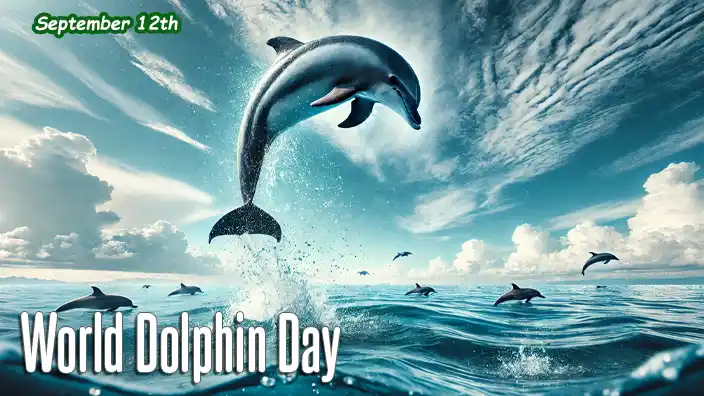
Every year on April 14, National Dolphin Day celebrates some of the most intelligent, social, and recognizable animals in the ocean. Dolphins have fascinated humans for centuries, and it isn't difficult to understand why. They communicate, cooperate, play, hunt together, form long-lasting social relationships, and occasionally launch themselves spectacularly out of the water simply because swimming normally apparently isn't dramatic enough.
National Dolphin Day is also an opportunity to look beyond the famous dolphin smile. Dolphins face threats from fishing activity, pollution, habitat degradation, underwater noise, disease, and changes affecting marine ecosystems. Celebrating dolphins therefore means more than admiring photographs of them jumping through waves. It means understanding these remarkable animals and recognizing why healthy oceans are essential to their survival.
Frankly, if they ever work out online banking, we may be in trouble.
When Is National Dolphin Day?
National Dolphin Day is observed annually on April 14 in the United States. It is an informal observance dedicated to appreciating dolphins and increasing awareness of their conservation and welfare.
The precise origins of National Dolphin Day are difficult to establish, and accounts of its creation vary. Rather than attaching the celebration to a founder whose involvement cannot be firmly documented, it is safer to regard the day as one that has grown through the efforts of marine organizations, educators, conservation advocates, aquariums, wildlife facilities, and people who simply have an enduring fascination with dolphins.
Today, National Dolphin Day provides an excellent excuse to learn more about these extraordinary marine mammals while considering the challenges facing dolphins in oceans and coastal waters around the world.
The dolphins themselves remain unaware of the occasion and have yet to submit a request for holiday pay.
What Exactly Is a Dolphin?
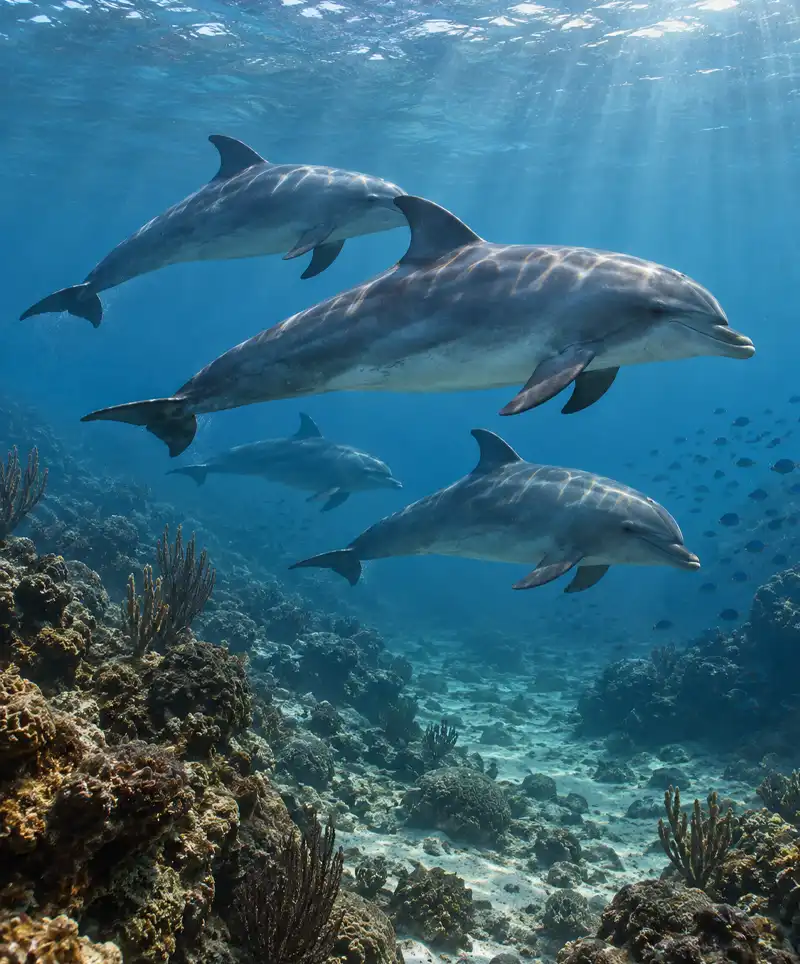
Dolphins are aquatic mammals belonging to the order Cetacea, the same group that contains whales and porpoises. Most of the species we commonly think of as dolphins belong to the family Delphinidae, known as the oceanic dolphins. This family includes familiar animals such as the common bottlenose dolphin, common dolphin, spinner dolphin, and Pacific white-sided dolphin. Despite considerable differences in size, appearance, and habitat, they share the streamlined bodies and remarkable adaptations that allow them to spend their entire lives in water.
Like other mammals, dolphins are warm-blooded, breathe air with lungs, give birth to live young, and feed their calves with milk. They cannot extract oxygen from water as fish do, so they must regularly return to the surface to breathe through the blowhole on top of the head. That blowhole is essentially a highly modified nostril positioned in an exceptionally convenient place for an animal that spends most of its life with everything except the top of its head underwater.
A dolphin's body has been thoroughly remodeled by evolution for life at sea. Its forelimbs have become flippers used primarily for steering and stability, while the hind limbs have disappeared externally. Propulsion comes from the powerful tail, which ends in two horizontal sections called flukes. Unlike a fish, which generally moves its tail from side to side, a dolphin drives its tail up and down to move through the water.
The familiar dorsal fin on the dolphin's back provides stability while swimming, although its shape varies among species and some dolphins have only a low ridge rather than a prominent fin. Researchers can sometimes identify individual dolphins from the distinctive shape, markings, scars, and notches found on their dorsal fins. For scientists trying to keep track of wild dolphins, nature has conveniently provided something resembling a swimming identification card.
Not every dolphin lives in the open ocean. Several species inhabit rivers and freshwater systems, including dolphins found in the Amazon and major river systems of Asia. Their environments can be very different from the clear coastal waters commonly associated with bottlenose dolphins, demonstrating just how successfully different members of the dolphin family have adapted to particular habitats.
There are also porpoises, which are frequently confused with dolphins but belong to a different cetacean family. Porpoises generally have shorter, less pronounced beaks, differently shaped teeth, and other anatomical distinctions. Calling every small cetacean a dolphin is therefore a little like calling every small domestic animal a terrier. You may get away with it in casual conversation, but somebody who knows the subject will eventually clear their throat.
Perhaps the biggest surprise in the dolphin family is the orca, commonly called the killer whale. Despite that famous name and its considerable size, the orca belongs to Delphinidae and is therefore the largest member of the oceanic dolphin family. Adult male orcas can grow dramatically larger than the bottlenose dolphins most people picture when they hear the word “dolphin.”
So the term dolphin covers a much broader and more varied collection of animals than the familiar smiling gray face seen on postcards and television programs. Dolphins can differ greatly in size, coloration, habitat, diet, and behavior, but all are highly specialized mammals whose ancestors made the transition from land to water millions of years ago.
And judging by the ease with which modern dolphins move through the ocean, none of them appears particularly interested in moving back.
Dolphins Are Mammals, Not Fish
It sounds obvious to many of us, but dolphins are sometimes mistaken for fish because they spend their entire lives in water, have fins, and are exceptionally good at swimming. Biologically, however, dolphins are every bit as mammalian as dogs, elephants, or the person standing on the beach pointing excitedly at them.
Unlike fish, dolphins breathe air using lungs and must regularly return to the surface. They inhale and exhale through the blowhole on top of the head, taking a breath before diving again. Dolphins cannot breathe underwater, which makes their ability to spend their entire lives at sea all the more impressive. Every dive ultimately comes with an appointment at the surface.
Dolphins are also warm-blooded, maintaining a relatively stable internal body temperature despite living in water that can draw heat away very quickly. A layer of insulating blubber beneath the skin helps conserve body heat while also storing energy. The thickness of that insulation varies according to species and environment.
Female dolphins give birth to live calves, which are nourished with milk produced by their mothers. The calf remains dependent upon its mother while learning the skills needed to survive, and in many dolphin species the relationship can continue for several years.
And, just to remove any lingering doubt about their mammalian credentials, dolphins even have hair—although not enough to require a comb. Bottlenose dolphin calves, for example, develop tiny hairs around the rostrum, or beak, before birth. These disappear shortly afterward, leaving small hair follicles behind.
So while a dolphin may have the streamlined shape, fins, and aquatic lifestyle we naturally associate with fish, those similarities are largely the result of adapting to the same environment. Underneath that remarkably efficient ocean-going design is a warm-blooded, air-breathing, milk-producing mammal.
Admittedly, one that has taken the whole “going for a swim” idea considerably further than the rest of us.
The Remarkable Dolphin Brain
Dolphins have large and highly developed brains, and decades of scientific research have revealed impressive abilities involving learning, memory, problem-solving, cooperation, imitation, and social recognition. Their brains evolved along a very different path from our own, yet dolphins demonstrate forms of complex cognition that continue to intrigue researchers studying animal intelligence.
However, intelligence across different species is notoriously difficult to rank. The popular claim that dolphins are definitively the “second-smartest animals after humans” makes a wonderful headline but oversimplifies a much more complicated subject. Chimpanzees, elephants, corvids, parrots, octopuses, and numerous other animals possess remarkable mental abilities adapted to the particular challenges of their environments. There is no universally accepted animal IQ test, and getting an octopus to sit at a desk with a No. 2 pencil would present difficulties of its own.
What scientists can say is that dolphins are capable of sophisticated learning and flexible behavior. Bottlenose dolphins can learn complicated tasks, remember information, understand relationships between signals and actions, imitate behaviors, cooperate with other dolphins, and adapt what they do based upon previous experience. Studies have also demonstrated remarkably long social memories, suggesting that dolphins can retain recognition of individuals they have not encountered for many years.
Researchers have also investigated dolphin self-recognition. Bottlenose dolphins have shown behavior in mirror experiments suggesting that they understand the reflection is connected to their own body rather than simply treating it as another dolphin. Mirror self-recognition is relatively uncommon among animals and remains an important area of research into how different species perceive themselves and their surroundings.
Their intelligence is particularly impressive because dolphins must solve problems in a three-dimensional, constantly changing environment. They need to locate prey, navigate large areas, recognize other individuals, learn from experience, coordinate activities, care for offspring, and respond to situations that can change rapidly. A dolphin's brain isn't simply large for decoration; it supports an exceptionally demanding way of life.
Young dolphins also have a considerable amount to learn. Calves spend years alongside their mothers, observing behavior and developing the skills required for independent life. In some dolphin populations, particular feeding techniques and other behaviors appear to be learned socially and passed between individuals or generations, giving researchers fascinating examples of what can reasonably be described as animal culture.
None of this means dolphins are little underwater humans. Their intelligence evolved to solve dolphin problems, just as ours evolved to solve human ones. Comparing the two can be fascinating, but appreciating dolphins on their own terms tells us far more about just how extraordinary their minds really are.
Besides, if intelligence were measured by the ability to catch breakfast while swimming at speed through the ocean, most of us wouldn't make the shortlist.
Dolphins Have Names — Sort Of
One of the most fascinating discoveries about bottlenose dolphins involves their signature whistles—distinctive sounds that function rather like individual acoustic identifiers. A young dolphin develops its own characteristic whistle, and that whistle can remain recognizable for many years.
That does not mean there is necessarily a dolphin somewhere officially named Pete. Humans use words such as Pete, Susan, or Bruce because that is how our language works. Dolphins operate in a world dominated by sound, and their version of identifying an individual is considerably more musical.
Researchers have found that dolphins can recognize the signature whistles of other dolphins. Even more remarkably, bottlenose dolphins have been observed copying another individual's signature whistle, particularly during social interactions. Scientists have interpreted this as something resembling addressing or calling a particular individual.
Imagine a pod spread across an area of water. Being able to produce a sound associated with one particular dolphin provides an obvious advantage. Instead of the aquatic equivalent of shouting, “Oi! Dolphin!” an animal can potentially direct its communication toward a particular member of the group.
There is also evidence that dolphins possess exceptionally long memories for these individual whistles. Research involving bottlenose dolphins has shown recognition of signature whistles belonging to animals they had been separated from for many years. In some documented cases, recognition persisted after more than a decade apart.
That ability makes considerable sense for animals living within complicated social communities. Dolphins may form relationships, separate, encounter one another again, change groups, and travel considerable distances. Remembering who is who can therefore be extremely useful.
Scientists are careful about simply declaring that dolphins have “names,” because human names are part of a language system that we should not automatically impose upon another species. A signature whistle is not necessarily equivalent to somebody saying, “My name is Pete.” What makes the discovery remarkable is that a dolphin produces a distinctive signal associated with its own identity and other dolphins can recognize and sometimes reproduce that signal.
Signature whistles are only part of dolphin communication. Dolphins also produce clicks, burst-pulsed sounds, body movements, physical contact, and other signals while interacting. Researchers continue studying what these different forms of communication mean and how much information dolphins can exchange.
So do dolphins have names? Sort of.
They certainly appear to possess something intriguingly close to individual acoustic labels, which is impressive enough without pretending we have translated the entire dolphin language.
Although I remain convinced that somewhere off the Florida coast there is a bottlenose dolphin named Pete, and Pete is thoroughly fed up with everyone getting his whistle wrong.
The Extraordinary World of Echolocation
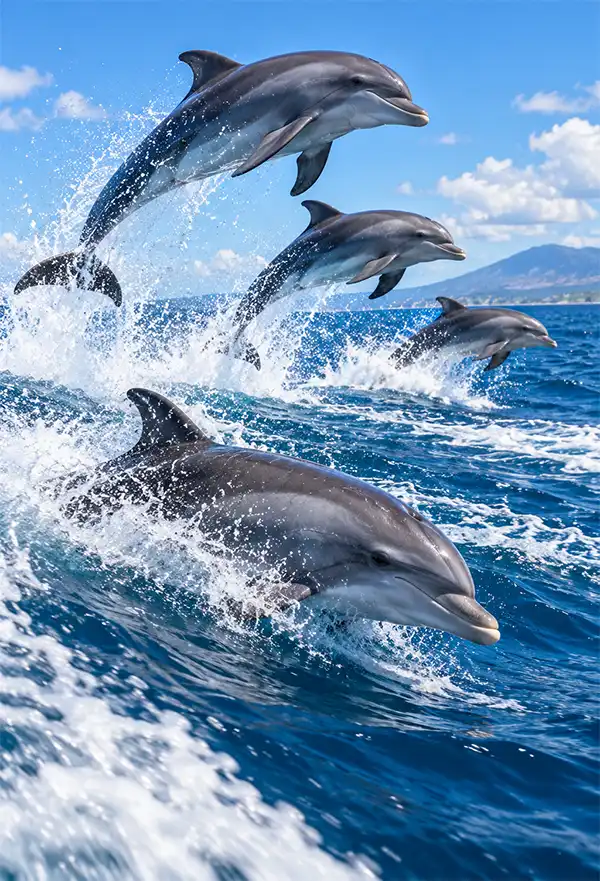
Of all the dolphin's remarkable abilities, echolocation may be the one that seems closest to possessing a genuine superpower. Dolphins can send sounds into the water, receive the echoes that bounce back, and use those returning signals to build remarkably detailed information about objects and animals around them—even when visibility is poor.
The basic principle sounds deceptively simple. A dolphin produces a rapid series of high-frequency clicks. Those sounds travel through the water until they encounter something—a fish, rock, boat, seabed, or other object—and part of the sound is reflected back toward the dolphin. By analyzing the returning echoes, the dolphin can gather information about the object's distance, direction, size, shape, and other physical characteristics.
The clicks are produced using specialized structures associated with the dolphin's nasal passages and are focused into a directional beam by the melon, the rounded mass of fatty tissue that gives many dolphins their familiar forehead shape. Rather than merely broadcasting sound everywhere, the dolphin can direct its echolocation clicks toward an area it wants to investigate.
Receiving the echo is equally remarkable. Much of the returning sound is conducted through specialized fatty tissues in the dolphin's lower jaw toward structures associated with the middle and inner ear. The dolphin's nervous system then processes the incoming acoustic information at extraordinary speed.
As a dolphin approaches or investigates a target, the pattern of clicks can change. Clicks may become increasingly rapid as the animal closes in on prey, eventually forming what researchers often describe as a terminal buzz during the final stages of an attempted capture. Imagine trying to chase a fish moving unpredictably through dark water while continuously measuring its position with sound—and doing the calculations quickly enough to have it for lunch.
Echolocation becomes particularly valuable because the underwater world is not always the crystal-clear blue paradise shown in travel brochures. Water can be dark, deep, murky, filled with suspended material, or simply lacking enough light for vision to do all the work. Sound, however, travels extremely well through water. Dolphins have evolved to take advantage of that physical property with extraordinary efficiency.
Experiments have demonstrated that dolphins can discriminate between objects using echolocation alone, distinguishing differences in characteristics such as shape, size, thickness, and material composition. What a human might need to examine visually or physically, a dolphin can sometimes investigate acoustically.
This does not mean a dolphin literally “sees with sound” in the same way humans see with light. We cannot climb inside a dolphin's mind and determine precisely what its acoustic perception feels like. Nevertheless, echolocation provides the animal with detailed information about an environment that might otherwise be partly or completely hidden from view.
Humans, of course, recognized the usefulness of essentially the same physical principle and developed sonar. Ships and submarines use active sonar by transmitting sound pulses and analyzing returning echoes, while passive sonar listens for sounds already present in the environment. Sonar became enormously important for submarine detection, navigation, mapping the seafloor, locating underwater objects, measuring depth, and numerous scientific and military applications.
The comparison with dolphins is irresistible. Human sonar can accomplish things dolphin echolocation was never designed to do, including detecting and tracking objects across enormous distances. It can employ large arrays of sensors, sophisticated signal processing, powerful computers, and decades of accumulated engineering. The dolphin, meanwhile, carries its entire system around inside its head. No electrical generator. No equipment racks. No display screens. No sonar dome requiring maintenance. No software update arriving just when everyone was perfectly happy with the previous version. Just click, echo, information.
Even more impressive is that the dolphin performs this while swimming, maneuvering, communicating, avoiding obstacles, monitoring its surroundings, and pursuing prey that has absolutely no intention of becoming dinner. The information must be produced, received, interpreted, and acted upon almost continuously.
Evolution has had millions of years to refine this biological sonar, while humans have been developing technological sonar for little more than a century. Our systems are astonishing achievements in their own right, but the dolphin remains a wonderful reminder that nature was conducting underwater acoustic engineering long before anyone built a submarine.
Humans needed hydrophones, transducers, electronics, computers, cables, technicians, operators, and quite a lot of money.
Pete just turns his head and clicks.
Dolphin Society Is Complicated
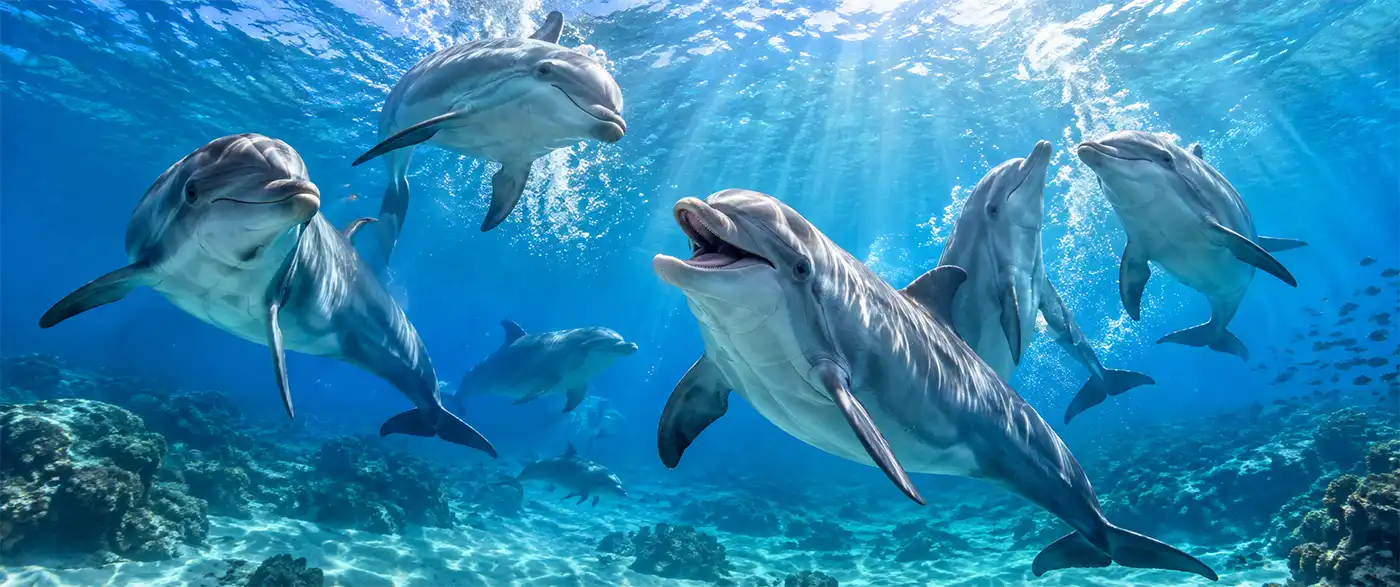
Dolphins are highly social animals, but simply saying that they live in pods makes their society sound much tidier than it really is. Depending upon the species, habitat, food supply, and circumstances, dolphins may travel in small groups, gather temporarily in much larger numbers, separate into smaller parties, and later meet up with familiar individuals again.
Bottlenose dolphins provide an especially fascinating example. Many live in what scientists call fission-fusion societies, meaning that group membership continually changes. A dolphin may spend part of the day with several familiar companions, separate to travel or forage with others, and later rejoin another group. Individuals can maintain relationships across this constantly changing social landscape. In other words, imagine having a family, several groups of friends, some work colleagues, a few neighbors you tolerate, and at least one individual you would rather avoid at the supermarket.
Now conduct the entire arrangement underwater.
Relationships between dolphins can last for years. Researchers studying identifiable wild dolphins have documented preferred companions and long-term associations, suggesting that dolphins do not simply gather randomly whenever they happen to be swimming in the same direction. Some individuals consistently choose to spend more time together than they do with others.
Male bottlenose dolphins can take cooperation to another level. In some populations, males form alliances with one another that can remain stable for many years. Researchers have even documented larger, multi-level alliances in which smaller groups of males cooperate with other groups. Keeping track of who is allied with whom can become surprisingly complicated.
Apparently dolphin politics developed before anyone invented elections.
The relationship between a mother and her calf is particularly important. Dolphin calves remain with their mothers for years in some species and populations, giving them plenty of time to learn the skills necessary for survival. A youngster must learn where to travel, what to eat, how to hunt, how to behave around other dolphins, and how to interpret the social world into which it has been born.
Some behaviors appear to be passed socially between generations. Particular dolphin populations have developed distinctive hunting techniques that younger animals can learn by observing experienced dolphins. One famous example involves bottlenose dolphins using marine sponges while searching for prey along the seafloor, apparently protecting their rostrums while foraging. The behavior is found among particular dolphins rather than universally throughout the species, making it an intriguing example of socially transmitted behavior.
Dolphins also cooperate while hunting. Depending upon the species and location, groups may herd fish into tight formations, drive prey toward shallow water, take turns moving through schools of fish, or coordinate their movements in other ways. Successful cooperation requires individuals to respond to one another while simultaneously keeping track of prey that is also moving. And all of this occurs in an environment where visibility may be limited and everybody is swimming.
Communication therefore plays an enormous role in dolphin society. Whistles, clicks, burst-pulsed sounds, body postures, touching, jaw claps, leaps, and other behaviors can all form part of social interaction. Their acoustic world allows dolphins to remain in contact when individuals cannot necessarily see one another.
Thanks to those signature whistles we met earlier, individual dolphins can also recognize distinctive calls associated with particular companions. So if Pete disappears around the other side of the reef, his friends do not necessarily need to swim around looking for him. They can call him.
Fortunately, dolphin telecommunications come with unlimited minutes, no roaming charges, and absolutely no phone bill.
Dolphin society isn't always peaceful, either. These are wild animals, not permanently cheerful characters from a children's cartoon. Dolphins compete for resources and mates, establish relationships that can involve dominance and aggression, and sometimes fight. Their intelligence and social complexity allow for cooperation, but they also provide plenty of opportunities for disagreement.
That combination is part of what makes dolphin society so interesting. Their lives involve family bonds, preferred companions, alliances, cooperation, competition, learning, communication, and relationships that may endure for years. Scientists can identify patterns within those relationships, but there is still much to learn about exactly how dolphins perceive their social world.
Calling a group of dolphins a pod is perfectly correct. Just don't assume everyone in the pod gets invited to Pete's birthday party.
How Dolphins Sleep Without Drowning
Going to sleep presents a rather serious problem when you are an air-breathing mammal that spends its entire life in water. Humans can climb into bed, turn off the light, and become completely oblivious for several hours. A dolphin attempting the same arrangement could fail to return to the surface for its next breath, with decidedly unfortunate consequences.
Dolphins solve the problem through an extraordinary adaptation known as unihemispheric slow-wave sleep. Instead of both halves of the brain entering deep sleep simultaneously, one cerebral hemisphere can rest while the other remains sufficiently active. After a period of time, the roles can switch, allowing the other half to get some rest.
The arrangement is possible partly because dolphin breathing is under much more deliberate control than human breathing. We can fall asleep and allow our brainstem to keep the respiratory machinery running automatically. Dolphins must maintain the awareness necessary to surface and breathe, so becoming completely unconscious for hours at a time would be a spectacularly poor design feature.
While resting, a dolphin may swim slowly, remain relatively stationary near the surface, or rest in other ways depending upon the species and circumstances. The more alert side of the brain helps maintain essential functions and awareness while the opposite hemisphere gets some downtime.
There is even an outward sign of what is happening. During unihemispheric sleep, the eye opposite the sleeping hemisphere may close while the other eye remains open. Later, when the resting side of the brain changes, the eyes can switch as well. Hence the famous description that dolphins sleep with one eye open.
It isn't paranoia. It is considerably more practical than drowning.
Keeping part of the brain alert also allows a resting dolphin to remain aware of its surroundings. That can be important when staying near companions, maintaining position, watching for potential danger, or simply avoiding becoming separated from the group. Dolphins are social animals living in an environment where conditions can change quickly, so completely switching off would not be particularly useful.
Young dolphins face an especially interesting challenge. Newborn calves need to remain close to their mothers, surface frequently, and keep moving during the demanding early period of life. Research has shown unusual patterns of activity and rest in dolphin mothers and newborn calves, demonstrating just how differently sleep can operate in an animal whose survival depends upon remaining mobile and breathing at the surface.
Dolphins do not remain permanently half asleep, of course. Their sleep occurs in periods distributed through the day and night, and scientists study different measures of rest and brain activity to understand exactly how much sleep various species require. The important point is that dolphin sleep is not simply the human version performed underwater. It is a specialized system adapted to an animal that can never entirely forget where the surface is. And no, as far as anyone knows, the pod does not appoint a Sentry Dolphin to swim around waking everybody for the next watch.
There is no dolphin equivalent of: “Wakey, wakey, Pete. You're on from midnight till four.”
Each dolphin's ability to rest one hemisphere while maintaining essential awareness means it carries its own remarkably effective watchkeeping system. No alarm clock is required, nobody has to shake the next watch awake, and there is no Chief Petty Officer wondering why Pete is still in his bunk five minutes after the pipe.
Humans generally require darkness, a comfortable mattress, several uninterrupted hours, and occasionally an alarm clock powerful enough to wake the dead. A dolphin can keep swimming, surface to breathe, remain partly aware of what is happening around it, and give half its brain the night off.
Even the Navy never managed a watch system quite that efficient.
Dolphins Know How to Play
Dolphins have repeatedly been observed engaging in behavior that appears unmistakably playful. They surf waves, chase one another, leap from the water, interact with floating objects, carry seaweed around, play with other animals, and sometimes create bubble rings that they appear to investigate and manipulate.
Some dolphins have been observed deliberately riding ocean swells and the bow waves created by boats. Rather than simply swimming from one place to another, they position themselves where the moving water can carry them along, sometimes repeatedly returning for another ride. Anyone who has watched dolphins surfing a breaking wave would have difficulty arguing that everything they do is strictly business.
Object play can be equally entertaining. Dolphins may carry pieces of seaweed on their fins or bodies, toss objects, pass them between individuals, or repeatedly retrieve something they have dropped. Young dolphins in particular spend considerable time exploring their surroundings and experimenting with objects, rather like children discovering that almost anything can become a toy if the adults aren't watching closely enough.
Then there are bubble rings. Dolphins can deliberately release air underwater in ways that create rings or clouds of bubbles, and some have been observed watching, following, biting, breaking, and apparently playing with them. Creating your own toy from nothing more than a carefully released bubble is an impressive solution to the problem of there being no toy store in the middle of the ocean.
Play is more than entertainment. For young dolphins, chasing, wrestling, manipulating objects, and interacting with companions may help develop the physical coordination and social skills they will need as adults. Play allows them to experiment with movements and situations when the consequences are considerably less serious than during an actual hunt or confrontation.
Dolphins also sometimes appear to invent games with one another, with individuals taking turns or repeatedly performing behaviors that have no obvious immediate purpose such as finding food or escaping danger. Scientists must be cautious about assigning human emotions and motivations to animals, but the repeated, voluntary nature of these activities provides strong evidence that play is an important part of dolphin life.
Perhaps that shouldn't surprise us. An intelligent, curious animal living within a complicated social community has plenty of reasons to explore, experiment, and occasionally do something simply because it is stimulating. Whether a dolphin experiences fun precisely as a human does is something Pete has so far declined to clarify.
But when several dolphins repeatedly surf the same wave, chase each other through the water, toss seaweed around, and leap spectacularly into the air before coming back for another go, they certainly make swimming twenty lengths of the community pool look terribly unimaginative.
How Fast Can Dolphins Swim?
Dolphins are powerful, efficient swimmers whose bodies have been superbly shaped for movement through water. Their streamlined form reduces drag, while strong muscles drive the horizontal tail flukes up and down to provide propulsion. The flippers help with steering and stability, allowing dolphins to accelerate, turn, dive, and change direction with remarkable agility.
Exactly how fast a dolphin can swim depends upon the species, individual animal, circumstances, and how the speed was measured. Figures of around 20 miles per hour or more are frequently quoted for some dolphins, but maximum-speed claims vary considerably and should be treated cautiously. What is certain is that dolphins can produce impressive bursts of speed when chasing prey, escaping danger, traveling, playing, or interacting with fast-moving boats.
They are not necessarily swimming flat-out all day. Like most animals, dolphins normally travel at more economical speeds, conserving energy until extra acceleration is useful. A dolphin commuting across its home range has no more reason to operate at maximum speed than you have to drive everywhere with your accelerator pressed against the floor.
Dolphins can also use a behavior known as porpoising, repeatedly leaping clear of the water while traveling quickly. Although the name sounds as though porpoises should have exclusive rights to it, dolphins do it too. At sufficiently high speeds, moving through air during part of each leap can reduce some of the resistance encountered while traveling through water.
Then there are the spectacular aerial displays. Dolphins breach, leap, twist, and slap the surface, while spinner dolphins take things considerably further by rotating rapidly in the air. Researchers have suggested several possible purposes for these behaviors, including communication, social activity, play, and possibly helping dislodge parasites. Whatever the reason, watching a dolphin accelerate through the water and launch its entire body into the air provides a wonderful demonstration of just how powerful these animals are.
Humans require racing swimsuits, starting blocks, months of training, carefully measured pools, and somebody standing nearby with a stopwatch. Pete just heard there was a fish over there.
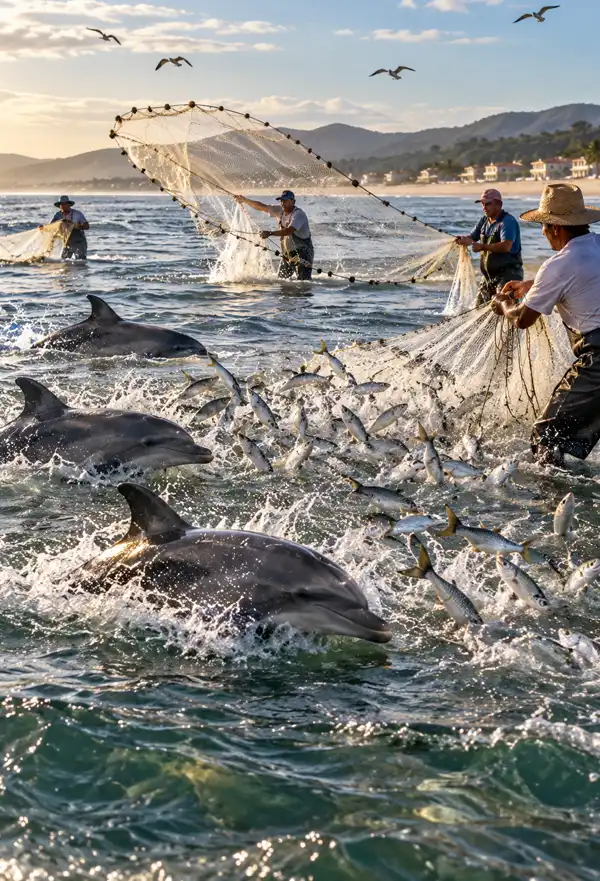
Dolphins and Humans: A Very Long Relationship
Humans have been fascinated by dolphins for thousands of years, and few wild animals seem capable of producing such an immediate reaction in people. Put a dolphin beside a boat and conversations stop, cameras appear, children start shouting, and otherwise dignified adults rush toward the rail as though Pete has personally arrived to welcome them aboard.
That fascination is nothing new. Dolphins appeared frequently in the art, mythology, coins, mosaics, and literature of the ancient Mediterranean world. Greek and Roman stories associated dolphins with the sea, protection, guidance, and rescue. The Greeks connected dolphins with gods including Apollo and Poseidon, while ancient writers recorded stories of dolphins interacting with people. Some of those old accounts describe dolphins supposedly rescuing sailors or carrying people safely through the water. Such stories are difficult to verify historically, and centuries of retelling have undoubtedly added a little polish. Nevertheless, they demonstrate something important: people were noticing dolphin behavior and imagining a special relationship with these animals long before marine biology became a science.
Reports of dolphins apparently helping humans have continued into modern times. There are documented accounts of dolphins remaining near swimmers, approaching people in distress, or behaving in ways interpreted as protective. Stories of dolphins placing themselves between swimmers and sharks have attracted particular attention. Scientists are appropriately cautious about assuming the animals understand a human emergency exactly as we do, but dolphins are certainly capable of responding to unusual behavior in other animals—including us.
Perhaps even more remarkable are places where humans and wild dolphins have developed cooperative fishing relationships.
In Laguna, Brazil, bottlenose dolphins and local fishers have worked around one another for generations. Dolphins herd schools of mullet toward fishermen standing in shallow water, and particular dolphin behaviors can signal when the fishermen should cast their nets. The fishermen gain access to fish they might otherwise struggle to locate, while the dolphins can benefit from prey disturbed or concentrated by the fishing activity. It is an extraordinary example of two very different species learning to read one another's behavior without anybody arranging a meeting, writing a training manual, or forming the Laguna Joint Human-Dolphin Fisheries Committee.
Relationships between people and dolphins have also developed in other fishing communities, although they differ greatly according to location and circumstances. These interactions remind us that the human-dolphin relationship isn't limited to dolphins performing tricks or people watching them from sightseeing boats. In some places, humans and dolphins have occupied the same coastal environment long enough to develop traditions involving both species.
Modern science has deepened that relationship considerably. Researchers identify individual dolphins, follow populations over decades, record their whistles, study their movements, examine social relationships, investigate their intelligence, and monitor their health. Some of the dolphins involved in long-running research projects have effectively been known to scientists for much of their lives.
That familiarity can make it tempting to think of dolphins almost as aquatic people. Their apparent smile certainly helps. But the famous dolphin grin is primarily the shape of the animal's jaw, not a permanent expression of happiness. A dolphin that appears to be smiling is not necessarily delighted to see us.
And that brings us to one of the most important parts of the modern relationship between dolphins and humans. Wild dolphins are still wild animals.
Our desire to interact with them does not automatically mean they want to interact with us. Swimming toward wild dolphins, attempting to touch them, feeding them, chasing them with boats, or repeatedly surrounding them for photographs can disrupt natural behavior. In some places, approaching or interacting with particular marine mammals is also restricted by law.
Responsible dolphin watching therefore requires a little restraint. Seeing dolphins traveling naturally, hunting, playing, or simply surfacing nearby can be far more rewarding than trying to force an encounter. If a wild dolphin chooses to approach a boat, that is one thing. Turning the boat around and pursuing it because somebody hasn't yet obtained the perfect photograph is quite another.
Humans have also developed complicated relationships with dolphins through aquariums, marine parks, rescue facilities, and rehabilitation programs. Attitudes toward keeping cetaceans under human care have changed considerably as scientific understanding of their intelligence, social needs, behavior, and welfare has increased. Discussions about dolphin care now involve difficult questions concerning education, research, rescue, rehabilitation, conservation, and animal welfare. What has remained constant is our fascination with them.
Perhaps part of the attraction comes from recognition. Dolphins are not remotely human, yet we see things in their behavior that seem strangely familiar: mothers caring for young, companions traveling together, youngsters playing, individuals cooperating, animals communicating across distances, and groups apparently enjoying one another's company.
Then one suddenly explodes from the water beside the boat, lands with an enormous splash, and everybody cheers. There aren't many wild animals capable of doing that to us.
For thousands of years, humans have carved dolphins into stone, painted them on pottery, written stories about them, studied them, sailed alongside them, worked with them, photographed them, and stood on beaches hoping to see one. And after all that time, the reaction hasn't changed very much.
Someone spots a dorsal fin. Someone points, and almost inevitably somebody shouts: “LOOK! DOLPHINS!” Even if Pete is only trying to get home for dinner.
Threats Facing Dolphins
Being intelligent, fast, and remarkably adaptable does not make dolphins immune to danger. Dolphins inhabit everything from busy coastal waters and estuaries to the open ocean, and many of those environments are increasingly affected by human activity. The threats are not identical for every species or population, but fishing activity, pollution, marine debris, habitat degradation, vessel traffic, underwater noise, and disturbance can all place additional pressure on dolphins. For some already small or declining populations, the combination can become particularly serious.
One of the greatest concerns is bycatch, the accidental capture of dolphins in fishing gear intended for other species. Dolphins can become trapped in gillnets, trawls, longlines, traps, recreational fishing gear, and other equipment. Because dolphins must reach the surface to breathe, becoming trapped underwater can quickly become fatal. Animals that escape may still suffer serious injuries, while fishing line or other material wrapped around the body can cut deeply into tissue, restrict movement, interfere with feeding, cause infection, and gradually weaken an animal. NOAA identifies fisheries interactions and entanglement among important threats facing several dolphin species and populations.
Lost and abandoned fishing gear creates another danger long after the person using it has gone home. Nets, lines, ropes, hooks, and other equipment can continue drifting or remaining in the marine environment, where dolphins and countless other animals may encounter them. Ordinary marine debris can also entangle wildlife or be swallowed directly or indirectly through prey. Plastic pollution therefore isn't simply an ugly collection of bottles and bags washing onto beaches; once rubbish enters the ocean, it becomes part of the environment through which marine animals must swim, hunt, reproduce, and raise their young.
Chemical pollution can be less visible but equally concerning. Contaminants entering rivers, estuaries, and coastal waters can accumulate through marine food webs, eventually reaching predators such as dolphins. Oil spills can create additional acute and long-term problems. Research following the Deepwater Horizon disaster, for example, found serious health effects among bottlenose dolphins in affected areas, including lung disease, impaired stress responses, and reproductive problems. A dolphin does not have to become coated dramatically in oil for pollution to affect its health; some of the most important consequences may occur internally and persist long after the television cameras have disappeared.
Then there is underwater noise. For an animal whose world depends so heavily upon sound, an increasingly noisy ocean presents a special challenge. Commercial shipping, construction, energy exploration, military activity, recreational vessels, and other human sources add sound to the marine environment. Depending upon its intensity, frequency, duration, and circumstances, human-generated noise can interfere with normal behavior, disrupt communication, cause animals to avoid important habitat, and potentially affect hearing. We have already seen how extraordinarily important sound is to dolphins for communication and echolocation, so adding noise to their environment is rather like asking humans to conduct every conversation, find dinner, locate the children, and navigate home while somebody operates heavy machinery beside them.
Boats and ships create another hazard. Dolphins frequently inhabit coastal waters that are also busy with commercial shipping, fishing boats, ferries, recreational craft, and high-speed vessels. Collisions can injure or kill marine animals, and the risk increases where heavy vessel traffic overlaps with important wildlife habitat. Dolphins may look wonderfully agile when they are riding a bow wave, but that should never be mistaken for immunity from vessel strikes. Marine animals spend much of their time below the surface and can be difficult for operators to see until there is little time to react.
Habitat itself can also change. Coastal development, dredging, altered freshwater flows, pollution, energy projects, and other modifications can affect the places dolphins use for feeding, breeding, traveling, and raising calves. Changes in prey availability can add further pressure. Climate-driven changes in ocean temperatures, currents, ecosystems, and the distribution of prey may alter where dolphins can find suitable conditions, and populations already dealing with other stresses may have less room to adapt.
Even our enthusiasm for dolphins can become a problem when admiration turns into harassment. Feeding wild dolphins can teach them to associate people and boats with food, increasing their chances of approaching fishing gear, vessels, and situations that can injure them. Chasing dolphins for photographs, crowding them with boats, repeatedly interrupting resting animals, or attempting to swim with and touch wild dolphins can also disturb natural behavior. Loving dolphins does not require Pete to pose for a selfie. Sometimes the kindest interaction is simply keeping our distance and watching him get on with his day.
The conservation picture is also important because there is no single worldwide answer to the question, “Are dolphins in trouble?” Some species and populations remain relatively numerous, while others are threatened with extinction. The IUCN Cetacean Specialist Group reports that more than a quarter of recognized cetacean species are currently classified as threatened, and some coastal dolphin populations are particularly vulnerable because their numbers are already small and their habitat overlaps heavily with human activity.
That is why dolphin conservation is not simply about rescuing an individual animal when something goes wrong. Rescue and rehabilitation matter enormously, but long-term conservation also means preventing the problem in the first place: reducing bycatch, developing safer fishing practices, removing marine debris, protecting important habitats, reducing harmful disturbance, improving water quality, understanding the effects of underwater noise, and giving vulnerable populations enough space and resources to recover.
Dolphins have spent millions of years becoming extraordinarily good at surviving in the ocean. They can navigate with sound, cooperate to catch fish, maintain complicated social relationships, sleep with half a brain, and remember companions they haven't encountered for years.
What Pete cannot do is clean up the ocean for us.
How to Celebrate National Dolphin Day
National Dolphin Day can be entertaining while still contributing to greater awareness of marine conservation.
- Learn about dolphins. Explore reputable documentaries, books, museum resources, and scientific organizations.
- Visit responsibly. Choose accredited educational facilities or ethical wildlife-watching operators that prioritize animal welfare.
- Organize a beach cleanup. Removing litter before it reaches the ocean benefits dolphins and countless other species.
- Reduce unnecessary plastics. Reusable alternatives can help reduce the amount of waste entering waterways.
- Learn about sustainable seafood. Fishing choices can influence marine ecosystems and bycatch.
- Support marine conservation. Reputable organizations conduct research, rescue animals, protect habitats, and educate communities.
- Teach children about ocean wildlife. Dolphins provide an excellent introduction to marine biology, animal behavior, and conservation.
- Share reliable dolphin facts. Social media contains enough questionable wildlife information already. The dolphins would undoubtedly appreciate some fact-checking.
And, naturally, you can spend part of April 14 watching dolphins on television while sitting comfortably on the sofa.
Conservation does not always require getting your feet wet.
More Than a Friendly Face
Perhaps the greatest value of National Dolphin Day is that it encourages us to look beyond the familiar image of the eternally smiling dolphin. These are wild animals superbly adapted to complex marine environments. Their popularity makes them powerful ambassadors for ocean conservation, but protecting dolphins means protecting much more than one charismatic family of marine mammals.
Healthy dolphin populations depend upon functioning ecosystems with suitable habitats, abundant prey, clean water, and countless interconnected species. Protecting those environments benefits everything from enormous whales to creatures so small that most of us would need a microscope to appreciate them. Protect the ocean, and we protect the extraordinary communities living within it.
National Dolphin Day FAQ
National Dolphin Day inevitably produces plenty of questions, from whether dolphins really have names to how they manage to sleep without forgetting to breathe. Here are answers to some frequently asked questions about April 14 and the remarkable marine mammals it celebrates.
When is National Dolphin Day?
National Dolphin Day is celebrated annually on April 14.
Are dolphins fish?
No. Dolphins are mammals. They breathe air through lungs, are warm-blooded, give birth to live young, and mothers produce milk for their calves.
Are killer whales dolphins?
Yes. Orcas, commonly called killer whales, belong to the oceanic dolphin family, Delphinidae, and are the largest members of that family.
Do dolphins use names?
Bottlenose dolphins develop individually distinctive signature whistles. Other dolphins recognize these whistles, and research suggests they can copy another dolphin's signature whistle when communicating with that individual.
How do dolphins find things underwater?
Dolphins can use echolocation, producing clicks and interpreting the returning echoes to gather information about objects and prey around them.
Do dolphins really sleep with one eye open?
They can. Dolphins use unihemispheric sleep, allowing one side of the brain to rest while the other helps maintain breathing and awareness of the surroundings.
Are dolphins endangered?
Conservation status varies greatly by species and population. Some remain relatively abundant, while others are threatened or endangered because of bycatch, habitat degradation, pollution, and other pressures.
What is the best way to celebrate National Dolphin Day?
Learn about dolphins, support reputable marine conservation programs, reduce ocean pollution, participate in a beach cleanup, and choose responsible wildlife-watching experiences.
One Last Splash Before We Go
National Dolphin Day gives us a reason to celebrate animals that have captivated people for thousands of years. Their intelligence is impressive, their social lives complicated, and their sensory abilities extraordinary. But perhaps the best way to appreciate dolphins is to allow them to remain exactly what they are: wild marine mammals living in healthy oceans.
We can admire them, study them, photograph them, and work to protect the environments they depend upon. If we do that properly, future generations will still have the opportunity to stand beside an ocean and experience the unmistakable thrill of seeing a dorsal fin break the surface.
And somewhere beneath those waves, there may be a dolphin looking back at us and wondering why the supposedly intelligent species is standing on the beach wearing socks with sandals.