
Celebrating Girls, Their Rights, and Their Remarkable Potential
International Day of the Girl Child, celebrated every October 11, recognizes the rights, achievements, ambitions, and extraordinary potential of girls around the world. It's a day to celebrate future scientists, artists, teachers, athletes, entrepreneurs, and leaders, while remembering that girls deserve equal opportunities to learn, grow, and make their own choices. After all, the world has spent centuries telling girls what they cannot do, and quite a few girls have responded by doing it anyway. Perhaps it's time the grown-ups started paying attention.
What Is International Day of the Girl Child?
International Day of the Girl Child is an annual United Nations observance dedicated to promoting girls' rights, gender equality, education, health, safety, and empowerment. Celebrated on October 11, the occasion draws attention to the barriers that prevent millions of girls from enjoying the same opportunities as their peers while recognizing their contributions to families, communities, and societies.
Also known as International Day of the Girl, the observance emphasizes that girls are not simply future adults waiting for their turn to contribute. They are individuals with ideas, opinions, talents, and rights that matter today. Girls are already participating in scientific discoveries, environmental campaigns, community projects, sports, technology, and social initiatives. Their contributions deserve recognition regardless of whether they eventually become world-famous leaders or simply pursue happy, fulfilling lives.
The day also encourages governments, schools, families, businesses, and community organizations to examine how girls are treated and whether existing policies provide genuine equality of opportunity. Access to education, protection from violence, appropriate healthcare, and freedom from discrimination are not special privileges. They are fundamental rights.
Of course, explaining this to a girl who has just been told she cannot become an engineer because engineering is supposedly for boys may result in a very interesting conversation. Particularly if she has already built a working robot while the adult is still trying to connect the printer.
The History of International Day of the Girl Child
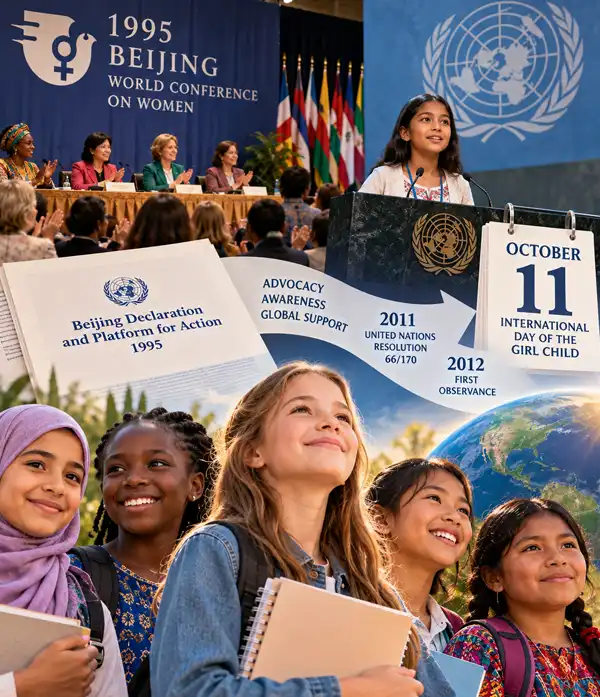
The history of International Day of the Girl Child is closely connected to decades of international efforts to advance the rights of women and girls. One important milestone occurred in September 1995, when representatives from governments and organizations gathered in Beijing, China, for the Fourth World Conference on Women. The conference produced the Beijing Declaration and Platform for Action, a landmark international agreement identifying priorities for achieving gender equality.
Among its important achievements was a specific commitment to addressing discrimination against girls. The agreement recognized that girls often experience challenges distinct from those affecting adult women, including unequal educational opportunities, child marriage, exploitation, violence, and limited access to essential services. It also emphasized the importance of ensuring that girls could participate in decisions affecting their lives.
Advocacy continued during the following years, with organizations such as Plan International drawing greater attention to the experiences of girls through its Because I Am a Girl campaign. The movement emphasized the importance of education, safety, economic opportunity, and the recognition of girls' human rights. Governments, community organizations, and campaigners increasingly supported the establishment of an internationally recognized day dedicated specifically to girls.
On December 19, 2011, the United Nations General Assembly adopted Resolution 66/170, officially designating October 11 as the International Day of the Girl Child. The first observance took place on October 11, 2012, focusing on ending child marriage. That choice reflected the serious consequences of marriage during childhood, including interrupted education, early pregnancy, economic dependence, and increased vulnerability to abuse.
Since then, International Day of the Girl Child has become an annual opportunity to highlight different aspects of girls' rights and experiences. Themes have addressed education, leadership, technology, humanitarian emergencies, equality, and the importance of listening to girls themselves.
The message has remained consistent: girls should not have to wait until adulthood to be heard, respected, protected, or given meaningful opportunities.
Ending Child Marriage and Protecting Girls' Rights
One of the most important issues highlighted by International Day of the Girl Child is the continuing struggle to end child marriage and protect the fundamental rights of girls worldwide. Child marriage generally refers to a formal marriage or informal union in which at least one person is younger than 18. Although boys can also be affected, the practice disproportionately affects girls, often limiting their education, independence, health, and opportunities long before they have reached adulthood. Ending child marriage is therefore an essential part of promoting gender equality, protecting children's rights, and ensuring that every girl has the freedom to make meaningful decisions about her future.
Child marriage is frequently associated with poverty, limited educational opportunities, discriminatory social expectations, and inadequate legal protections. In some communities, families facing severe economic hardship may view marriage as a way to provide financial security for their daughters. Elsewhere, longstanding traditions, concerns about family reputation, or unequal expectations for girls and boys contribute to the practice. Armed conflict, displacement, and humanitarian emergencies can make these circumstances even more difficult, increasing the vulnerability of girls who have already lost access to schools, healthcare, and other essential services. Understanding these underlying causes is important because preventing child marriage requires more than simply telling families that the practice is harmful. It requires addressing the circumstances that allow it to continue.
The consequences of child marriage can extend throughout a girl's life. Marriage during childhood may interrupt or permanently end her education, reduce her opportunities for employment, and limit her ability to make independent decisions. Girls who marry young may also face increased risks associated with early pregnancy and childbirth, domestic violence, social isolation, and economic dependence. These difficulties can affect not only the girls themselves but also their children, families, and communities. When girls are denied the opportunity to complete their education and develop their abilities, society loses valuable talent, creativity, and potential.
Preventing child marriage requires coordinated efforts involving governments, schools, healthcare providers, families, community leaders, and organizations dedicated to children's rights. Effective approaches include enforcing appropriate legal protections, improving access to quality education, providing economic support to vulnerable families, ensuring access to healthcare, and challenging discriminatory attitudes that restrict girls' choices. Equally important is creating opportunities for girls to express their concerns, participate in community decisions, and receive support when their rights are threatened. Programs are more likely to succeed when they respect local circumstances while remaining firmly committed to protecting children's rights.
International Day of the Girl Child provides an opportunity to bring these issues into public discussion and encourage practical action. It reminds us that childhood should be a time for learning, developing friendships, discovering interests, and imagining possibilities—not a period in which major life decisions are imposed before a young person is ready to make them. Every girl deserves the opportunity to finish school, explore her ambitions, and approach adulthood with the knowledge, confidence, and freedom to choose her own path.
After all, deciding what to do with the rest of your life is challenging enough when you're an adult. Girls should have the chance to finish their homework, enjoy their childhood, and discover who they want to become before anyone starts making those decisions for them.
Why Do Girls Need Their Own International Day?
Some people wonder why a separate international observance for girls is necessary when International Women's Day already exists. The answer lies in recognizing that childhood and adolescence bring particular experiences, opportunities, and vulnerabilities that deserve focused attention.
International Women's Day, observed on March 8, celebrates women's achievements and promotes gender equality across society. International Day of the Girl Child focuses specifically on the rights and needs of girls, including the importance of protecting childhood, supporting education, preventing harmful practices, and ensuring that girls can develop their abilities without discrimination.
For many girls, inequality begins long before adulthood. Expectations about appropriate behavior, household responsibilities, academic subjects, clothing, sports, and career ambitions can influence their opportunities from an early age. In some communities, girls spend considerably more time performing unpaid household work than boys, reducing the time available for studying, recreation, and personal development.
Elsewhere, girls may face pressure to leave school, marry early, or abandon ambitions that conflict with traditional expectations. Others experience bullying, harassment, or discrimination because of their gender, disability, economic circumstances, or background.
International Day of the Girl Child challenges these barriers while recognizing that girls have different interests and ambitions. One girl may dream of becoming an astronaut, another of opening a bakery, and another of raising a family. Equality means ensuring that their choices are not unnecessarily restricted simply because they are girls.
And if a girl wants to become an astronaut who owns a bakery, somebody should probably help her investigate the practicalities of baking bread in zero gravity.
Girls' Education: The Foundation of Equal Opportunity
Education is one of the most important issues highlighted by International Day of the Girl Child. Every girl deserves access to safe, inclusive, high-quality schooling that develops her knowledge, confidence, abilities, and opportunities for the future.
Yet significant barriers remain. UNESCO has reported that approximately 133 million girls worldwide are out of school, illustrating the enormous educational barriers that remain despite decades of progress. Because international education statistics are periodically revised, the figure represents a published estimate rather than an unchanging total
Education can provide benefits extending well beyond the classroom. Girls who complete secondary education generally have greater opportunities for employment, improved access to information about health, and increased ability to participate in economic and community decisions. Education is also an important protective factor against child marriage.
However, access alone is not enough. Girls need classrooms where they feel safe, teachers who encourage their ambitions, appropriate sanitation facilities, and opportunities to study subjects traditionally dominated by men. Science, technology, engineering, and mathematics deserve particular attention because gender stereotypes can discourage girls from pursuing interests in these fields.
Fortunately, girls do not need special permission from the laws of physics to become scientists. Gravity, electricity, and mathematics have never shown the slightest interest in whether the person studying them is male or female.
The challenge is making certain that society follows their example.
Girls' Health, Safety, and the Right to Grow Up
Supporting girls' rights also means protecting their physical and emotional well-being. Access to healthcare, nutritious food, clean water, sanitation, and accurate health information can make an enormous difference during childhood and adolescence.
Adolescence brings significant physical and emotional changes, making reliable healthcare and age-appropriate education particularly important. Girls need access to information about puberty, menstrual health, personal safety, nutrition, and healthy relationships. They also deserve environments where asking questions about their health does not result in embarrassment, ridicule, or unnecessary restrictions.
Menstrual health remains a substantial concern in many communities. Some girls lack affordable menstrual products, private sanitation facilities, or adequate information about menstruation. These barriers can affect school attendance, confidence, and participation in everyday activities. Addressing them requires practical solutions, including accessible supplies, safe toilets, clean water, and education that reduces stigma.
Girls must also be protected from violence, exploitation, trafficking, harassment, and harmful practices. Effective protection involves families, schools, healthcare professionals, social services, and legal systems working together to create environments where girls can report concerns and receive appropriate support.
Mental health deserves equal consideration. Academic pressure, bullying, discrimination, social expectations, and exposure to harmful online content can affect girls' emotional well-being. Providing supportive relationships, appropriate services, and opportunities for recreation helps girls navigate these challenges.
The goal is not to protect girls from every ordinary difficulty of growing up. Childhood will always involve disappointments, embarrassing moments, and occasionally discovering that the school photograph was taken on the worst possible hair day.
The goal is to ensure that preventable harm and discrimination do not stand between girls and a healthy, secure childhood.
Girls in Science, Technology, Sports, and Leadership
International Day of the Girl Child also celebrates girls who are exploring interests, developing skills, and challenging expectations in fields where they have historically faced barriers.
In science and technology, girls are participating in robotics competitions, computer programming, engineering projects, environmental research, and scientific education. Programs encouraging girls to study STEM subjects help counter stereotypes and introduce them to careers they might otherwise never consider.
Access to technology is increasingly important for education, employment, and civic participation. Yet unequal access to devices, internet connections, digital skills training, and safe online environments can limit opportunities. Improving digital inclusion helps girls participate more fully in a world where technology influences almost every aspect of daily life.
Sports offer another valuable opportunity. Participation can support physical health, teamwork, confidence, and leadership skills. However, girls may encounter fewer sporting opportunities, inadequate facilities, unequal funding, or social pressure to abandon activities as they grow older. Encouraging participation and providing safe, welcoming environments allows girls to discover their abilities and enjoy the benefits of physical activity.
Leadership opportunities are equally important. School councils, youth organizations, community initiatives, and student-led projects provide practical experience in communication, problem-solving, cooperation, and decision-making.
Not every girl wants to be a politician, professional athlete, or software engineer, and that is perfectly fine. The important thing is that opportunities should be available to those who do.
Besides, anyone who has watched a determined group of students organize a school fundraiser knows that young people can accomplish remarkable things when adults stop explaining why their ideas won't work.
Girls Who Have Already Changed the World
History provides numerous examples of girls and young women whose actions challenged expectations and influenced society. Their achievements demonstrate that meaningful contributions do not necessarily require decades of experience or an impressive collection of business cards.
Malala Yousafzai became internationally recognized for advocating girls' education in Pakistan. After surviving an assassination attempt by the Taliban in 2012, she continued campaigning for educational opportunities and became the youngest recipient of the Nobel Peace Prize in 2014. Through the Malala Fund, she has supported efforts to ensure girls can complete their education.
Greta Thunberg began a school strike for climate action outside the Swedish Parliament in 2018. Her protest helped inspire the international Fridays for Future movement, encouraging young people around the world to participate in discussions about climate change and environmental policy.
Ruby Bridges made history in 1960 when, at six years old, she became the first Black child to integrate the all-white William Frantz Elementary School in New Orleans. Escorted by federal marshals amid intense opposition, her attendance became an important moment in the American civil rights movement.
Anne Frank, whose diary documented her experiences while hiding from Nazi persecution during World War II, left an extraordinary historical record of adolescence under unimaginable circumstances. Published after her death, her writing has helped generations understand the human consequences of the Holocaust.
These individuals had very different experiences and motivations, but their stories illustrate how girls' voices and actions can influence public understanding, challenge discrimination, and inspire others.
Yet famous examples tell only part of the story. Around the world, countless girls contribute to their communities without appearing in newspaper headlines. They organize neighborhood projects, help classmates, support family members, develop creative ideas, and challenge unfair treatment in everyday life.
Not every achievement earns a Nobel Prize, a documentary, or a statue in the town square. Sometimes making a difference begins with noticing that something is wrong and deciding to do something about it.

Girls Are Individuals, Not Superheroes in Training
Celebrations of girls' empowerment sometimes describe girls as superheroes who can overcome any obstacle through determination alone. Although the sentiment is encouraging, it can unintentionally place unreasonable expectations on young people.
Girls should not have to demonstrate extraordinary courage, academic brilliance, leadership ability, or resilience to deserve respect and equal treatment. They should be allowed to make mistakes, change their minds, explore different interests, and enjoy childhood without feeling responsible for solving every problem society has created.
A girl who excels at mathematics deserves encouragement. So does one who loves painting, gardening, reading, dancing, repairing bicycles, or simply spending an afternoon with friends. Talents and ambitions are individual, and equality means allowing those interests to develop without unnecessary restrictions.
Resilience is valuable, but it should not become an excuse for leaving girls to confront discrimination or danger without support. Adults, institutions, and communities have responsibilities to create safe environments, remove barriers, and ensure that girls have meaningful opportunities.
The message of International Day of the Girl Child is not that girls must become extraordinary to matter. It is that every girl already matters, whether she becomes a world-famous scientist or grows up to enjoy an ordinary, satisfying life.
And frankly, childhood contains enough challenges without expecting everyone to save the planet before finishing their homework.
How Families, Schools, and Communities Can Empower Girls
Meaningful support for girls begins with everyday actions. Families can encourage curiosity, listen to children's opinions, share household responsibilities fairly, and avoid limiting interests according to gender stereotypes. Girls benefit from knowing that their ambitions will be taken seriously, even when those ambitions change several times before breakfast.
Schools can contribute by providing inclusive learning environments, addressing bullying and harassment, encouraging participation in all academic subjects, and ensuring that girls have opportunities for leadership, sports, technology, and creative activities. Teachers and mentors can make a lasting difference by recognizing potential and offering constructive guidance.
Communities can support girls through accessible libraries, recreational facilities, healthcare services, youth organizations, mentoring programs, and safe transportation. Local businesses and professional organizations can provide educational experiences that introduce girls to different careers and practical skills.
Boys and men also have an important role in promoting gender equality. Challenging discrimination, treating others respectfully, sharing responsibilities, and supporting equal opportunities are not exclusively women's or girls' concerns. Creating a fairer society requires participation from everyone.
Most importantly, girls should be involved in decisions about programs intended to support them. Listening to their experiences and ideas helps ensure that well-intentioned initiatives address actual needs rather than assumptions made by adults.
Because there is nothing quite like a committee of grown-ups spending six months designing something for teenagers, only to discover that nobody thought to ask the teenagers whether they wanted it.
How to Celebrate International Day of the Girl Child on October 11
International Day of the Girl Child offers opportunities for individuals, families, schools, and organizations to celebrate girls' achievements while supporting practical improvements in their lives.
Begin by listening to the girls in your family or community. Ask about their interests, ambitions, concerns, and ideas. Encourage them to explore new subjects, develop skills, and participate in activities that build confidence. Recognition does not always require a formal ceremony; sometimes a thoughtful conversation or an opportunity to try something new can be equally meaningful.
Schools can organize discussions about girls' rights, invite women working in different professions to speak with students, or highlight the achievements of girls and women throughout history. Educational activities might explore the importance of equal access to schooling, the challenges of child marriage, or the contributions of women in science, sports, literature, and public life.
Community organizations can arrange mentoring sessions, educational workshops, book donations, sports activities, or fundraising events supporting girls' education and protection. Families can also learn about reputable organizations such as UNICEF, Plan International, the Malala Fund, and local charities working to improve opportunities for girls.
Sharing reliable information online can help raise awareness, particularly when posts highlight practical solutions rather than simply repeating alarming statistics. Supporting girls' voices directly is especially valuable, whether through student publications, youth-led projects, community presentations, or other appropriate platforms.
Above all, remember that empowering girls is not something that should happen only once a year. October 11 provides a useful reminder, but respect, encouragement, protection, and equal opportunity should remain priorities throughout the other 364 days.
After all, nobody expects girls to stop having ambitions when the calendar changes to October 12.
Giving Every Girl the Freedom to Write Her Own Future
International Day of the Girl Child is ultimately a celebration of possibility. It reminds us that girls around the world possess an extraordinary range of talents, ambitions, perspectives, and abilities, but that opportunity is not distributed equally. Some grow up surrounded by educational resources, supportive families, and communities that encourage their dreams. Others encounter poverty, discrimination, violence, restrictions on education, or expectations that limit their choices before they have had an opportunity to discover what they want from life. Recognizing these differences is essential because genuine equality cannot be achieved through encouraging words alone. It requires practical commitments to education, healthcare, safety, legal protection, and meaningful participation in society.
The progress achieved since the adoption of the Beijing Declaration and Platform for Action in 1995 demonstrates that positive change is possible. More girls have gained access to education, greater international attention has been directed toward harmful practices such as child marriage, and girls' voices have become increasingly visible in discussions about their rights. Yet substantial challenges remain, and the work is far from finished. Governments, communities, schools, families, and international organizations all have responsibilities to ensure that advances in gender equality translate into real improvements in girls' everyday lives. Equally important is recognizing that girls themselves must participate in shaping those improvements. They understand their experiences, have valuable ideas, and deserve opportunities to influence decisions affecting their futures.
As we celebrate International Day of the Girl Child on October 11, perhaps the most meaningful thing we can do is replace assumptions with opportunities and restrictions with encouragement. Let girls ask questions, pursue interests, challenge stereotypes, make mistakes, discover talents, and develop into the individuals they choose to become. Some may change the world through scientific discoveries, public service, or remarkable acts of courage. Others will make equally meaningful contributions through their families, friendships, professions, and communities. Every one of those possibilities deserves respect. And if the next generation occasionally makes the adults look a little foolish by finding better solutions to problems we've been debating for decades, perhaps we should consider that a bonus.
The future belongs to girls just as much as anyone else. Our responsibility is to make certain they have every opportunity to enjoy it.