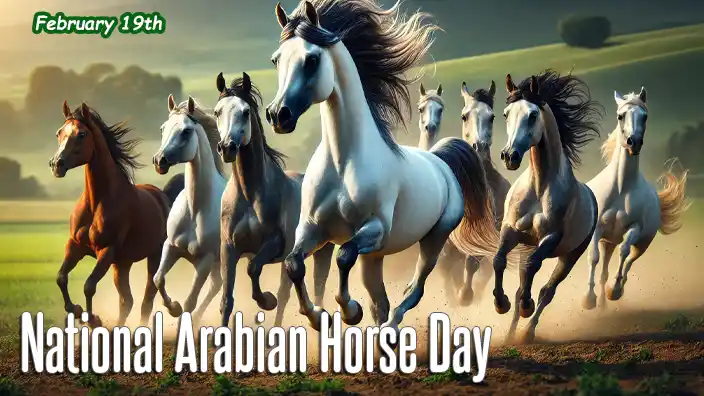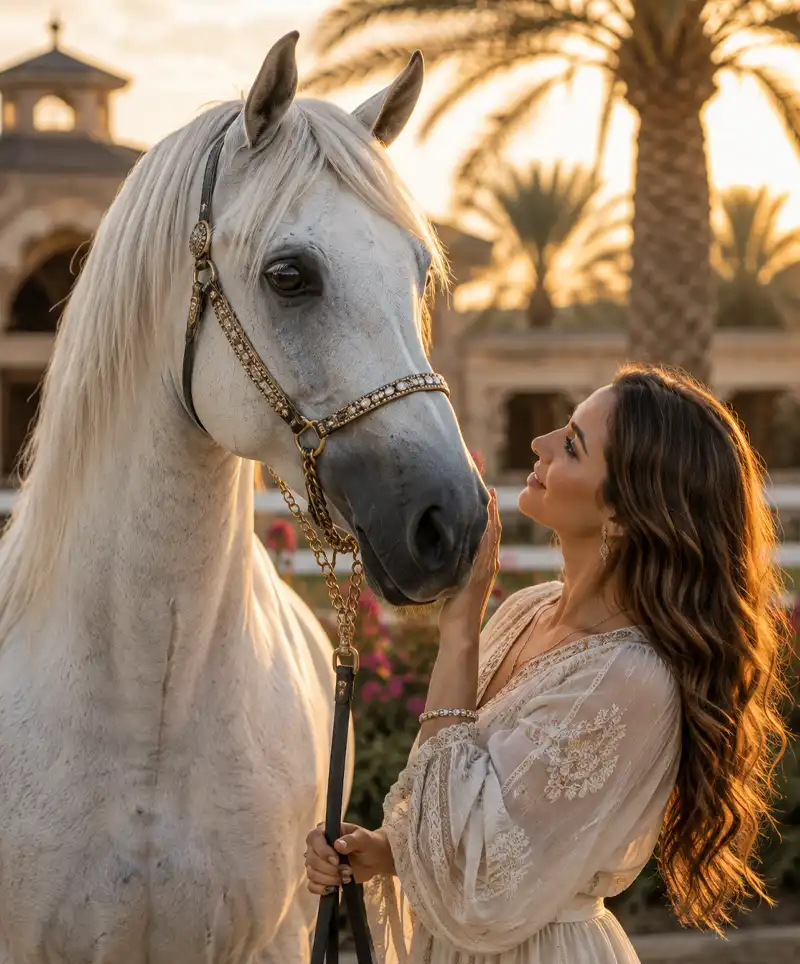
Every February 19, National Arabian Horse Day celebrates a breed that has mastered the art of looking elegant while simultaneously giving the impression that it knows considerably more than you do. With its distinctive dished face, arched neck, enormous expressive eyes and naturally high-carried tail, the Arabian horse doesn't exactly sneak into a room. It arrives.
Behind all that equine glamor, however, is an extraordinary working animal. Arabian horses developed alongside the peoples of the Middle East under conditions that rewarded endurance, intelligence, toughness and a close relationship with humans. Those qualities eventually carried the Arabian far beyond its ancestral homeland and made it enormously influential in the development of horses around the world. Today, Arabians compete in everything from dressage and jumping to racing and Western disciplines, but endurance remains one of the places where the breed is particularly formidable.
National Arabian Horse Day gives us an excuse to admire the beauty. The horse gives us plenty of reasons to stick around for the rest of the story.
When Is National Arabian Horse Day?
National Arabian Horse Day is celebrated every year on February 19. Unlike many horse-related observances that developed informally over time, this one has a clearly identifiable beginning. The Arabian Horse Association of Arizona founded National Arabian Horse Day in 2021, and the Registrar at National Day Calendar proclaimed the first observance for February 19, 2022. The purpose was to introduce more people to Arabian horses, educate the public about the breed and help ensure its continued appreciation for generations to come.
The date also placed the inaugural celebration right in the middle of one of the most important gatherings in the Arabian horse world: the Scottsdale Arabian Horse Show in Arizona. Contemporary announcements promoted the first National Arabian Horse Day celebration as taking place during the show, where Arabian horses, breeders, competitors and enthusiasts were already gathered. Subsequent Scottsdale shows have continued celebrating National Arabian Horse Day with activities on February 19.
It would therefore be very reasonable to see the Scottsdale show as part of the thinking behind the date, particularly since the organization that created National Arabian Horse Day is also responsible for the show. However, the published history of the observance does not appear to record a specific explanation for why February 19 itself was selected, so we shouldn't invent a more romantic origin story where none has been documented.
What we do know is that the combination worked rather nicely. Instead of launching a new horse observance on some otherwise ordinary day and hoping people noticed, its founders introduced it while thousands of Arabian horse enthusiasts—and quite a few actual Arabian horses—were already gathered in Scottsdale.
For once, nobody had to ask the guests of honor to clear their calendars.
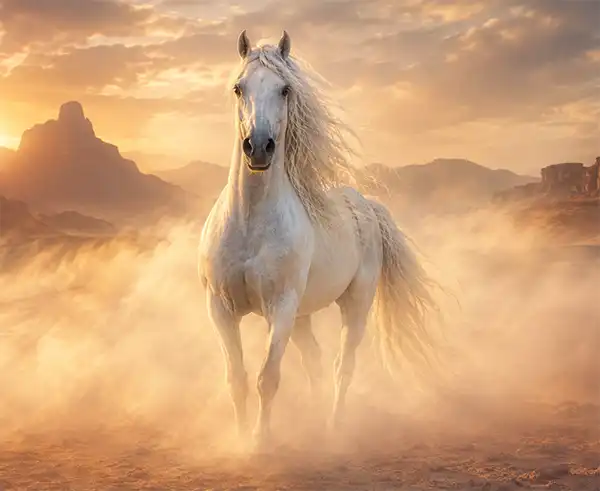
From the Desert Came an Extraordinary Horse
The history of the Arabian horse reaches so far into the past that separating documented history from centuries of tradition and legend can be difficult. It is frequently described as one of the world's oldest horse breeds, but exactly where the ancestors of the modern Arabian first developed remains debated. Even the Arabian Horse Association notes competing theories placing its early origins in areas ranging from northern Syria and southern Turkey to parts of the Arabian Peninsula. What is much clearer is that, over many centuries, the horse became inseparably associated with the peoples of the Middle East and particularly with the nomadic Bedouin tribes of the desert.
Life in that environment was an unforgiving test of both people and animals. Water and grazing could be scarce, temperatures punishing and journeys long. A horse that was merely attractive was of limited value when its rider needed to cross substantial distances or move rapidly during warfare. Bedouin breeders therefore valued qualities with decidedly practical consequences: stamina, soundness, speed, courage and an ability to remain useful under difficult conditions. Horses possessing those qualities were the animals most prized for breeding, and generations of selection helped establish the endurance for which the Arabian remains famous today.
The Arabian was especially valuable as a war horse. Camels were enormously important for desert transportation and survival, but horses offered something different: speed and maneuverability. A swift horse could carry a rider across difficult country and, when necessary, participate in the rapid raids that formed part of Bedouin warfare. This demanded an animal capable of conserving its strength during travel and still having enough energy available when speed suddenly mattered. The Arabian's celebrated endurance was therefore not originally developed so somebody could win a ribbon on Saturday afternoon. For its early breeders and riders, performance could be a matter of survival.
That practical value made a good Arabian horse an extraordinarily precious possession. The Bedouin took the ancestry of their horses seriously, preserving knowledge of bloodlines through oral tradition and developing recognized families or strains. Mares were particularly prized, and some bloodlines acquired reputations extending across generations. The Arabian Horse Association identifies five traditionally important families—Kehilan, Seglawi, Abeyan, Hamdani and Hadban—along with numerous strains and substrains that developed around celebrated horses, breeders and tribes. Pedigree was not merely an interesting bit of paperwork to be filed away somewhere; the history of an important horse could be part of the accumulated knowledge of an entire family or tribe.
The relationship between the Bedouin and their horses was also unusually intimate. Valuable horses received precious food and water, foals grew up close to people, and accounts of favored mares being permitted inside family tents are not simply a modern romantic invention. Arabian Horse Association educational material records that horses were sometimes sheltered in tents with their owners, particularly prized animals being treated as treasured members of the household. That close association with people, combined with generations of breeding for manageable temperament as well as performance, is commonly credited with helping develop the intelligence, responsiveness and human affinity for which Arabians remain known.
Imagine that relationship for a moment. This was not a horse standing anonymously at the far end of a large pasture. The animal might travel with the family, depend upon the same scarce resources, carry its rider over tremendous distances and potentially carry that rider into danger. Horse and human had very good reasons to understand and trust one another. Thousands of years later, Arabian owners still frequently describe their horses as unusually interested in people—and occasionally interested in absolutely everything the people are doing.
The desert also helped shape the physical animal. The modern Arabian is compact rather than enormous, with a deep chest, strong legs, short back and the capacity for sustained exertion. Its large nostrils, distinctive head, arched neck and high tail carriage contribute to an appearance so recognizable that even people who know relatively little about horses can often identify an Arabian. Modern genetic research confirms the breed's reputation for heat tolerance and athletic endurance, while also cautioning us that some of the extremely pronounced characteristics seen in today's show horses—particularly very dished faces—have been intensified by more recent selective breeding. The Arabian of the desert was beautiful, but above all else it had to work.
As trade, warfare and diplomacy carried these horses beyond the Middle East, outsiders began appreciating the same qualities the Bedouin had valued for generations. Arabian horses reached Europe and subsequently contributed to breeding programs far beyond their homeland. Their influence would eventually appear in numerous other breeds, while purebred Arabians themselves spread around the world. The horse shaped by desert necessity had become internationally desirable precisely because the qualities necessary for survival in the desert—endurance, intelligence, soundness and athleticism—were useful almost everywhere.
That is perhaps the most remarkable part of the Arabian's story. The elegant horse we now see floating around a show ring with its neck arched and tail held proudly in the air was not created merely to look magnificent. Beneath all that beauty is the legacy of an animal expected to cross hostile country, conserve its strength, respond instantly to its rider and keep going when conditions became difficult.
The Arabian learned elegance in the desert but the desert made certain it was tough first.
A Horse Built for the Job
The Arabian is immediately recognizable, and much of its appearance reflects characteristics that breeders have preserved for generations. The head is comparatively small and refined, with large, widely set eyes, prominent nostrils and the famous straight or slightly concave—or “dished”—profile. Add a long, arched neck and naturally high-carried tail and you have a horse capable of looking rather pleased with itself even while merely walking across a paddock.
Beneath that elegant exterior, however, is a remarkably practical design. Arabians generally have a short, strong back, deep chest, well-sprung ribs, muscular shoulders and strong legs. The official breed standard emphasizes balance and sound conformation rather than beauty alone. These are characteristics suited to carrying a rider efficiently over considerable distances—the sort of durability that mattered enormously when the breed's ancestors were expected to perform in demanding desert conditions.
Arabians are also relatively compact horses. The traditional breed standard places them around 14.1 to 15.1 hands, although individuals can fall outside that range. What they lack in sheer size they make up for with athleticism, balance and an ability to keep going. Their long, sloping shoulders encourage an efficient stride, while the short back and strong hindquarters help produce the strength and agility required of a riding horse.
Then there is the movement. A good Arabian can display a light, animated trot that seems almost to float across the ground, particularly when the horse becomes excited and that famous tail rises behind it. It is an extraordinarily effective combination of function and showmanship: a horse shaped by generations of practical demands that somehow emerged looking as though it had also hired its own publicity department.
The Arabian may have been built for the job, but apparently nobody told it that looking magnificent while doing the job was optional.
The Marathon Runner of the Horse World
If there is one modern equestrian discipline that demonstrates exactly why the Arabian horse developed such a formidable reputation, it is endurance riding. This is long-distance competition over natural terrain, often involving substantial changes in elevation, footing and weather. Recognized endurance rides commonly cover 50 to 100 miles in a single day, and at the upper levels Arabians and Arabian-related horses dominate the sport.
A 100-mile endurance ride is not simply a matter of pointing the horse toward the horizon and hanging on until somebody produces a trophy. Horse and rider must manage pace, terrain, hydration, feeding and energy throughout the event. Mandatory veterinary checks are conducted along the route, and a horse must be judged physically fit to continue. A horse showing lameness or metabolic problems can be withdrawn regardless of how competitive its time might have been. In endurance riding, arriving first is considerably less useful if the veterinarian says your horse has finished for the day.
This is where the Arabian's physical characteristics become especially valuable. Their generally smaller size and lighter weight give them a favorable relationship between body mass and surface area, helping with sweating and cooling during prolonged exercise. Strong, dense bone and relatively large feet for their size help withstand mile after mile of travel, while their athletic build avoids carrying unnecessary muscular bulk that would generate additional heat and require more energy. A U.S. endurance team veterinarian compared the difference rather neatly to the physique of a human marathon runner rather than that of a football lineman.
Their success is hardly a recent discovery. Arabian horses demonstrated exceptional endurance during U.S. Cavalry endurance trials more than a century ago. In the 1920 Cavalry Endurance Ride, horses traveled 60 miles a day for five consecutive days while carrying 245 pounds, and Arabians achieved the highest average points of any breed entered. Those early performances helped convince the U.S. Army of the Arabian's value for developing durable riding and military horses.
Modern endurance competition continues to showcase the same qualities. The famous Tevis Cup, for example, sends horse and rider across 100 rugged miles of California's Sierra Nevada terrain within 24 hours. In 2021, every one of the top 20 finishers listed by the Arabian Horse Association was riding an Arabian.
Perhaps the most revealing expression in the sport is the endurance rider's motto: “To Finish Is To Win.” Endurance isn't simply about raw speed. It rewards conditioning, soundness, intelligent riding and a horse capable of recovering and continuing after distances that would make an ordinary Sunday trail ride seem like a quick trip around the block.
For the Arabian horse, there is also something wonderfully appropriate about all of this. Thousands of years after its ancestors were prized for carrying riders across demanding country, the modern Arabian is still being asked essentially the same question:
Can you keep going? The Arabian's answer, rather inconveniently for the competition, is usually yes.
Arabian Horses Are Remarkably Versatile
After spending an entire section explaining why Arabians are so formidable at endurance riding, it would be easy to assume that long-distance competition is their specialty and everything else is something they occasionally do on weekends. The Arabian horse has other ideas. One of the breed's most impressive characteristics is its versatility, with Arabians competing successfully in an extraordinary range of English, Western and sport-horse disciplines. US Equestrian lists Arabians in everything from saddle seat, hunter pleasure and Western pleasure to dressage, jumping, eventing, ranch work, reining, cow horse competition, endurance and racing.
That variety becomes particularly striking when you consider how different those jobs actually are. Dressage asks for balance, precision and responsiveness to extremely subtle signals from the rider. Jumping requires athleticism, courage and the ability to rapidly judge an obstacle. Reining demands quick acceleration, sliding stops, spins and exceptionally precise control. Working cow horse asks the Arabian to read and react to cattle, while trail competition tests careful foot placement and willingness to negotiate obstacles. Arabian racing calls upon speed, while endurance competition asks the horse to conserve that speed and energy over tremendous distances. These aren't slightly different versions of the same job; they require genuinely different combinations of physical and mental ability.
The Arabian's intelligence plays an important role in that versatility. A horse that learns quickly, pays attention to its surroundings and develops a close relationship with its rider can adapt to very different kinds of work. Balance and agility help in disciplines requiring precise maneuvering, while the stamina inherited from generations of horses bred for demanding travel provides a useful foundation almost regardless of the job. The Arabian Horse Association specifically points to the breed's intelligence, trainability, disposition and stamina as qualities that allow it to participate successfully in such a broad range of activities.
The working Western disciplines provide a particularly entertaining answer to anyone who thinks an Arabian belongs only in an elegant show ring. Modern Arabians compete in ranch riding, trail, reining, cutting and working cow horse classes, where they may be asked to maneuver rapidly around cattle rather than merely pose beautifully beside them. Competitors interviewed by US Equestrian describe Arabians as quick-footed, resilient and capable of anticipating the movement of cattle—useful qualities when the cow has apparently decided that cooperation is somebody else's responsibility.
At the other end of the equestrian spectrum are the sport-horse disciplines. Arabian and Half-Arabian championship competition includes dressage, hunters and jumping, while Arabians also participate in eventing and Western dressage. Here, the breed's lighter athletic build, responsiveness and balance can be put to entirely different use. An Arabian that spends its afternoon performing a carefully controlled dressage test may look considerably removed from its desert ancestors, but the underlying qualities—agility, intelligence, stamina and close communication with a rider—remain remarkably familiar.
Nor does every Arabian need a competition schedule. The breed is widely used for recreational and trail riding, and both US Equestrian and the Arabian Horse Association emphasize its role as a pleasure and family horse. That may actually be one of the better demonstrations of versatility. Winning ribbons requires athletic ability, but being a dependable riding companion asks something different of a horse: willingness, trainability and the ability to form a partnership with people.
There are even specialized Arabian bloodlines emphasizing different kinds of performance. Some have been developed particularly for show disciplines, others for racing or endurance, while individual horses and families may demonstrate strengths in Western or sport-horse competition. Arabian blood is also frequently crossed with other breeds, producing Half-Arabians and combinations such as the Anglo-Arabian, which blends Arabian and Thoroughbred ancestry.
Of course, no sensible person is suggesting that every individual Arabian horse is equally talented at dressage, jumping, cattle work, endurance racing and everything else on the equestrian menu. The versatility belongs to the breed as a whole. As one Arabian rider neatly explained when discussing the many disciplines represented by Arabians, no single horse can do all of them—but across the breed, they cover an enormous amount of ground.
So, if the Arabian's résumé seems suspiciously long, that's because it is. It can race, jump, work cattle, perform dressage, tackle trails, carry a recreational rider and, as we have already discovered, travel 100 miles while everybody else begins questioning their life choices.
Apparently spending thousands of years becoming extraordinarily good at endurance wasn't enough. The Arabian wanted hobbies.
The Arabian's Influence Reached Far Beyond Arabia
The Arabian horse might have developed its famous qualities in the deserts of the Middle East, but those qualities were far too useful to remain there. As travel, warfare, trade and diplomacy brought horses from the East into Europe, horsemen encountered animals that were lighter, quicker and remarkably enduring compared with many of the heavier European horses of the period. Arabian horses increasingly became prized breeding stock, particularly as changes in warfare reduced the need for massive horses capable of carrying heavily armored knights and increased demand for faster, more agile cavalry mounts.
European breeders soon realized that they did not necessarily have to replace their existing horses with Arabians to benefit from them. Arabian stallions could be crossed with local mares in an attempt to introduce desirable characteristics such as speed, stamina, refinement and agility. The Arabian Horse Association describes this infusion of Arabian blood as having influenced many of the world's modern light horse breeds, both directly and indirectly. Once Arabian ancestry entered another successful breed, that breed could spread the influence still farther.
The most famous example is undoubtedly the Thoroughbred. During the late 17th and early 18th centuries, imported Middle Eastern stallions were bred to English mares as breeders sought faster horses for racing. Three stallions became particularly important: the Darley Arabian, Byerley Turk and Godolphin Arabian, sometimes also called the Godolphin Barb. Their descendants established the three principal paternal foundation lines traditionally associated with the modern Thoroughbred. Historical terminology surrounding the precise breeding of these early Eastern stallions can be complicated—the familiar names should not be taken to mean that all three were unquestionably purebred Arabians as that term is understood today—but their importance to Thoroughbred development is beyond dispute.
The Darley Arabian provides an extraordinary illustration of just how far the influence of one horse can travel. Purchased in Aleppo and brought to England in 1704, he became an enormously important breeding stallion. His descendants eventually included the undefeated 18th-century racehorse Eclipse, and the Darley Arabian's male line became overwhelmingly dominant among modern Thoroughbreds. A horse imported into England more than three centuries ago therefore remains embedded in the pedigrees of racehorses thundering down tracks today.
And the Thoroughbred subsequently became an influential breed in its own right. Thoroughbred blood was incorporated into other populations of riding and sport horses, meaning some of the Arabian's influence traveled outward a second time. The Arabian Horse Association notes that Arabian blood, either directly or through the Thoroughbred, contributed to light horse breeds well beyond Britain. Arabian influence is also associated with the development or improvement of breeds including the Orlov Trotter in Russia, the Morgan in America and the Percheron in France.
The story eventually crossed the Atlantic. Arabian horses were present in North America during the colonial period, but organized American breeding developed much later. In 1873, former President Ulysses S. Grant received two stallions, Leopard and Linden Tree, during his travels abroad. Later breeding efforts involving Leopard became part of the early history of Arabian breeding in the United States. Then, at the 1893 World's Columbian Exposition in Chicago, a group of Arabian horses attracted considerable attention, helping introduce the breed to a much larger American audience. Two horses from that exhibition, the mare Nejdme and stallion Obeyran, eventually became numbers one and two in the Arabian Horse Stud Book of America.
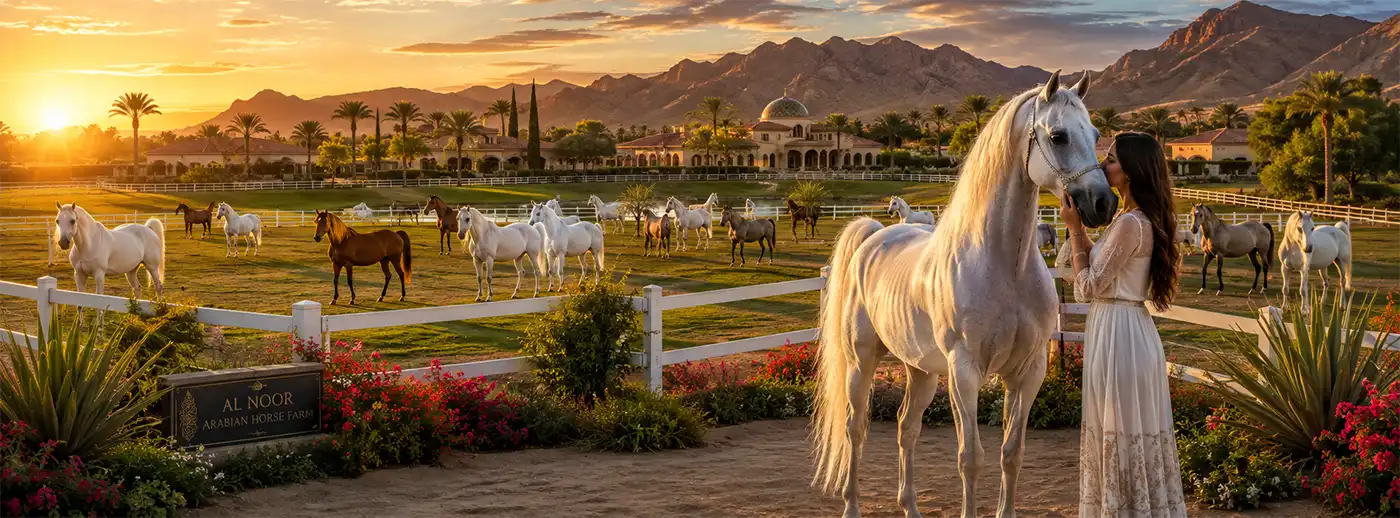
Crossbreeding with Arabians continues today, but now it is often formalized rather than simply being part of another breed's distant history. The Arabian Horse Association maintains registration for Half-Arabians, horses with one registered purebred Arabian parent, as well as Anglo-Arabians, which combine Arabian and Thoroughbred breeding. The modern association represents more than a million registered Arabian, Half-Arabian and Anglo-Arabian horses in its records.
All of this makes the Arabian's influence rather extraordinary. The breed did not simply leave its desert homeland and become popular elsewhere. Its desirable characteristics were deliberately carried into other breeding populations, and some of those populations subsequently became internationally important breeds themselves. The Arabian therefore occupies an unusual place in equestrian history: it is both a celebrated breed in its own right and an ancestor whose influence can be found far beyond horses carrying the Arabian name.
For an animal generally standing only around 14 to 15 hands high, the Arabian has managed to cast an impressively long shadow. Apparently nobody told it that conquering the horse world was supposed to require a bigger horse.
Famous Riders and Famous Arabians
A horse with thousands of years of history inevitably collects a few famous names along the way, and the Arabian has accumulated an impressive list. Conquerors, generals, presidents, aristocrats and dedicated breeders have all been associated with Arabian horses. The Arabian Horse Association itself points to historical figures including Alexander the Great, Genghis Khan, Napoleon Bonaparte and George Washington when describing the breed's long relationship with influential riders. Some of the individual stories have been polished by generations of retelling, however, so—as is often the case when horses and famous humans share the same legend—it pays to distinguish the well-documented connections from the particularly good stories.
Napoleon Bonaparte is probably the best-known example. His name is closely associated with Marengo, the small gray horse traditionally described as an Arabian that Napoleon rode during several military campaigns. Marengo became so closely identified with the emperor that the horse acquired historical celebrity of his own, and the association helped reinforce the Arabian's image as a mount capable of combining stamina, courage and considerable presence. The American Museum of Natural History identifies Marengo as a gray Arabian stallion and notes Napoleon among the famous military leaders associated with the breed.
George Washington provides an interesting American connection, although the details are more nuanced than the familiar claim that Washington simply “rode an Arabian.” Mount Vernon records that Washington actually owned an Arabian stallion named Magnolia, which he used for breeding. Two of his favorite Revolutionary War mounts were Nelson and the striking gray Blueskin. Blueskin has traditionally been described as half-Arabian, reportedly sired by a stallion known as Lindsay's Arabian. Modern historical examination cautions that the pedigree rests largely on later tradition rather than surviving Revolutionary-era documentation, so describing Blueskin's Arabian ancestry as traditional rather than absolutely proven is the safer course. Washington's direct involvement with Arabian breeding through Magnolia, however, gives him a genuine place in the breed's American story.
Famous riders are only half the story. Arabian history also contains horses whose names became enormously important because of what happened after they stopped carrying riders and entered the breeding shed. One of the most influential was Skowronek, a gray Arabian stallion foaled in Poland in 1908 or 1909. After being brought to England, he eventually became the prized stallion of Lady Wentworth at the famous Crabbet Arabian Stud. Skowronek was admired for his refinement, Arabian type and conformation, but his real historical importance came through his descendants. His offspring and later descendants spread through breeding programs in Britain, the United States, Australia, Russia, Spain and elsewhere, leaving an influence that remains visible in Arabian pedigrees today.
The Crabbet Arabian Stud itself deserves a place in this story because individual famous horses rarely become influential without equally determined humans behind them. Established in England in 1878 by Wilfrid Scawen Blunt and Lady Anne Blunt, Crabbet was built from Arabians acquired during journeys in the Middle East and from important Egyptian breeding programs. Their daughter, Lady Wentworth, later continued the stud and introduced Skowronek. Horses from Crabbet were exported around the world, and its bloodlines became enormously influential internationally. The history of the Arabian is therefore not simply a parade of famous stallions; it is also the story of breeders who spent lifetimes deciding which horses should produce the next generation.
America eventually produced Arabian celebrities of its own. Among the most important was Bask, a bay stallion foaled in Poland in 1956 and imported to the United States in 1963. Bask achieved the unusual distinction of becoming a national champion both in halter, where conformation and breed type are judged, and in performance. His greater legacy came as a sire: his offspring included an extraordinary number of U.S. and Canadian National Champions. Bask demonstrated something particularly appropriate about the Arabian breed—he was celebrated for looking like an exceptional Arabian and for actually performing like one.
These famous horses also illustrate how international the Arabian story became. A horse might be bred in Poland, establish its greatest influence in England, send descendants to Russia, America and Australia, and appear generations later in pedigrees on another continent entirely. The Arabian's history is filled with these journeys. Horses were exchanged as diplomatic gifts, purchased by breeders, imported to improve national breeding programs and occasionally became so valuable that acquiring one involved considerably more intrigue than purchasing an ordinary horse.
Perhaps that is why lists of famous Arabian riders can never quite tell the whole story. Napoleon and Washington certainly add recognizable human names, but the horses eventually became historical figures in their own right. Marengo became inseparable from the legend of Napoleon; Skowronek reshaped breeding programs thousands of miles from his birthplace; and Bask became one of the defining Arabian sires of 20th-century America.
How to Celebrate National Arabian Horse Day
National Arabian Horse Day is a particularly easy celebration to enjoy because you don't actually have to own an Arabian horse. Admittedly, having one standing outside would improve matters considerably, but February 19 is really about discovering the breed, appreciating its history and perhaps meeting some of the people and horses keeping that history alive today.
One of the best ways to celebrate is to see an Arabian horse in person. Look for an Arabian horse farm, riding stable, breed club, open house or equestrian event in your area. The Arabian Horse Association maintains a network of regional clubs across the United States and Canada, and these can be useful starting points for discovering local shows, competitions and other activities. Arabian shows are particularly interesting because they demonstrate just how many different things the breed can do. You might arrive expecting beautifully groomed horses trotting around a show ring and discover Arabians competing in Western, English, sport-horse and working disciplines as well. (arabianhorses.org)
If you're fortunate enough to be in Arizona, there could hardly be a more appropriate place to celebrate than the Scottsdale Arabian Horse Show. National Arabian Horse Day was launched in connection with this enormous annual gathering, and February 19 celebrations have been incorporated into the event. The show attracts Arabian horses, owners, breeders and spectators from around the world, providing an opportunity to see everything from elaborate halter presentations to serious athletic competition. Even somebody who arrives knowing little about Arabians is unlikely to leave wondering why people become so enthusiastic about them. (scottsdaleshow.com)
You can also use the day to explore the Arabian's remarkable history. Learn about the Bedouin breeders who helped shape the horse, the Arabian's journey into Europe and North America, or the famous breeding programs that preserved and developed different bloodlines. Pedigree enthusiasts can disappear particularly far down this rabbit hole. Start investigating one influential stallion and before long you're three generations backward, six generations forward and explaining to somebody who only asked what you were doing why a gray horse born in Poland more than a century ago is suddenly extremely important.
For horse lovers who prefer action to pedigrees, watch an endurance competition. Seeing Arabians covering serious distances provides a much better understanding of the breed than simply describing them as beautiful. The American Endurance Ride Conference sanctions rides throughout the United States and Canada, while international endurance competition demonstrates the Arabian's abilities on an even larger stage. Once you've watched a horse negotiate mile after mile of demanding terrain while repeatedly passing veterinary inspections, that elegant little animal with the floating trot begins to look considerably more formidable. (aerc.org)
National Arabian Horse Day is also an excellent excuse for photography, drawing or painting. The breed's distinctive profile, expressive eyes, arched neck and high tail carriage have made Arabians favorite subjects for artists for generations. If you're photographing horses that don't belong to you, naturally ask permission first and respect the instructions of the owner or handler. A magnificent Arabian galloping toward the perfect sunset may look like an irresistible photograph. A magnificent Arabian galloping toward you is a somewhat different photographic opportunity.
Those who already own or ride Arabians can make the celebration considerably simpler: spend some extra time with the horse. Take a trail ride, enjoy a relaxed grooming session, practice something together or simply provide the sort of attention that horses have spent thousands of years training humans to provide. Owners can also share photographs and stories about their Arabians online, particularly stories showing the intelligence, athletic ability and personality behind the breed's glamorous appearance.
And National Arabian Horse Day can be an opportunity to support the wider horse community. Attend a local equestrian event, support a reputable rescue or equine charity, volunteer with an appropriate organization, or introduce a young person to horses in a safe and supervised environment. Celebrating a breed with such a long history is also an opportunity to encourage responsible horsemanship and ensure that the horses themselves remain at the center of the celebration.
Whatever you choose, February 19 doesn't require elaborate arrangements. Learn something about an Arabian, watch one compete, meet one if you have the opportunity, or simply spend a few minutes appreciating a horse whose history stretches from desert camps to modern competition around the world.
And should an Arabian happen to investigate your pockets during the introduction, don't immediately assume you're experiencing that legendary human-horse bond. You may simply be standing between an Arabian and a carrot.
Why National Arabian Horse Day Matters
National Arabian Horse Day matters because the Arabian is much more than a particularly beautiful breed of horse. Its history tells a much larger story about the relationship between people, animals and the environments in which they live. For generations, horses in the Middle East were selectively bred for qualities that could make the difference between completing a difficult journey and failing to do so: endurance, soundness, intelligence, courage and the ability to work closely with a human partner. The elegant Arabian we recognize today carries the legacy of those practical requirements, even when its modern surroundings are a beautifully prepared show ring rather than an unforgiving desert.
The observance also provides an opportunity to understand just how influential the Arabian has been beyond its own breed. Arabian horses traveled far beyond their ancestral homeland through trade, diplomacy, warfare and deliberate breeding programs. Their bloodlines contributed to the development and improvement of other horses, including the Thoroughbred and numerous other light horse breeds. In that sense, celebrating the Arabian is also acknowledging an important chapter in the broader history of the domestic horse. You do not necessarily need an Arabian standing in your pasture for Arabian ancestry to have influenced the horses you know and admire.
National Arabian Horse Day is equally important because it encourages people to look beyond appearance. The Arabian's dished profile, enormous expressive eyes, arched neck and spectacular high-carried tail understandably receive plenty of attention, but concentrating entirely on beauty misses much of what makes the breed extraordinary. These are serious athletes capable of competing in endurance, racing, dressage, jumping, reining, working Western events and numerous other disciplines. The same horse that looks almost impossibly refined while trotting around a show ring belongs to a breed capable of tackling a 100-mile endurance ride. The pretty face comes attached to some remarkably substantial machinery.
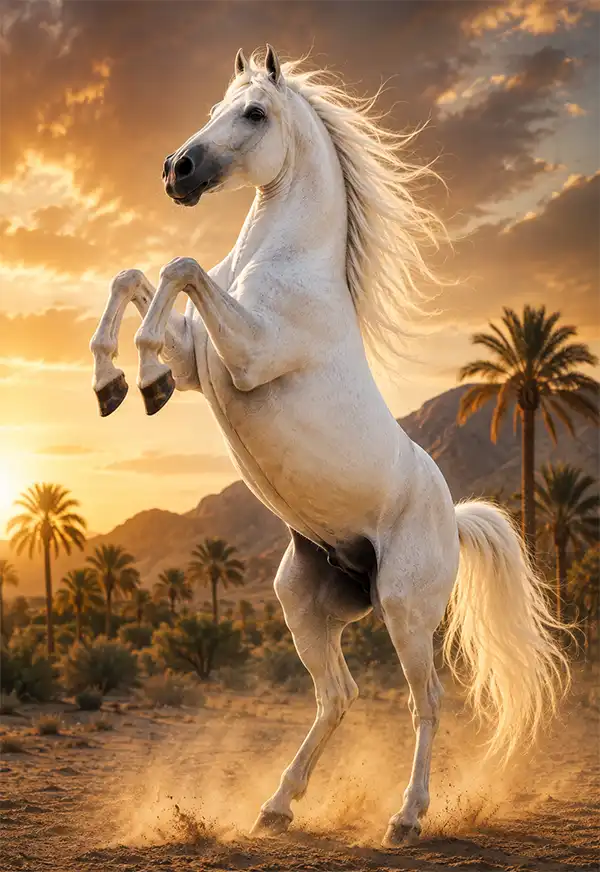
There is also value in preserving knowledge of the people who developed and protected Arabian bloodlines across generations. The history of the breed includes Bedouin families carefully maintaining prized strains, European and American breeders establishing influential studs, and modern organizations recording pedigrees and promoting responsible breeding. The Arabian did not arrive in the modern world by accident. Generations of people made deliberate decisions about which characteristics were worth preserving, while the horses themselves repeatedly demonstrated why those characteristics mattered.
That makes education an important part of the day. Popular horse history is filled with wonderful stories, but centuries of admiration have also produced legends that are sometimes repeated as unquestioned fact. National Arabian Horse Day gives us an excuse to investigate the breed more carefully: to distinguish documented history from tradition, understand how Arabians actually contributed to other breeds, learn what makes them successful endurance horses and appreciate that not every Arabian possesses precisely the same physical characteristics or personality. Admiration becomes considerably more meaningful when we understand what we're admiring.
Perhaps most importantly, the day helps introduce the Arabian horse to people who have never encountered one. That was part of the purpose when the Arabian Horse Association of Arizona created the observance. Horse enthusiasts already know February 19 gives them an excuse to celebrate a favorite breed, but the greater opportunity is reaching somebody who knows Arabians only as the beautiful horses with the funny-shaped faces and permanently enthusiastic tails. One visit to a farm, one afternoon at a horse show or one encounter with an Arabian enthusiast can reveal a breed with a far richer story.
National Arabian Horse Day therefore isn't simply about looking backward at an ancient breed. It is also about ensuring there will be people interested enough to carry its story forward. Responsible breeders, owners, riders, veterinarians, trainers, clubs and enthusiasts all contribute to preserving both the horses and the knowledge surrounding them. Celebrating the breed encourages another generation to become interested in its history, welfare and future.
After thousands of years alongside humans, the Arabian horse has certainly earned a day of recognition.
Although judging by that raised tail, arched neck and unmistakable expression of self-confidence, the Arabian may be slightly surprised to learn that it only gets one.
Arabian Horse FAQ
The Arabian horse has accumulated thousands of years of history, an international following and more than a few legends along the way. That naturally produces plenty of questions. Here are answers to some of the most common questions about National Arabian Horse Day and the remarkable breed it celebrates.
When is National Arabian Horse Day?
National Arabian Horse Day is celebrated every year on February 19. The Arabian Horse Association of Arizona founded the observance in 2021, and National Day Calendar proclaimed the first National Arabian Horse Day for February 19, 2022. The inaugural celebration coincided with the Scottsdale Arabian Horse Show, although published accounts do not appear to document a specific reason February 19 itself was selected.
Why do we celebrate National Arabian Horse Day?
National Arabian Horse Day was created to increase awareness and appreciation of the Arabian horse. It provides an opportunity to learn about the breed's history, distinctive characteristics, athletic abilities and enormous influence on horses throughout the world. It also encourages people who may never have encountered an Arabian to discover why the breed has inspired such devoted enthusiasm.
Where did Arabian horses originate?
Arabian horses are historically associated with the Middle East and particularly with the Bedouin peoples of the desert. The precise geographic origin of the breed's earliest ancestors remains debated, but centuries of selective breeding in the region helped produce horses renowned for endurance, intelligence, soundness and their close relationship with humans.
Why are Arabian horses so recognizable?
Arabians have several distinctive physical characteristics, including a comparatively small and refined head, large expressive eyes, prominent nostrils, an arched neck and the famous straight or slightly concave profile commonly called a dished face. Their naturally high tail carriage is another unmistakable characteristic and tends to ensure that an Arabian entering a field does so with approximately the same discretion as royalty entering a ballroom.
How big is an Arabian horse?
Arabian horses are relatively compact compared with many riding breeds. Traditional breed standards generally place them around 14.1 to 15.1 hands high, although individual horses can be taller or shorter. Their comparatively modest size should not be confused with a lack of athletic ability; Arabians are renowned for strength, stamina and endurance.
Why are Arabian horses so good at endurance riding?
Arabians possess a combination of characteristics particularly well suited to long-distance exercise. Their relatively light, efficient build, stamina, ability to dissipate heat and generations of selection for horses capable of traveling considerable distances all contribute to their success. Arabians and Arabian-related horses are consequently prominent in modern endurance competition, including events covering 100 miles in a day.
Are Arabian horses only used for endurance riding?
Not remotely. Arabians compete in dressage, jumping, racing, reining, ranch riding, working cow horse, trail, Western and English pleasure, sport-horse classes and numerous other disciplines. They are also popular recreational and family riding horses. Endurance may be their most famous athletic specialty, but the breed apparently saw no reason to limit its résumé.
Are Arabian horses intelligent?
Arabians have a longstanding reputation for intelligence, alertness and responsiveness to people. Their history involved close cooperation with humans, and modern owners frequently value their ability to learn quickly and develop strong relationships with their handlers. Naturally, a horse capable of learning desirable things quickly may also prove remarkably efficient at learning exactly how you fasten the gate.
Did Bedouins really keep Arabian horses inside their tents?
Historical accounts and Arabian breed organizations support the tradition that particularly valuable horses, especially prized mares, could be sheltered close to their owners and sometimes inside tents. Horses were enormously valuable in the desert, and the close relationship between Bedouin families and their animals became an important part of Arabian horse history.
Do Arabian horses really have fewer vertebrae than other horses?
Some do, but the popular claim is often stated too absolutely. Arabians commonly have a short back and may possess one fewer lumbar vertebra than is typical in other horses, but this is not an anatomical rule applying to every individual Arabian. Biological variation stubbornly refuses to cooperate with tidy Internet trivia.
What colors can Arabian horses be?
Purebred Arabians are registered in bay, gray, chestnut, black and roan. Gray Arabians can become extremely light as they age and may appear white, but genetically they are gray. Their skin is generally dark beneath the coat except beneath certain white markings.
Did Arabian horses influence the Thoroughbred?
Yes. The modern Thoroughbred traces its paternal foundation lines to three famous stallions imported into Britain: the Darley Arabian, Godolphin Arabian and Byerley Turk. Historical terminology concerning the precise ancestry of these early Eastern stallions is complicated, so not all should automatically be described as purebred Arabians by modern standards. Nevertheless, Arabian and other Middle Eastern horse blood played an enormously important role in the development of the Thoroughbred.
What is a Half-Arabian?
A Half-Arabian has one registered purebred Arabian parent and another parent of different breeding. Crossing Arabians with other horses allows breeders to combine Arabian characteristics such as stamina, refinement and intelligence with qualities from another breed. The Arabian Horse Association maintains registration programs for Half-Arabians as well as purebred Arabians.
What is an Anglo-Arabian?
An Anglo-Arabian combines Arabian and Thoroughbred ancestry. The cross brings together two closely connected but distinct breeds and is particularly associated with athletic sport horses. Anglo-Arabians have their own registration requirements and are recognized separately from purebred Arabians and other Half-Arabians.
Are Arabian horses good for beginners?
They can be, but breed alone should never determine whether a particular horse is suitable for an inexperienced rider. Arabians are intelligent and responsive, but individual temperament, age, training and experience vary enormously. A calm, well-trained Arabian with an appropriate instructor can be an excellent partner for a beginner; a highly spirited competition horse may be considerably less interested in providing introductory lessons.
How can I celebrate National Arabian Horse Day?
Visit an Arabian horse show or farm, learn about the breed's history, watch an endurance competition, support an equestrian organization, create Arabian-inspired artwork or spend time with an Arabian if you're fortunate enough to know one. February 19 is primarily an opportunity to discover and appreciate the breed.
And if you do meet one in person, remember that several thousand years of selective breeding have produced an intelligent, observant and highly capable horse. It will probably locate the treats before you finish introducing yourself.
Celebrating a Horse That Never Needed Help Looking Impressive
There are some animals that seem perfectly content to blend into the scenery. The Arabian horse has never shown much interest in joining them. With its arched neck, expressive eyes, refined profile and naturally high-carried tail, an Arabian can transform something as ordinary as trotting across a pasture into an entrance. Thousands of years of breeding produced a horse instantly recognizable around the world, and the Arabian Horse Association still identifies those distinctive characteristics as fundamental elements of Arabian breed type.
But if National Arabian Horse Day were only a celebration of an attractive horse, we would be missing most of the story. Beneath all that elegance is an animal shaped by demanding conditions. The horses developed and preserved by Bedouin breeders needed the stamina to travel considerable distances, the soundness to withstand difficult terrain and the intelligence to work closely with people. Those qualities remain central to the modern Arabian's reputation, particularly its extraordinary endurance and its close relationship with humans.
That combination of beauty and practicality may be the most remarkable thing about the breed. Arabians didn't become athletes after somebody decided they were pretty enough for a horse show. Athletic ability was already part of the package. Today they compete in everything from endurance and dressage to Western disciplines, jumping, trail riding and ranch work. The modern show ring gives the Arabian another place to display itself, but the underlying abilities were developed long before ribbons, trophies and carefully groomed arenas existed.
The Arabian also left hoofprints far beyond its own pedigree books. As these horses spread into Europe and elsewhere, breeders recognized the value of their speed, stamina and agility and introduced Eastern blood into other populations. Arabian influence became particularly important in the development of the Thoroughbred and subsequently traveled still farther through breeds influenced by the Thoroughbred itself. The little desert horse didn't merely become an international breed; it helped shape the development of other horses around the world.
Perhaps even more impressive is that the Arabian never became simply a historical curiosity. It survived the transition from war horse and essential transportation to recreational companion and modern competition athlete. The Arabian Horse Association today represents purebred Arabians as well as Half-Arabians and Anglo-Arabians, maintaining records for more than a million registered horses while supporting competitive and recreational activities across the United States and Canada.
National Arabian Horse Day therefore gives us an opportunity to appreciate the entire horse rather than just its famous silhouette. It celebrates the endurance athlete capable of traveling astonishing distances, the versatile riding horse that can move comfortably between disciplines, the influential breeding animal whose descendants changed other breeds, and the intelligent companion whose relationship with people has been part of its story for generations.
It also reminds us that preserving a historic breed means more than admiring old paintings and pedigrees. Arabian horses continue to need responsible breeders, knowledgeable owners, skilled trainers, veterinarians, riders and organizations willing to introduce new generations to them. The Arabian Horse Association actively encourages that outreach today, including programs designed to bring people into barns and give newcomers their first opportunity to meet an Arabian horse.
After thousands of years, countless journeys, changing civilizations, new equestrian sports and an extraordinary amount of human history, the Arabian is still here—still recognizable, still athletic, still forming remarkable partnerships with people and still carrying that tail as though somebody has just announced its arrival.
So, on February 19, we celebrate the history, endurance, intelligence, versatility and enduring influence of the Arabian horse. As for celebrating its beauty? The Arabian appears to have been handling that department perfectly well on its own.